Level: Basic. Demonstrate how a capacitor smoothes ripple in a half-wave rectified signal.
Objective and use case
In this practical case, you will build a half-wave rectifier circuit and observe the effect of adding a filter capacitor in parallel with the load.
* Why it is useful:
* Essential for converting Alternating Current (AC) from the mains into Direct Current (DC) for powering electronics.
* Used in simple battery chargers.
* Fundamental concept for audio signal demodulation (envelope detectors).
* Demonstrates energy storage properties of capacitors in power supplies.
* Expected outcome:
* Input: A pure AC sine wave (swinging positive and negative).
* Step 1 Output: A pulsing positive-only signal (half-wave rectification).
* Step 2 Output: A steady DC voltage with slight variation (ripple) after connecting the capacitor.
* Target audience and level: Students and hobbyists understanding basic AC/DC conversion.
Materials
- V1: 10 V (peak), 50 Hz sine wave source, function: AC power input.
- D1: 1N4007 diode, function: rectifies AC to pulsating DC.
- R1: 1 kΩ resistor, function: acts as the electrical load.
- C1: 100 µF electrolytic capacitor, function: filters voltage ripple (stores energy).
- GND: Ground reference (0 V).
Wiring guide
Construct the circuit following these node connections:
- V1 (Source): Connect the positive terminal to node
VACand the negative terminal to node0(GND). - D1 (Rectifier): Connect the Anode to node
VACand the Cathode to nodeVOUT. - R1 (Load): Connect between node
VOUTand node0(GND). - C1 (Filter): Connect the positive terminal to node
VOUTand the negative terminal to node0(GND). Note: Initially leave C1 disconnected to observe the unfiltered signal, then connect it.
Conceptual block diagram
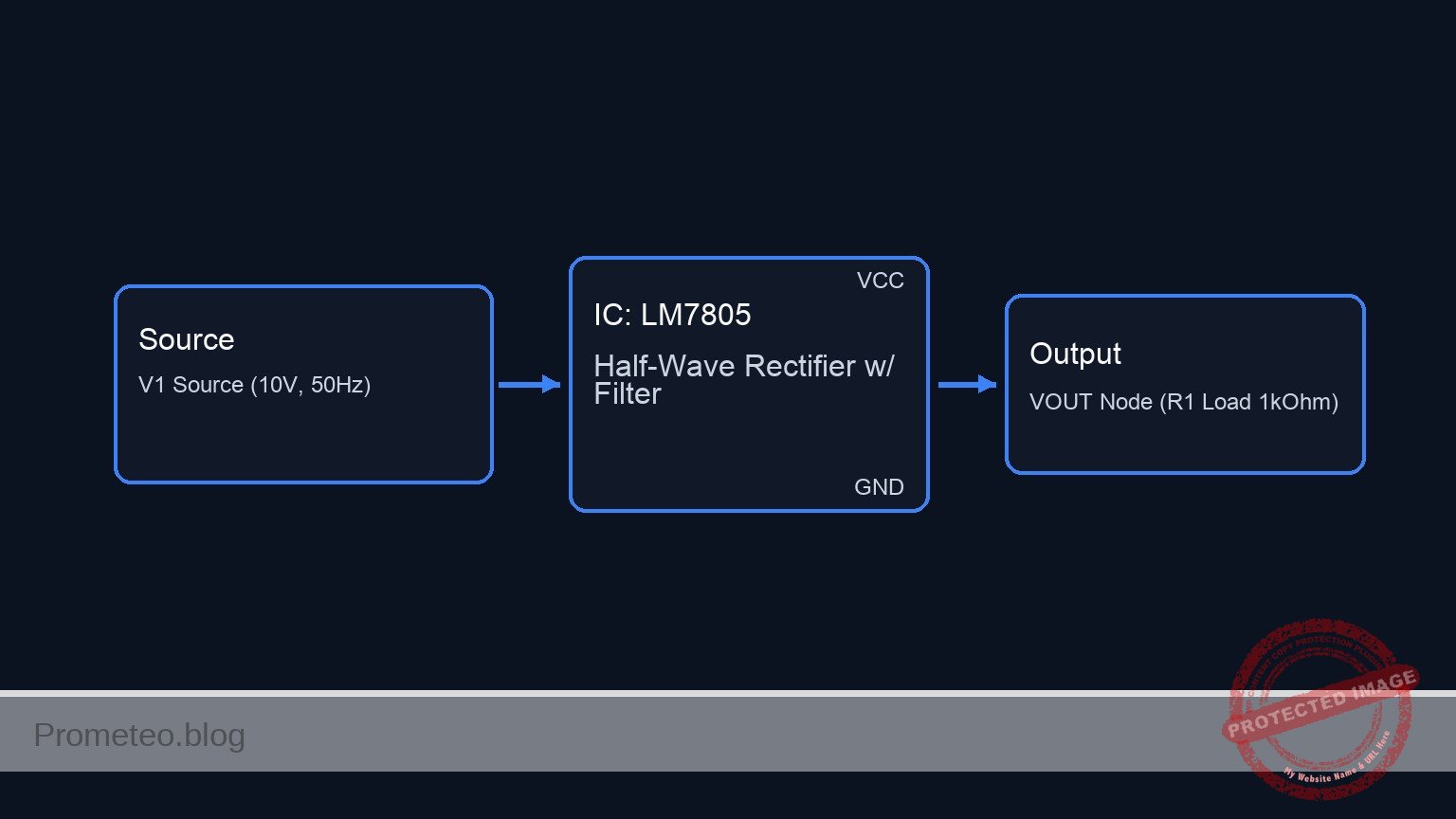
Schematic
[ AC SOURCE ]            [ RECTIFICATION ]             [ OUTPUT STAGE ]

                                                          +--> [ C1 Filter ] --> GND
                                                          |    (100 uF)
    [ V1 Source ] --(VAC)--> [ D1 Diode ] --(VOUT Node)-->+
    (10 V, 50Hz)              (1N4007)                     |
                                                          +--> [ R1 Load ]   --> GND
                                                               (1 kOhm)
Measurements and tests
Perform the following steps using an oscilloscope or a multimeter:
- Input Verification:
- Connect the probe to
VAC. - Verify a sine wave oscillating between +10 V and -10 V.
- Connect the probe to
- Unfiltered Rectification (C1 Disconnected):
- Remove
C1temporarily. - Measure
VOUT. You should see only the positive half-cycles of the sine wave (approx. 0 V to 9.3 V due to diode drop). The voltage drops to zero between peaks.
- Remove
- Filtered Rectification (C1 Connected):
- Connect
C1acrossR1. - Measure
VOUT. The signal should now be a DC voltage near the peak value (approx. 9 V) that does not drop to zero. - Vripple Measurement: Set the oscilloscope to AC coupling to zoom in on the small voltage fluctuation («sawtooth» shape) on top of the DC line.
- Connect
SPICE netlist and simulation
Reference SPICE Netlist (ngspice) — excerptFull SPICE netlist (ngspice)
* Basic rectifier filtering

* --- Components ---

* V1: 10 V (peak), 50 Hz sine wave source
* Connected: Positive -> VAC, Negative -> 0 (GND)
V1 VAC 0 SIN(0 10 50)

* D1: 1N4007 diode (Rectifier)
* Connected: Anode -> VAC, Cathode -> VOUT
D1 VAC VOUT 1N4007

* R1: 1 kΩ resistor (Load)
* Connected: Between VOUT and 0 (GND)
R1 VOUT 0 1k

* C1: 100 µF electrolytic capacitor (Filter)
* Connected: Positive -> VOUT, Negative -> 0 (GND)
* Note: Included to demonstrate the filtering effect described in the case.
C1 VOUT 0 100u
* ... (truncated in public view) ...
Copy this content into a .cir file and run with ngspice.
* Basic rectifier filtering

* --- Components ---

* V1: 10 V (peak), 50 Hz sine wave source
* Connected: Positive -> VAC, Negative -> 0 (GND)
V1 VAC 0 SIN(0 10 50)

* D1: 1N4007 diode (Rectifier)
* Connected: Anode -> VAC, Cathode -> VOUT
D1 VAC VOUT 1N4007

* R1: 1 kΩ resistor (Load)
* Connected: Between VOUT and 0 (GND)
R1 VOUT 0 1k

* C1: 100 µF electrolytic capacitor (Filter)
* Connected: Positive -> VOUT, Negative -> 0 (GND)
* Note: Included to demonstrate the filtering effect described in the case.
C1 VOUT 0 100u

* --- Models ---

* Standard silicon rectifier diode model approximation for 1N4007
.model 1N4007 D(IS=7.03n RS=0.04 N=1.85 CJO=10p VJ=1 M=0.5 BV=1000 IBV=10u TT=5u)

* --- Analysis Directives ---

* Transient analysis: 100ms duration (5 cycles of 50Hz) with 0.1ms step
.tran 0.1ms 100ms

* Operating point analysis
.op

* Print directives for simulation logging
.print tran V(VAC) V(VOUT)

.end
Simulation Results (Transient Analysis)

Show raw data table (1017 rows)
Index   time            v(vac)          v(vout)
0	0.000000e+00	0.000000e+00	-2.77024e-22
1	1.000000e-06	3.141593e-03	3.430255e-10
2	2.000000e-06	6.283185e-03	6.932562e-10
3	4.000000e-06	1.256637e-02	1.411758e-09
4	8.000000e-06	2.513271e-02	2.956960e-09
5	1.600000e-05	5.026527e-02	6.646271e-09
6	3.200000e-05	1.005293e-01	1.882015e-08
7	5.304087e-05	1.666251e-01	6.310202e-08
8	7.565486e-05	2.376544e-01	2.484107e-07
9	1.009625e-04	3.171298e-01	1.270798e-06
10	1.280850e-04	4.022822e-01	7.576310e-06
11	1.570209e-04	4.930958e-01	5.140208e-05
12	1.876236e-04	5.890955e-01	3.869871e-04
13	2.197798e-04	6.899101e-01	3.065854e-03
14	2.535671e-04	7.957622e-01	2.015809e-02
15	2.900907e-04	9.100857e-01	7.787813e-02
16	3.269176e-04	1.025237e+00	1.740794e-01
17	3.659101e-04	1.147010e+00	2.922342e-01
18	4.156771e-04	1.302180e+00	4.470469e-01
19	4.731074e-04	1.480844e+00	6.257990e-01
20	5.731074e-04	1.790758e+00	9.360689e-01
21	6.731074e-04	2.098905e+00	1.244455e+00
22	7.731074e-04	2.404980e+00	1.550935e+00
23	8.731074e-04	2.708681e+00	1.855020e+00
... (993 more rows) ...
Common mistakes and how to avoid them
- Reversing Capacitor Polarity:
- Error: Connecting the negative leg of an electrolytic capacitor to the positive voltage node.
- Solution: Always ensure the stripe (negative side) of the capacitor connects to Ground (
0). Reverse polarity can cause the capacitor to explode.
- Load Resistance Too Low:
- Error: Using a very small resistor (e.g., 10 Ω) with a small capacitor.
- Solution: If the load draws too much current, the capacitor discharges too quickly, causing massive ripple. Increase C1 or R1.
- Ignoring Diode Voltage Drop:
- Error: Expecting exactly 10 V DC from a 10 V AC peak source.
- Solution: Account for the ~0.7 V drop across the silicon diode. Expect around 9.3 V peak.
Troubleshooting
- Symptom: Output is identical to Input (AC sine wave).
- Cause: Diode is shorted internally.
- Fix: Replace D1.
- Symptom: Output is 0 V.
- Cause: Diode is open or connected backward (blocking positive cycle).
- Fix: Check diode orientation (anode to source).
- Symptom: Ripple is very high (voltage drops deeply between peaks).
- Cause: Capacitor value is too low for the frequency or load.
- Fix: Increase C1 to 470 µF or 1000 µF.
Possible improvements and extensions
- Full-Wave Rectification: Replace the single diode with a bridge rectifier (4 diodes) to utilize the negative half-cycle, doubling the ripple frequency and improving efficiency.
- Voltage Regulator: Add a Zener diode or a linear regulator (like an LM7805) after the capacitor to create a fixed, stable DC output regardless of ripple.
More Practical Cases on Prometeo.blog
Find this product and/or books on this topic on Amazon
As an Amazon Associate, I earn from qualifying purchases. If you buy through this link, you help keep this project running.
Quick Quiz

Telecommunications Electronics Engineer and Computer Engineer (official degrees in Spain).