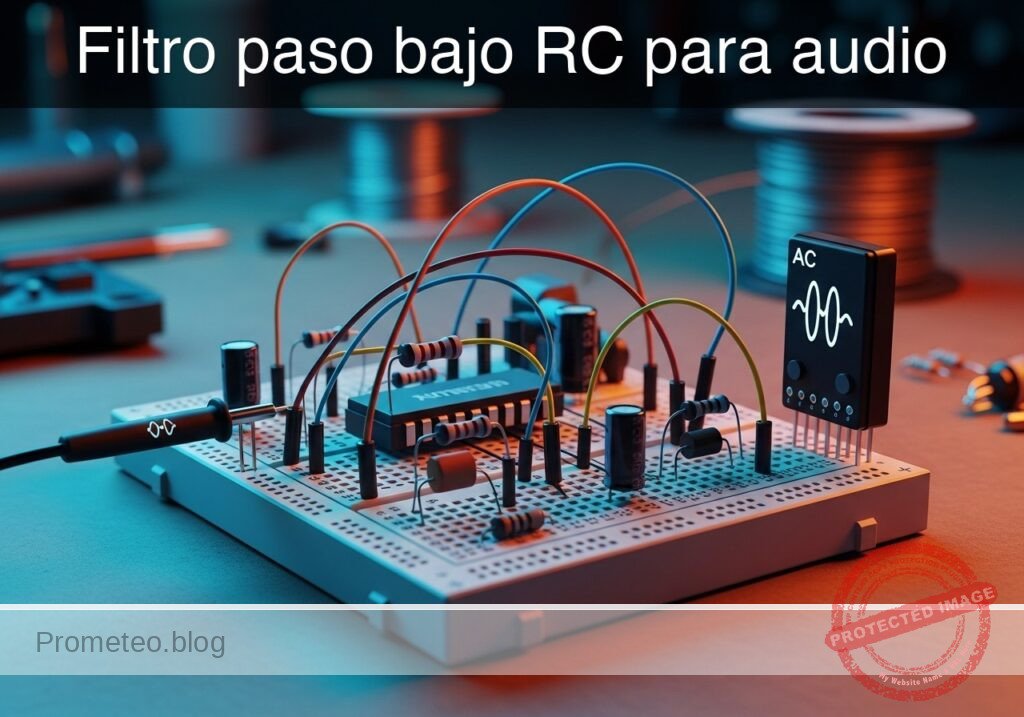
Caso práctico: Filtro paso bajo RC para audio

Prototipo de Filtro paso bajo RC para audio (Maker Style)

Nivel: Medio — Diseñar y analizar un circuito que atenúa las frecuencias altas utilizando un condensador y una resistencia para verificar la frecuencia de corte.

Objetivo y caso de uso

En este caso práctico, construirá un Filtro Paso Bajo (LPF) pasivo de primer orden utilizando una resistencia y un condensador conectados en serie. Analizará cómo cambia la reactancia del condensador con la frecuencia, permitiendo el paso de frecuencias bajas mientras atenúa las señales por encima de un punto de corte calculado.

Por qué es útil:
* Reducción de ruido de audio: Elimina el siseo de alta frecuencia o la estática de las grabaciones de audio.
* Crossovers para subwoofers: Dirige solo las notas graves de baja frecuencia al controlador (driver) del subwoofer.
* Acondicionamiento de señal: Actúa como filtro anti-aliasing antes de la Conversión Analógico-Digital (ADC) para prevenir artefactos digitales.
* Suavizado de fuente de alimentación: Filtra el ruido de rizado de alta frecuencia de las líneas de alimentación de CC.

Resultado esperado:
* Banda de paso: Las frecuencias por debajo de ~1 kHz conservan aproximadamente su amplitud original (Vin ≈ Vout).
* Punto de corte: En la frecuencia de corte calculada (fc), el voltaje de salida cae a aproximadamente el 70,7% del voltaje de entrada (-3 dB).
* Banda de rechazo: Las frecuencias significativamente superiores a 1 kHz son fuertemente atenuadas.
* Desfase: Observar un retraso de fase de -45° en la frecuencia de corte.

Público objetivo y nivel: Estudiantes de electrónica y entusiastas del audio; Nivel: Medio.

Materiales

  • V1: Fuente de voltaje CA (Onda senoidal, 5 Vpk, frecuencia ajustable), función: Simulación de señal de audio de entrada.
  • R1: Resistencia de 1.6 kΩ, función: Limitación de corriente y parte del divisor de voltaje.
  • C1: Condensador de 100 nF (cerámico o de película), función: Derivación a tierra dependiente de la frecuencia.
  • Herramienta de medición: Osciloscopio (doble canal) o Trazador de Bode.

Guía de conexionado

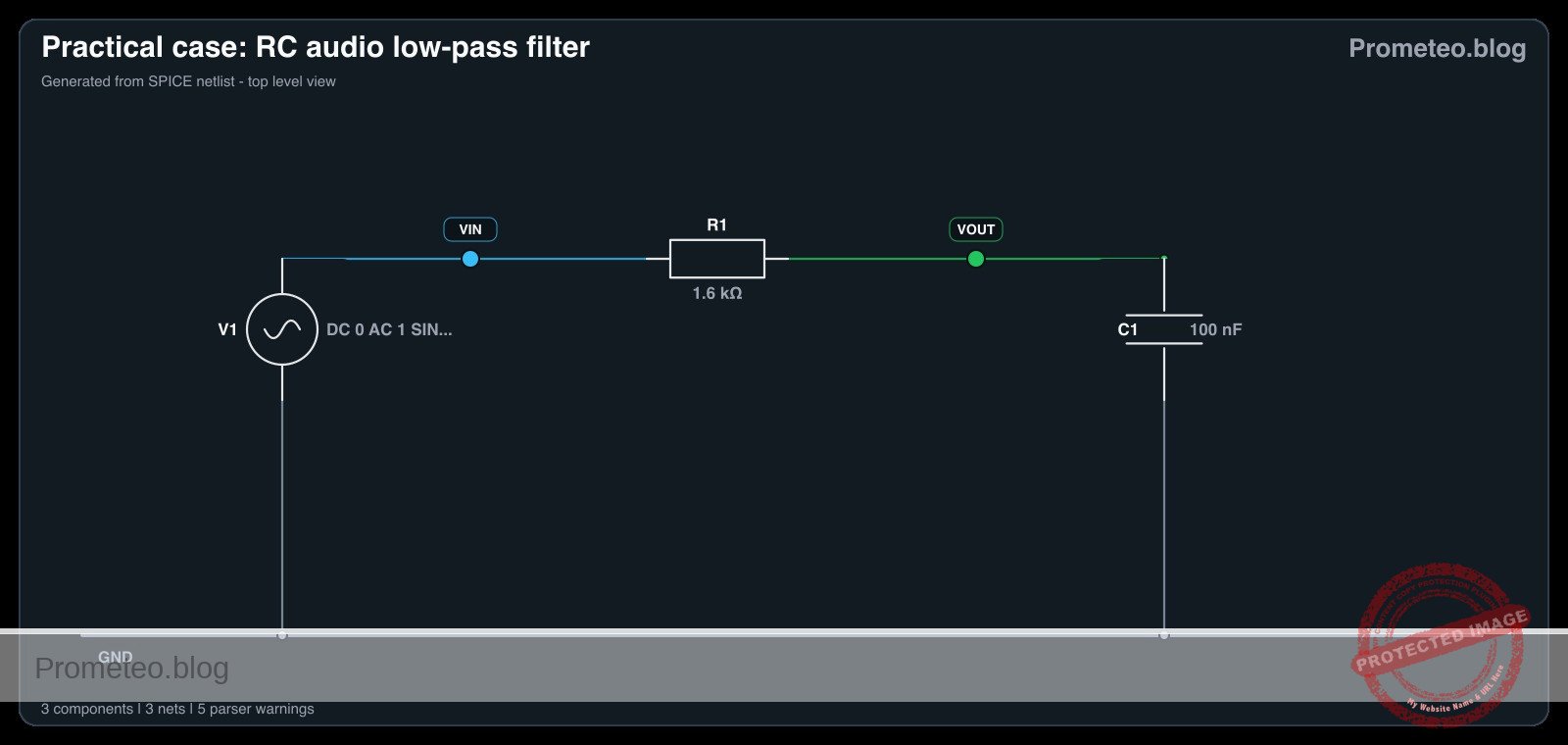
Construya el circuito utilizando las siguientes conexiones. Observe los nombres de nodo explícitos para el análisis.

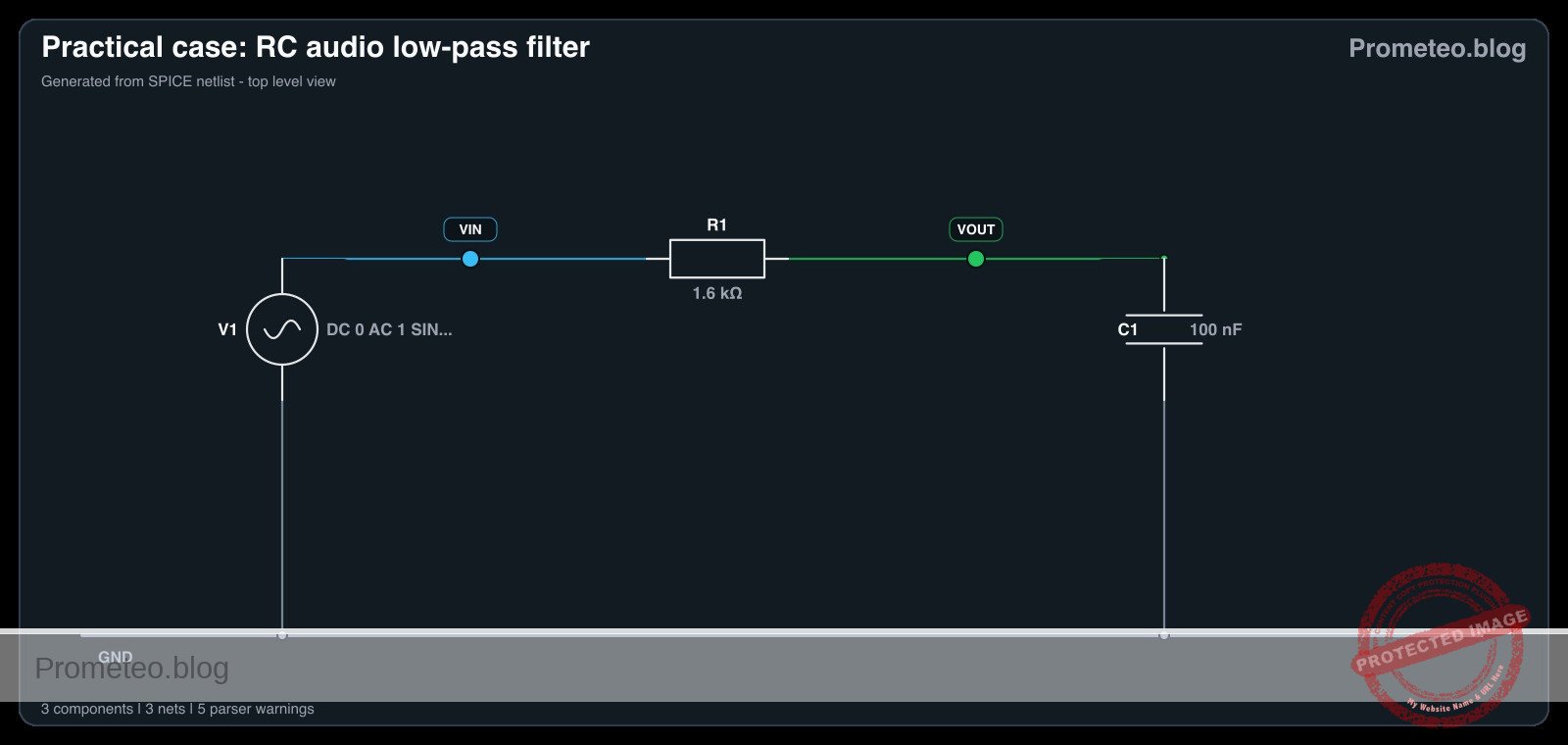
  • V1 (Fuente): Conecte el terminal positivo al nodo VIN y el terminal negativo al nodo 0 (GND).
  • R1: Conecte una patilla al nodo VIN y la otra patilla al nodo VOUT.
  • C1: Conecte una patilla al nodo VOUT y la otra patilla al nodo 0 (GND).
  • Osciloscopio Ch1: Conecte la punta de la sonda a VIN y la pinza de tierra a 0.
  • Osciloscopio Ch2: Conecte la punta de la sonda a VOUT y la pinza de tierra a 0.

Diagrama de bloques conceptual

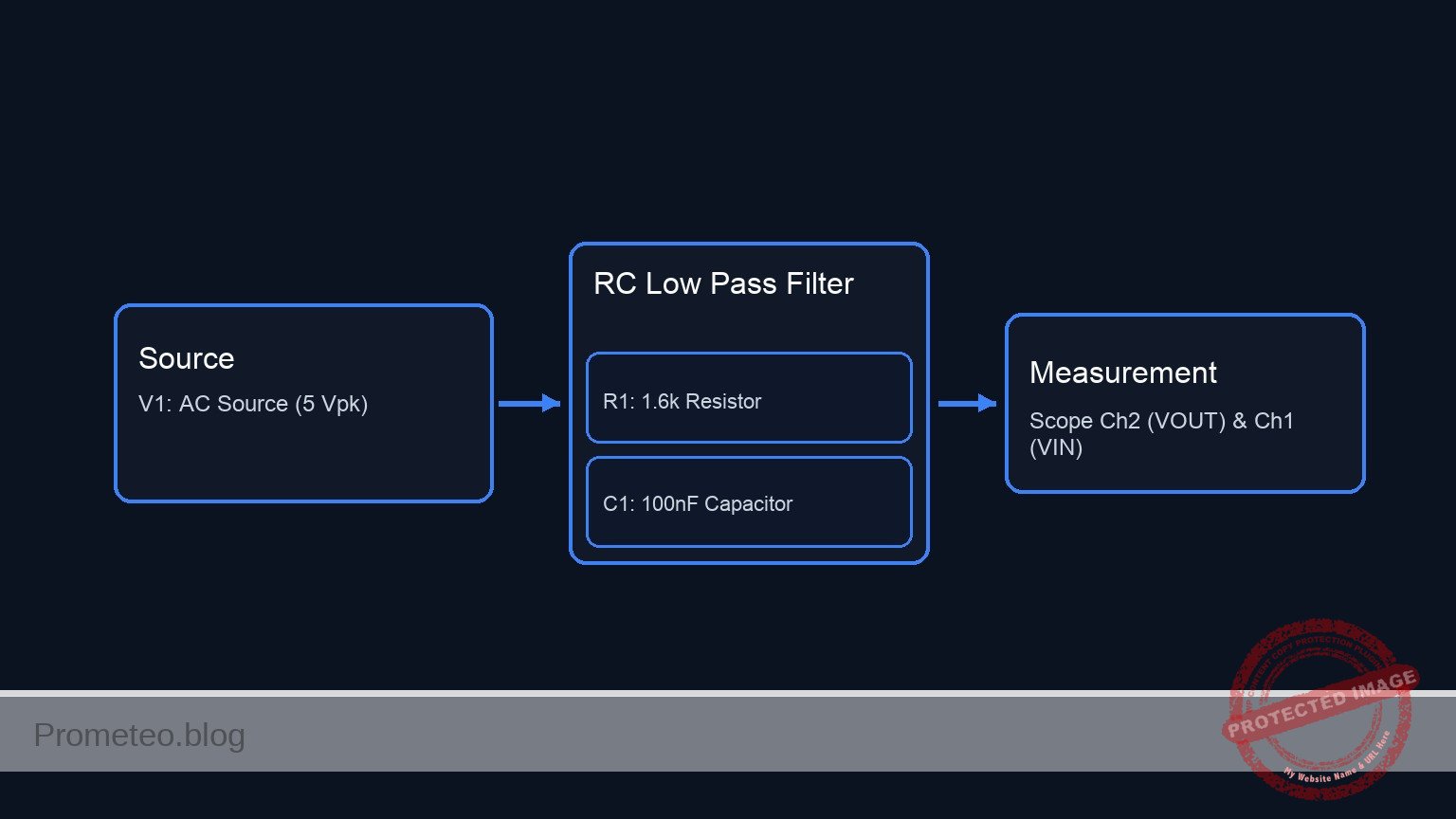
Conceptual block diagram — RC Low Pass Filter
Lectura rápida: entradas → bloque principal → salida (actuador o medida). Resume el esquemático ASCII de la siguiente sección.

Esquemático

[ SIGNAL SOURCE ]               [ RC FILTER STAGE ]                 [ MEASUREMENT ]

                                       +--------------------------------------> [ Scope Ch1 (Input) ]
                              |
[ V1: AC Source ] --(VIN)-->--+--> [ R1: 1.6k Resistor ] --(VOUT)-->--+--> [ Scope Ch2 (Output) ]
      (5 Vpk)                                                         |
                                                                      +--> [ C1: 100nF Cap ] --> GND
Esquema Eléctrico

Diagrama eléctrico

Diagrama electrico del caso: Filtro pasa bajos RC de audio
Generado desde la netlist SPICE validada del caso.

🔒 Este diagrama eléctrico es premium. Con el pase de 7 días o la suscripción mensual podrás desbloquear el material didáctico completo y el pack PDF listo para imprimir.🔓 Ver planes de acceso premium

Mediciones y pruebas

Siga estos pasos para validar el diseño del filtro (fc ≈ 1 kHz):

  1. Prueba de baja frecuencia (Banda de paso):

    • Ajuste V1 a 100 Hz.
    • Mida el valor pico a pico de Vout. Debería ser casi idéntico a Vin (aprox. 5 V).
  2. Verificación de frecuencia de corte (fc):

    • Aumente la frecuencia de V1 a 1 kHz.
    • Mida Vout. Debería caer a aproximadamente 0.707 × Vin (aprox. 3.53 V).
    • Mida la diferencia de fase entre Ch1 y Ch2. Vout debería retrasarse respecto a Vin aproximadamente 45°.
  3. Prueba de alta frecuencia (Banda de rechazo):

    • Ajuste V1 a 10 kHz (una década por encima del corte).
    • Mida Vout. La amplitud debería estar significativamente atenuada (aprox. 0.5 V o -20 dB en relación con la entrada).
  4. Análisis de diagrama de Bode (Opcional):

    • Si utiliza una simulación o un trazador de Bode, realice un barrido de 10 Hz a 100 kHz. Observe la pendiente de «caída» de -20 dB/década después del punto de corte.

Netlist SPICE y simulación

Netlist SPICE de referencia (ngspice) — extractoNetlist SPICE completo (ngspice)

* Practical case: RC audio low-pass filter

* --- Components per BOM and Wiring Guide ---
* V1: AC Voltage Source (Sine Wave, 5 Vpk, 1kHz, AC 1V for Bode)
* Connected: Positive -> VIN, Negative -> 0 (GND)
V1 VIN 0 DC 0 AC 1 SIN(0 5 1000)

* R1: 1.6 kOhm resistor
* Connected: VIN -> VOUT
R1 VIN VOUT 1.6k

* C1: 100 nF capacitor
* Connected: VOUT -> 0 (GND)
C1 VOUT 0 100n

* --- Simulation Commands ---
* Using .control block to sequence analyses and printing correctly in ngspice
.control
    * Transient Analysis: 1kHz signal, run for 5ms
    tran 10u 5ms
* ... (truncated in public view) ...

Copia este contenido en un archivo .cir y ejecútalo con ngspice.

🔒 Parte del contenido de esta sección es premium. Con el pase de 7 días o la suscripción mensual tendrás acceso al contenido completo (materiales, conexionado, compilación detallada, validación paso a paso, troubleshooting, mejoras/variantes y checklist) y podrás descargar el pack PDF listo para imprimir.

* Practical case: RC audio low-pass filter

* --- Components per BOM and Wiring Guide ---
* V1: AC Voltage Source (Sine Wave, 5 Vpk, 1kHz, AC 1V for Bode)
* Connected: Positive -> VIN, Negative -> 0 (GND)
V1 VIN 0 DC 0 AC 1 SIN(0 5 1000)

* R1: 1.6 kOhm resistor
* Connected: VIN -> VOUT
R1 VIN VOUT 1.6k

* C1: 100 nF capacitor
* Connected: VOUT -> 0 (GND)
C1 VOUT 0 100n

* --- Simulation Commands ---
* Using .control block to sequence analyses and printing correctly in ngspice
.control
    * Transient Analysis: 1kHz signal, run for 5ms
    tran 10u 5ms
    * Print transient results (Oscilloscope)
    print V(VIN) V(VOUT)

    * AC Analysis: Bode Plot, 10 Hz to 100 kHz
    ac dec 10 10 100k
    * Print AC results (Bode Plotter)
    print V(VOUT)

    * Operating Point
    op
.endc

.end

Resultados de Simulación (Transitorio)

Resultados de Simulación (Transitorio)
Show raw data table (512 rows)
Index   time            v(vin)          v(vout)
0	0.000000e+00	0.000000e+00	0.000000e+00
1	1.000000e-07	3.141592e-03	1.962269e-06
2	1.084035e-07	3.405596e-03	2.141025e-06
3	1.252105e-07	3.933604e-03	2.526248e-06
4	1.588245e-07	4.989618e-03	3.462948e-06
5	2.260525e-07	7.101647e-03	6.001184e-06
6	3.605086e-07	1.132570e-02	1.373560e-05
7	6.294206e-07	1.977378e-02	3.982505e-05
8	1.167245e-06	3.666975e-02	1.343969e-04
9	2.242893e-06	7.046023e-02	4.923968e-04
10	4.394190e-06	1.380300e-01	1.878099e-03
11	8.696783e-06	2.730815e-01	7.282571e-03
12	1.730197e-05	5.424874e-01	2.825846e-02
13	2.730197e-05	8.535162e-01	6.884897e-02
14	3.730197e-05	1.161176e+00	1.257276e-01
15	4.730197e-05	1.464254e+00	1.976662e-01
16	5.730197e-05	1.761553e+00	2.834382e-01
17	6.730197e-05	2.051900e+00	3.818193e-01
18	7.730197e-05	2.334149e+00	4.915893e-01
19	8.730197e-05	2.607186e+00	6.115335e-01
20	9.730197e-05	2.869934e+00	7.404442e-01
21	1.073020e-04	3.121356e+00	8.771230e-01
22	1.173020e-04	3.360458e+00	1.020383e+00
23	1.273020e-04	3.586299e+00	1.169049e+00
... (488 more rows) ...

Errores comunes y cómo evitarlos

  1. Intercambiar componentes (Paso alto vs. Paso bajo):
    • Error: Conectar C1 en serie y R1 a tierra crea un filtro Paso Alto.
    • Solución: Asegúrese de que el Condensador sea el componente conectado entre el nodo de salida y Tierra.
  2. Ignorar la impedancia de carga:
    • Error: Conectar una carga de baja impedancia (como un altavoz de 8 Ω) directamente a VOUT.
    • Solución: Este filtro pasivo tiene una alta impedancia de salida. Utilice un búfer con amplificador operacional si maneja una carga pesada.
  3. Usar condensadores polarizados incorrectamente:
    • Error: Usar un condensador electrolítico con polaridad inversa en un circuito de CA sin una polarización de CC.
    • Solución: Para señales de audio de CA pura, utilice condensadores no polarizados (cerámicos, de película o electrolíticos bipolares).

Solución de problemas

  • Síntoma: Vout es cero en todas las frecuencias.
    • Causa: Cortocircuito en C1 o circuito abierto en R1.
    • Solución: Verifique la continuidad en C1; si pita, el condensador está en corto o el nodo está conectado a tierra accidentalmente.
  • Síntoma: No se produce atenuación en frecuencias altas.
    • Causa: C1 está abierto (roto) o R1 está en corto.
    • Solución: Reemplace C1. Verifique que R1 mida 1.6 kΩ.
  • Síntoma: La frecuencia de corte es totalmente incorrecta.
    • Causa: Valores de componentes incorrectos (por ejemplo, usar 100 pF en lugar de 100 nF).
    • Solución: Verifique los códigos de colores en las resistencias y las marcas en los condensadores (código 104 = 100 nF).

Posibles mejoras y extensiones

  1. Filtro de segundo orden: Conecte en cascada dos etapas RC en serie para lograr una caída más pronunciada (-40 dB/década) para un mejor rechazo del ruido.
  2. Filtro paso bajo activo: Añada un Amplificador Operacional (Op-Amp) para crear un filtro activo, permitiendo ganancia de señal y evitando que la carga afecte la respuesta de frecuencia del filtro.

Más Casos Prácticos en Prometeo.blog

Encuentra este producto y/o libros sobre este tema en Amazon

Ir a Amazon

Como afiliado de Amazon, gano con las compras que cumplan los requisitos. Si compras a través de este enlace, ayudas a mantener este proyecto.

Quiz rápido

Pregunta 1: ¿Qué tipo de filtro se construye en este caso práctico utilizando una resistencia y un condensador en serie?


Pregunta 2: ¿Cuál es el principio fundamental que permite al circuito atenuar las frecuencias altas?


Pregunta 3: ¿Qué sucede con las señales de audio por encima del punto de corte calculado?


Pregunta 4: ¿Cuál es una aplicación útil mencionada para este tipo de filtro en sistemas de audio?


Pregunta 5: ¿Qué función cumple este filtro en los 'crossovers' para subwoofers?


Pregunta 6: ¿Qué porcentaje del voltaje de entrada representa el voltaje de salida en la frecuencia de corte (fc)?


Pregunta 7: ¿A cuántos decibelios corresponde la caída de voltaje en el punto de corte?


Pregunta 8: ¿Qué se espera que ocurra en la 'Banda de paso' (frecuencias por debajo de ~1 kHz)?


Pregunta 9: ¿Qué fenómeno de fase se debe observar en la frecuencia de corte en un filtro RC paso bajo?


Pregunta 10: ¿Por qué es útil este filtro antes de una Conversión Analógico-Digital (ADC)?


Carlos Núñez Zorrilla
Electronics & Computer Engineer

Ingeniero Superior en Electrónica de Telecomunicaciones e Ingeniero en Informática (titulaciones oficiales en España).
Sígueme:


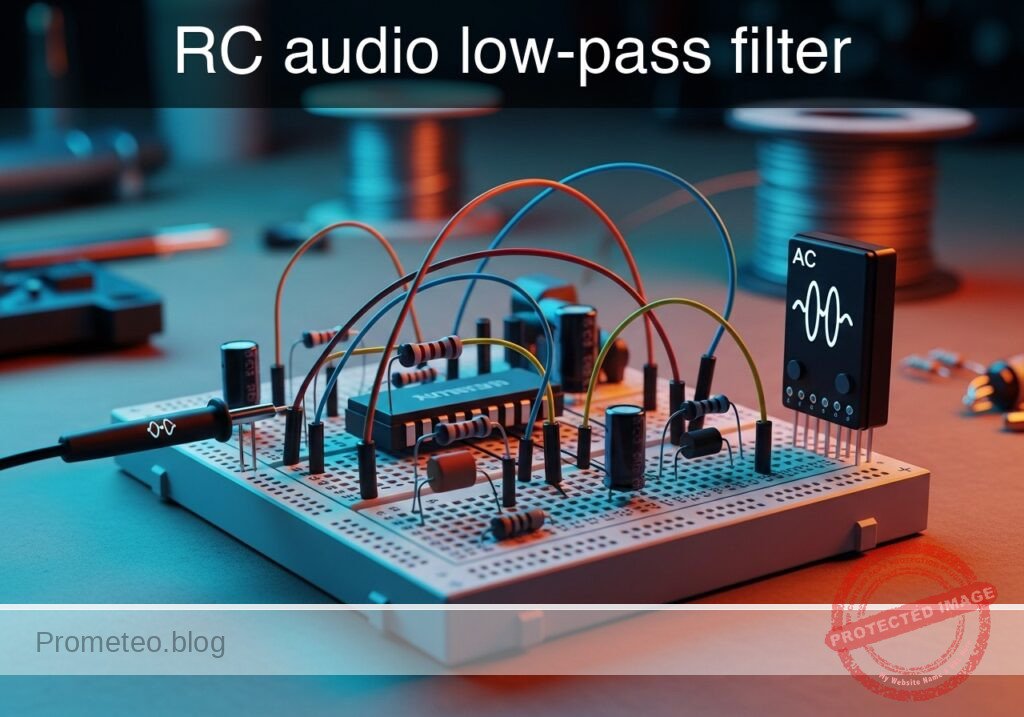
Practical case: RC audio low-pass filter

RC audio low-pass filter prototype (Maker Style)

Level: Medium — Design and analyze a circuit that attenuates high frequencies using a capacitor and a resistor to verify the cutoff frequency.

Objective and use case

In this practical case, you will build a passive first-order Low-Pass Filter (LPF) using a resistor and a capacitor connected in series. You will analyze how the capacitor’s reactance changes with frequency, allowing low frequencies to pass while attenuating signals above a calculated cutoff point.

Why it is useful:
* Audio noise reduction: Removes high-frequency hiss or static from audio recordings.
* Subwoofer crossovers: Directs only low-frequency bass notes to the subwoofer driver.
* Signal conditioning: Acts as an anti-aliasing filter before Analog-to-Digital Conversion (ADC) to prevent digital artifacts.
* Power supply smoothing: Filters out high-frequency ripple noise from DC power lines.

Expected outcome:
* Passband: Frequencies below ~1 kHz retain approximately their original amplitude (Vin ≈ Vout).
* Cutoff point: At the calculated cutoff frequency (fc), the output voltage drops to approximately 70.7% of the input voltage (-3 dB).
* Stopband: Frequencies significantly higher than 1 kHz are heavily attenuated.
* Phase shift: Observe a phase lag of -45° at the cutoff frequency.

Target audience and level: Electronics students and audio enthusiasts; Level: Medium.

Materials

  • V1: AC Voltage Source (Sine Wave, 5 Vpk, tunable frequency), function: Input audio signal simulation.
  • R1: 1.6 kΩ resistor, function: Current limiting and voltage division partner.
  • C1: 100 nF capacitor (ceramic or film), function: Frequency-dependent shunt to ground.
  • Measurement Tool: Oscilloscope (Dual channel) or Bode Plotter.

Wiring guide

Construct the circuit using the following connections. Note the explicit node names for analysis.

  • V1 (Source): Connect the positive terminal to node VIN and the negative terminal to node 0 (GND).
  • R1: Connect one leg to node VIN and the other leg to node VOUT.
  • C1: Connect one leg to node VOUT and the other leg to node 0 (GND).
  • Oscilloscope Ch1: Connect probe tip to VIN and ground clip to 0.
  • Oscilloscope Ch2: Connect probe tip to VOUT and ground clip to 0.

Conceptual block diagram

Conceptual block diagram — RC Low Pass Filter
Quick read: inputs → main block → output (actuator or measurement). This summarizes the ASCII schematic below.

Schematic

[ SIGNAL SOURCE ]               [ RC FILTER STAGE ]                 [ MEASUREMENT ]

                              +--------------------------------------> [ Scope Ch1 (Input) ]
                              |
[ V1: AC Source ] --(VIN)-->--+--> [ R1: 1.6k Resistor ] --(VOUT)-->--+--> [ Scope Ch2 (Output) ]
      (5 Vpk)                                                         |
                                                                      +--> [ C1: 100nF Cap ] --> GND
Schematic (ASCII)

Electrical diagram

Electrical diagram for case: RC audio low-pass filter
Generated from the validated SPICE netlist for this case.

🔒 This electrical diagram is premium. With the 7-day pass or the monthly membership you can unlock the complete didactic material and the print-ready PDF pack.🔓 See premium access plans

Measurements and tests

Follow these steps to validate the filter design (fc ≈ 1 kHz):

  1. Low Frequency Test (Passband):

    • Set V1 to 100 Hz.
    • Measure Vout peak-to-peak. It should be nearly identical to Vin (approx. 5 V).
  2. Cutoff Frequency Verification (fc):

    • Increase V1 frequency to 1 kHz.
    • Measure Vout. It should drop to approximately 0.707 × Vin (approx. 3.53 V).
    • Measure the phase difference between Ch1 and Ch2. Vout should lag Vin by roughly 45°.
  3. High Frequency Test (Stopband):

    • Set V1 to 10 kHz (one decade above cutoff).
    • Measure Vout. The amplitude should be significantly attenuated (approx. 0.5 V or -20 dB relative to input).
  4. Bode Plot Analysis (Optional):

    • If using a simulation or Bode plotter, sweep from 10 Hz to 100 kHz. Observe the «roll-off» slope of -20 dB/decade after the cutoff point.

SPICE netlist and simulation

Reference SPICE Netlist (ngspice) — excerptFull SPICE netlist (ngspice)

* Practical case: RC audio low-pass filter

* --- Components per BOM and Wiring Guide ---
* V1: AC Voltage Source (Sine Wave, 5 Vpk, 1kHz, AC 1V for Bode)
* Connected: Positive -> VIN, Negative -> 0 (GND)
V1 VIN 0 DC 0 AC 1 SIN(0 5 1000)

* R1: 1.6 kOhm resistor
* Connected: VIN -> VOUT
R1 VIN VOUT 1.6k

* C1: 100 nF capacitor
* Connected: VOUT -> 0 (GND)
C1 VOUT 0 100n

* --- Simulation Commands ---
* Using .control block to sequence analyses and printing correctly in ngspice
.control
    * Transient Analysis: 1kHz signal, run for 5ms
    tran 10u 5ms
* ... (truncated in public view) ...

Copy this content into a .cir file and run with ngspice.

🔒 Part of this section is premium. With the 7-day pass or the monthly membership you can access the full content (materials, wiring, detailed build, validation, troubleshooting, variants and checklist) and download the complete print-ready PDF pack.

* Practical case: RC audio low-pass filter

* --- Components per BOM and Wiring Guide ---
* V1: AC Voltage Source (Sine Wave, 5 Vpk, 1kHz, AC 1V for Bode)
* Connected: Positive -> VIN, Negative -> 0 (GND)
V1 VIN 0 DC 0 AC 1 SIN(0 5 1000)

* R1: 1.6 kOhm resistor
* Connected: VIN -> VOUT
R1 VIN VOUT 1.6k

* C1: 100 nF capacitor
* Connected: VOUT -> 0 (GND)
C1 VOUT 0 100n

* --- Simulation Commands ---
* Using .control block to sequence analyses and printing correctly in ngspice
.control
    * Transient Analysis: 1kHz signal, run for 5ms
    tran 10u 5ms
    * Print transient results (Oscilloscope)
    print V(VIN) V(VOUT)

    * AC Analysis: Bode Plot, 10 Hz to 100 kHz
    ac dec 10 10 100k
    * Print AC results (Bode Plotter)
    print V(VOUT)

    * Operating Point
    op
.endc

.end

Simulation Results (Transient Analysis)

Simulation Results (Transient Analysis)
Show raw data table (512 rows)
Index   time            v(vin)          v(vout)
0	0.000000e+00	0.000000e+00	0.000000e+00
1	1.000000e-07	3.141592e-03	1.962269e-06
2	1.084035e-07	3.405596e-03	2.141025e-06
3	1.252105e-07	3.933604e-03	2.526248e-06
4	1.588245e-07	4.989618e-03	3.462948e-06
5	2.260525e-07	7.101647e-03	6.001184e-06
6	3.605086e-07	1.132570e-02	1.373560e-05
7	6.294206e-07	1.977378e-02	3.982505e-05
8	1.167245e-06	3.666975e-02	1.343969e-04
9	2.242893e-06	7.046023e-02	4.923968e-04
10	4.394190e-06	1.380300e-01	1.878099e-03
11	8.696783e-06	2.730815e-01	7.282571e-03
12	1.730197e-05	5.424874e-01	2.825846e-02
13	2.730197e-05	8.535162e-01	6.884897e-02
14	3.730197e-05	1.161176e+00	1.257276e-01
15	4.730197e-05	1.464254e+00	1.976662e-01
16	5.730197e-05	1.761553e+00	2.834382e-01
17	6.730197e-05	2.051900e+00	3.818193e-01
18	7.730197e-05	2.334149e+00	4.915893e-01
19	8.730197e-05	2.607186e+00	6.115335e-01
20	9.730197e-05	2.869934e+00	7.404442e-01
21	1.073020e-04	3.121356e+00	8.771230e-01
22	1.173020e-04	3.360458e+00	1.020383e+00
23	1.273020e-04	3.586299e+00	1.169049e+00
... (488 more rows) ...

Common mistakes and how to avoid them

  1. Swapping components (High-Pass vs. Low-Pass):
    • Error: Connecting C1 in series and R1 to ground creates a High-Pass filter.
    • Solution: Ensure the Capacitor is the component connected between the output node and Ground.
  2. Ignoring Load Impedance:
    • Error: Connecting a low-impedance load (like an 8 Ω speaker) directly to VOUT.
    • Solution: This passive filter has high output impedance. Use an op-amp buffer if driving a heavy load.
  3. Using Polarized Capacitors Incorrectly:
    • Error: Using an electrolytic capacitor with reverse polarity in an AC circuit without a DC bias.
    • Solution: For pure AC audio signals, use non-polarized capacitors (ceramic, film, or bipolar electrolytic).

Troubleshooting

  • Symptom: Vout is zero at all frequencies.
    • Cause: Short circuit across C1 or open circuit at R1.
    • Fix: Check continuity across C1; if it beeps, the capacitor is shorted or the node is grounded accidentally.
  • Symptom: No attenuation occurs at high frequencies.
    • Cause: C1 is open (broken) or R1 is shorted.
    • Fix: Replace C1. Verify R1 measures 1.6 kΩ.
  • Symptom: Cutoff frequency is totally wrong.
    • Cause: Incorrect component values (e.g., using 100 pF instead of 100 nF).
    • Fix: Double-check color codes on resistors and markings on capacitors (104 code = 100 nF).

Possible improvements and extensions

  1. Second-Order Filter: Cascade two RC stages in series to achieve a steeper roll-off (-40 dB/decade) for better noise rejection.
  2. Active Low-Pass Filter: Add an Operational Amplifier (Op-Amp) to create an active filter, allowing for signal gain and preventing the load from affecting the filter’s frequency response.

More Practical Cases on Prometeo.blog

Find this product and/or books on this topic on Amazon

Go to Amazon

As an Amazon Associate, I earn from qualifying purchases. If you buy through this link, you help keep this project running.

Quick Quiz

Question 1: What is the primary function of the passive first-order Low-Pass Filter (LPF) described in the text?


Question 2: Which two components are connected in series to build this specific filter?


Question 3: At the cutoff frequency (fc), what percentage of the input voltage is the output voltage approximately equal to?


Question 4: What is the decibel drop at the cutoff frequency?


Question 5: Which of the following is NOT listed as a use case for this circuit?


Question 6: In the expected outcome, what happens to frequencies in the passband (below ~1 kHz)?


Question 7: Why is this filter useful before Analog-to-Digital Conversion (ADC)?


Question 8: How does the capacitor behave in this circuit to achieve filtering?


Question 9: What is a specific application of this filter in audio systems mentioned in the text?


Question 10: What does this circuit filter out from DC power lines?


Carlos Núñez Zorrilla
Electronics & Computer Engineer

Telecommunications Electronics Engineer and Computer Engineer (official degrees in Spain).

Follow me:


Caso práctico: Temporizador simple con transistor

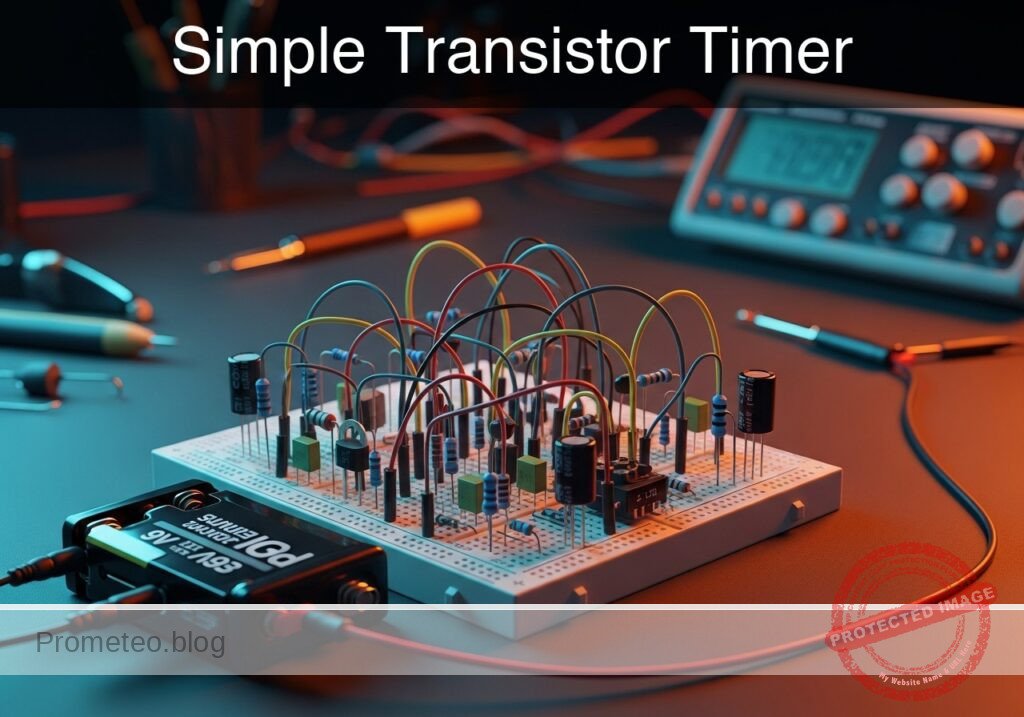
Prototipo de Temporizador simple con transistor (Maker Style)

Nivel: Básico. Construye un circuito de retardo al apagado utilizando la descarga lenta de un condensador para controlar un transistor.

Objetivo y caso de uso

En esta sesión, construirás un circuito temporizador analógico que mantiene un LED iluminado durante una duración específica después de soltar un pulsador. Esto demuestra cómo un condensador almacena energía y la descarga a lo largo del tiempo para controlar un elemento de conmutación (el transistor).

Por qué es útil:
* Iluminación interior de coches: Luces que se apagan lentamente después de cerrar la puerta.
* Temporizadores de escalera: Iluminación que permanece encendida el tiempo suficiente para que alguien suba las escaleras.
* Ventiladores de baño: Ventiladores que continúan funcionando durante unos minutos después de apagarlos para eliminar la humedad.
* Eliminación de rebotes (Debouncing): Suavizado de interrupciones de señal cortas y no deseadas.

Resultado esperado:
* Pulsación del botón: El LED se ENCIENDE inmediatamente con brillo máximo.
* Liberación del botón: El LED permanece ENCENDIDO inicialmente.
* Fase de retardo: El LED se atenúa gradualmente y se APAGA después de unos segundos a medida que cae el voltaje del condensador.
* Público objetivo: Estudiantes y aficionados que aprenden sobre constantes de tiempo RC y conmutación con transistores.

Materiales

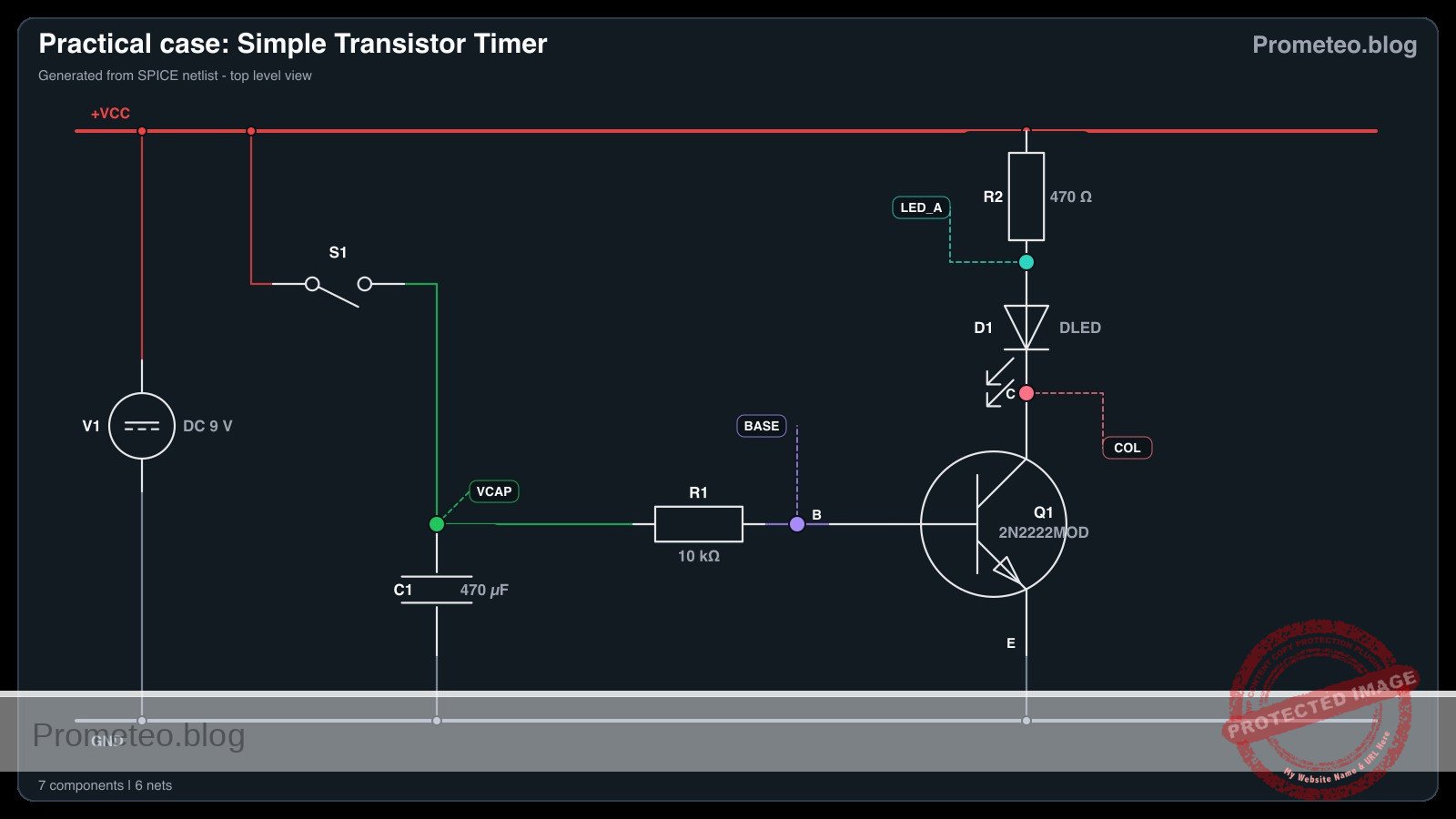
  • V1: Fuente de alimentación de 9 V CC, función: fuente de alimentación principal.
  • S1: Pulsador (Normalmente Abierto), función: disparador de carga.
  • C1: Condensador electrolítico de 470 µF, función: temporización y almacenamiento de energía.
  • R1: Resistencia de 10 kΩ, función: resistencia de temporización de descarga.
  • R2: Resistencia de 470 Ω, función: limitación de corriente del LED.
  • Q1: Transistor NPN 2N2222, función: interruptor de corriente.
  • D1: LED rojo, función: indicador visual de salida.

Guía de conexionado

Construye el circuito siguiendo estas conexiones utilizando los nombres de nodo específicos proporcionados.

  • Fuente de alimentación:

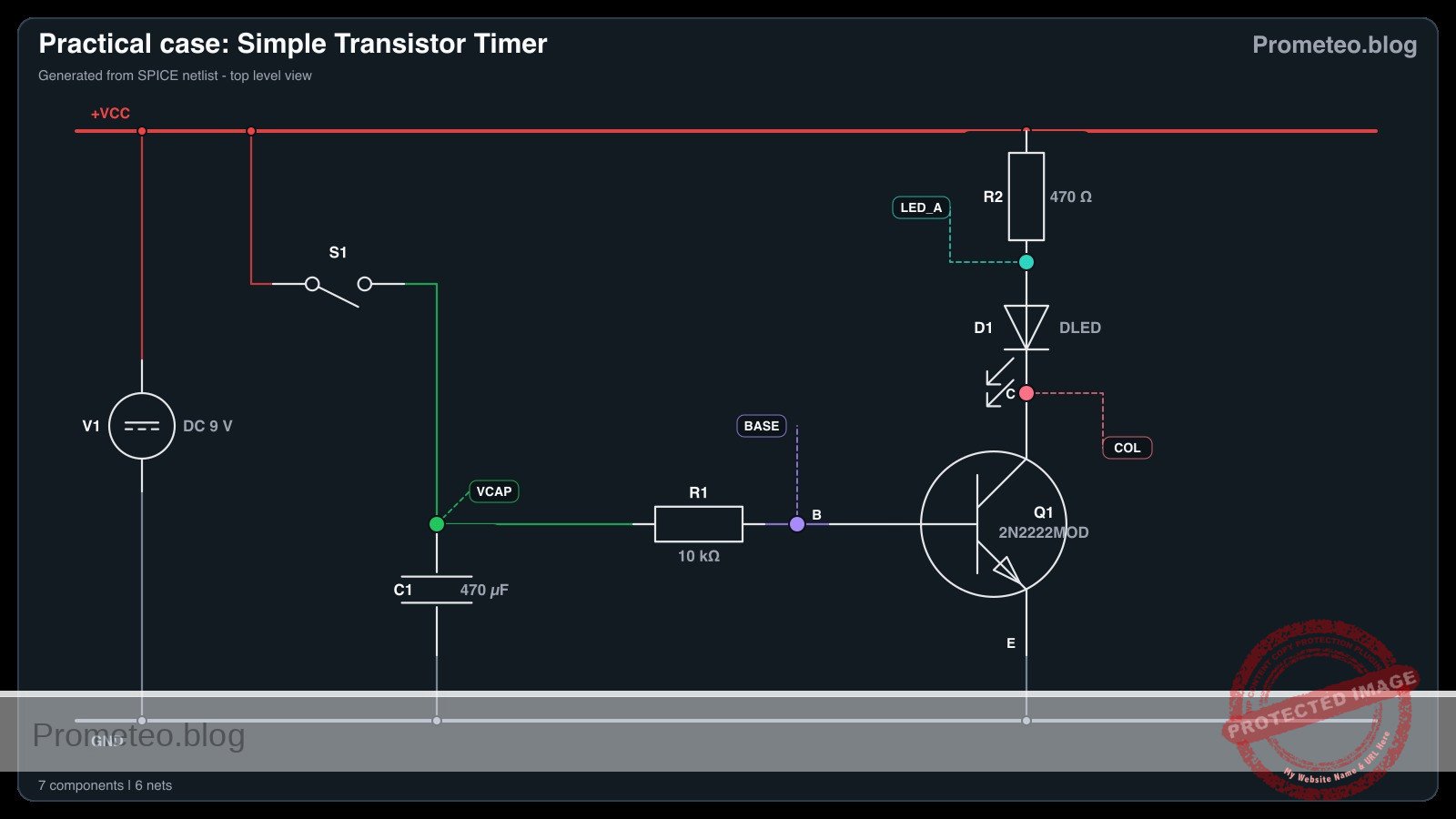
    • Conecta el terminal positivo de V1 al nodo VCC.
    • Conecta el terminal negativo de V1 al nodo 0 (GND).
  • Red de entrada y temporización:

    • Conecta S1 entre el nodo VCC y el nodo VCAP.
    • Conecta el terminal positivo de C1 al nodo VCAP.
    • Conecta el terminal negativo de C1 al nodo 0.
    • Conecta R1 entre el nodo VCAP y el nodo BASE.
  • Interruptor de transistor:

    • Conecta la Base de Q1 al nodo BASE.
    • Conecta el Emisor de Q1 al nodo 0.
    • Conecta el Colector de Q1 al nodo COL.
  • Carga de salida (LED):

    • Conecta R2 entre el nodo VCC y el nodo LED_A.
    • Conecta el Ánodo de D1 al nodo LED_A.
    • Conecta el Cátodo de D1 al nodo COL.

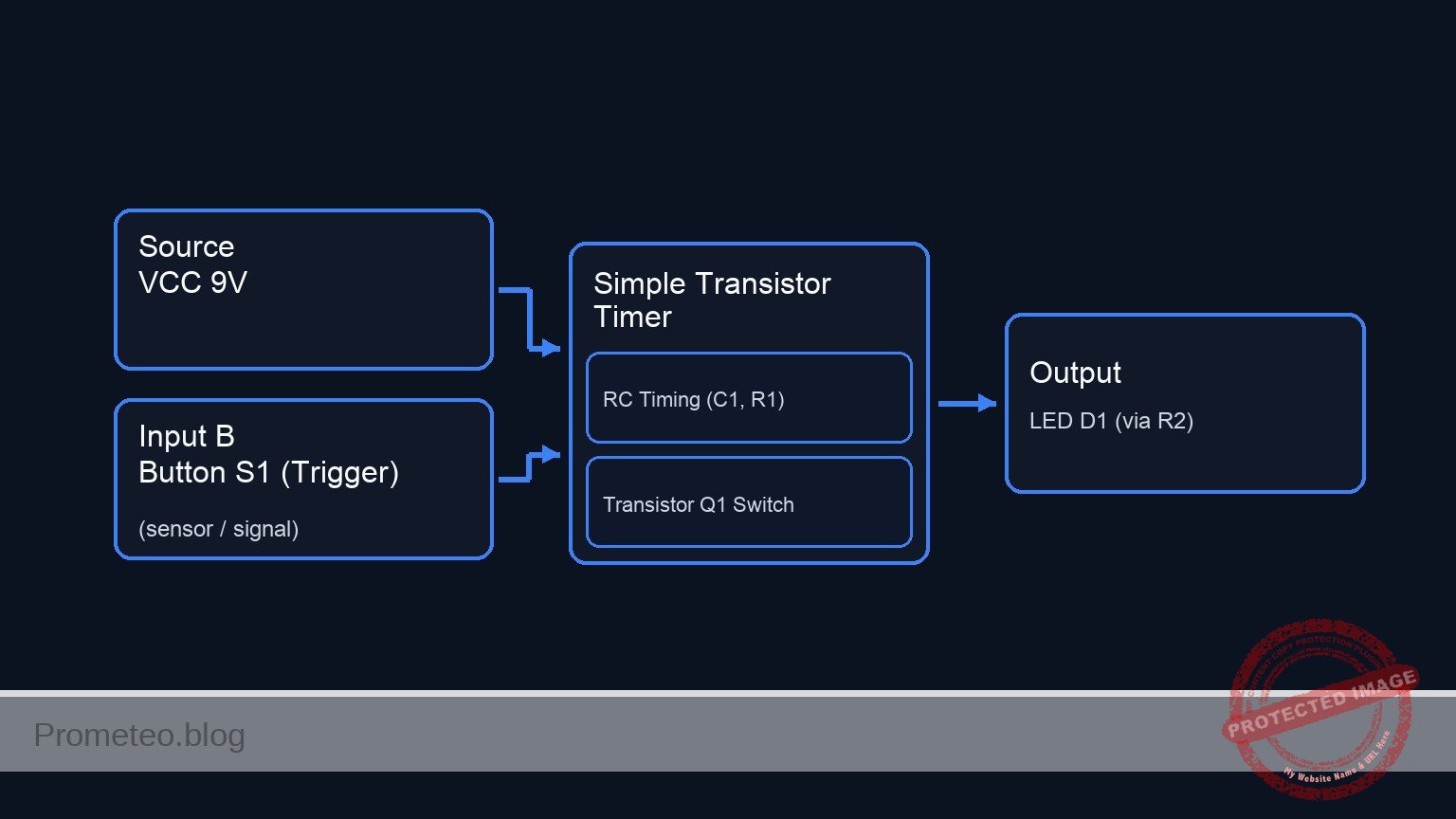
Diagrama de bloques conceptual

Conceptual block diagram — Simple Transistor Timer
Lectura rápida: entradas → bloque principal → salida (actuador o medida). Resume el esquemático ASCII de la siguiente sección.

Esquemático

[ INPUT & TIMING ]                  [ LOGIC / SWITCH ]                 [ OUTPUT LOAD ]

(VCC 9 V) --+--(Power Path)--------------------------------------------------> [ Resistor R2 ]
           |                                                                        |
           |                                                                        v
     [ Button S1 ]                                                             [ LED D1 ]
           |                                                                        |
           v (Trigger)                                                              |
     [ Node VCAP ] --(Slow Discharge)--> [ Resistor R1 ] --(Base Sig)-->+           |
           |                                                            |           |
           + <--(Stores Charge)-- [ Capacitor C1 ]                      |           |
                                       |                                v           v
                                       v                        +-----------------------+
                                    [ GND ]                     |     TRANSISTOR Q1     |
                                                                | (Base)    (Collector) |
                                                                +-----------------------+
                                                                            |
                                                                            v (Emitter)
                                                                         [ GND ]
Esquema Eléctrico

Diagrama eléctrico

Diagrama electrico del caso: Temporizador simple con transistor
Generado desde la netlist SPICE validada del caso.

🔒 Este diagrama eléctrico es premium. Con el pase de 7 días o la suscripción mensual podrás desbloquear el material didáctico completo y el pack PDF listo para imprimir.🔓 Ver planes de acceso premium

Mediciones y pruebas

Sigue estos pasos para validar el comportamiento del circuito usando un multímetro.

  1. Estado inicial: Asegúrate de que S1 no esté presionado. El LED debe estar APAGADO.
    • Mide el voltaje en VCAP. Debería estar cerca de 0 V.
  2. Fase de carga: Mantén presionado S1.
    • Comprobación: El LED se ENCIENDE inmediatamente.
    • Medición: El voltaje en VCAP debería subir instantáneamente a aproximadamente 9 V (VCC).
  3. Fase de descarga: Suelta S1 e inicia un cronómetro.
    • Observación: El LED permanece encendido.
    • Medición: Monitorea el voltaje en VCAP. Disminuirá lentamente.
    • Umbral: Cuando VCAP cae por debajo de aproximadamente 1.4 V (V_BE + caída en R1), el LED se atenuará significativamente y se APAGARÁ.
  4. Constante de tiempo: Registra el tiempo desde la liberación hasta que el LED se apague por completo.

Netlist SPICE y simulación

Netlist SPICE de referencia (ngspice) — extractoNetlist SPICE completo (ngspice)

* Practical case: Simple Transistor Timer

* --- Power Supply ---
* V1: 9 V DC supply
V1 VCC 0 DC 9

* --- Input and Timing Network ---
* S1: Push-button (Normally Open)
* Modeled as a Voltage Controlled Switch (S1) driven by a control pulse (V_S1_ACT)
* Connects VCC to VCAP when activated
S1 VCC VCAP CTRL 0 SW_MODEL

* Control signal for the button press simulation
* Press button at T=0.5s, hold for 0.5s, then release to allow discharge
V_S1_ACT CTRL 0 PULSE(0 5 0.5 1m 1m 0.5 20)

* C1: 470 µF electrolytic capacitor
C1 VCAP 0 470u

* R1: 10 kΩ resistor (Discharge path to Base)
* ... (truncated in public view) ...

Copia este contenido en un archivo .cir y ejecútalo con ngspice.

🔒 Parte del contenido de esta sección es premium. Con el pase de 7 días o la suscripción mensual tendrás acceso al contenido completo (materiales, conexionado, compilación detallada, validación paso a paso, troubleshooting, mejoras/variantes y checklist) y podrás descargar el pack PDF listo para imprimir.

* Practical case: Simple Transistor Timer

* --- Power Supply ---
* V1: 9 V DC supply
V1 VCC 0 DC 9

* --- Input and Timing Network ---
* S1: Push-button (Normally Open)
* Modeled as a Voltage Controlled Switch (S1) driven by a control pulse (V_S1_ACT)
* Connects VCC to VCAP when activated
S1 VCC VCAP CTRL 0 SW_MODEL

* Control signal for the button press simulation
* Press button at T=0.5s, hold for 0.5s, then release to allow discharge
V_S1_ACT CTRL 0 PULSE(0 5 0.5 1m 1m 0.5 20)

* C1: 470 µF electrolytic capacitor
C1 VCAP 0 470u

* R1: 10 kΩ resistor (Discharge path to Base)
R1 VCAP BASE 10k

* --- Transistor Switch ---
* Q1: 2N2222 NPN transistor
* Connections: Collector=COL, Base=BASE, Emitter=0(GND)
Q1 COL BASE 0 2N2222MOD

* --- Output Load (LED) ---
* R2: 470 Ω resistor
R2 VCC LED_A 470

* D1: Red LED
* Connections: Anode=LED_A, Cathode=COL
D1 LED_A COL DLED

* --- Models ---
* Switch Model: Threshold 2.5V, Low On-Resistance
.model SW_MODEL SW(Vt=2.5 Ron=0.1 Roff=100Meg)

* NPN Transistor Model (Generic 2N2222)
.model 2N2222MOD NPN(IS=1E-14 VAF=100 BF=200 IKF=0.3 XTB=1.5 BR=3 CJC=8E-12 CJE=25E-12 TR=46.91E-9 TF=411.1E-12 ITF=0.6 VTF=1.7 XTF=3 RB=10 RC=0.3 RE=0.2)

* LED Model (Red LED approx)
.model DLED D(IS=1u N=2 RS=10 BV=5 IBV=10u)

* --- Analysis Commands ---
* Transient analysis for 10 seconds to observe the long RC discharge (Tau ~ 4.7s)
.tran 10m 10s

* Output voltage of Capacitor, Base, Collector, and LED Anode
.print tran V(VCAP) V(BASE) V(COL) V(LED_A)

.op
.end

Resultados de Simulación (Transitorio)

Resultados de Simulación (Transitorio)
Show raw data table (2110 rows)
Index   time            v(vcap)         v(base)         v(col)
0	0.000000e+00	5.504285e-01	5.495835e-01	8.838023e+00
1	1.000000e-04	5.504285e-01	5.495836e-01	8.838088e+00
2	2.000000e-04	5.504285e-01	5.495835e-01	8.838088e+00
3	4.000000e-04	5.504285e-01	5.495835e-01	8.838088e+00
4	8.000000e-04	5.504285e-01	5.495835e-01	8.838088e+00
5	1.600000e-03	5.504285e-01	5.495835e-01	8.838088e+00
6	3.200000e-03	5.504285e-01	5.495835e-01	8.838088e+00
7	6.400000e-03	5.504285e-01	5.495835e-01	8.838088e+00
8	1.280000e-02	5.504285e-01	5.495835e-01	8.838088e+00
9	2.280000e-02	5.504285e-01	5.495835e-01	8.838088e+00
10	3.280000e-02	5.504285e-01	5.495835e-01	8.838088e+00
11	4.280000e-02	5.504285e-01	5.495835e-01	8.838088e+00
12	5.280000e-02	5.504285e-01	5.495835e-01	8.838088e+00
13	6.280000e-02	5.504285e-01	5.495835e-01	8.838088e+00
14	7.280000e-02	5.504285e-01	5.495835e-01	8.838088e+00
15	8.280000e-02	5.504285e-01	5.495835e-01	8.838088e+00
16	9.280000e-02	5.504285e-01	5.495835e-01	8.838088e+00
17	1.028000e-01	5.504285e-01	5.495835e-01	8.838088e+00
18	1.128000e-01	5.504285e-01	5.495835e-01	8.838088e+00
19	1.228000e-01	5.504285e-01	5.495835e-01	8.838088e+00
20	1.328000e-01	5.504285e-01	5.495835e-01	8.838088e+00
21	1.428000e-01	5.504285e-01	5.495835e-01	8.838088e+00
22	1.528000e-01	5.504285e-01	5.495835e-01	8.838088e+00
23	1.628000e-01	5.504285e-01	5.495835e-01	8.838088e+00
... (2086 more rows) ...

Errores comunes y cómo evitarlos

  1. Polaridad del condensador invertida: Los condensadores electrolíticos pueden explotar o fallar si se conectan al revés. Asegúrate de que la franja negativa en C1 se conecte a 0 (GND).
  2. Pin-out del transistor incorrecto: Confundir el Colector y el Emisor impide la conmutación. Verifica la hoja de datos del 2N2222; generalmente, la pestaña o el lado plano indica la orientación de los pines.
  3. Valor del condensador demasiado pequeño: Usar un condensador pequeño (por ejemplo, 100 nF) resulta en un retardo demasiado corto para que el ojo humano lo perciba. Usa al menos 100 µF para resultados visibles.

Solución de problemas

  • Síntoma: El LED nunca se ENCIENDE.
    • Causa: LED instalado al revés o transistor roto.
    • Solución: Verifica la orientación de D1 (Ánodo a resistencia, Cátodo a Colector) y verifica las conexiones de Q1.
  • Síntoma: El LED se APAGA inmediatamente al soltar el botón.
    • Causa: Falta el condensador, está desconectado o el valor es demasiado bajo.
    • Solución: Asegúrate de que C1 esté firmemente conectado entre VCAP y 0. Intenta aumentar C1 a 1000 µF.
  • Síntoma: El transistor se calienta mucho.
    • Causa: Falta la resistencia de base o hay un cortocircuito en la salida.
    • Solución: Asegúrate de que R1 (10 kΩ) esté instalada correctamente entre el condensador y la base para limitar la corriente de base.

Posibles mejoras y extensiones

  1. Temporizador variable: Reemplaza R1 con un potenciómetro de 50 kΩ en serie con una resistencia de 1 kΩ para permitir al usuario ajustar la duración del retardo.
  2. Par Darlington: Reemplaza Q1 con un transistor Darlington (o dos NPN conectados como un par Darlington) para aumentar significativamente la impedancia de entrada, permitiendo retardos mucho más largos con el mismo valor de condensador.

Más Casos Prácticos en Prometeo.blog

Encuentra este producto y/o libros sobre este tema en Amazon

Ir a Amazon

Como afiliado de Amazon, gano con las compras que cumplan los requisitos. Si compras a través de este enlace, ayudas a mantener este proyecto.

Quiz rápido

Pregunta 1: ¿Cuál es el objetivo principal del circuito descrito en el artículo?


Pregunta 2: ¿Qué componente es responsable de almacenar la energía para crear el retardo?


Pregunta 3: ¿Qué sucede con el LED cuando se pulsa el botón?


Pregunta 4: ¿Cuál es una aplicación práctica mencionada para este tipo de circuito?


Pregunta 5: ¿Qué función cumple el transistor en este circuito?


Pregunta 6: ¿Qué ocurre durante la 'Fase de retardo' descrita?


Pregunta 7: ¿Qué fenómeno físico se utiliza para controlar el transistor en este proyecto?


Pregunta 8: ¿Para qué sirve este circuito en los ventiladores de baño según el texto?


Pregunta 9: ¿Qué es el 'Debouncing' o eliminación de rebotes mencionado como utilidad?


Pregunta 10: ¿Qué nivel de dificultad se asigna a este proyecto en el texto?


Carlos Núñez Zorrilla
Electronics & Computer Engineer

Ingeniero Superior en Electrónica de Telecomunicaciones e Ingeniero en Informática (titulaciones oficiales en España).
Sígueme:


Practical case: Simple Transistor Timer

Simple Transistor Timer prototype (Maker Style)

Level: Basic. Build an off-delay circuit using the slow discharge of a capacitor to control a transistor.

Objective and use case

In this session, you will build an analog timer circuit that keeps an LED illuminated for a specific duration after a push-button is released. This demonstrates how a capacitor stores energy and discharges it over time to control a switching element (the transistor).

Why it is useful:
* Interior car lighting: Lights that fade out slowly after the door is closed.
* Staircase timers: Lighting that remains on long enough for someone to climb the stairs.
* Bathroom fans: Fans that continue running for a few minutes after being switched off to clear humidity.
* Debouncing: Smoothing out short, unwanted signal interruptions.

Expected outcome:
* Button Press: The LED turns ON immediately to full brightness.
* Button Release: The LED remains ON initially.
* Delay Phase: The LED gradually dims and turns OFF after a few seconds as the capacitor voltage drops.
* Target Audience: Students and hobbyists learning about RC time constants and transistor switching.

Materials

  • V1: 9 V DC supply, function: main power source.
  • S1: Push-button (Normally Open), function: charging trigger.
  • C1: 470 µF electrolytic capacitor, function: timing and energy storage.
  • R1: 10 kΩ resistor, function: discharge timing resistor.
  • R2: 470 Ω resistor, function: LED current limiting.
  • Q1: 2N2222 NPN transistor, function: current switch.
  • D1: Red LED, function: visual output indicator.

Wiring guide

Construct the circuit following these connections using the specific node names provided.

  • Power Supply:

    • Connect V1 positive terminal to node VCC.
    • Connect V1 negative terminal to node 0 (GND).
  • Input and Timing Network:

    • Connect S1 between node VCC and node VCAP.
    • Connect C1 positive terminal to node VCAP.
    • Connect C1 negative terminal to node 0.
    • Connect R1 between node VCAP and node BASE.
  • Transistor Switch:

    • Connect Q1 Base to node BASE.
    • Connect Q1 Emitter to node 0.
    • Connect Q1 Collector to node COL.
  • Output Load (LED):

    • Connect R2 between node VCC and node LED_A.
    • Connect D1 Anode to node LED_A.
    • Connect D1 Cathode to node COL.

Conceptual block diagram

Conceptual block diagram — Simple Transistor Timer
Quick read: inputs → main block → output (actuator or measurement). This summarizes the ASCII schematic below.

Schematic

[ INPUT & TIMING ]                  [ LOGIC / SWITCH ]                 [ OUTPUT LOAD ]

(VCC 9 V) --+--(Power Path)--------------------------------------------------> [ Resistor R2 ]
           |                                                                        |
           |                                                                        v
     [ Button S1 ]                                                             [ LED D1 ]
           |                                                                        |
           v (Trigger)                                                              |
     [ Node VCAP ] --(Slow Discharge)--> [ Resistor R1 ] --(Base Sig)-->+           |
           |                                                            |           |
           + <--(Stores Charge)-- [ Capacitor C1 ]                      |           |
                                       |                                v           v
                                       v                        +-----------------------+
                                    [ GND ]                     |     TRANSISTOR Q1     |
                                                                | (Base)    (Collector) |
                                                                +-----------------------+
                                                                            |
                                                                            v (Emitter)
                                                                         [ GND ]
Schematic (ASCII)

Electrical diagram

Electrical diagram for case: Simple Transistor Timer
Generated from the validated SPICE netlist for this case.

🔒 This electrical diagram is premium. With the 7-day pass or the monthly membership you can unlock the complete didactic material and the print-ready PDF pack.🔓 See premium access plans

Measurements and tests

Follow these steps to validate the circuit behavior using a multimeter.

  1. Initial State: Ensure S1 is not pressed. The LED should be OFF.
    • Measure voltage at VCAP. It should be near 0 V.
  2. Charging Phase: Press and hold S1.
    • Check: The LED turns ON immediately.
    • Measurement: The voltage at VCAP should instantly rise to approximately 9 V (VCC).
  3. Discharge Phase: Release S1 and start a stopwatch.
    • Observation: The LED remains lit.
    • Measurement: Monitor the voltage at VCAP. It will slowly decrease.
    • Threshold: When VCAP drops below approximately 1.4 V (V_BE + drop across R1), the LED will dim significantly and turn OFF.
  4. Time Constant: Record the time from release until the LED turns completely off.

SPICE netlist and simulation

Reference SPICE Netlist (ngspice) — excerptFull SPICE netlist (ngspice)

* Practical case: Simple Transistor Timer

* --- Power Supply ---
* V1: 9 V DC supply
V1 VCC 0 DC 9

* --- Input and Timing Network ---
* S1: Push-button (Normally Open)
* Modeled as a Voltage Controlled Switch (S1) driven by a control pulse (V_S1_ACT)
* Connects VCC to VCAP when activated
S1 VCC VCAP CTRL 0 SW_MODEL

* Control signal for the button press simulation
* Press button at T=0.5s, hold for 0.5s, then release to allow discharge
V_S1_ACT CTRL 0 PULSE(0 5 0.5 1m 1m 0.5 20)

* C1: 470 µF electrolytic capacitor
C1 VCAP 0 470u

* R1: 10 kΩ resistor (Discharge path to Base)
* ... (truncated in public view) ...

Copy this content into a .cir file and run with ngspice.

🔒 Part of this section is premium. With the 7-day pass or the monthly membership you can access the full content (materials, wiring, detailed build, validation, troubleshooting, variants and checklist) and download the complete print-ready PDF pack.

* Practical case: Simple Transistor Timer

* --- Power Supply ---
* V1: 9 V DC supply
V1 VCC 0 DC 9

* --- Input and Timing Network ---
* S1: Push-button (Normally Open)
* Modeled as a Voltage Controlled Switch (S1) driven by a control pulse (V_S1_ACT)
* Connects VCC to VCAP when activated
S1 VCC VCAP CTRL 0 SW_MODEL

* Control signal for the button press simulation
* Press button at T=0.5s, hold for 0.5s, then release to allow discharge
V_S1_ACT CTRL 0 PULSE(0 5 0.5 1m 1m 0.5 20)

* C1: 470 µF electrolytic capacitor
C1 VCAP 0 470u

* R1: 10 kΩ resistor (Discharge path to Base)
R1 VCAP BASE 10k

* --- Transistor Switch ---
* Q1: 2N2222 NPN transistor
* Connections: Collector=COL, Base=BASE, Emitter=0(GND)
Q1 COL BASE 0 2N2222MOD

* --- Output Load (LED) ---
* R2: 470 Ω resistor
R2 VCC LED_A 470

* D1: Red LED
* Connections: Anode=LED_A, Cathode=COL
D1 LED_A COL DLED

* --- Models ---
* Switch Model: Threshold 2.5V, Low On-Resistance
.model SW_MODEL SW(Vt=2.5 Ron=0.1 Roff=100Meg)

* NPN Transistor Model (Generic 2N2222)
.model 2N2222MOD NPN(IS=1E-14 VAF=100 BF=200 IKF=0.3 XTB=1.5 BR=3 CJC=8E-12 CJE=25E-12 TR=46.91E-9 TF=411.1E-12 ITF=0.6 VTF=1.7 XTF=3 RB=10 RC=0.3 RE=0.2)

* LED Model (Red LED approx)
.model DLED D(IS=1u N=2 RS=10 BV=5 IBV=10u)

* --- Analysis Commands ---
* Transient analysis for 10 seconds to observe the long RC discharge (Tau ~ 4.7s)
.tran 10m 10s

* Output voltage of Capacitor, Base, Collector, and LED Anode
.print tran V(VCAP) V(BASE) V(COL) V(LED_A)

.op
.end

Simulation Results (Transient Analysis)

Simulation Results (Transient Analysis)
Show raw data table (2110 rows)
Index   time            v(vcap)         v(base)         v(col)
0	0.000000e+00	5.504285e-01	5.495835e-01	8.838023e+00
1	1.000000e-04	5.504285e-01	5.495836e-01	8.838088e+00
2	2.000000e-04	5.504285e-01	5.495835e-01	8.838088e+00
3	4.000000e-04	5.504285e-01	5.495835e-01	8.838088e+00
4	8.000000e-04	5.504285e-01	5.495835e-01	8.838088e+00
5	1.600000e-03	5.504285e-01	5.495835e-01	8.838088e+00
6	3.200000e-03	5.504285e-01	5.495835e-01	8.838088e+00
7	6.400000e-03	5.504285e-01	5.495835e-01	8.838088e+00
8	1.280000e-02	5.504285e-01	5.495835e-01	8.838088e+00
9	2.280000e-02	5.504285e-01	5.495835e-01	8.838088e+00
10	3.280000e-02	5.504285e-01	5.495835e-01	8.838088e+00
11	4.280000e-02	5.504285e-01	5.495835e-01	8.838088e+00
12	5.280000e-02	5.504285e-01	5.495835e-01	8.838088e+00
13	6.280000e-02	5.504285e-01	5.495835e-01	8.838088e+00
14	7.280000e-02	5.504285e-01	5.495835e-01	8.838088e+00
15	8.280000e-02	5.504285e-01	5.495835e-01	8.838088e+00
16	9.280000e-02	5.504285e-01	5.495835e-01	8.838088e+00
17	1.028000e-01	5.504285e-01	5.495835e-01	8.838088e+00
18	1.128000e-01	5.504285e-01	5.495835e-01	8.838088e+00
19	1.228000e-01	5.504285e-01	5.495835e-01	8.838088e+00
20	1.328000e-01	5.504285e-01	5.495835e-01	8.838088e+00
21	1.428000e-01	5.504285e-01	5.495835e-01	8.838088e+00
22	1.528000e-01	5.504285e-01	5.495835e-01	8.838088e+00
23	1.628000e-01	5.504285e-01	5.495835e-01	8.838088e+00
... (2086 more rows) ...

Common mistakes and how to avoid them

  1. Reversed Capacitor Polarity: Electrolytic capacitors can explode or fail if connected backwards. Ensure the negative stripe on C1 connects to 0 (GND).
  2. Incorrect Transistor Pinout: Confusing the Collector and Emitter prevents switching. Verify the 2N2222 datasheet; usually, the tab or flat side indicates the pin orientation.
  3. Capacitor Value Too Small: Using a small capacitor (e.g., 100 nF) results in a delay too short for the human eye to perceive. Use at least 100 µF for visible results.

Troubleshooting

  • Symptom: LED never turns ON.
    • Cause: LED installed backwards or transistor broken.
    • Fix: Check D1 orientation (Anode to resistor, Cathode to Collector) and verify Q1 connections.
  • Symptom: LED turns OFF immediately upon releasing the button.
    • Cause: Capacitor is missing, disconnected, or value is too low.
    • Fix: Ensure C1 is firmly connected between VCAP and 0. Try increasing C1 to 1000 µF.
  • Symptom: Transistor gets very hot.
    • Cause: Missing base resistor or short circuit at the output.
    • Fix: Ensure R1 (10 kΩ) is correctly installed between the capacitor and the base to limit base current.

Possible improvements and extensions

  1. Variable Timer: Replace R1 with a 50 kΩ potentiometer in series with a 1 kΩ resistor to allow the user to adjust the delay duration.
  2. Darlington Pair: Replace Q1 with a Darlington transistor (or two NPNs connected as a Darlington pair) to significantly increase input impedance, allowing for much longer delays with the same capacitor value.

More Practical Cases on Prometeo.blog

Find this product and/or books on this topic on Amazon

Go to Amazon

As an Amazon Associate, I earn from qualifying purchases. If you buy through this link, you help keep this project running.

Quick Quiz

Question 1: What is the primary function of the capacitor (C1) in this circuit?


Question 2: Which component acts as the current switch in this off-delay circuit?


Question 3: What happens to the LED immediately after the push-button is released?


Question 4: Which real-world application is mentioned as a use case for this type of circuit?


Question 5: What is the purpose of the resistor R2 (470 Ω) in a typical LED circuit like this?


Question 6: What is the voltage of the power supply (V1) used in this project?


Question 7: Which component works in conjunction with the capacitor to determine the discharge timing?


Question 8: What type of switch is S1 described as in the expected outcome?


Question 9: During the 'Delay Phase', why does the LED eventually turn off?


Question 10: What is the target audience for this specific project?


Carlos Núñez Zorrilla
Electronics & Computer Engineer

Telecommunications Electronics Engineer and Computer Engineer (official degrees in Spain).

Follow me:


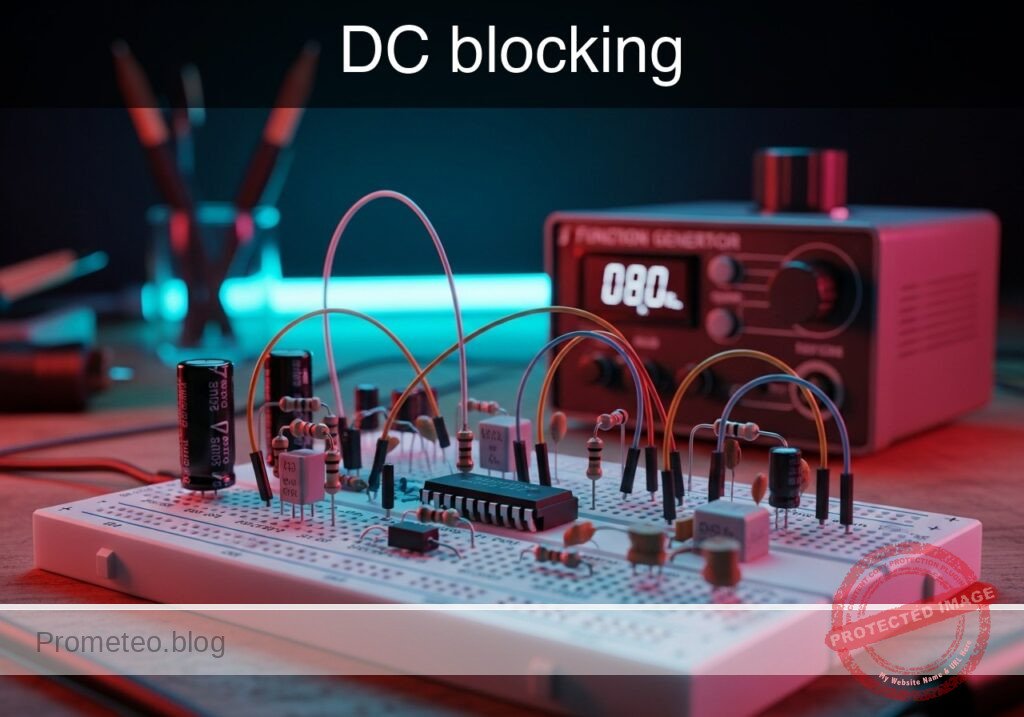
Caso práctico: Bloqueo de corriente continua

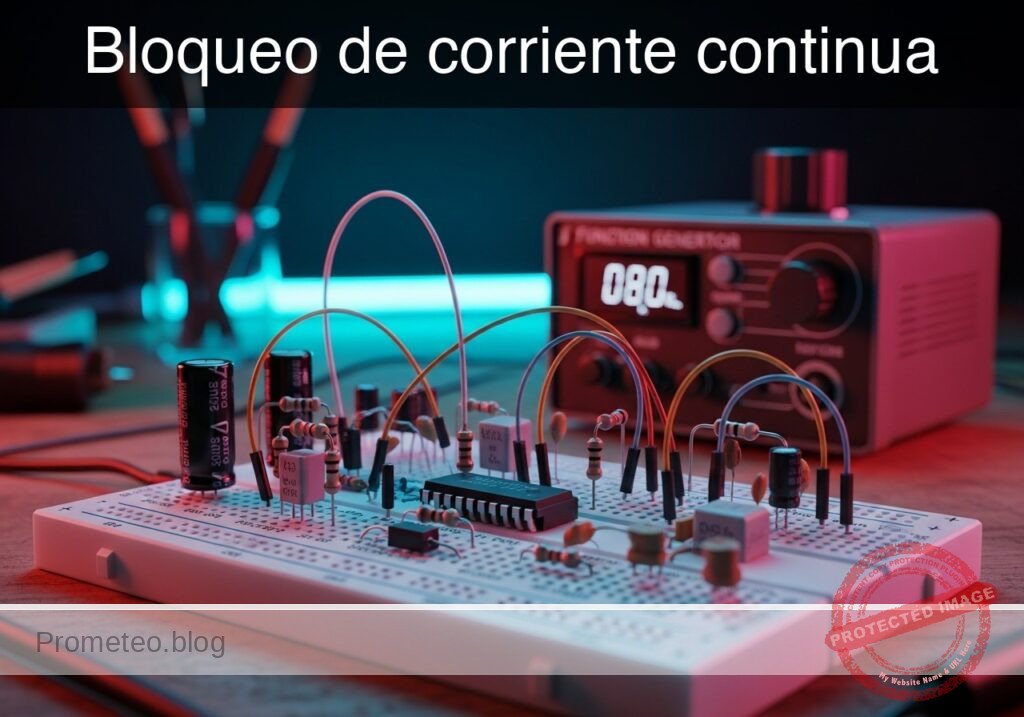
Prototipo de Bloqueo de corriente continua (Maker Style)

Nivel: Básico. Verifique que un condensador permite el paso de señales de CA mientras bloquea los componentes de CC.

Objetivo y caso de uso

Construirá un circuito pasivo que conecta una fuente de señal con un offset de CC a una carga a través de un condensador en serie. La configuración demuestra cómo el condensador filtra el componente de corriente continua (CC) mientras permite que la señal de corriente alterna (CA) llegue a la carga.

Por qué es útil:
* Acoplamiento de audio: Esencial para conectar etapas de amplificación donde existen diferentes voltajes de polarización de CC, pero la señal de audio debe pasar sin cambios.
* Acondicionamiento de sensores: Elimina los offsets de voltaje constante de los sensores (como los elementos piezoeléctricos) para centrarse solo en los cambios dinámicos.
* Protección: Evita que corrientes peligrosas de CC fluyan hacia cargas sensibles como auriculares o altavoces.

Resultado esperado:
* Señal de entrada: Una onda sinusoidal que oscila estrictamente por encima de 0 V (por ejemplo, entre +2 V y +4 V).
* Señal de salida: La misma onda sinusoidal centrada alrededor de 0 V (oscilando entre -1 V y +1 V).
* Medición de CC: El nodo de entrada mide un voltaje de CC constante (por ejemplo, +3 V), mientras que el nodo de salida mide 0 V CC.

Público objetivo y nivel:
Estudiantes y aficionados que aprenden sobre filtros pasivos y acoplamiento de CA.

Materiales

  • V1: Generador de funciones, función: proporciona una onda sinusoidal de 1 kHz (2 Vpp) con un offset de CC de +3 V.
  • C1: Condensador electrolítico de 10 µF, función: condensador de acoplamiento para bloqueo de CC.
  • R1: Resistencia de 10 kΩ, función: carga de salida a tierra.
  • Herramientas de medición: Osciloscopio (modo de acoplamiento DC) y multímetro.

Guía de conexionado

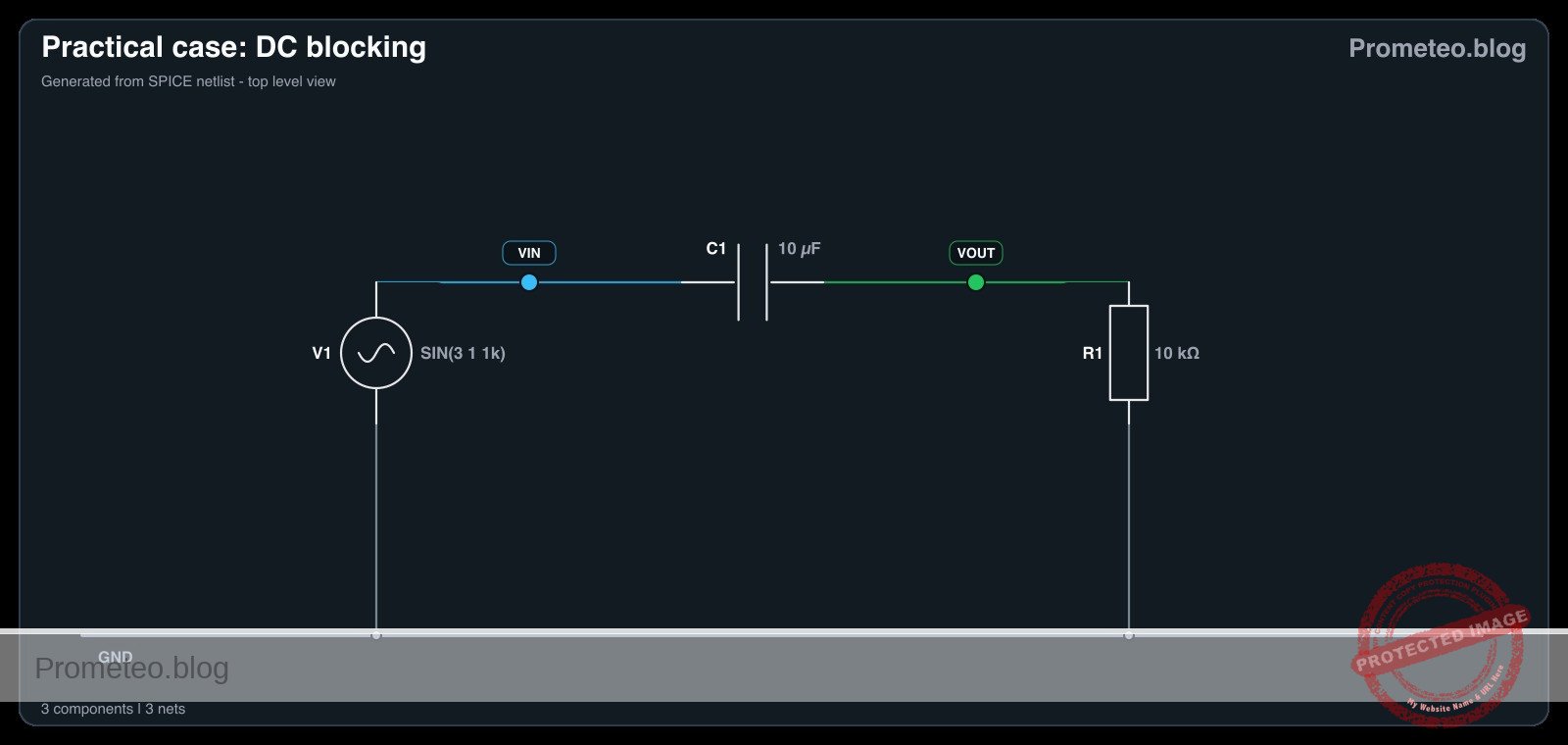
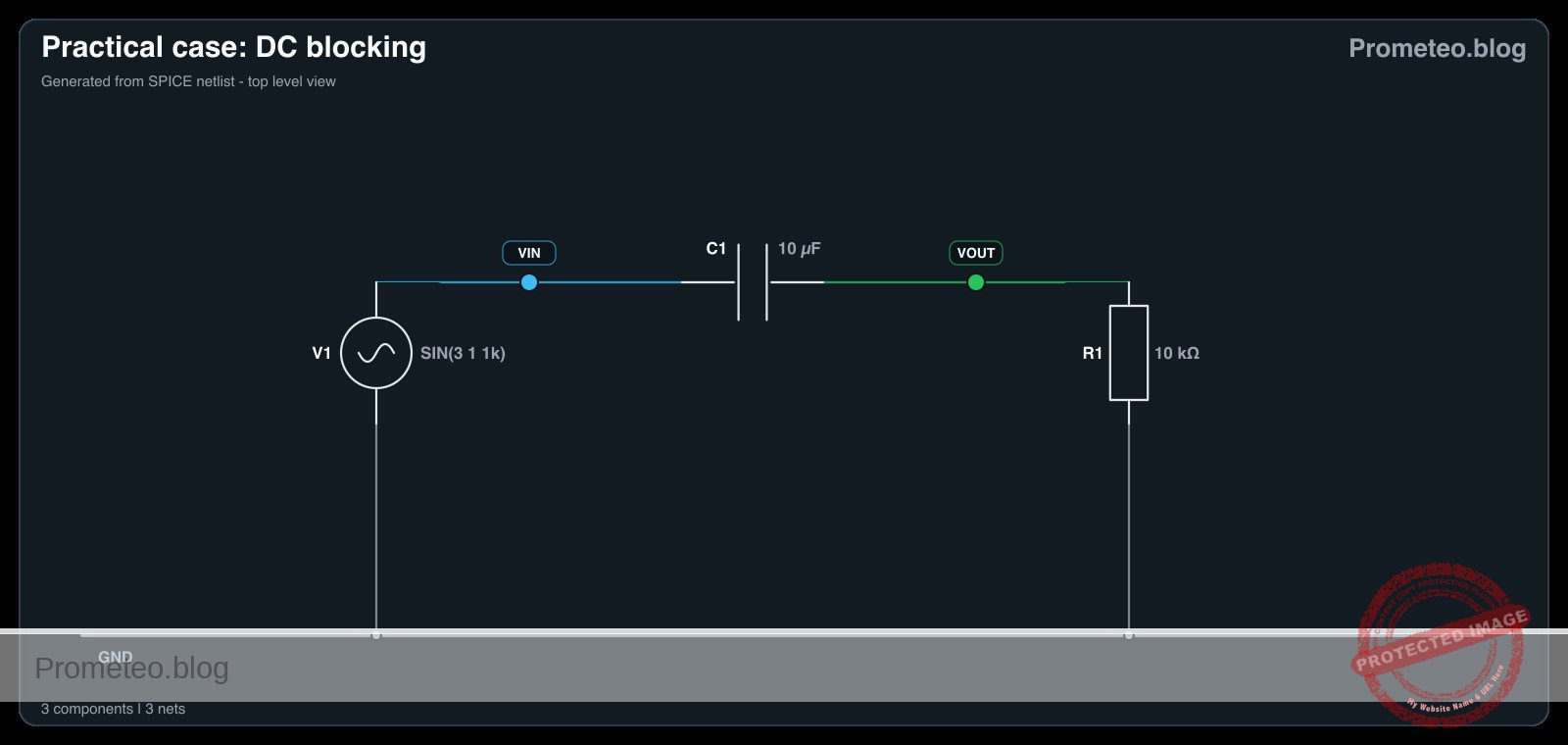
Este circuito utiliza tres nodos específicos: VIN (fuente), VOUT (carga) y 0 (GND).

  • V1 (Fuente): Conecte el terminal positivo al nodo VIN y el terminal negativo/tierra al nodo 0.
  • C1 (Condensador): Conecte el terminal positivo (ánodo) al nodo VIN y el terminal negativo (cátodo) al nodo VOUT.
  • R1 (Resistencia): Conecte una pata al nodo VOUT y la otra pata al nodo 0.

Diagrama de bloques conceptual

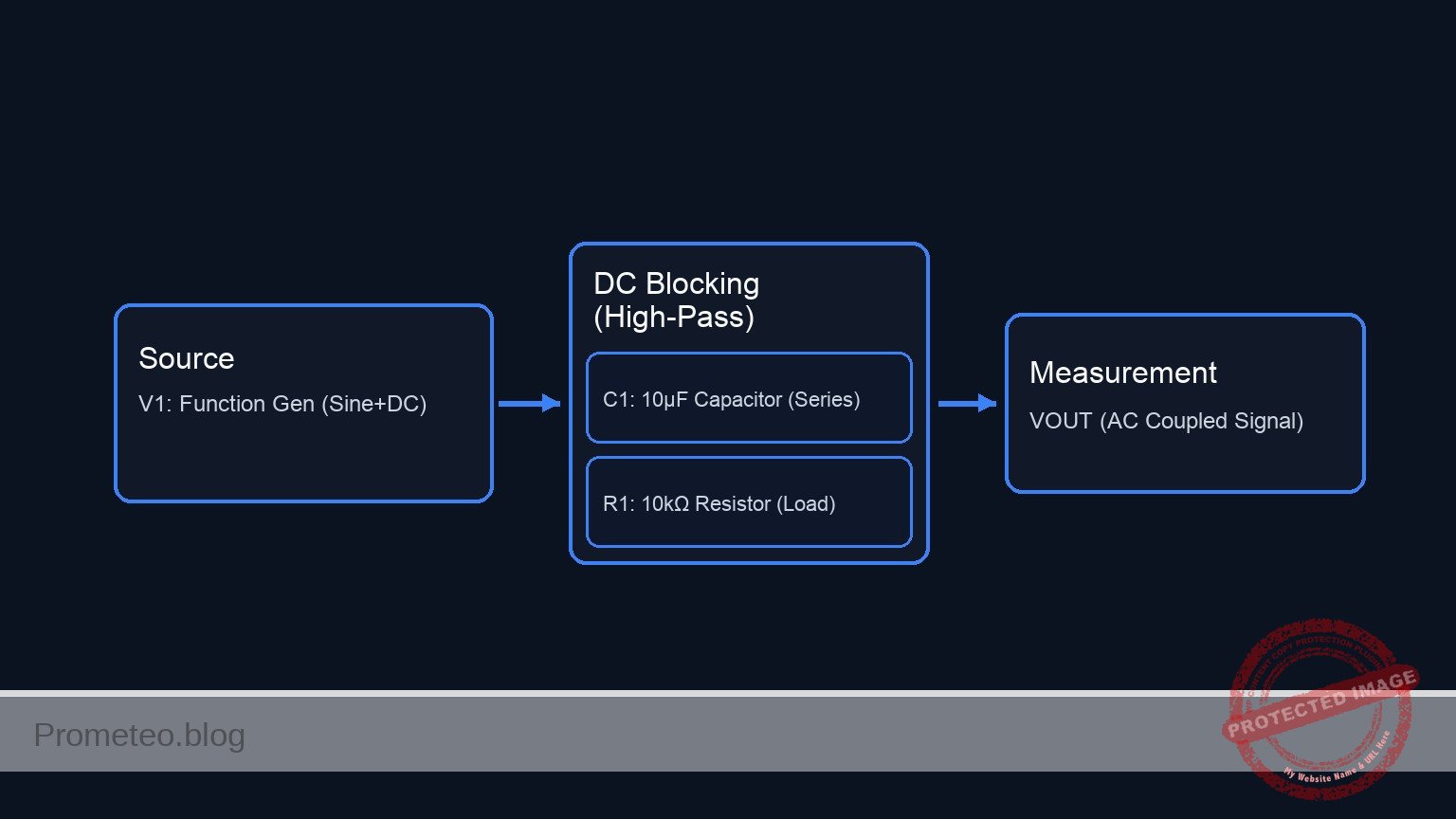
Conceptual block diagram — DC Blocking (High-Pass)
Lectura rápida: entradas → bloque principal → salida (actuador o medida). Resume el esquemático ASCII de la siguiente sección.

Esquemático

[ INPUT SOURCE ]                 [ PROCESSING ]                   [ OUTPUT LOAD ]

    [ V1: Function Gen ]             [ C1: Capacitor ]                 [ R1: Resistor ]
    ( 1kHz Sine, 2Vpp  ) --(VIN)--> +[     10 µF     ]- --(VOUT)--> [     10 kΩ      ] --> GND
    (   +3 V DC Offset  )      |      ( Electrolytic  )       |
                              |                              |
                              v                              v
                       [ Measurement ]                [ Measurement ]
                       (Scope/Multi)                  (Scope/Multi)
Esquema Eléctrico

Diagrama eléctrico

Diagrama electrico del caso: Bloqueo DC
Generado desde la netlist SPICE validada del caso.

🔒 Este diagrama eléctrico es premium. Con el pase de 7 días o la suscripción mensual podrás desbloquear el material didáctico completo y el pack PDF listo para imprimir.🔓 Ver planes de acceso premium

Mediciones y pruebas

Para validar el circuito, asegúrese de que su osciloscopio esté configurado en DC Coupling (Acoplamiento DC) en el canal de entrada. Si se configura en AC Coupling, el propio osciloscopio bloqueará la CC, ocultando el efecto del condensador externo.

  1. Configurar fuente (V1): Configure el generador de funciones en onda sinusoidal, Frecuencia = 1 kHz, Amplitud = 2 V pico a pico, Offset = +3 V.
  2. Medir entrada (VIN):
    • Conecte la sonda del osciloscopio a VIN.
    • Observación: La señal debe oscilar entre +2 V y +4 V. La línea central está en +3 V.
    • Medidor de CC: Debe leer aproximadamente +3 V.
  3. Medir salida (VOUT):
    • Conecte la sonda del osciloscopio a VOUT.
    • Observación: La señal debe oscilar entre -1 V y +1 V. La línea central está en 0 V.
    • Medidor de CC: Debe leer aproximadamente 0 V.
  4. Verificación: Confirme que la forma y la amplitud (2 Vpp) de la onda de CA permanecen en gran medida inalteradas, pero la posición vertical se ha desplazado hacia abajo 3 voltios.

Netlist SPICE y simulación

Netlist SPICE de referencia (ngspice) — extractoNetlist SPICE completo (ngspice)

* Practical case: DC blocking

* --- Components ---

* V1: Function Generator
* Specs: 1 kHz sine wave, 2 Vpp (Amplitude = 1V), +3 V DC offset
* Connection: Positive to VIN, Negative to 0 (GND)
V1 VIN 0 SIN(3 1 1k)

* C1: 10 uF electrolytic capacitor
* Function: DC blocking coupling capacitor
* Connection: Positive (VIN) to Negative (VOUT)
C1 VIN VOUT 10u

* R1: 10 kOhm resistor
* Function: Output load to ground
* Connection: VOUT to 0 (GND)
R1 VOUT 0 10k

* --- Simulation Commands ---
* ... (truncated in public view) ...

Copia este contenido en un archivo .cir y ejecútalo con ngspice.

🔒 Parte del contenido de esta sección es premium. Con el pase de 7 días o la suscripción mensual tendrás acceso al contenido completo (materiales, conexionado, compilación detallada, validación paso a paso, troubleshooting, mejoras/variantes y checklist) y podrás descargar el pack PDF listo para imprimir.

* Practical case: DC blocking

* --- Components ---

* V1: Function Generator
* Specs: 1 kHz sine wave, 2 Vpp (Amplitude = 1V), +3 V DC offset
* Connection: Positive to VIN, Negative to 0 (GND)
V1 VIN 0 SIN(3 1 1k)

* C1: 10 uF electrolytic capacitor
* Function: DC blocking coupling capacitor
* Connection: Positive (VIN) to Negative (VOUT)
C1 VIN VOUT 10u

* R1: 10 kOhm resistor
* Function: Output load to ground
* Connection: VOUT to 0 (GND)
R1 VOUT 0 10k

* --- Simulation Commands ---

* Operating point analysis
.op

* Transient analysis
* Frequency is 1kHz (Period = 1ms). Simulate 5ms to see 5 cycles.
.tran 10u 5m

* --- Output Directives ---
* Print input and output voltages for logging
.print tran V(VIN) V(VOUT)

.end

Resultados de Simulación (Transitorio)

Resultados de Simulación (Transitorio)
Show raw data table (508 rows)
Index   time            v(vin)          v(vout)
0	0.000000e+00	3.000000e+00	0.000000e+00
1	1.000000e-07	3.000628e+00	6.283179e-04
2	2.000000e-07	3.001257e+00	1.256635e-03
3	4.000000e-07	3.002513e+00	2.513266e-03
4	8.000000e-07	3.005027e+00	5.026506e-03
5	1.600000e-06	3.010053e+00	1.005285e-02
6	3.200000e-06	3.020105e+00	2.010452e-02
7	6.400000e-06	3.040202e+00	4.020026e-02
8	1.280000e-05	3.080338e+00	8.033296e-02
9	2.280000e-05	3.142767e+00	1.427508e-01
10	3.280000e-05	3.204633e+00	2.045991e-01
11	4.280000e-05	3.265691e+00	2.656336e-01
12	5.280000e-05	3.325700e+00	3.256134e-01
13	6.280000e-05	3.384424e+00	3.843020e-01
14	7.280000e-05	3.441631e+00	4.414676e-01
15	8.280000e-05	3.497095e+00	4.968847e-01
16	9.280000e-05	3.550597e+00	5.503345e-01
17	1.028000e-04	3.601927e+00	6.016061e-01
18	1.128000e-04	3.650880e+00	6.504972e-01
19	1.228000e-04	3.697265e+00	6.968148e-01
20	1.328000e-04	3.740898e+00	7.403761e-01
21	1.428000e-04	3.781608e+00	7.810093e-01
22	1.528000e-04	3.819232e+00	8.185538e-01
23	1.628000e-04	3.853624e+00	8.528617e-01
... (484 more rows) ...

Errores comunes y cómo evitarlos

  1. Usar acoplamiento de CA en el osciloscopio: Este es el error más frecuente. Hace que la entrada se vea exactamente igual que la salida porque el osciloscopio bloquea la CC internamente. Solución: Verifique siempre que el canal del osciloscopio esté configurado en «DC Coupling».
  2. Invertir la polaridad del condensador: Usar un condensador electrolítico polarizado al revés puede hacer que tenga fugas de corriente o falle. Solución: Asegúrese de que el lado positivo de C1 esté orientado hacia el potencial de CC más alto (la fuente VIN en este caso).
  3. Resistencia de carga (R1) demasiado baja: Si R1 es muy pequeña, crea un filtro paso alto con una frecuencia de corte superior a 1 kHz, atenuando la señal de CA. Solución: Asegúrese de que R1 × C1 sea lo suficientemente grande para que fcutoff = (1 / (2\pi R C)) esté muy por debajo de la frecuencia de la señal.

Solución de problemas

  • Síntoma: VOUT muestra un voltaje de CC significativamente mayor que 0 V.
    • Causa: El condensador C1 tiene fugas o está dañado (actuando como una resistencia).
    • Solución: Reemplace C1 con un condensador nuevo.
  • Síntoma: No hay señal en VOUT (0 V CA y 0 V CC).
    • Causa: Conexión de circuito abierto o pista de protoboard defectuosa.
    • Solución: Verifique la continuidad entre el cátodo de C1 y R1.
  • Síntoma: La señal de CA en VOUT es mucho más pequeña que en VIN.
    • Causa: La frecuencia de la fuente es demasiado baja para la combinación seleccionada de C1/R1 (efecto de filtrado paso alto).
    • Solución: Aumente la frecuencia de V1 o aumente el valor de C1.

Posibles mejoras y extensiones

  1. Barrido de frecuencia: Baje la frecuencia de V1 de 1 kHz a 1 Hz para observar cómo el condensador eventualmente bloquea también la señal de CA (demostración de filtro paso alto).
  2. Carga variable: Reemplace R1 con un potenciómetro para ver cómo el cambio de la impedancia de carga afecta el punto de corte de baja frecuencia.

Más Casos Prácticos en Prometeo.blog

Encuentra este producto y/o libros sobre este tema en Amazon

Ir a Amazon

Como afiliado de Amazon, gano con las compras que cumplan los requisitos. Si compras a través de este enlace, ayudas a mantener este proyecto.

Quiz rápido

Pregunta 1: ¿Cuál es el objetivo principal del circuito descrito en el texto?


Pregunta 2: ¿Qué componente es responsable de filtrar el componente de corriente continua (CC)?


Pregunta 3: ¿Por qué es útil este circuito en el acoplamiento de audio?


Pregunta 4: ¿Qué efecto tiene este circuito en el acondicionamiento de sensores?


Pregunta 5: ¿Cómo se describe la señal de entrada en el resultado esperado?


Pregunta 6: ¿Cuál es el resultado esperado para la señal de salida después de pasar por el condensador?


Pregunta 7: ¿Qué función de protección cumple este circuito según el texto?


Pregunta 8: ¿Qué tipo de circuito se indica que se construirá en el objetivo?


Pregunta 9: ¿Qué sucede con el componente de CA de la señal al pasar por el condensador?


Pregunta 10: ¿Cuál es un ejemplo de carga sensible mencionado que se beneficia de la protección contra CC?


Carlos Núñez Zorrilla
Electronics & Computer Engineer

Ingeniero Superior en Electrónica de Telecomunicaciones e Ingeniero en Informática (titulaciones oficiales en España).
Sígueme:


Practical case: DC blocking

DC blocking prototype (Maker Style)

Level: Basic. Verify that a capacitor allows AC signals to pass while blocking DC components.

Objective and use case

You will build a passive circuit connecting a signal source with a DC offset to a load through a series capacitor. The setup demonstrates how the capacitor filters out the direct current (DC) component while allowing the alternating current (AC) signal to reach the load.

Why it is useful:
* Audio Coupling: Essential for connecting amplifier stages where different DC bias voltages exist but the audio signal must pass through unchanged.
* Sensor Conditioning: Removes constant voltage offsets from sensors (like piezoelectric elements) to focus only on dynamic changes.
* Protection: Prevents dangerous DC currents from flowing into sensitive loads like headphones or speakers.

Expected outcome:
* Input Signal: A sine wave oscillating strictly above 0 V (e.g., between +2 V and +4 V).
* Output Signal: The same sine wave centered around 0 V (oscillating between -1 V and +1 V).
* DC Measurement: The input node measures a steady DC voltage (e.g., +3 V), while the output node measures 0 V DC.

Target audience and level:
Students and hobbyists learning about passive filters and AC coupling.

Materials

  • V1: Function Generator, function: provides 1 kHz sine wave (2 Vpp) with +3 V DC offset.
  • C1: 10 µF electrolytic capacitor, function: DC blocking coupling capacitor.
  • R1: 10 kΩ resistor, function: output load to ground.
  • Measurement Tools: Oscilloscope (DC coupling mode) and Multimeter.

Wiring guide

This circuit uses three specific nodes: VIN (source), VOUT (load), and 0 (GND).

  • V1 (Source): Connect the positive terminal to node VIN and the negative/ground terminal to node 0.
  • C1 (Capacitor): Connect the positive terminal (anode) to node VIN and the negative terminal (cathode) to node VOUT.
  • R1 (Resistor): Connect one leg to node VOUT and the other leg to node 0.

Conceptual block diagram

Conceptual block diagram — DC Blocking (High-Pass)
Quick read: inputs → main block → output (actuator or measurement). This summarizes the ASCII schematic below.

Schematic

[ INPUT SOURCE ]                 [ PROCESSING ]                   [ OUTPUT LOAD ]

    [ V1: Function Gen ]             [ C1: Capacitor ]                 [ R1: Resistor ]
    ( 1kHz Sine, 2Vpp  ) --(VIN)--> +[     10 µF     ]- --(VOUT)--> [     10 kΩ      ] --> GND
    (   +3 V DC Offset  )      |      ( Electrolytic  )       |
                              |                              |
                              v                              v
                       [ Measurement ]                [ Measurement ]
                       (Scope/Multi)                  (Scope/Multi)
Schematic (ASCII)

Electrical diagram

Electrical diagram for case: DC blocking
Generated from the validated SPICE netlist for this case.

🔒 This electrical diagram is premium. With the 7-day pass or the monthly membership you can unlock the complete didactic material and the print-ready PDF pack.🔓 See premium access plans

Measurements and tests

To validate the circuit, ensure your oscilloscope is set to DC Coupling on the input channel. If set to AC Coupling, the scope itself will block the DC, hiding the effect of the external capacitor.

  1. Configure Source (V1): Set the function generator to a Sine wave, Frequency = 1 kHz, Amplitude = 2 V peak-to-peak, Offset = +3 V.
  2. Measure Input (VIN):
    • Connect the scope probe to VIN.
    • Observation: The signal should oscillate between +2 V and +4 V. The center line is at +3 V.
    • DC Meter: Should read approximately +3 V.
  3. Measure Output (VOUT):
    • Connect the scope probe to VOUT.
    • Observation: The signal should oscillate between -1 V and +1 V. The center line is at 0 V.
    • DC Meter: Should read approximately 0 V.
  4. Verification: Confirm that the shape and amplitude (2 Vpp) of the AC wave remain largely unchanged, but the vertical position has shifted down by 3 volts.

SPICE netlist and simulation

Reference SPICE Netlist (ngspice) — excerptFull SPICE netlist (ngspice)

* Practical case: DC blocking

* --- Components ---

* V1: Function Generator
* Specs: 1 kHz sine wave, 2 Vpp (Amplitude = 1V), +3 V DC offset
* Connection: Positive to VIN, Negative to 0 (GND)
V1 VIN 0 SIN(3 1 1k)

* C1: 10 uF electrolytic capacitor
* Function: DC blocking coupling capacitor
* Connection: Positive (VIN) to Negative (VOUT)
C1 VIN VOUT 10u

* R1: 10 kOhm resistor
* Function: Output load to ground
* Connection: VOUT to 0 (GND)
R1 VOUT 0 10k

* --- Simulation Commands ---
* ... (truncated in public view) ...

Copy this content into a .cir file and run with ngspice.

🔒 Part of this section is premium. With the 7-day pass or the monthly membership you can access the full content (materials, wiring, detailed build, validation, troubleshooting, variants and checklist) and download the complete print-ready PDF pack.

* Practical case: DC blocking

* --- Components ---

* V1: Function Generator
* Specs: 1 kHz sine wave, 2 Vpp (Amplitude = 1V), +3 V DC offset
* Connection: Positive to VIN, Negative to 0 (GND)
V1 VIN 0 SIN(3 1 1k)

* C1: 10 uF electrolytic capacitor
* Function: DC blocking coupling capacitor
* Connection: Positive (VIN) to Negative (VOUT)
C1 VIN VOUT 10u

* R1: 10 kOhm resistor
* Function: Output load to ground
* Connection: VOUT to 0 (GND)
R1 VOUT 0 10k

* --- Simulation Commands ---

* Operating point analysis
.op

* Transient analysis
* Frequency is 1kHz (Period = 1ms). Simulate 5ms to see 5 cycles.
.tran 10u 5m

* --- Output Directives ---
* Print input and output voltages for logging
.print tran V(VIN) V(VOUT)

.end

Simulation Results (Transient Analysis)

Simulation Results (Transient Analysis)
Show raw data table (508 rows)
Index   time            v(vin)          v(vout)
0	0.000000e+00	3.000000e+00	0.000000e+00
1	1.000000e-07	3.000628e+00	6.283179e-04
2	2.000000e-07	3.001257e+00	1.256635e-03
3	4.000000e-07	3.002513e+00	2.513266e-03
4	8.000000e-07	3.005027e+00	5.026506e-03
5	1.600000e-06	3.010053e+00	1.005285e-02
6	3.200000e-06	3.020105e+00	2.010452e-02
7	6.400000e-06	3.040202e+00	4.020026e-02
8	1.280000e-05	3.080338e+00	8.033296e-02
9	2.280000e-05	3.142767e+00	1.427508e-01
10	3.280000e-05	3.204633e+00	2.045991e-01
11	4.280000e-05	3.265691e+00	2.656336e-01
12	5.280000e-05	3.325700e+00	3.256134e-01
13	6.280000e-05	3.384424e+00	3.843020e-01
14	7.280000e-05	3.441631e+00	4.414676e-01
15	8.280000e-05	3.497095e+00	4.968847e-01
16	9.280000e-05	3.550597e+00	5.503345e-01
17	1.028000e-04	3.601927e+00	6.016061e-01
18	1.128000e-04	3.650880e+00	6.504972e-01
19	1.228000e-04	3.697265e+00	6.968148e-01
20	1.328000e-04	3.740898e+00	7.403761e-01
21	1.428000e-04	3.781608e+00	7.810093e-01
22	1.528000e-04	3.819232e+00	8.185538e-01
23	1.628000e-04	3.853624e+00	8.528617e-01
... (484 more rows) ...

Common mistakes and how to avoid them

  1. Using AC Coupling on the Oscilloscope: This is the most frequent error. It makes the input look exactly like the output because the scope blocks the DC internally. Solution: Always verify the scope channel is set to «DC Coupling».
  2. Reversing Capacitor Polarity: Using a polarized electrolytic capacitor backwards can cause it to leak current or fail. Solution: Ensure the positive side of C1 faces the higher DC potential (the source VIN in this case).
  3. Load Resistance (R1) too Low: If R1 is very small, it creates a High-Pass filter with a cutoff frequency above 1 kHz, attenuating the AC signal. Solution: Ensure R1 × C1 is large enough so fcutoff = (1 / (2\pi R C)) is well below the signal frequency.

Troubleshooting

  • Symptom: VOUT shows a DC voltage significantly higher than 0 V.
    • Cause: The capacitor C1 is leaky or damaged (acting like a resistor).
    • Fix: Replace C1 with a new capacitor.
  • Symptom: No signal at VOUT (0 V AC and 0 V DC).
    • Cause: Open circuit connection or defective breadboard track.
    • Fix: Check continuity between C1 cathode and R1.
  • Symptom: The AC signal at VOUT is much smaller than at VIN.
    • Cause: The source frequency is too low for the selected C1/R1 combination (High-Pass filtering effect).
    • Fix: Increase the frequency of V1 or increase the value of C1.

Possible improvements and extensions

  1. Frequency Sweep: Lower the frequency of V1 from 1 kHz down to 1 Hz to observe how the capacitor eventually blocks the AC signal as well (High-Pass filter demonstration).
  2. Variable Load: Replace R1 with a potentiometer to see how changing load impedance affects the low-frequency cutoff point.

More Practical Cases on Prometeo.blog

Find this product and/or books on this topic on Amazon

Go to Amazon

As an Amazon Associate, I earn from qualifying purchases. If you buy through this link, you help keep this project running.

Quick Quiz

Question 1: What is the primary function of the capacitor in the described circuit?


Question 2: Which component is typically used as the output load to ground in this type of circuit?


Question 3: Why is this circuit essential for 'Audio Coupling'?


Question 4: If the input signal oscillates between +2 V and +4 V, what is the average DC offset at the input?


Question 5: What is the expected behavior of the output signal compared to the input signal?


Question 6: Based on the context, what type of capacitor is likely used for values like 10 µF?


Question 7: Why is this circuit useful for sensor conditioning?


Question 8: What is the expected DC measurement at the output node after the capacitor?


Question 9: In the described setup, which node connects directly to the signal source?


Question 10: What protection benefit does this circuit offer for sensitive loads like headphones?


Carlos Núñez Zorrilla
Electronics & Computer Engineer

Telecommunications Electronics Engineer and Computer Engineer (official degrees in Spain).

Follow me: