Practical case: Noise suppression with RF choke

Level: Medium – Demonstrate the high impedance of the inductor at high frequencies to block noise in power lines.

Objective and use case

You will construct an LR low-pass filter using an RF choke to isolate a DC power line from high-frequency AC noise. By superimposing an AC signal onto a DC voltage supply, you will observe how the inductor’s frequency-dependent reactance permits DC to pass while heavily attenuating high-frequency noise before it reaches the load.

This circuit concept is highly useful in the real world for:
* Preventing high-frequency switching noise from entering sensitive analog sensor circuits.
* Filtering out radio frequency interference (RFI) from long power supply lines.
* Isolating different functional blocks that share a common power rail on a PCB.
* Protecting automotive audio and communication electronics from alternator whine.

Expected outcome:
* The mixed input signal (V_IN_MIX) will display a steady DC offset combined with significant high-frequency ripples.
* The output voltage (V_OUT_CLEAN) across the load will show a stable DC level with the AC noise vastly reduced.
* An FFT (Fast Fourier Transform) analysis of the input will reveal a large 0 Hz (DC) component and a prominent high-frequency peak.
* An FFT analysis of the output will show the high-frequency peak almost completely suppressed, confirming the choke’s blocking action.

Target audience: Intermediate electronics students learning about reactive components and AC/DC superimposition.

Materials

  • V1: 5 V DC source, function: main DC power supply
  • V2: 500 mV peak sine wave AC source at 100 kHz, function: high-frequency noise simulator
  • L1: 1 mH inductor, function: RF choke to block high-frequency noise
  • R1: 100 Ω resistor, function: load simulation

Wiring guide

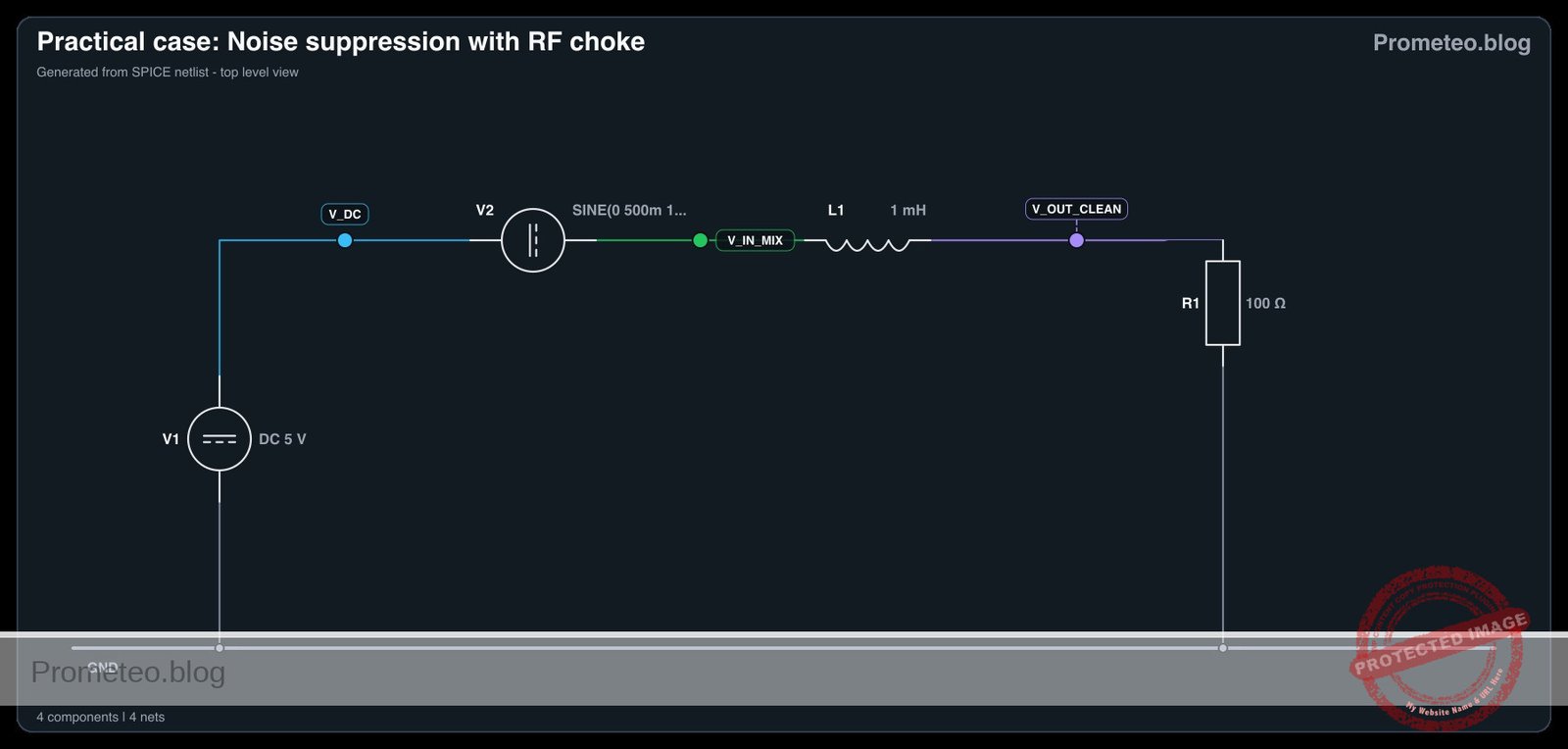
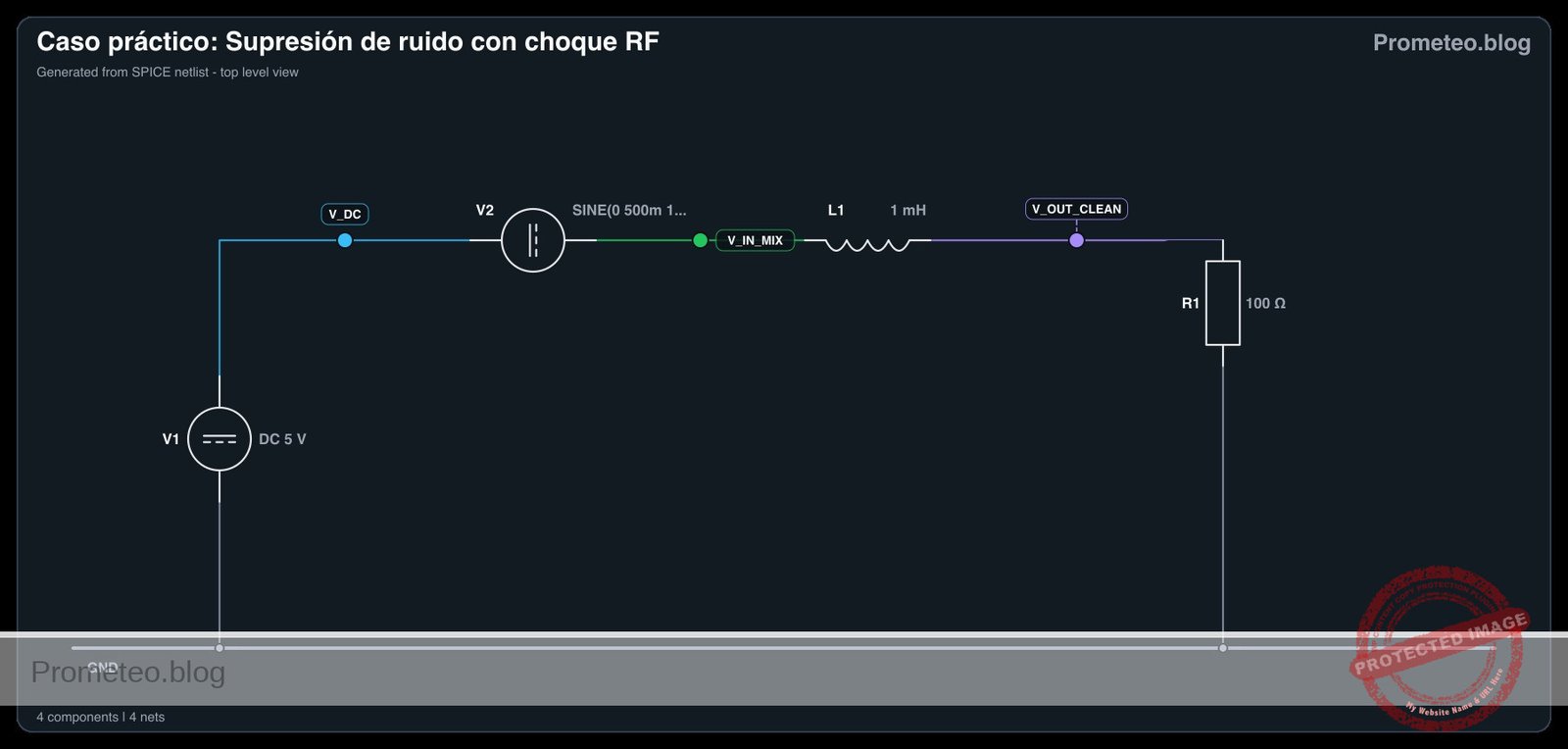
  • V1: connects between V_DC and 0
  • V2: connects between V_IN_MIX and V_DC
  • L1: connects between V_IN_MIX and V_OUT_CLEAN
  • R1: connects between V_OUT_CLEAN and 0

Conceptual block diagram
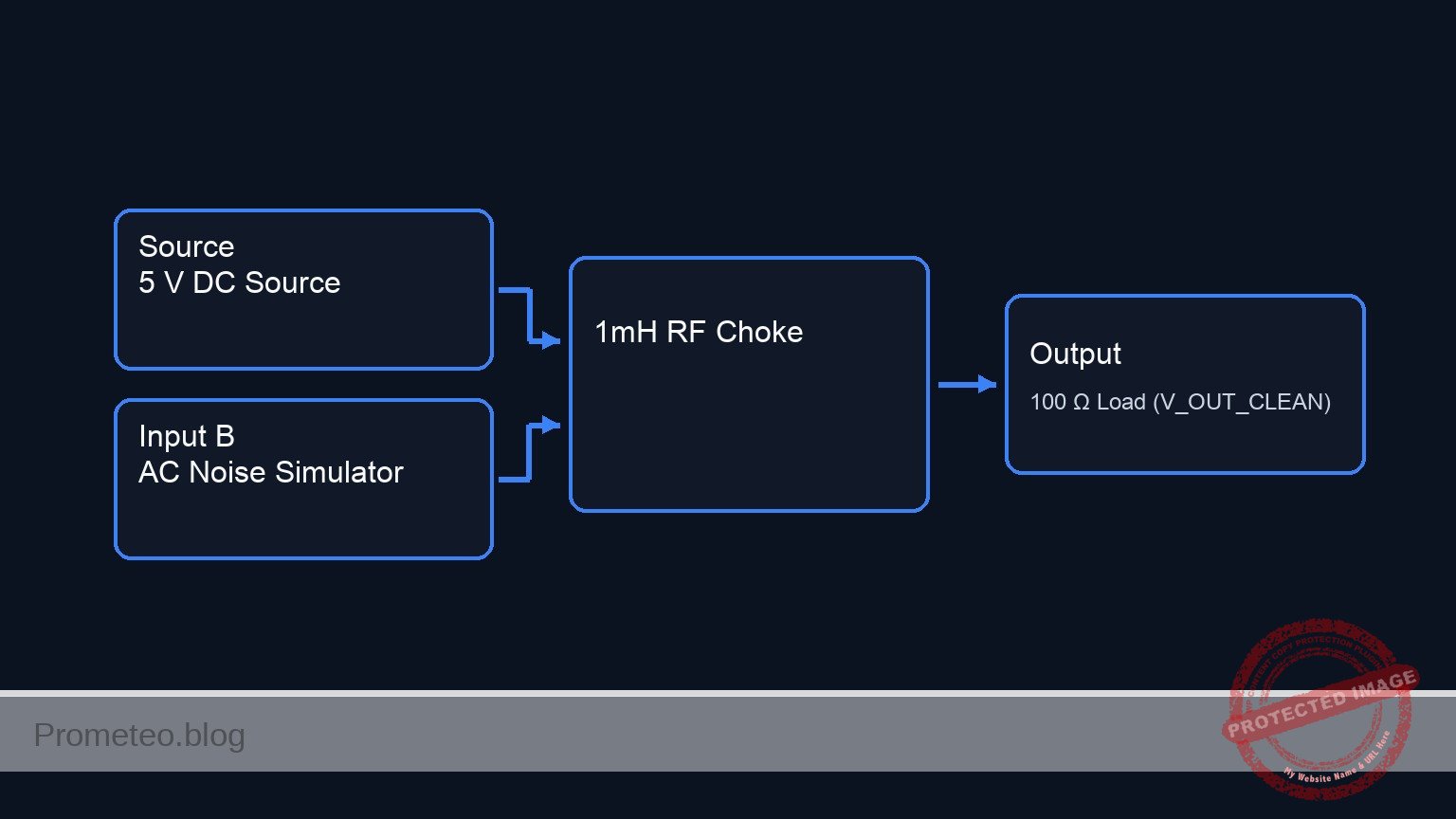
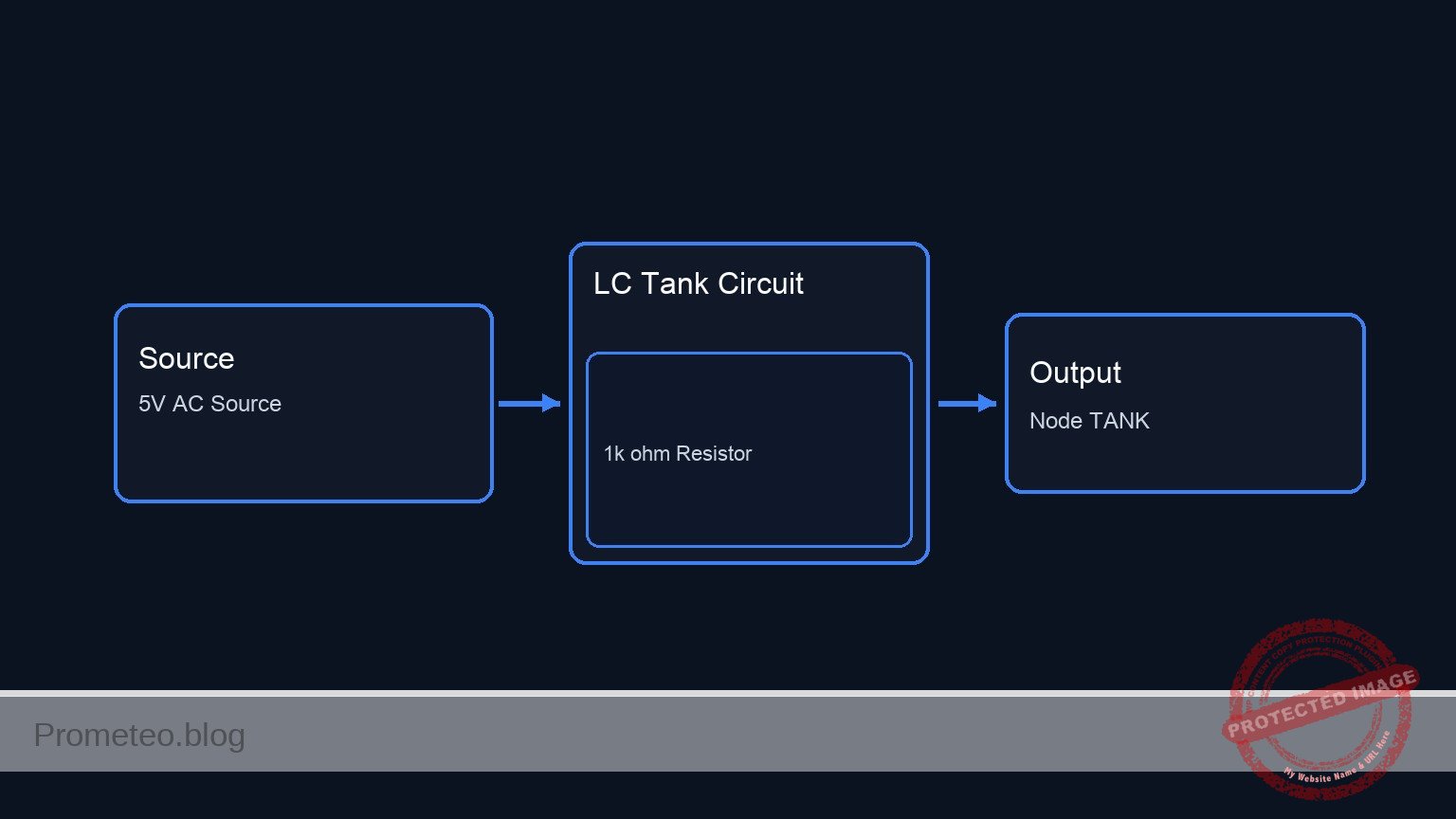
Conceptual block diagram — 1mH RF Choke
Quick read: inputs → main block → output (actuator or measurement). This summarizes the ASCII schematic below.

Schematic

[ V1: 5 V DC Source ] --(V_DC)--> [ V2: AC Noise Simulator ] --(V_IN_MIX)--> [ L1: 1mH RF Choke ] --(V_OUT_CLEAN)--> [ R1: 100 Ω Load ] --> GND
Electrical Schematic

Electrical diagram

Electrical diagram for case: Practical case: Noise suppression with RF choke
Generated from the validated SPICE netlist for this case.

🔒 This electrical diagram is premium. With the 7-day pass or the monthly membership you can unlock the complete didactic material and the print-ready PDF pack.🔓 See premium access plans

Measurements and tests

  1. Connect an oscilloscope probe to V_IN_MIX with the ground clip attached to node 0. Set the channel coupling to DC. You should observe a 5 V DC baseline with a 1 V peak-to-peak 100 kHz sine wave riding on top of it.
  2. Connect a second oscilloscope probe to V_OUT_CLEAN. Observe that the DC voltage remains at approximately 5 V, but the high-frequency 100 kHz ripple is drastically attenuated due to the high inductive reactance (XL = 2\pi fL) of the choke.
  3. Activate the FFT (Fast Fourier Transform) math function on the oscilloscope for the V_IN_MIX channel. Note the massive spike at 0 Hz (representing the 5 V DC component) and the distinct noise spike at 100 kHz.
  4. Apply the FFT function to the V_OUT_CLEAN channel. Compare the magnitude of the 100 kHz spike against the input measurement; it should be significantly reduced, successfully proving the inductor’s high-frequency blocking capabilities.

SPICE netlist and simulation

Reference SPICE Netlist (ngspice) — excerptFull SPICE netlist (ngspice)

* Noise suppression with RF choke
.width out=256

* Main DC power supply (5V)
V1 V_DC 0 DC 5

* High-frequency noise simulator (500mV peak, 100kHz sine wave superimposed on DC)
V2 V_IN_MIX V_DC SINE(0 500m 100k)

* RF choke to block high-frequency noise (1mH)
L1 V_IN_MIX V_OUT_CLEAN 1m

* Load simulation (100 ohms)
* ... (truncated in public view) ...

Copy this content into a .cir file and run with ngspice.

🔒 Part of this section is premium. With the 7-day pass or the monthly membership you can access the full content (materials, wiring, detailed build, validation, troubleshooting, variants and checklist) and download the complete print-ready PDF pack.

* Noise suppression with RF choke
.width out=256

* Main DC power supply (5V)
V1 V_DC 0 DC 5

* High-frequency noise simulator (500mV peak, 100kHz sine wave superimposed on DC)
V2 V_IN_MIX V_DC SINE(0 500m 100k)

* RF choke to block high-frequency noise (1mH)
L1 V_IN_MIX V_OUT_CLEAN 1m

* Load simulation (100 ohms)
R1 V_OUT_CLEAN 0 100

* Analysis directives
.op
* Simulate for 100us to capture 10 full cycles of the 100kHz noise
.tran 0.1u 100u
.print tran V(V_IN_MIX) V(V_OUT_CLEAN) V(V_DC) I(L1)

.end

Simulation Results (Transient Analysis)

Simulation Results (Transient Analysis)
Analysis: The simulation shows a 5V DC signal with a superimposed 500mV peak 100kHz sine wave at the input (V_IN_MIX ranges from 4.5V to 5.5V). At the output (V_OUT_CLEAN), the voltage ranges from 4.92V to 5.12V, indicating that the 1mH RF choke significantly attenuates the high-frequency noise while passing the DC component to the 100-ohm load.
Show raw data table (1008 rows)
Index   time            v(v_in_mix)     v(v_out_clean)  v(v_dc)         l1#branch
0	0.000000e+00	5.000000e+00	5.000000e+00	5.000000e+00	5.000000e-02
1	1.000000e-09	5.000314e+00	5.000000e+00	5.000000e+00	5.000000e-02
2	2.000000e-09	5.000628e+00	5.000000e+00	5.000000e+00	5.000000e-02
3	4.000000e-09	5.001257e+00	5.000000e+00	5.000000e+00	5.000000e-02
4	8.000000e-09	5.002513e+00	5.000001e+00	5.000000e+00	5.000001e-02
5	1.600000e-08	5.005026e+00	5.000004e+00	5.000000e+00	5.000004e-02
6	3.200000e-08	5.010052e+00	5.000016e+00	5.000000e+00	5.000016e-02
7	6.400000e-08	5.020101e+00	5.000064e+00	5.000000e+00	5.000064e-02
8	1.280000e-07	5.040169e+00	5.000256e+00	5.000000e+00	5.000256e-02
9	2.280000e-07	5.071384e+00	5.000808e+00	5.000000e+00	5.000808e-02
10	3.280000e-07	5.102316e+00	5.001665e+00	5.000000e+00	5.001665e-02
11	4.280000e-07	5.132845e+00	5.002818e+00	5.000000e+00	5.002818e-02
12	5.280000e-07	5.162850e+00	5.004261e+00	5.000000e+00	5.004261e-02
13	6.280000e-07	5.192212e+00	5.005985e+00	5.000000e+00	5.005985e-02
14	7.280000e-07	5.220816e+00	5.007980e+00	5.000000e+00	5.007980e-02
15	8.280000e-07	5.248548e+00	5.010236e+00	5.000000e+00	5.010236e-02
16	9.280000e-07	5.275299e+00	5.012741e+00	5.000000e+00	5.012741e-02
17	1.028000e-06	5.300963e+00	5.015481e+00	5.000000e+00	5.015481e-02
18	1.128000e-06	5.325440e+00	5.018443e+00	5.000000e+00	5.018443e-02
19	1.228000e-06	5.348633e+00	5.021613e+00	5.000000e+00	5.021613e-02
20	1.328000e-06	5.370449e+00	5.024976e+00	5.000000e+00	5.024976e-02
21	1.428000e-06	5.390804e+00	5.028515e+00	5.000000e+00	5.028515e-02
22	1.528000e-06	5.409616e+00	5.032213e+00	5.000000e+00	5.032213e-02
23	1.628000e-06	5.426812e+00	5.036054e+00	5.000000e+00	5.036054e-02
... (984 more rows) ...

Common mistakes and how to avoid them

  • Using an inductor with a low self-resonant frequency (SRF): All inductors have parasitic winding capacitance. If the noise frequency exceeds the inductor’s SRF, the component behaves like a capacitor and allows high-frequency noise to pass straight through. Always verify the SRF is well above your target noise frequency.
  • Neglecting the inductor’s DC resistance (DCR): Inductors are made of coiled wire which naturally possesses resistance. High load currents passing through an inductor with high DCR will cause an unacceptable DC voltage drop. Choose a choke with an appropriately low DCR for your load.
  • Core saturation due to high DC current: If the load draws more continuous current than the inductor’s saturation rating (Isat), the core’s magnetic flux saturates. This causes the inductance to drop sharply, destroying its filtering capability. Always check the saturation current rating.

Troubleshooting

  • Symptom: High-frequency noise is still heavily present at V_OUT_CLEAN.
  • Cause: The inductor value is too low to provide significant reactance at the simulated noise frequency, or its SRF has been exceeded.
  • Fix: Increase the inductance value (e.g., scale from 10 µH to 1 mH) or verify the frequency limits of the specific choke being used.
  • Symptom: Significant DC voltage drop at V_OUT_CLEAN under load (e.g., reading 4 V instead of 5 V).
  • Cause: The inductor’s internal DC resistance (DCR) is too high relative to the load resistor R1.
  • Fix: Replace the inductor with a physically larger one that uses thicker wire, which lowers the DCR, or increase the load resistance if it’s drawing more current than intended.
  • Symptom: The choke gets excessively hot during operation.
  • Cause: The DC current drawn by the load exceeds the continuous thermal current rating (Irms) of the inductor.
  • Fix: Select a higher-rated power inductor capable of safely handling the steady-state load current.

Possible improvements and extensions

  • Form an LC Low-Pass Filter: Add a decoupling capacitor (e.g., 100 nF or 1 µF) parallel to the load (between V_OUT_CLEAN and 0). This creates a second-order filter, providing a much steeper roll-off and vastly superior noise attenuation compared to the simple LR configuration.
  • Implement a Pi-Filter: Use a Capacitor-Inductor-Capacitor (C-L-C) arrangement to provide bidirectional noise suppression. This not only cleans the power entering the load but also prevents any switching noise generated by the load from polluting the main DC supply line.

More Practical Cases on Prometeo.blog

Find this product and/or books on this topic on Amazon

Go to Amazon

As an Amazon Associate, I earn from qualifying purchases. If you buy through this link, you help keep this project running.

Quick Quiz

Question 1: What is the primary purpose of the inductor in the described circuit?


Question 2: What type of filter is constructed in this experiment?


Question 3: How does the inductor react to the DC portion of the signal?


Question 4: Which of the following is a real-world application of this circuit concept mentioned in the text?


Question 5: What will the mixed input signal (V_IN_MIX) display according to the expected outcomes?


Question 6: Based on the expected outcomes, what is the effect of the circuit on the output voltage (V_OUT_CLEAN)?


Question 7: What is the stated difficulty level of demonstrating the high impedance of the inductor in this context?


Question 8: What specific type of interference can this circuit filter out from long power supply lines?


Question 9: How does the circuit help different functional blocks that share a common power rail on a PCB?


Question 10: What component is specifically used as an RF choke in this low-pass filter circuit?


Carlos Núñez Zorrilla
Electronics & Computer Engineer

Telecommunications Electronics Engineer and Computer Engineer (official degrees in Spain).
Follow me:


Caso práctico: Supresión de ruido con choque de RF

Esquemático — Caso práctico: Supresión de ruido con choque de RF

Nivel: Medio – Demostrar la alta impedancia del inductor a altas frecuencias para bloquear el ruido en las líneas de alimentación.

Objetivo y caso de uso

Construirá un filtro paso bajo LR utilizando un choque de RF para aislar una línea de alimentación de CC del ruido de CA de alta frecuencia. Al superponer una señal de CA sobre una fuente de tensión de CC, observará cómo la reactancia del inductor, dependiente de la frecuencia, permite el paso de la CC mientras atenúa fuertemente el ruido de alta frecuencia antes de que llegue a la carga.

Este concepto de circuito es muy útil en el mundo real para:
* Evitar que el ruido de conmutación de alta frecuencia entre en circuitos de sensores analógicos sensibles.
* Filtrar la interferencia de radiofrecuencia (RFI) de líneas largas de suministro de energía.
* Aislar diferentes bloques funcionales que comparten un raíl de alimentación común en un PCB.
* Proteger la electrónica de comunicación y audio del automóvil contra el zumbido del alternador.

Resultado esperado:
* La señal de entrada mixta (V_IN_MIX) mostrará un offset de CC estable combinado con un rizado significativo de alta frecuencia.
* La tensión de salida (V_OUT_CLEAN) en la carga mostrará un nivel de CC estable con el ruido de CA enormemente reducido.
* Un análisis FFT (Transformada Rápida de Fourier) de la entrada revelará una gran componente a 0 Hz (CC) y un pico prominente de alta frecuencia.
* Un análisis FFT de la salida mostrará el pico de alta frecuencia casi completamente suprimido, confirmando la acción de bloqueo del choque.

Público objetivo: Estudiantes de electrónica de nivel intermedio que aprenden sobre componentes reactivos y superposición de CA/CC.

Materiales

  • V1: fuente de CC de 5 V, función: fuente de alimentación principal de CC
  • V2: fuente de CA de onda senoidal de 500 mV de pico a 100 kHz, función: simulador de ruido de alta frecuencia
  • L1: inductor de 1 mH, función: choque de RF para bloquear el ruido de alta frecuencia
  • R1: resistencia de 100 Ω, función: simulación de carga

Guía de conexionado

  • V1: se conecta entre V_DC y 0
  • V2: se conecta entre V_IN_MIX y V_DC
  • L1: se conecta entre V_IN_MIX y V_OUT_CLEAN
  • R1: se conecta entre V_OUT_CLEAN y 0

Diagrama de bloques conceptual

Conceptual block diagram — 1mH RF Choke
Lectura rápida: entradas → bloque principal → salida (actuador o medida). Resume el esquemático ASCII de la siguiente sección.

Esquemático

[ V1: 5 V DC Source ] --(V_DC)--> [ V2: AC Noise Simulator ] --(V_IN_MIX)--> [ L1: 1mH RF Choke ] --(V_OUT_CLEAN)--> [ R1: 100 Ω Load ] --> GND
Esquema Eléctrico

Diagrama eléctrico

Diagrama electrico del caso: Caso práctico: Supresión de ruido con choque de RF
Generado desde la netlist SPICE validada del caso.

🔒 Este diagrama eléctrico es premium. Con el pase de 7 días o la suscripción mensual podrás desbloquear el material didáctico completo y el pack PDF listo para imprimir.🔓 Ver planes de acceso premium

Mediciones y pruebas

  1. Conecte una sonda de osciloscopio a V_IN_MIX con la pinza de tierra conectada al nodo 0. Configure el acoplamiento del canal en CC. Debería observar una línea base de 5 V de CC con una onda senoidal de 100 kHz y 1 V pico a pico montada sobre ella.
  2. Conecte una segunda sonda de osciloscopio a V_OUT_CLEAN. Observe que la tensión de CC se mantiene en aproximadamente 5 V, pero el rizado de alta frecuencia de 100 kHz se atenúa drásticamente debido a la alta reactancia inductiva (XL = 2\pi fL) del choque.
  3. Active la función matemática FFT (Transformada Rápida de Fourier) en el osciloscopio para el canal V_IN_MIX. Note el pico masivo a 0 Hz (que representa la componente de CC de 5 V) y el pico de ruido distintivo a 100 kHz.
  4. Aplique la función FFT al canal V_OUT_CLEAN. Compare la magnitud del pico de 100 kHz con la medición de entrada; debería estar significativamente reducido, demostrando con éxito las capacidades de bloqueo de alta frecuencia del inductor.

Netlist SPICE y simulación

Netlist SPICE de referencia (ngspice) — extractoNetlist SPICE completo (ngspice)

* Noise suppression with RF choke
.width out=256

* Main DC power supply (5V)
V1 V_DC 0 DC 5

* High-frequency noise simulator (500mV peak, 100kHz sine wave superimposed on DC)
V2 V_IN_MIX V_DC SINE(0 500m 100k)

* RF choke to block high-frequency noise (1mH)
L1 V_IN_MIX V_OUT_CLEAN 1m

* Load simulation (100 ohms)
* ... (truncated in public view) ...

Copia este contenido en un archivo .cir y ejecútalo con ngspice.

🔒 Parte del contenido de esta sección es premium. Con el pase de 7 días o la suscripción mensual tendrás acceso al contenido completo (materiales, conexionado, compilación detallada, validación paso a paso, troubleshooting, mejoras/variantes y checklist) y podrás descargar el pack PDF listo para imprimir.

* Noise suppression with RF choke
.width out=256

* Main DC power supply (5V)
V1 V_DC 0 DC 5

* High-frequency noise simulator (500mV peak, 100kHz sine wave superimposed on DC)
V2 V_IN_MIX V_DC SINE(0 500m 100k)

* RF choke to block high-frequency noise (1mH)
L1 V_IN_MIX V_OUT_CLEAN 1m

* Load simulation (100 ohms)
R1 V_OUT_CLEAN 0 100

* Analysis directives
.op
* Simulate for 100us to capture 10 full cycles of the 100kHz noise
.tran 0.1u 100u
.print tran V(V_IN_MIX) V(V_OUT_CLEAN) V(V_DC) I(L1)

.end

Resultados de Simulación (Transitorio)

Resultados de Simulación (Transitorio)
Análisis: The simulation shows a 5V DC signal with a superimposed 500mV peak 100kHz sine wave at the input (V_IN_MIX ranges from 4.5V to 5.5V). At the output (V_OUT_CLEAN), the voltage ranges from 4.92V to 5.12V, indicating that the 1mH RF choke significantly attenuates the high-frequency noise while passing the DC component to the 100-ohm load.
Show raw data table (1008 rows)
Index   time            v(v_in_mix)     v(v_out_clean)  v(v_dc)         l1#branch
0	0.000000e+00	5.000000e+00	5.000000e+00	5.000000e+00	5.000000e-02
1	1.000000e-09	5.000314e+00	5.000000e+00	5.000000e+00	5.000000e-02
2	2.000000e-09	5.000628e+00	5.000000e+00	5.000000e+00	5.000000e-02
3	4.000000e-09	5.001257e+00	5.000000e+00	5.000000e+00	5.000000e-02
4	8.000000e-09	5.002513e+00	5.000001e+00	5.000000e+00	5.000001e-02
5	1.600000e-08	5.005026e+00	5.000004e+00	5.000000e+00	5.000004e-02
6	3.200000e-08	5.010052e+00	5.000016e+00	5.000000e+00	5.000016e-02
7	6.400000e-08	5.020101e+00	5.000064e+00	5.000000e+00	5.000064e-02
8	1.280000e-07	5.040169e+00	5.000256e+00	5.000000e+00	5.000256e-02
9	2.280000e-07	5.071384e+00	5.000808e+00	5.000000e+00	5.000808e-02
10	3.280000e-07	5.102316e+00	5.001665e+00	5.000000e+00	5.001665e-02
11	4.280000e-07	5.132845e+00	5.002818e+00	5.000000e+00	5.002818e-02
12	5.280000e-07	5.162850e+00	5.004261e+00	5.000000e+00	5.004261e-02
13	6.280000e-07	5.192212e+00	5.005985e+00	5.000000e+00	5.005985e-02
14	7.280000e-07	5.220816e+00	5.007980e+00	5.000000e+00	5.007980e-02
15	8.280000e-07	5.248548e+00	5.010236e+00	5.000000e+00	5.010236e-02
16	9.280000e-07	5.275299e+00	5.012741e+00	5.000000e+00	5.012741e-02
17	1.028000e-06	5.300963e+00	5.015481e+00	5.000000e+00	5.015481e-02
18	1.128000e-06	5.325440e+00	5.018443e+00	5.000000e+00	5.018443e-02
19	1.228000e-06	5.348633e+00	5.021613e+00	5.000000e+00	5.021613e-02
20	1.328000e-06	5.370449e+00	5.024976e+00	5.000000e+00	5.024976e-02
21	1.428000e-06	5.390804e+00	5.028515e+00	5.000000e+00	5.028515e-02
22	1.528000e-06	5.409616e+00	5.032213e+00	5.000000e+00	5.032213e-02
23	1.628000e-06	5.426812e+00	5.036054e+00	5.000000e+00	5.036054e-02
... (984 more rows) ...

Errores comunes y cómo evitarlos

  • Usar un inductor con una baja frecuencia de autorresonancia (SRF): Todos los inductores tienen capacitancia parásita de devanado. Si la frecuencia del ruido supera la SRF del inductor, el componente se comporta como un condensador y permite que el ruido de alta frecuencia pase directamente. Verifique siempre que la SRF esté muy por encima de la frecuencia de ruido objetivo.
  • Ignorar la resistencia de CC (DCR) del inductor: Los inductores están hechos de alambre enrollado que naturalmente posee resistencia. Altas corrientes de carga pasando por un inductor con alta DCR causarán una caída de tensión de CC inaceptable. Elija un choque con una DCR adecuadamente baja para su carga.
  • Saturación del núcleo debido a alta corriente de CC: Si la carga consume más corriente continua que la especificación de saturación del inductor (Isat), el flujo magnético del núcleo se satura. Esto hace que la inductancia caiga drásticamente, destruyendo su capacidad de filtrado. Compruebe siempre la especificación de corriente de saturación.

Solución de problemas

  • Síntoma: El ruido de alta frecuencia sigue estando muy presente en V_OUT_CLEAN.
  • Causa: El valor del inductor es demasiado bajo para proporcionar una reactancia significativa a la frecuencia del ruido simulado, o se ha superado su SRF.
  • Solución: Aumente el valor de la inductancia (por ejemplo, escale de 10 µH a 1 mH) o verifique los límites de frecuencia del choque específico que se está utilizando.
  • Síntoma: Caída significativa de tensión de CC en V_OUT_CLEAN bajo carga (por ejemplo, leyendo 4 V en lugar de 5 V).
  • Causa: La resistencia interna de CC (DCR) del inductor es demasiado alta en relación con la resistencia de carga R1.
  • Solución: Reemplace el inductor por uno físicamente más grande que utilice un alambre más grueso, lo que reduce la DCR, o aumente la resistencia de carga si está consumiendo más corriente de la prevista.
  • Síntoma: El choque se calienta en exceso durante el funcionamiento.
  • Causa: La corriente de CC consumida por la carga excede la especificación de corriente térmica continua (Irms) del inductor.
  • Solución: Seleccione un inductor de potencia de mayor especificación capaz de manejar de forma segura la corriente de carga en estado estable.

Posibles mejoras y extensiones

  • Formar un filtro paso bajo LC: Añada un condensador de desacoplo (por ejemplo, 100 nF o 1 µF) en paralelo a la carga (entre V_OUT_CLEAN y 0). Esto crea un filtro de segundo orden, proporcionando una caída mucho más pronunciada y una atenuación de ruido inmensamente superior en comparación con la configuración LR simple.
  • Implementar un filtro Pi: Utilice una disposición Condensador-Inductor-Condensador (C-L-C) para proporcionar una supresión de ruido bidireccional. Esto no solo limpia la energía que entra a la carga, sino que también evita que cualquier ruido de conmutación generado por la carga contamine la línea principal de suministro de CC.

Más Casos Prácticos en Prometeo.blog

Encuentra este producto y/o libros sobre este tema en Amazon

Ir a Amazon

Como afiliado de Amazon, gano con las compras que cumplan los requisitos. Si compras a través de este enlace, ayudas a mantener este proyecto.

Quiz rápido

Pregunta 1: ¿Cuál es el objetivo principal del circuito descrito en el artículo?


Pregunta 2: ¿Qué componente se utiliza específicamente para bloquear el ruido de alta frecuencia en este circuito?


Pregunta 3: ¿Cómo se comporta la reactancia del inductor frente a las señales de alta frecuencia?


Pregunta 4: ¿Qué tipo de señal permite pasar el inductor hacia la carga con mayor facilidad?


Pregunta 5: Según el texto, ¿cuál es una aplicación real de este concepto de circuito?


Pregunta 6: ¿Qué se espera observar en la señal de entrada mixta (V_IN_MIX)?


Pregunta 7: ¿Qué función cumple el filtro paso bajo LR en una placa de circuito impreso (PCB)?


Pregunta 8: ¿De qué depende la reactancia del inductor en este circuito?


Pregunta 9: ¿Qué problema soluciona este circuito en la electrónica de comunicación de un automóvil?


Pregunta 10: ¿Qué se espera que ocurra con la tensión de salida (V_OUT_CLEAN) en comparación con la entrada?


Carlos Núñez Zorrilla
Electronics & Computer Engineer

Ingeniero Superior en Electrónica de Telecomunicaciones e Ingeniero en Informática (titulaciones oficiales en España).

Sígueme:


Caso práctico: Resonancia en circuito tanque LC

Esquemático — Caso práctico: Resonancia en circuito tanque LC

Nivel: Medio | Analizar el intercambio de energía y determinar la frecuencia de resonancia de un tanque LC alimentado por CA.

Objetivo y caso de uso

En este caso práctico, construirás un circuito tanque LC en paralelo alimentado por una fuente de onda senoidal de CA a través de una resistencia en serie. Al realizar un barrido de la frecuencia de entrada, observarás el punto exacto donde las reactancias inductiva y capacitiva se anulan, maximizando la impedancia del circuito.

Comprender la resonancia LC es esencial en la electrónica moderna porque estos circuitos son los bloques de construcción fundamentales de la selección de frecuencia. Las aplicaciones en el mundo real incluyen:
* Sintonización de radiofrecuencia (RF): Seleccionar la frecuencia de una estación específica mientras se rechazan otras.
* Filtrado de audio y señales: Crear filtros pasa banda o rechaza banda (notch) para eliminar el ruido.
* Transferencia de energía inalámbrica: Maximizar la eficiencia del acoplamiento inductivo entre las bobinas transmisora y receptora.
* Circuitos osciladores: Generar señales de reloj estables para microcontroladores y transceptores.

Resultado esperado:
* Calcularás la frecuencia de resonancia teórica basándote en los valores de $L$ y $C$ elegidos.
* La corriente total extraída de la fuente (Itotal) caerá a su valor mínimo en la resonancia.
* El voltaje a través del tanque LC (VLC) alcanzará su pico en la frecuencia de resonancia.
* Observarás cómo la energía oscila continuamente de un lado a otro entre el campo eléctrico del condensador y el campo magnético del inductor.

Público objetivo: Estudiantes de electrónica de nivel intermedio que están en transición de los conceptos básicos de CC a los circuitos reactivos de CA.

Materiales

  • V1: Fuente de voltaje de CA de 5 V pico a pico, función: generador de onda senoidal para barrido de frecuencia
  • R1: Resistencia de 1 kΩ, función: impedancia de la fuente para permitir variaciones de voltaje a través del tanque
  • L1: Inductor de 10 mH, función: almacenamiento de energía magnética
  • C1: Condensador cerámico o de película de 100 nF, función: almacenamiento de energía eléctrica

Guía de conexionado

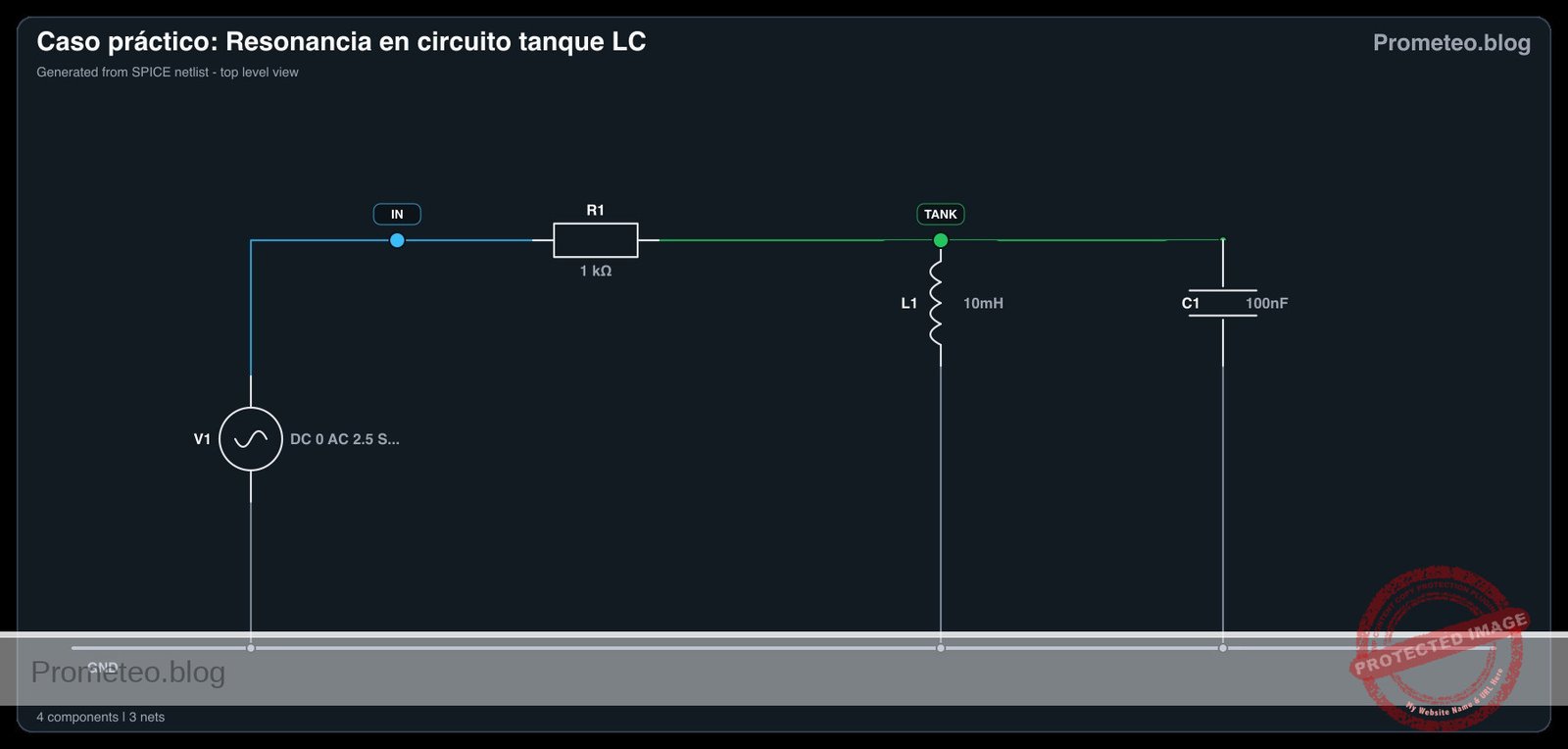
  • V1: Conecta el terminal positivo al nodo IN y el terminal negativo al nodo 0 (GND).
  • R1: Conecta un pin al nodo IN y el otro pin al nodo TANK.
  • L1: Conecta un pin al nodo TANK y el otro pin al nodo 0 (GND).
  • C1: Conecta un pin al nodo TANK y el otro pin al nodo 0 (GND).

Diagrama de bloques conceptual

Conceptual block diagram — LC Tank Circuit
Lectura rápida: entradas → bloque principal → salida (actuador o medida). Resume el esquemático ASCII de la siguiente sección.

Esquemático

[ V1: 5 V AC ] --(IN)--> [ R1: 1k ohm ] --(Node TANK)--+--> [ L1: 10mH ] --> GND
                                                      |
                                                      +--> [ C1: 100nF ] --> GND
Esquema Eléctrico

Diagrama eléctrico

Diagrama electrico del caso: Caso práctico: Resonancia en circuito tanque LC
Generado desde la netlist SPICE validada del caso.

🔒 Este diagrama eléctrico es premium. Con el pase de 7 días o la suscripción mensual podrás desbloquear el material didáctico completo y el pack PDF listo para imprimir.🔓 Ver planes de acceso premium

Mediciones y pruebas

  1. Calcular la frecuencia de resonancia teórica (fr):
    Utiliza la fórmula fr = (1 / 2\pi\sqrtLC). Con L = 10 mH y C = 100 nF, la frecuencia de resonancia esperada es aproximadamente 5032 Hz.
  2. Configurar el barrido de frecuencia:
    Configura V1 para emitir una onda senoidal de 5 V pico a pico. Comienza con una frecuencia de 1 kHz y auméntala gradualmente hasta 10 kHz.
  3. Medir VLC (Voltaje del tanque):
    Monitorea la amplitud del voltaje en el nodo TANK con respecto al nodo 0 (GND) usando un osciloscopio o un voltímetro de CA. A medida que te acercas a 5 kHz, la amplitud del voltaje aumentará de manera constante, alcanzando un máximo pronunciado exactamente en la resonancia, y luego caerá a medida que la frecuencia siga aumentando.
  4. Medir Itotal (Corriente de la fuente):
    Mide la corriente que fluye a través de R1 (esto se puede hacer observando la diferencia de voltaje entre IN y TANK y aplicando la ley de Ohm: Itotal = ((VIN – VTANK) / R1)). Ten en cuenta que en resonancia, el tanque LC en paralelo presenta la máxima impedancia, lo que significa que Itotal caerá a su mínimo.
  5. Calcular el factor Q del circuito:
    Identifica las frecuencias de -3dB (mitad de potencia) por encima y por debajo del pico de resonancia para encontrar el ancho de banda ($BW$). El factor de calidad es Q = (fr / BW).

Netlist SPICE y simulación

Netlist SPICE de referencia (ngspice) — extractoNetlist SPICE completo (ngspice)

* Practical case: Resonance in LC tank circuit
.width out=256

* 5V peak-to-peak implies an amplitude of 2.5V. 
* The resonant frequency of 10mH and 100nF is approximately 5033 Hz.
* We configure V1 with both a transient sine wave at resonance and an AC magnitude for optional AC analysis.
V1 IN 0 DC 0 AC 2.5 SIN(0 2.5 5033)

* Source impedance
R1 IN TANK 1k

* LC Tank circuit components
L1 TANK 0 10mH
* ... (truncated in public view) ...

Copia este contenido en un archivo .cir y ejecútalo con ngspice.

🔒 Parte del contenido de esta sección es premium. Con el pase de 7 días o la suscripción mensual tendrás acceso al contenido completo (materiales, conexionado, compilación detallada, validación paso a paso, troubleshooting, mejoras/variantes y checklist) y podrás descargar el pack PDF listo para imprimir.

* Practical case: Resonance in LC tank circuit
.width out=256

* 5V peak-to-peak implies an amplitude of 2.5V. 
* The resonant frequency of 10mH and 100nF is approximately 5033 Hz.
* We configure V1 with both a transient sine wave at resonance and an AC magnitude for optional AC analysis.
V1 IN 0 DC 0 AC 2.5 SIN(0 2.5 5033)

* Source impedance
R1 IN TANK 1k

* LC Tank circuit components
L1 TANK 0 10mH
C1 TANK 0 100nF

* Operating point and Transient analysis
.op
.tran 1u 2m

* Print directives for logging the input and output (resonance) nodes
.print tran V(IN) V(TANK) I(L1)

.end

Resultados de Simulación (Transitorio)

Resultados de Simulación (Transitorio)
Análisis: The transient simulation shows the input voltage V(IN) oscillating as a sine wave with a 2.5V amplitude (5V peak-to-peak). The voltage at the tank node V(TANK) closely follows V(IN) with nearly the same amplitude, and the inductor current oscillates, confirming the resonant behavior of the LC tank circuit at the specified frequency.
Show raw data table (2015 rows)
Index   time            v(in)           v(tank)         l1#branch
0	0.000000e+00	0.000000e+00	0.000000e+00	0.000000e+00
1	1.000000e-08	7.905818e-04	7.905026e-08	7.905026e-14
2	1.084006e-08	8.569951e-04	8.624878e-08	8.629565e-14
3	1.252017e-08	9.898217e-04	1.017615e-07	1.020896e-13
4	1.588039e-08	1.255475e-03	1.394809e-07	1.426210e-13
5	2.260084e-08	1.786781e-03	2.416948e-07	2.707046e-13
6	3.604174e-08	2.849394e-03	5.532131e-07	8.049184e-13
7	5.708432e-08	4.512980e-03	1.327631e-06	2.783809e-12
8	8.603868e-08	6.802053e-03	2.965106e-06	8.998482e-12
9	1.305078e-07	1.031768e-02	6.769425e-06	3.064276e-11
10	1.955195e-07	1.545732e-02	1.514065e-05	1.018634e-10
11	2.946313e-07	2.329267e-02	3.431881e-05	3.469641e-10
12	4.417944e-07	3.492633e-02	7.707420e-05	1.166612e-09
13	6.644501e-07	5.252635e-02	1.741480e-04	3.963414e-09
14	9.972436e-07	7.882720e-02	3.917455e-04	1.337970e-08
15	1.499113e-06	1.184727e-01	8.834917e-04	4.537981e-08
16	2.252017e-06	1.778899e-01	1.987598e-03	1.534626e-07
17	3.252017e-06	2.566456e-01	4.126641e-03	4.591745e-07
18	4.252017e-06	3.351447e-01	7.022468e-03	1.016630e-06
19	5.252017e-06	4.133086e-01	1.066173e-02	1.900840e-06
20	6.252017e-06	4.910592e-01	1.502968e-02	3.185410e-06
21	7.252017e-06	5.683189e-01	2.011023e-02	4.942405e-06
22	8.252017e-06	6.450102e-01	2.588597e-02	7.242215e-06
23	9.252017e-06	7.210565e-01	3.233820e-02	1.015342e-05
... (1991 more rows) ...

Errores comunes y cómo evitarlos

  • Usar un condensador polarizado en un circuito de CA: Los condensadores electrolíticos generalmente están polarizados y pueden fallar o explotar si se someten a voltajes de CA inversos. Usa siempre condensadores no polarizados (como cerámicos o de película) para un tanque LC.
  • Ignorar la resistencia equivalente en serie (ESR) del inductor: Los inductores reales consisten en largas bobinas de alambre, lo que añade resistencia parásita de CC al tanque. Si el factor Q medido es mucho menor de lo esperado (resultando en un pico más ancho y plano), la ESR del inductor suele ser la culpable.
  • Confundir la frecuencia angular (\omega) con la frecuencia estándar ($f$): Recuerda que \omega = (1 / \sqrtLC) produce resultados en radianes por segundo. Debes dividir entre 2\pi para obtener la frecuencia en Hertz.

Solución de problemas

  • Síntoma: La frecuencia de resonancia medida es significativamente mayor o menor que los 5032 Hz calculados.
    • Causa: Tolerancias de los componentes. Los condensadores cerámicos estándar pueden tener una tolerancia del ±20%, y los inductores a menudo tienen un ±10%.
    • Solución: Mide los valores exactos de L1 y C1 usando un medidor LCR y vuelve a calcular la frecuencia esperada.
  • Síntoma: VLC no muestra un pico notable durante el barrido; el voltaje se mantiene relativamente plano.
    • Causa: El rango de barrido de frecuencia elegido no cubre el punto de resonancia, o R1 es demasiado pequeña, cortocircuitando efectivamente el tanque a la fuente de voltaje rígida.
    • Solución: Revisa los cálculos matemáticos para tus valores específicos de $L$ y $C$ para asegurar que el rango de barrido abarque fr. Asegúrate de que R1 tenga el tamaño adecuado (1 kΩ es un buen punto de partida).
  • Síntoma: Se observa distorsión o recorte de la señal en el nodo TANK.
    • Causa: La fuente de CA podría estar sobreexcitando el circuito, o se está produciendo saturación del núcleo en el inductor (si se usa un núcleo de ferrita muy pequeño con corrientes altas).
    • Solución: Reduce la amplitud de V1 de 5 V a 1 V pico a pico y comprueba si la onda senoidal vuelve a ser limpia.

Posibles mejoras y extensiones

  • Variar la resistencia de amortiguamiento: Cambia R1 por diferentes valores (ej. 470 Ω, 10 kΩ) o añade una resistencia directamente en paralelo con el tanque LC. Observa y registra cómo esto afecta la agudeza del pico de resonancia (el factor Q).
  • Construir un oscilador activo: Retira la fuente de CA y conecta el tanque LC a un transistor o un amplificador operacional con retroalimentación positiva (como una configuración Colpitts o Hartley) para crear un circuito independiente que genere su propia onda senoidal continua en la frecuencia de resonancia.

Más Casos Prácticos en Prometeo.blog

Encuentra este producto y/o libros sobre este tema en Amazon

Ir a Amazon

Como afiliado de Amazon, gano con las compras que cumplan los requisitos. Si compras a través de este enlace, ayudas a mantener este proyecto.

Quiz rápido

Pregunta 1: ¿Cuál es el objetivo principal del caso práctico descrito en el texto?


Pregunta 2: ¿Qué ocurre exactamente en el punto de frecuencia de resonancia en el circuito tanque LC descrito?


Pregunta 3: ¿Cómo se alimenta el circuito tanque LC en este caso práctico?


Pregunta 4: ¿Por qué es esencial comprender la resonancia LC en la electrónica moderna?


Pregunta 5: En la sintonización de radiofrecuencia (RF), ¿para qué se utiliza un circuito LC?


Pregunta 6: ¿Qué tipo de filtros se pueden crear con circuitos LC para eliminar el ruido en señales de audio?


Pregunta 7: ¿Cuál es el papel de la resonancia LC en la transferencia de energía inalámbrica?


Pregunta 8: ¿Para qué se utilizan los circuitos LC en los circuitos osciladores?


Pregunta 9: ¿Qué método se menciona en el texto para encontrar la frecuencia de resonancia del circuito?


Pregunta 10: A nivel físico, ¿qué fenómeno principal se analiza en un tanque LC alimentado por CA?


Carlos Núñez Zorrilla
Electronics & Computer Engineer

Ingeniero Superior en Electrónica de Telecomunicaciones e Ingeniero en Informática (titulaciones oficiales en España).

Sígueme:


Practical case: Resonance in LC tank circuit

Level: Medium | Analyze the energy exchange and determine the resonant frequency of an AC-driven LC tank.

Objective and use case

In this practical case, you will build a parallel LC tank circuit driven by an AC sine wave source through a series resistor. By sweeping the input frequency, you will observe the precise point where inductive and capacitive reactances cancel out, maximizing the circuit’s impedance.

Understanding LC resonance is essential in modern electronics because these circuits are the fundamental building blocks of frequency selection. Real-world applications include:
* Radio frequency (RF) tuning: Selecting a specific station’s frequency while rejecting others.
* Audio and signal filtering: Creating band-pass or band-stop (notch) filters to eliminate noise.
* Wireless power transfer: Maximizing the efficiency of inductive coupling between transmitter and receiver coils.
* Oscillator circuits: Generating stable clock signals for microcontrollers and transceivers.

Expected outcome:
* You will calculate the theoretical resonant frequency based on the chosen $L$ and $C$ values.
* The total current drawn from the source (Itotal) will drop to its minimum value at resonance.
* The voltage across the LC tank (VLC) will peak at the resonant frequency.
* You will observe how energy continuously sloshes back and forth between the capacitor’s electric field and the inductor’s magnetic field.

Target audience: Intermediate electronics students transitioning from DC basics to AC reactive circuits.

Materials

  • V1: 5 V peak-to-peak AC voltage source, function: sine wave generator for frequency sweep
  • R1: 1 kΩ resistor, function: source impedance to allow voltage variations across the tank
  • L1: 10 mH inductor, function: magnetic energy storage
  • C1: 100 nF ceramic or film capacitor, function: electric energy storage

Wiring guide

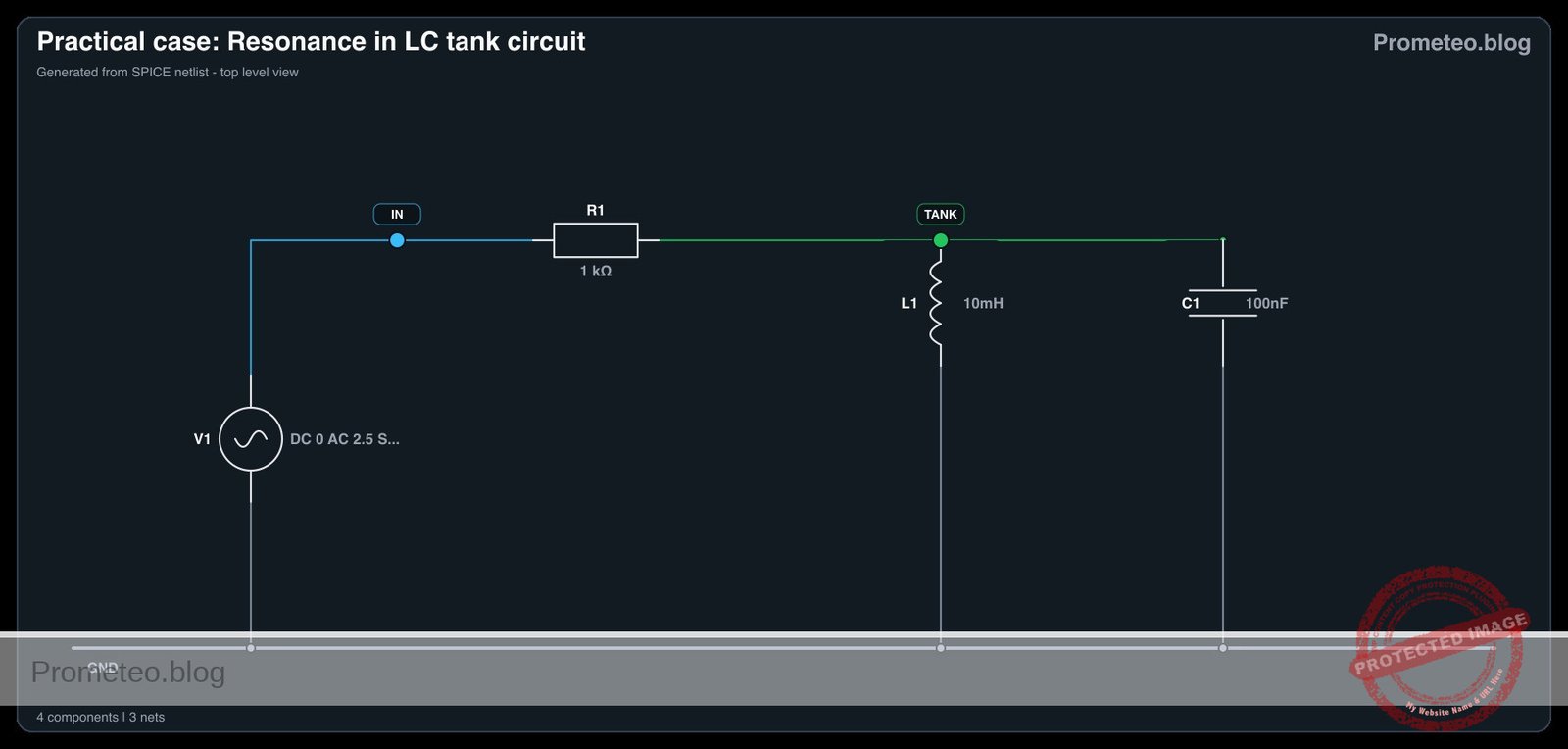
  • V1: Connect the positive terminal to node IN and the negative terminal to node 0 (GND).
  • R1: Connect one pin to node IN and the other pin to node TANK.
  • L1: Connect one pin to node TANK and the other pin to node 0 (GND).
  • C1: Connect one pin to node TANK and the other pin to node 0 (GND).

Conceptual block diagram

Conceptual block diagram — LC Tank Circuit
Quick read: inputs → main block → output (actuator or measurement). This summarizes the ASCII schematic below.

Schematic

[ V1: 5 V AC ] --(IN)--> [ R1: 1k ohm ] --(Node TANK)--+--> [ L1: 10mH ] --> GND
                                                      |
                                                      +--> [ C1: 100nF ] --> GND
Electrical Schematic

Electrical diagram

Electrical diagram for case: Practical case: Resonance in LC tank circuit
Generated from the validated SPICE netlist for this case.

🔒 This electrical diagram is premium. With the 7-day pass or the monthly membership you can unlock the complete didactic material and the print-ready PDF pack.🔓 See premium access plans

Measurements and tests

  1. Calculate the theoretical resonant frequency (fr):
    Use the formula fr = (1 / 2\pi\sqrtLC). With L = 10 mH and C = 100 nF, the expected resonant frequency is approximately 5032 Hz.
  2. Set up the frequency sweep:
    Configure V1 to output a 5 V peak-to-peak sine wave. Begin with a frequency of 1 kHz and gradually increase it up to 10 kHz.
  3. Measure VLC (Tank Voltage):
    Monitor the voltage amplitude at node TANK relative to node 0 (GND) using an oscilloscope or an AC voltmeter. As you approach 5 kHz, the voltage amplitude will rise steadily, hitting a sharp maximum exactly at resonance, and then fall as the frequency increases further.
  4. Measure Itotal (Source Current):
    Measure the current flowing through R1 (this can be done by observing the voltage difference between IN and TANK and applying Ohm’s law: Itotal = ((VIN – VTANK) / R1)). Note that at resonance, the parallel LC tank exhibits maximum impedance, meaning Itotal will drop to its minimum.
  5. Calculate the circuit’s Q-factor:
    Identify the -3dB (half-power) frequencies above and below the resonance peak to find the bandwidth ($BW$). The Quality Factor is Q = (fr / BW).

SPICE netlist and simulation

Reference SPICE Netlist (ngspice) — excerptFull SPICE netlist (ngspice)

* Practical case: Resonance in LC tank circuit
.width out=256

* 5V peak-to-peak implies an amplitude of 2.5V. 
* The resonant frequency of 10mH and 100nF is approximately 5033 Hz.
* We configure V1 with both a transient sine wave at resonance and an AC magnitude for optional AC analysis.
V1 IN 0 DC 0 AC 2.5 SIN(0 2.5 5033)

* Source impedance
R1 IN TANK 1k

* LC Tank circuit components
L1 TANK 0 10mH
* ... (truncated in public view) ...

Copy this content into a .cir file and run with ngspice.

🔒 Part of this section is premium. With the 7-day pass or the monthly membership you can access the full content (materials, wiring, detailed build, validation, troubleshooting, variants and checklist) and download the complete print-ready PDF pack.

* Practical case: Resonance in LC tank circuit
.width out=256

* 5V peak-to-peak implies an amplitude of 2.5V. 
* The resonant frequency of 10mH and 100nF is approximately 5033 Hz.
* We configure V1 with both a transient sine wave at resonance and an AC magnitude for optional AC analysis.
V1 IN 0 DC 0 AC 2.5 SIN(0 2.5 5033)

* Source impedance
R1 IN TANK 1k

* LC Tank circuit components
L1 TANK 0 10mH
C1 TANK 0 100nF

* Operating point and Transient analysis
.op
.tran 1u 2m

* Print directives for logging the input and output (resonance) nodes
.print tran V(IN) V(TANK) I(L1)

.end

Simulation Results (Transient Analysis)

Simulation Results (Transient Analysis)
Analysis: The transient simulation shows the input voltage V(IN) oscillating as a sine wave with a 2.5V amplitude (5V peak-to-peak). The voltage at the tank node V(TANK) closely follows V(IN) with nearly the same amplitude, and the inductor current oscillates, confirming the resonant behavior of the LC tank circuit at the specified frequency.
Show raw data table (2015 rows)
Index   time            v(in)           v(tank)         l1#branch
0	0.000000e+00	0.000000e+00	0.000000e+00	0.000000e+00
1	1.000000e-08	7.905818e-04	7.905026e-08	7.905026e-14
2	1.084006e-08	8.569951e-04	8.624878e-08	8.629565e-14
3	1.252017e-08	9.898217e-04	1.017615e-07	1.020896e-13
4	1.588039e-08	1.255475e-03	1.394809e-07	1.426210e-13
5	2.260084e-08	1.786781e-03	2.416948e-07	2.707046e-13
6	3.604174e-08	2.849394e-03	5.532131e-07	8.049184e-13
7	5.708432e-08	4.512980e-03	1.327631e-06	2.783809e-12
8	8.603868e-08	6.802053e-03	2.965106e-06	8.998482e-12
9	1.305078e-07	1.031768e-02	6.769425e-06	3.064276e-11
10	1.955195e-07	1.545732e-02	1.514065e-05	1.018634e-10
11	2.946313e-07	2.329267e-02	3.431881e-05	3.469641e-10
12	4.417944e-07	3.492633e-02	7.707420e-05	1.166612e-09
13	6.644501e-07	5.252635e-02	1.741480e-04	3.963414e-09
14	9.972436e-07	7.882720e-02	3.917455e-04	1.337970e-08
15	1.499113e-06	1.184727e-01	8.834917e-04	4.537981e-08
16	2.252017e-06	1.778899e-01	1.987598e-03	1.534626e-07
17	3.252017e-06	2.566456e-01	4.126641e-03	4.591745e-07
18	4.252017e-06	3.351447e-01	7.022468e-03	1.016630e-06
19	5.252017e-06	4.133086e-01	1.066173e-02	1.900840e-06
20	6.252017e-06	4.910592e-01	1.502968e-02	3.185410e-06
21	7.252017e-06	5.683189e-01	2.011023e-02	4.942405e-06
22	8.252017e-06	6.450102e-01	2.588597e-02	7.242215e-06
23	9.252017e-06	7.210565e-01	3.233820e-02	1.015342e-05
... (1991 more rows) ...

Common mistakes and how to avoid them

  • Using a polarized capacitor in an AC circuit: Electrolytic capacitors are generally polarized and can fail or explode if subjected to reversing AC voltages. Always use non-polarized capacitors (like ceramic or film) for an LC tank.
  • Ignoring the inductor’s Equivalent Series Resistance (ESR): Real inductors consist of long coils of wire, adding parasitic DC resistance to the tank. If the measured Q-factor is much lower than expected (resulting in a wider, flatter peak), inductor ESR is usually the culprit.
  • Confusing angular frequency (\omega) with standard frequency ($f$): Remember that \omega = (1 / \sqrtLC) yields results in radians per second. You must divide by 2\pi to get the frequency in Hertz.

Troubleshooting

  • Symptom: The measured resonant frequency is significantly higher or lower than the calculated 5032 Hz.
    • Cause: Component tolerances. Standard ceramic capacitors can have a ±20% tolerance, and inductors often have ±10%.
    • Fix: Measure the exact values of L1 and C1 using an LCR meter and recalculate the expected frequency.
  • Symptom: VLC shows no noticeable peak during the sweep; the voltage remains relatively flat.
    • Cause: The chosen frequency sweep range does not cover the resonant point, or R1 is too small, effectively shorting the tank to the rigid voltage source.
    • Fix: Double-check the math for your specific $L$ and $C$ values to ensure the sweep range encompasses fr. Ensure R1 is adequately sized (1 kΩ is a good starting point).
  • Symptom: Signal distortion or clipping is observed at node TANK.
    • Cause: The AC source might be overdriving the circuit, or core saturation is occurring in the inductor (if using a very small ferrite core at high currents).
    • Fix: Reduce the amplitude of V1 from 5 V to 1 V peak-to-peak and check if the sine wave becomes clean again.

Possible improvements and extensions

  • Vary the damping resistor: Swap R1 for different values (e.g., 470 Ω, 10 kΩ) or add a resistor directly in parallel with the LC tank. Observe and chart how this affects the sharpness of the resonance peak (the Q-factor).
  • Build an active oscillator: Remove the AC source and connect the LC tank to a transistor or an op-amp with positive feedback (such as a Colpitts or Hartley configuration) to create a standalone circuit that generates its own continuous sine wave at the resonant frequency.

More Practical Cases on Prometeo.blog

Find this product and/or books on this topic on Amazon

Go to Amazon

As an Amazon Associate, I earn from qualifying purchases. If you buy through this link, you help keep this project running.

Quick Quiz

Question 1: What is the primary objective of sweeping the input frequency in the described LC tank circuit?


Question 2: In a parallel LC tank circuit at resonance, what happens to the total current drawn from the source?


Question 3: What happens to the voltage across the LC tank at the resonant frequency?


Question 4: How does energy behave in an LC tank circuit at resonance?


Question 5: Which of the following is a real-world application of LC resonance mentioned in the text?


Question 6: What is the function of the series resistor (R1) in this practical case?


Question 7: What type of source is used to drive the LC tank circuit in this practical case?


Question 8: In the context of audio and signal filtering, what can LC circuits be used to create?


Question 9: Why is understanding LC resonance essential for wireless power transfer?


Question 10: Who is the target audience for this practical case?


Carlos Núñez Zorrilla
Electronics & Computer Engineer

Telecommunications Electronics Engineer and Computer Engineer (official degrees in Spain).
Follow me:


Caso práctico: Almacenamiento en convertidor Boost

Esquemático — Caso práctico: Almacenamiento en convertidor Boost

Nivel: Medio | Comprender el almacenamiento de energía magnética para elevar el voltaje.

Objetivo y caso de uso

En este caso práctico, construirás un convertidor Boost básico de lazo abierto para demostrar cómo un inductor almacena y libera energía magnética para elevar un voltaje de CC.

Por qué es útil:
* Permite que los dispositivos alimentados por batería funcionen a voltajes más altos (por ejemplo, generando 5 V a partir de una sola celda de iones de litio de 3.7 V).
* Alimenta tiras de LEDs que requieren un voltaje directo alto y constante.
* Captura y eleva el voltaje en sistemas de recolección de energía y frenado regenerativo.
* Proporciona rieles de alimentación versátiles en dispositivos electrónicos portátiles compactos sin requerir múltiples baterías.

Resultado esperado:
* Observarás que la corriente del inductor (I_inductor) aumenta cuando el interruptor está cerrado y disminuye cuando se abre.
* El voltaje de salida (V_out) será demostrablemente mayor que la fuente de voltaje de entrada.
* Registrarás la relación directa entre el ciclo de trabajo (Duty Cycle) del interruptor y la magnitud resultante de V_out.

Público objetivo y nivel:
Estudiantes de electrónica de nivel intermedio que están aprendiendo los fundamentos de las fuentes de alimentación conmutadas.

Materiales

  • V1: Fuente de CC de 5 V, función: entrada de alimentación principal
  • V2: Fuente de voltaje de pulsos (0-5 V, 100kHz, 50% de ciclo de trabajo), función: señal PWM para el interruptor
  • L1: Inductor de 100 µH, función: almacenamiento de energía magnética
  • M1: MOSFET de canal N (ej. IRLZ44N), función: elemento de conmutación principal
  • D1: Diodo Schottky (ej. 1N5819), función: evita la corriente inversa desde el capacitor
  • C1: Capacitor de 47 µF, función: suavizado del voltaje de salida
  • R1: Resistor de 100 Ω, función: carga básica para descargar el capacitor

Guía de conexionado

  • V1: se conecta entre VIN y 0 (GND).
  • V2: se conecta entre GATE_PWM y 0 (GND).
  • L1: se conecta entre VIN y SW_NODE.
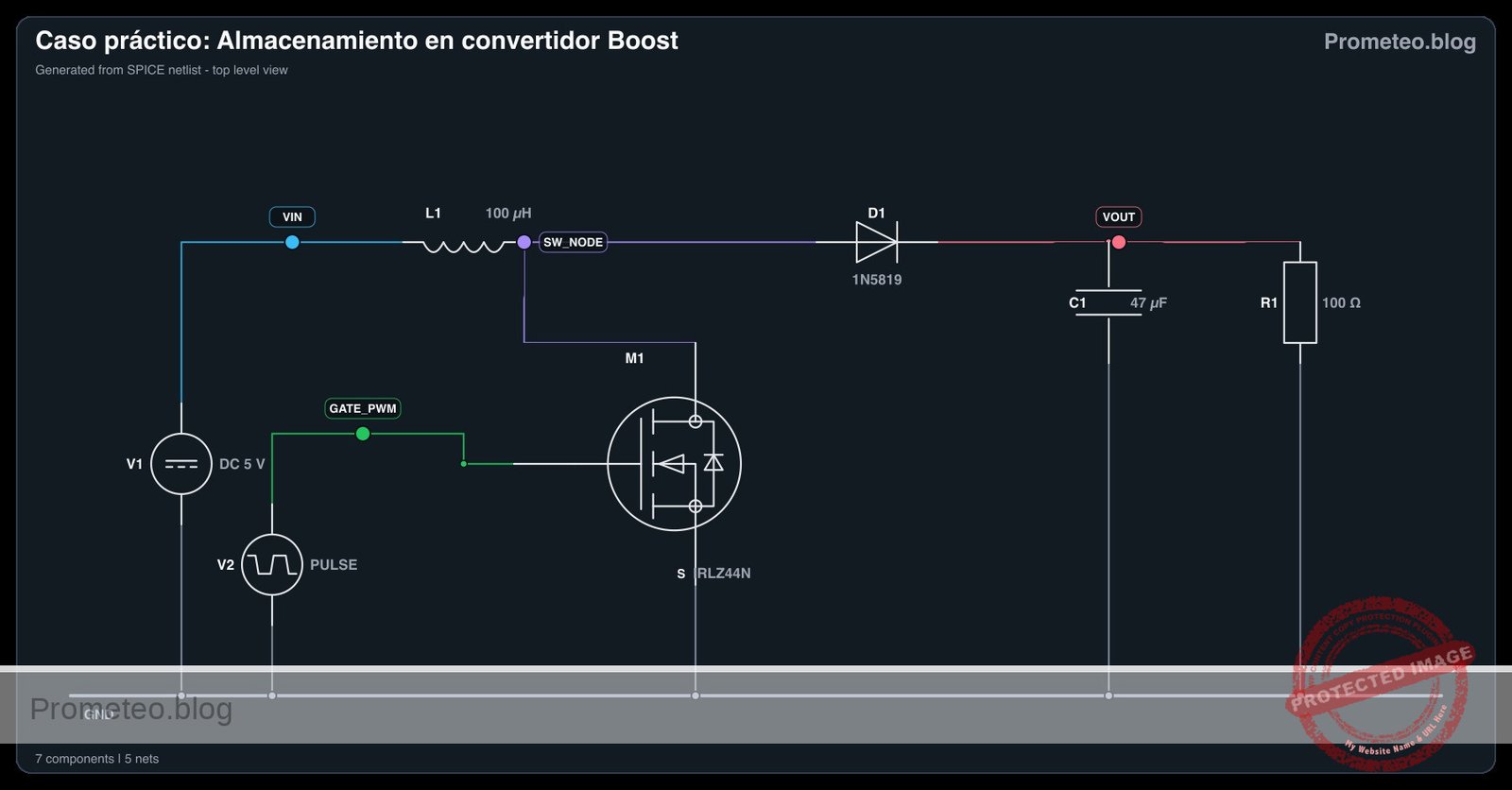
  • M1: el Drenador (Drain) se conecta a SW_NODE, la Puerta (Gate) se conecta a GATE_PWM, el Surtidor (Source) se conecta a 0 (GND).
  • D1: el Ánodo se conecta a SW_NODE, el Cátodo se conecta a VOUT.
  • C1: se conecta entre VOUT y 0 (GND).
  • R1: se conecta entre VOUT y 0 (GND).

Diagrama de bloques conceptual

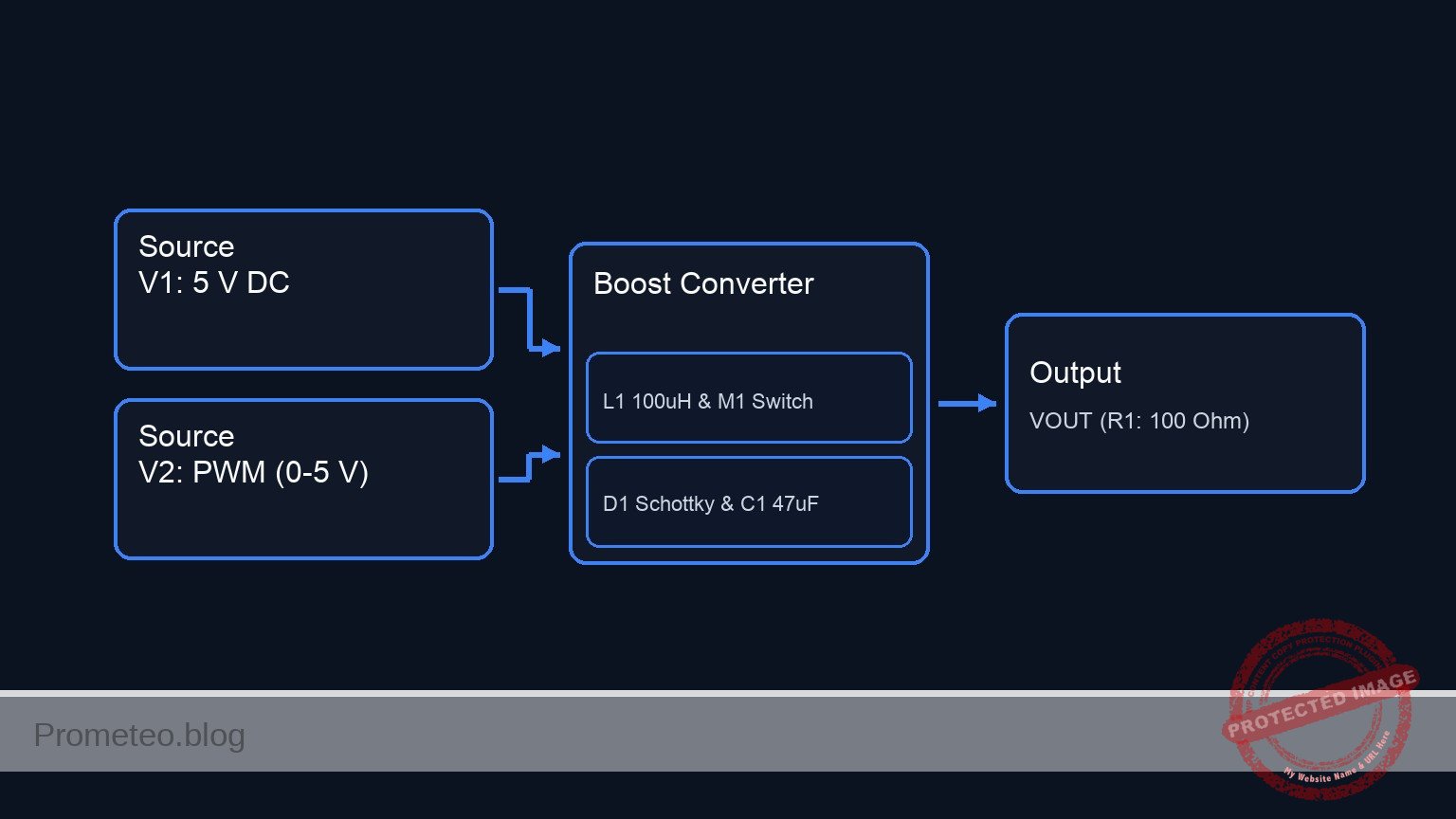
Conceptual block diagram — Boost Converter
Lectura rápida: entradas → bloque principal → salida (actuador o medida). Resume el esquemático ASCII de la siguiente sección.

Esquemático

Control Signal:
[ V2: PWM (0-5 V) ] --(GATE_PWM)--> [ M1:Gate ]

Power & Switching Path:
[ V1: 5 V DC ] --(VIN)--> [ L1: 100µH ] --(SW_NODE)--> [ M1:Drain ] --(Switch)--> [ M1:Source ] --> GND
                                             |
Boost Output & Load:                         |
                                            +--> [ D1: Schottky ] --(VOUT)--> [ R1: 100 Ω ] --> GND
                                                                       |
                                                                       +--> [ C1: 47µF ] --> GND
Esquema Eléctrico

Diagrama eléctrico

Diagrama electrico del caso: Caso práctico: Almacenamiento en convertidor Boost
Generado desde la netlist SPICE validada del caso.

🔒 Este diagrama eléctrico es premium. Con el pase de 7 días o la suscripción mensual podrás desbloquear el material didáctico completo y el pack PDF listo para imprimir.🔓 Ver planes de acceso premium

Mediciones y pruebas

  1. Comprobación del estado inicial: Aplica V1 (5 V) con V2 apagado (0% de ciclo de trabajo). Mide VOUT. El voltaje debería ser de aproximadamente 4.7 V (la entrada de 5 V menos la caída de voltaje directo del diodo Schottky).
  2. Activación de la conmutación: Activa V2 para suministrar una onda cuadrada de 100kHz con un ciclo de trabajo del 50%. Mide VOUT a través de R1. El voltaje debería subir a aproximadamente 9 V-10 V, demostrando la acción de elevación.
  3. Observación de la corriente del inductor: Mide la corriente que fluye a través de L1 (I_inductor). Observarás una forma de onda triangular. La pendiente ascendente ocurre mientras M1 está ENCENDIDO (almacenamiento de energía), y la pendiente descendente ocurre mientras M1 está APAGADO (liberación de energía hacia VOUT).
  4. Mapeo del ciclo de trabajo: Ajusta el ciclo de trabajo de V2 del 30% al 70% en incrementos del 10%. Registra VOUT en cada paso para verificar que un ciclo de trabajo mayor produce un voltaje de salida mayor.

Netlist SPICE y simulación

Netlist SPICE de referencia (ngspice) — extractoNetlist SPICE completo (ngspice)

* Boost converter storage

* Main power input
V1 VIN 0 DC 5

* PWM signal for the switch (100kHz, 50% duty cycle)
V2 GATE_PWM 0 PULSE(0 5 0 10n 10n 5u 10u)

* Magnetic energy storage
L1 VIN SW_NODE 100u

* Main switching element (N-channel MOSFET)
* Drain: SW_NODE, Gate: GATE_PWM, Source: 0, Bulk: 0
M1 SW_NODE GATE_PWM 0 0 IRLZ44N

* Prevents reverse current from capacitor
* Anode: SW_NODE, Cathode: VOUT
D1 SW_NODE VOUT 1N5819

* Output voltage smoothing
* ... (truncated in public view) ...

Copia este contenido en un archivo .cir y ejecútalo con ngspice.

🔒 Parte del contenido de esta sección es premium. Con el pase de 7 días o la suscripción mensual tendrás acceso al contenido completo (materiales, conexionado, compilación detallada, validación paso a paso, troubleshooting, mejoras/variantes y checklist) y podrás descargar el pack PDF listo para imprimir.

* Boost converter storage

* Main power input
V1 VIN 0 DC 5

* PWM signal for the switch (100kHz, 50% duty cycle)
V2 GATE_PWM 0 PULSE(0 5 0 10n 10n 5u 10u)

* Magnetic energy storage
L1 VIN SW_NODE 100u

* Main switching element (N-channel MOSFET)
* Drain: SW_NODE, Gate: GATE_PWM, Source: 0, Bulk: 0
M1 SW_NODE GATE_PWM 0 0 IRLZ44N

* Prevents reverse current from capacitor
* Anode: SW_NODE, Cathode: VOUT
D1 SW_NODE VOUT 1N5819

* Output voltage smoothing
C1 VOUT 0 47u

* Basic load to discharge capacitor
R1 VOUT 0 100

* Models
.model IRLZ44N NMOS(Level=1 VTO=2.0 KP=10.0 RS=0.05 RD=0.05)
.model 1N5819 D(IS=1e-6 RS=0.1 N=1.05 EG=0.69 XTI=2)

* Output Directives
* VOUT is the main output, GATE_PWM is the input stimulus
.print tran V(VOUT) V(GATE_PWM) V(SW_NODE) V(VIN) I(L1)

* Analysis
* Time constant is R*C = 4.7ms. Simulating for 10ms to observe steady-state boost voltage.
.op
.tran 0.1u 10m

.end

Resultados de Simulación (Transitorio)

Resultados de Simulación (Transitorio)
Análisis: The simulation shows the boost converter operating correctly. The output voltage (VOUT) starts near 5V and rises to a steady-state value of approximately 9.6V, with the switch node (SW_NODE) switching between ~0V and ~10V as driven by the 100kHz PWM signal.
Show raw data table (119800 rows)
Index   time            v(vout)         v(gate_pwm)     v(sw_node)      v(vin)          l1#branch
0	0.000000e+00	4.702912e+00	0.000000e+00	5.000000e+00	5.000000e+00	4.702912e-02
1	1.000000e-10	4.702912e+00	5.000000e-02	4.999798e+00	5.000000e+00	4.702912e-02
2	2.000000e-10	4.702912e+00	1.000000e-01	4.999798e+00	5.000000e+00	4.702912e-02
3	4.000000e-10	4.702912e+00	2.000000e-01	4.999797e+00	5.000000e+00	4.702912e-02
4	8.000000e-10	4.702912e+00	4.000000e-01	4.999797e+00	5.000000e+00	4.702912e-02
5	1.600000e-09	4.702912e+00	8.000000e-01	4.999797e+00	5.000000e+00	4.702912e-02
6	3.200000e-09	4.702912e+00	1.600000e+00	4.999797e+00	5.000000e+00	4.702913e-02
7	6.400000e-09	4.702910e+00	3.200000e+00	8.651034e-03	5.000000e+00	4.710899e-02
8	1.000000e-08	4.702907e+00	5.000000e+00	6.306948e-03	5.000000e+00	4.728872e-02
9	1.064000e-08	4.702906e+00	5.000000e+00	6.311218e-03	5.000000e+00	4.732068e-02
10	1.192000e-08	4.702905e+00	5.000000e+00	6.319746e-03	5.000000e+00	4.738460e-02
11	1.448000e-08	4.702902e+00	5.000000e+00	6.336800e-03	5.000000e+00	4.751244e-02
12	1.960000e-08	4.702897e+00	5.000000e+00	6.370908e-03	5.000000e+00	4.776811e-02
13	2.984000e-08	4.702887e+00	5.000000e+00	6.439123e-03	5.000000e+00	4.827946e-02
14	5.032000e-08	4.702866e+00	5.000000e+00	6.575553e-03	5.000000e+00	4.930212e-02
15	9.128000e-08	4.702825e+00	5.000000e+00	6.848406e-03	5.000000e+00	5.134738e-02
16	1.732000e-07	4.702743e+00	5.000000e+00	7.394086e-03	5.000000e+00	5.543754e-02
17	2.732000e-07	4.702643e+00	5.000000e+00	8.060152e-03	5.000000e+00	6.042981e-02
18	3.732000e-07	4.702543e+00	5.000000e+00	8.726166e-03	5.000000e+00	6.542142e-02
19	4.732000e-07	4.702443e+00	5.000000e+00	9.392128e-03	5.000000e+00	7.041236e-02
20	5.732000e-07	4.702343e+00	5.000000e+00	1.005804e-02	5.000000e+00	7.540264e-02
21	6.732000e-07	4.702243e+00	5.000000e+00	1.072390e-02	5.000000e+00	8.039225e-02
22	7.732000e-07	4.702143e+00	5.000000e+00	1.138970e-02	5.000000e+00	8.538119e-02
23	8.732000e-07	4.702043e+00	5.000000e+00	1.205546e-02	5.000000e+00	9.036947e-02
... (119776 more rows) ...

Errores comunes y cómo evitarlos

  • Usar un diodo rectificador estándar (ej. 1N4007): Los diodos estándar son demasiado lentos para apagarse a 100kHz, lo que provoca pérdidas de conmutación masivas y una mala conversión de voltaje. Usa siempre un diodo de recuperación rápida o Schottky como el 1N5819.
  • Saturación del núcleo del inductor: Si la clasificación de corriente máxima del inductor es menor que la corriente máxima de conmutación, el núcleo magnético se saturará. El inductor actuará entonces como un cortocircuito, destruyendo potencialmente el MOSFET. Verifica siempre la clasificación de corriente de saturación del inductor.
  • Operar sin carga: Hacer funcionar un convertidor boost sin una resistencia de carga (R1) puede hacer que el voltaje de salida aumente continuamente con cada ciclo de conmutación, alcanzando teóricamente el infinito y destruyendo el capacitor de salida o el MOSFET. Incluye siempre una carga mínima.

Solución de problemas

  • Síntoma: El voltaje de salida es igual al voltaje de entrada (menos la caída del diodo).
  • Causa: El MOSFET no está conmutando. V2 podría estar desconectado o el nivel de voltaje es demasiado bajo para superar el umbral de la puerta del MOSFET.
  • Solución: Verifica la señal GATE_PWM con un osciloscopio. Usa un MOSFET de nivel lógico si tu señal PWM está limitada a 3.3 V o 5 V.
  • Síntoma: El MOSFET se calienta extremadamente rápido.
  • Causa: El inductor se está saturando, o el MOSFET tiene una alta resistencia de encendido (RDS(on)) y está experimentando altas pérdidas de conducción.
  • Solución: Cambia el inductor por uno con una mayor clasificación de corriente. Asegúrate de que el voltaje de accionamiento de la puerta sea suficiente para encender completamente el MOSFET.
  • Síntoma: Voltaje de salida inestable o con mucha ondulación (ripple).
  • Causa: El capacitor de salida C1 es demasiado pequeño para la carga o tiene una alta Resistencia Serie Equivalente (ESR).
  • Solución: Aumenta la capacitancia de C1 o coloca un capacitor cerámico en paralelo con el capacitor electrolítico para reducir la ESR general.

Posibles mejoras y extensiones

  • Control de lazo cerrado: Agrega un divisor de voltaje en la salida conectado a un amplificador de error o a la entrada analógica de un microcontrolador. Ajusta dinámicamente el ciclo de trabajo PWM para mantener un VOUT constante independientemente de los cambios en R1 (la carga).
  • Rectificación síncrona: Reemplaza el diodo Schottky D1 con un segundo MOSFET de canal P o canal N accionado. Conmutar este segundo MOSFET de forma síncrona (inversamente a M1) reduce la caída de voltaje típica de un diodo, mejorando significativamente la eficiencia general del convertidor.

Más Casos Prácticos en Prometeo.blog

Encuentra este producto y/o libros sobre este tema en Amazon

Ir a Amazon

Como afiliado de Amazon, gano con las compras que cumplan los requisitos. Si compras a través de este enlace, ayudas a mantener este proyecto.

Quiz rápido

Pregunta 1: ¿Cuál es el objetivo principal del convertidor Boost descrito en el texto?


Pregunta 2: ¿Qué sucede con la corriente del inductor cuando el interruptor se cierra?


Pregunta 3: ¿Cuál de las siguientes es una aplicación útil del convertidor Boost mencionada en el artículo?


Pregunta 4: ¿Qué sucede con la corriente del inductor cuando el interruptor se abre?


Pregunta 5: ¿Cómo es el voltaje de salida (V_out) en comparación con la fuente de voltaje de entrada en este circuito?


Pregunta 6: ¿Qué tipo de relación existe entre el ciclo de trabajo (Duty Cycle) del interruptor y la magnitud resultante de V_out?


Pregunta 7: ¿Qué tipo de lazo de control utiliza el convertidor Boost básico que se construirá en el caso práctico?


Pregunta 8: ¿Por qué es útil el convertidor Boost para alimentar tiras de LEDs?


Pregunta 9: Además de dispositivos a batería y LEDs, ¿en qué otro sistema se captura y eleva el voltaje usando esta tecnología?


Pregunta 10: ¿Qué ventaja ofrece el convertidor Boost en dispositivos electrónicos portátiles compactos?


Carlos Núñez Zorrilla
Electronics & Computer Engineer

Ingeniero Superior en Electrónica de Telecomunicaciones e Ingeniero en Informática (titulaciones oficiales en España).

Sígueme:


Practical case: Boost converter storage

Level: Medium | Understand magnetic energy storage to boost voltage.

Objective and use case

In this practical case, you will build a basic open-loop Boost converter to demonstrate how an inductor stores and releases magnetic energy to step up a DC voltage.

Why it is useful:
* Allows battery-powered devices to operate at higher voltages (e.g., generating 5 V from a single 3.7 V Li-ion cell).
* Drives strings of LEDs that require a constant, high forward voltage.
* Captures and steps up voltage in energy harvesting and regenerative braking systems.
* Provides versatile power rails in compact portable electronics without requiring multiple batteries.

Expected outcome:
* You will observe the inductor current (I_inductor) ramping up when the switch is closed and ramping down when it opens.
* The output voltage (V_out) will be demonstrably higher than the input voltage source.
* You will record the direct relationship between the switch’s Duty Cycle and the resulting V_out magnitude.

Target audience and level:
Intermediate electronics students learning the fundamentals of switch-mode power supplies.

Materials

  • V1: 5 V DC source, function: main power input
  • V2: Pulse voltage source (0-5 V, 100kHz, 50% duty cycle), function: PWM signal for the switch
  • L1: 100 µH inductor, function: magnetic energy storage
  • M1: N-channel MOSFET (e.g., IRLZ44N), function: main switching element
  • D1: Schottky diode (e.g., 1N5819), function: prevents reverse current from capacitor
  • C1: 47 µF capacitor, function: output voltage smoothing
  • R1: 100 Ω resistor, function: basic load to discharge capacitor

Wiring guide

  • V1: connects between VIN and 0 (GND).
  • V2: connects between GATE_PWM and 0 (GND).
  • L1: connects between VIN and SW_NODE.
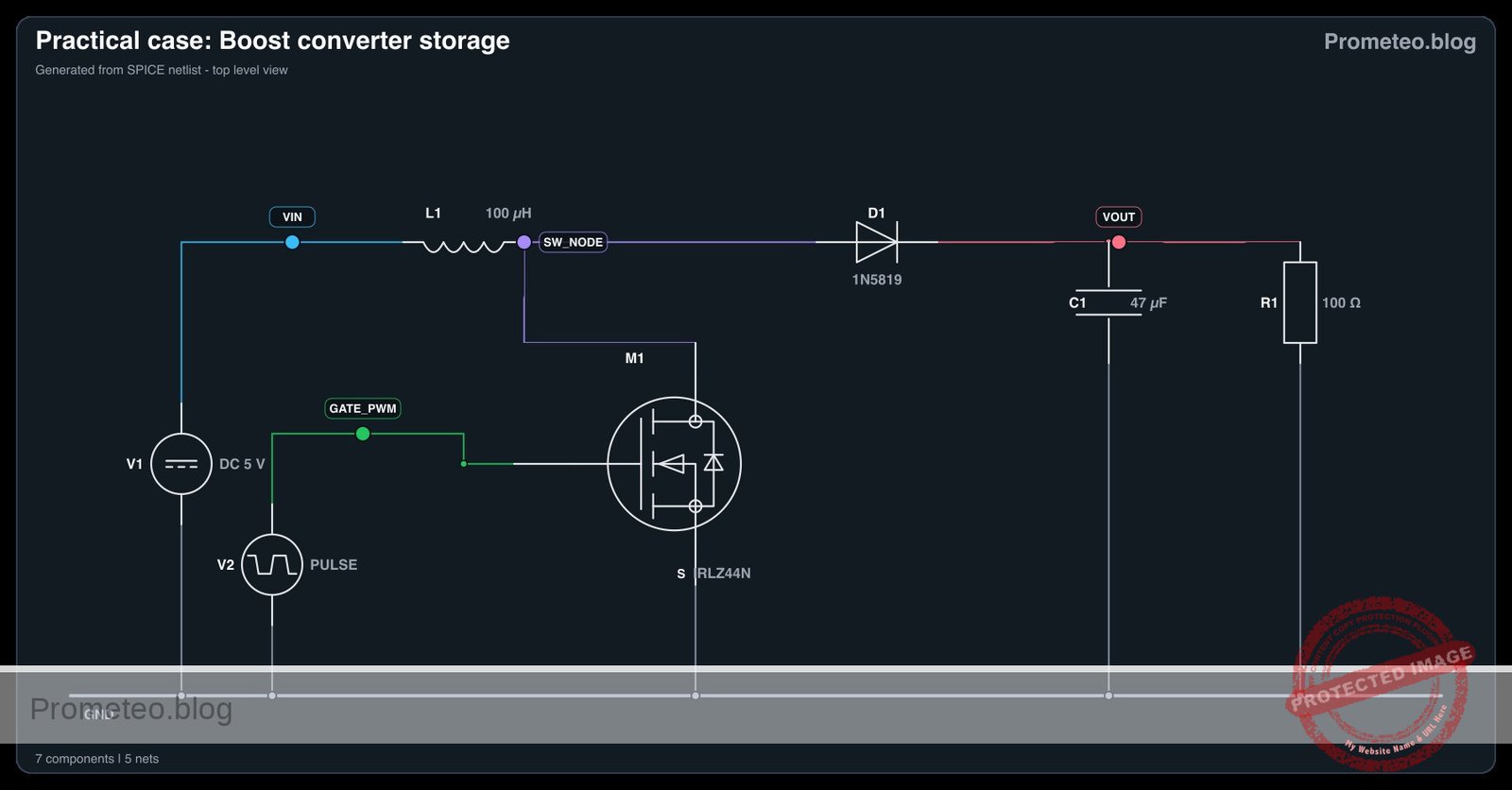
  • M1: Drain connects to SW_NODE, Gate connects to GATE_PWM, Source connects to 0 (GND).
  • D1: Anode connects to SW_NODE, Cathode connects to VOUT.
  • C1: connects between VOUT and 0 (GND).
  • R1: connects between VOUT and 0 (GND).

Conceptual block diagram

Conceptual block diagram — Boost Converter
Quick read: inputs → main block → output (actuator or measurement). This summarizes the ASCII schematic below.

Schematic

Control Signal:
[ V2: PWM (0-5 V) ] --(GATE_PWM)--> [ M1:Gate ]

Power & Switching Path:
[ V1: 5 V DC ] --(VIN)--> [ L1: 100µH ] --(SW_NODE)--> [ M1:Drain ] --(Switch)--> [ M1:Source ] --> GND
                                             |
Boost Output & Load:                         |
                                             +--> [ D1: Schottky ] --(VOUT)--> [ R1: 100 Ω ] --> GND
                                                                       |
                                                                       +--> [ C1: 47µF ] --> GND
Electrical Schematic

Electrical diagram

Electrical diagram for case: Practical case: Boost converter storage
Generated from the validated SPICE netlist for this case.

🔒 This electrical diagram is premium. With the 7-day pass or the monthly membership you can unlock the complete didactic material and the print-ready PDF pack.🔓 See premium access plans

Measurements and tests

  1. Initial state check: Apply V1 (5 V) with V2 turned off (0% duty cycle). Measure VOUT. The voltage should be roughly 4.7 V (the 5 V input minus the forward voltage drop of the Schottky diode).
  2. Switching activation: Activate V2 to supply a 100kHz square wave at a 50% duty cycle. Measure VOUT across R1. The voltage should rise to approximately 9 V-10 V, demonstrating the step-up action.
  3. Inductor current observation: Probe the current flowing through L1 (I_inductor). You will observe a triangular waveform. The upward slope occurs while M1 is ON (energy storage), and the downward slope occurs while M1 is OFF (energy release to VOUT).
  4. Duty Cycle mapping: Adjust the Duty Cycle of V2 from 30% to 70% in 10% increments. Record VOUT at each step to verify that a higher duty cycle yields a higher output voltage.

SPICE netlist and simulation

Reference SPICE Netlist (ngspice) — excerptFull SPICE netlist (ngspice)

* Boost converter storage

* Main power input
V1 VIN 0 DC 5

* PWM signal for the switch (100kHz, 50% duty cycle)
V2 GATE_PWM 0 PULSE(0 5 0 10n 10n 5u 10u)

* Magnetic energy storage
L1 VIN SW_NODE 100u

* Main switching element (N-channel MOSFET)
* Drain: SW_NODE, Gate: GATE_PWM, Source: 0, Bulk: 0
M1 SW_NODE GATE_PWM 0 0 IRLZ44N

* Prevents reverse current from capacitor
* Anode: SW_NODE, Cathode: VOUT
D1 SW_NODE VOUT 1N5819

* Output voltage smoothing
* ... (truncated in public view) ...

Copy this content into a .cir file and run with ngspice.

🔒 Part of this section is premium. With the 7-day pass or the monthly membership you can access the full content (materials, wiring, detailed build, validation, troubleshooting, variants and checklist) and download the complete print-ready PDF pack.

* Boost converter storage

* Main power input
V1 VIN 0 DC 5

* PWM signal for the switch (100kHz, 50% duty cycle)
V2 GATE_PWM 0 PULSE(0 5 0 10n 10n 5u 10u)

* Magnetic energy storage
L1 VIN SW_NODE 100u

* Main switching element (N-channel MOSFET)
* Drain: SW_NODE, Gate: GATE_PWM, Source: 0, Bulk: 0
M1 SW_NODE GATE_PWM 0 0 IRLZ44N

* Prevents reverse current from capacitor
* Anode: SW_NODE, Cathode: VOUT
D1 SW_NODE VOUT 1N5819

* Output voltage smoothing
C1 VOUT 0 47u

* Basic load to discharge capacitor
R1 VOUT 0 100

* Models
.model IRLZ44N NMOS(Level=1 VTO=2.0 KP=10.0 RS=0.05 RD=0.05)
.model 1N5819 D(IS=1e-6 RS=0.1 N=1.05 EG=0.69 XTI=2)

* Output Directives
* VOUT is the main output, GATE_PWM is the input stimulus
.print tran V(VOUT) V(GATE_PWM) V(SW_NODE) V(VIN) I(L1)

* Analysis
* Time constant is R*C = 4.7ms. Simulating for 10ms to observe steady-state boost voltage.
.op
.tran 0.1u 10m

.end

Simulation Results (Transient Analysis)

Simulation Results (Transient Analysis)
Analysis: The simulation shows the boost converter operating correctly. The output voltage (VOUT) starts near 5V and rises to a steady-state value of approximately 9.6V, with the switch node (SW_NODE) switching between ~0V and ~10V as driven by the 100kHz PWM signal.
Show raw data table (119800 rows)
Index   time            v(vout)         v(gate_pwm)     v(sw_node)      v(vin)          l1#branch
0	0.000000e+00	4.702912e+00	0.000000e+00	5.000000e+00	5.000000e+00	4.702912e-02
1	1.000000e-10	4.702912e+00	5.000000e-02	4.999798e+00	5.000000e+00	4.702912e-02
2	2.000000e-10	4.702912e+00	1.000000e-01	4.999798e+00	5.000000e+00	4.702912e-02
3	4.000000e-10	4.702912e+00	2.000000e-01	4.999797e+00	5.000000e+00	4.702912e-02
4	8.000000e-10	4.702912e+00	4.000000e-01	4.999797e+00	5.000000e+00	4.702912e-02
5	1.600000e-09	4.702912e+00	8.000000e-01	4.999797e+00	5.000000e+00	4.702912e-02
6	3.200000e-09	4.702912e+00	1.600000e+00	4.999797e+00	5.000000e+00	4.702913e-02
7	6.400000e-09	4.702910e+00	3.200000e+00	8.651034e-03	5.000000e+00	4.710899e-02
8	1.000000e-08	4.702907e+00	5.000000e+00	6.306948e-03	5.000000e+00	4.728872e-02
9	1.064000e-08	4.702906e+00	5.000000e+00	6.311218e-03	5.000000e+00	4.732068e-02
10	1.192000e-08	4.702905e+00	5.000000e+00	6.319746e-03	5.000000e+00	4.738460e-02
11	1.448000e-08	4.702902e+00	5.000000e+00	6.336800e-03	5.000000e+00	4.751244e-02
12	1.960000e-08	4.702897e+00	5.000000e+00	6.370908e-03	5.000000e+00	4.776811e-02
13	2.984000e-08	4.702887e+00	5.000000e+00	6.439123e-03	5.000000e+00	4.827946e-02
14	5.032000e-08	4.702866e+00	5.000000e+00	6.575553e-03	5.000000e+00	4.930212e-02
15	9.128000e-08	4.702825e+00	5.000000e+00	6.848406e-03	5.000000e+00	5.134738e-02
16	1.732000e-07	4.702743e+00	5.000000e+00	7.394086e-03	5.000000e+00	5.543754e-02
17	2.732000e-07	4.702643e+00	5.000000e+00	8.060152e-03	5.000000e+00	6.042981e-02
18	3.732000e-07	4.702543e+00	5.000000e+00	8.726166e-03	5.000000e+00	6.542142e-02
19	4.732000e-07	4.702443e+00	5.000000e+00	9.392128e-03	5.000000e+00	7.041236e-02
20	5.732000e-07	4.702343e+00	5.000000e+00	1.005804e-02	5.000000e+00	7.540264e-02
21	6.732000e-07	4.702243e+00	5.000000e+00	1.072390e-02	5.000000e+00	8.039225e-02
22	7.732000e-07	4.702143e+00	5.000000e+00	1.138970e-02	5.000000e+00	8.538119e-02
23	8.732000e-07	4.702043e+00	5.000000e+00	1.205546e-02	5.000000e+00	9.036947e-02
... (119776 more rows) ...

Common mistakes and how to avoid them

  • Using a standard rectifier diode (e.g., 1N4007): Standard diodes are too slow to turn off at 100kHz, leading to massive switching losses and poor voltage conversion. Always use a fast-recovery or Schottky diode like the 1N5819.
  • Inductor core saturation: If the inductor’s maximum current rating is lower than the peak switching current, the magnetic core will saturate. The inductor will then act as a short circuit, potentially destroying the MOSFET. Always verify the inductor’s saturation current rating.
  • Operating without a load: Running a boost converter with no load resistor (R1) can cause the output voltage to continuously rise with every switching cycle, theoretically reaching infinity and destroying the output capacitor or MOSFET. Always include a minimum load.

Troubleshooting

  • Symptom: Output voltage equals the input voltage (minus diode drop).
  • Cause: The MOSFET is not switching. V2 might be disconnected or the voltage level is too low to surpass the MOSFET’s gate threshold.
  • Fix: Check the GATE_PWM signal with an oscilloscope. Use a logic-level MOSFET if your PWM signal is limited to 3.3 V or 5 V.
  • Symptom: MOSFET becomes extremely hot very quickly.
  • Cause: The inductor is saturating, or the MOSFET has a high ON-resistance (RDS(on)) and is experiencing high conduction losses.
  • Fix: Swap the inductor for one with a higher current rating. Ensure the gate drive voltage is sufficient to turn the MOSFET completely ON.
  • Symptom: Unstable or highly rippled output voltage.
  • Cause: The output capacitor C1 is too small for the load or has a high Equivalent Series Resistance (ESR).
  • Fix: Increase the capacitance of C1 or place a ceramic capacitor in parallel with the electrolytic capacitor to lower the overall ESR.

Possible improvements and extensions

  • Closed-loop control: Add a voltage divider at the output connected to an error amplifier or microcontroller analog input. Dynamically adjust the PWM duty cycle to maintain a constant VOUT regardless of changes in R1 (the load).
  • Synchronous rectification: Replace the Schottky diode D1 with a second P-channel or driven N-channel MOSFET. Switching this second MOSFET synchronously (inversely to M1) reduces the voltage drop typical of a diode, significantly improving overall converter efficiency.

More Practical Cases on Prometeo.blog

Find this product and/or books on this topic on Amazon

Go to Amazon

As an Amazon Associate, I earn from qualifying purchases. If you buy through this link, you help keep this project running.

Quick Quiz

Question 1: What is the primary purpose of the Boost converter in this practical case?


Question 2: Which component is responsible for storing and releasing magnetic energy?


Question 3: What happens to the inductor current when the switch is closed?


Question 4: Which of the following is a mentioned use case for a Boost converter?


Question 5: What happens to the inductor current when the switch opens?


Question 6: What parameter of the switch has a direct relationship with the magnitude of the output voltage?


Question 7: How can a Boost converter benefit battery-powered devices?


Question 8: What role does the Boost converter play in energy harvesting systems?


Question 9: What is the expected relationship between the output voltage and the input voltage source?


Question 10: Who is the target audience for this practical case?


Carlos Núñez Zorrilla
Electronics & Computer Engineer

Telecommunications Electronics Engineer and Computer Engineer (official degrees in Spain).
Follow me: