Practical case: Automatic Reservoir Pump Controller

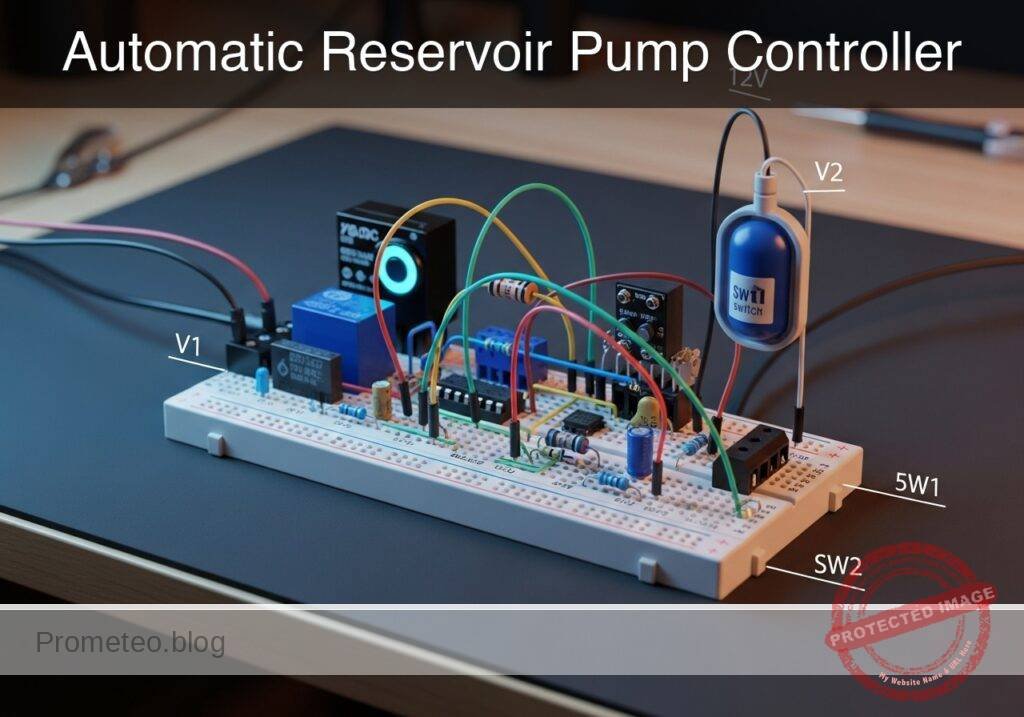
Automatic Reservoir Pump Controller prototype (Maker Style)

Level: Medium | Construct a transistor-driven relay circuit to automatically control a water pump using a float switch.

Objective and use case

In this practical case, you will build an automatic reservoir pump controller. The circuit uses a mechanical float switch to trigger an NPN transistor, which energizes an electromechanical relay to drive a high-current DC pump (simulated here as a resistive load) and a status LED.

Why this is useful:
* Automates water level management in tanks, reservoirs, and sump basins.
* Safely isolates low-voltage control circuits from high-power loads.
* Demonstrates the practical interfacing of simple mechanical sensors with power electronics.
* Prevents overflow or dry-running conditions in industrial and agricultural settings.

Expected outcome:
* Closing the float switch applies a voltage to the transistor base, turning it on (saturation).
* The transistor sinks current for the relay coil, energizing it and closing its normally open (NO) contact.
* The simulated DC pump (load resistor) receives the full supply voltage.
* The status indicator LED illuminates when the pump is active.
* Releasing the switch de-energizes the relay, and the flyback diode safely dissipates the inductive voltage spike from the coil.

Target audience: Intermediate electronics students learning about transistor switching, electromechanical relays, and inductive load protection.

Materials

  • V1: 12 V DC supply, function: main power for relay coil and pump
  • V2: 5 V DC supply, function: control logic power for the float switch
  • SW1: SPST switch, function: simulated float switch or high-level sensor
  • R1: 1 kΩ resistor, function: transistor base current limiting
  • R2: 10 kΩ resistor, function: pull-down for transistor base to ensure turn-off
  • R3: 1 kΩ resistor, function: LED current limiting
  • RLOAD: 50 Ω high-power resistor, function: simulated DC pump load
  • Q1: 2N2222 NPN transistor, function: relay coil driver
  • D1: 1N4007 diode, function: flyback protection for relay coil
  • D2: Green LED, function: pump status indicator
  • K1: 12 V SPDT Relay, function: electromechanical switch for the pump

Wiring guide

  • V1 connects between node VCC12 and node 0.
  • V2 connects between node VCC5 and node 0.
  • SW1 connects between node VCC5 and node SENSE.
  • R1 connects between node SENSE and node VB.
  • R2 connects between node VB and node 0.
  • Q1 base connects to node VB, emitter connects to node 0, and collector connects to node COIL_NEG.
  • K1 coil connects between node VCC12 and node COIL_NEG.
  • K1 COM (Common) contact connects to node VCC12.
  • K1 NO (Normally Open) contact connects to node LOAD_SW.
  • D1 cathode connects to node VCC12 and anode connects to node COIL_NEG (placed anti-parallel to the relay coil).
  • RLOAD connects between node LOAD_SW and node 0.
  • R3 connects between node LOAD_SW and the anode of D2.
  • D2 cathode connects to node 0.

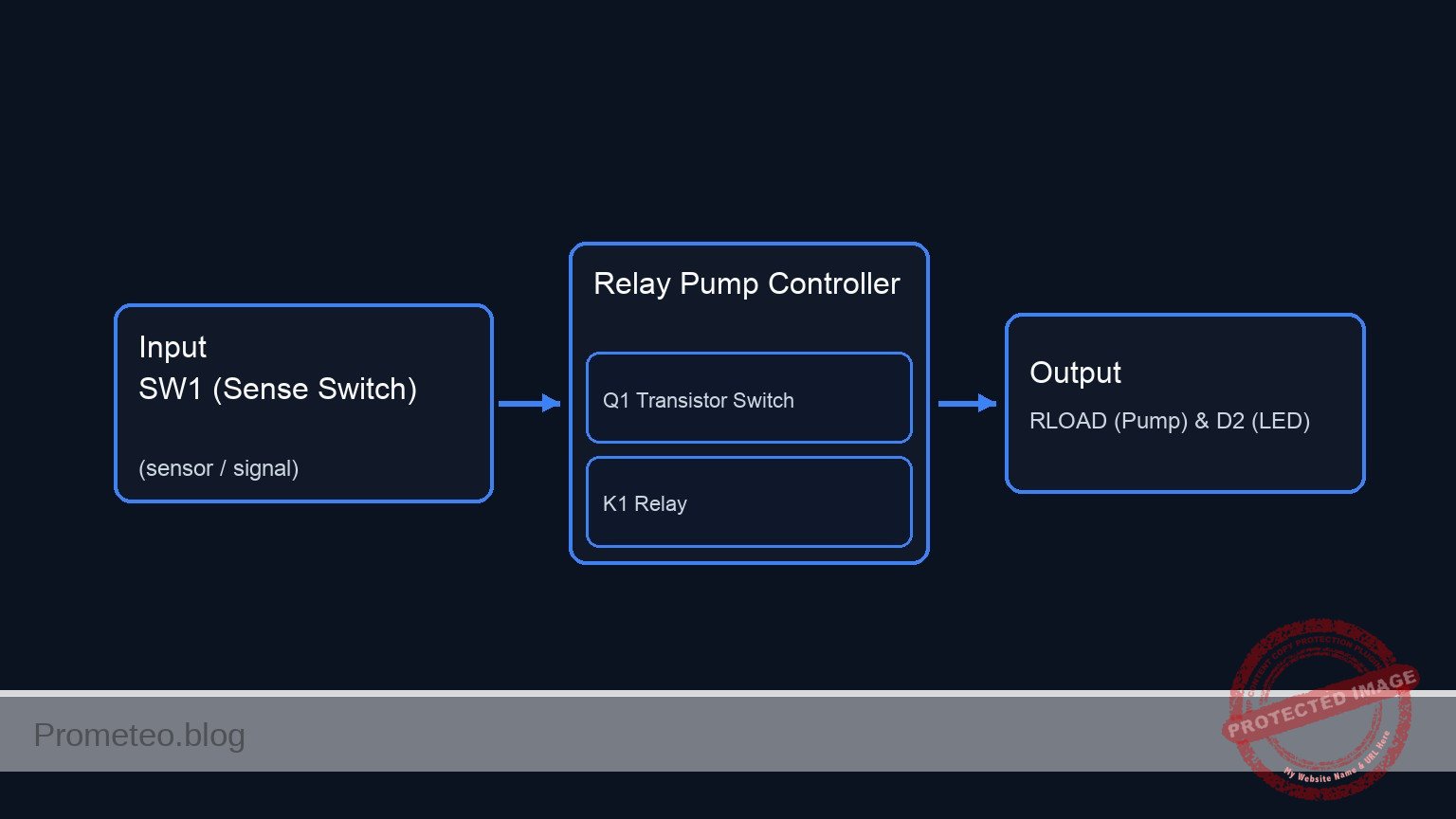
Conceptual block diagram

Conceptual block diagram — Relay Pump Controller
Quick read: inputs → main block → output (actuator or measurement). This summarizes the ASCII schematic below.

Schematic

VCC5 --> [ SW1 ] --(SENSE)--> [ R1 ] --(VB)--> [ Q1:B ]
                                              |          |
                                            [ R2 ]       |
                                              |          |
                                             GND         |
                                                         |
      VCC12 --> [ K1 Coil || D1(Rev) ] --(COIL_NEG)--> [ Q1:C ] --( )-- [ Q1:E ] --> GND
                       |
                (Magnetic Link)
                       v
      VCC12 --> [ K1 Switch (COM->NO) ] --(LOAD_SW)--> [ RLOAD (Pump) ] --> GND
                                              |
                                              +------> [ R3 ] --> [ D2 (LED) ] --> GND
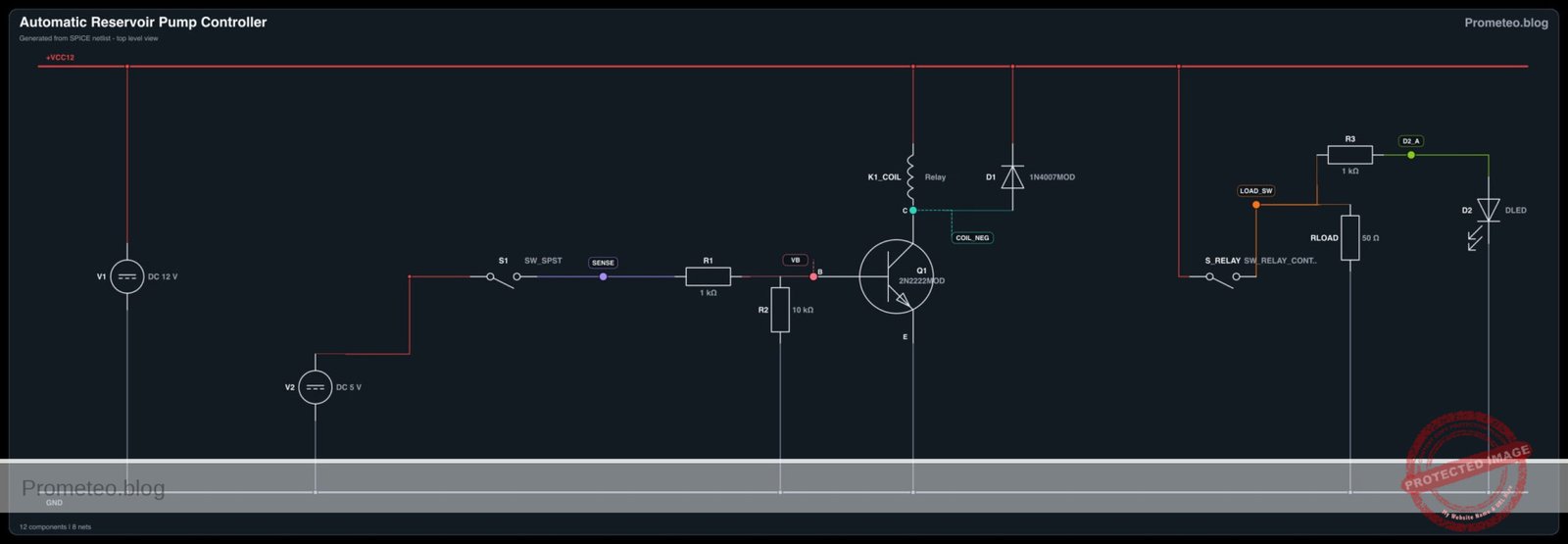
Electrical Schematic

Electrical diagram

Electrical diagram for case: Automatic reservoir pump controller
Generated from the validated SPICE netlist for this case.

🔒 This electrical diagram is premium. With the 7-day pass or the monthly membership you can unlock the complete didactic material and the print-ready PDF pack.🔓 See premium access plans

Measurements and tests

  1. Control Logic Test: With SW1 open, measure the voltage at node SENSE. It should be 0 V. Close SW1 and verify the voltage rises to 5 V.
  2. Base Drive Verification: Measure the voltage at node VB with SW1 closed. It should read approximately 0.7 V, confirming the base-emitter junction of Q1 is forward-biased.
  3. Coil Switching Verification: Probe node COIL_NEG. When SW1 is open, it should measure 12 V. When SW1 is closed, it should drop to near 0 V (Vce_sat of the transistor), confirming the coil is energized.
  4. Load Delivery Test: Measure the voltage at node LOAD_SW. Verify that it reads 0 V when the relay is off, and jumps to 12 V when the relay clicks on. Check that the RLOAD draws current and D2 illuminates.

SPICE netlist and simulation

Reference SPICE Netlist (ngspice) — excerptFull SPICE netlist (ngspice)

* Automatic Reservoir Pump Controller
.width out=256

* Power Supplies
V1 VCC12 0 DC 12
V2 VCC5 0 DC 5

* Simulated Float Switch (SW1)
* Using a voltage-controlled switch and a pulse source to simulate a user/sensor triggering the switch
V_SW_CTRL SW_CTRL 0 PULSE(0 5 50u 1u 1u 200u 500u)
S1 VCC5 SENSE SW_CTRL 0 myswitch

* Base driving circuit
R1 SENSE VB 1k
R2 VB 0 10k

* Relay Driver Transistor
Q1 COIL_NEG VB 0 2N2222MOD

* Relay Coil (K1)
* ... (truncated in public view) ...

Copy this content into a .cir file and run with ngspice.

🔒 Part of this section is premium. With the 7-day pass or the monthly membership you can access the full content (materials, wiring, detailed build, validation, troubleshooting, variants and checklist) and download the complete print-ready PDF pack.

* Automatic Reservoir Pump Controller
.width out=256

* Power Supplies
V1 VCC12 0 DC 12
V2 VCC5 0 DC 5

* Simulated Float Switch (SW1)
* Using a voltage-controlled switch and a pulse source to simulate a user/sensor triggering the switch
V_SW_CTRL SW_CTRL 0 PULSE(0 5 50u 1u 1u 200u 500u)
S1 VCC5 SENSE SW_CTRL 0 myswitch

* Base driving circuit
R1 SENSE VB 1k
R2 VB 0 10k

* Relay Driver Transistor
Q1 COIL_NEG VB 0 2N2222MOD

* Relay Coil (K1)
* Modeled as a series resistor and inductor
R_K1 VCC12 K1_COIL_INT 400
L_K1 K1_COIL_INT COIL_NEG 10mH

* Flyback Diode
D1 COIL_NEG VCC12 1N4007MOD

* Relay Contacts (K1 NO)
* The switch closes when the voltage across the coil (VCC12 - COIL_NEG) exceeds 8V
S_RELAY VCC12 LOAD_SW VCC12 COIL_NEG relay_sw

* Simulated Pump Load
RLOAD LOAD_SW 0 50

* Status LED
R3 LOAD_SW D2_A 1k
D2 D2_A 0 DLED

* Models
.model myswitch SW(vt=2.5 vh=0.5 ron=0.1 roff=10MEG)
.model relay_sw SW(vt=8 vh=1 ron=0.05 roff=100MEG)
.model 2N2222MOD NPN(IS=1E-14 VAF=100 BF=200 IKF=0.3 XTB=1.5 BR=3 CJC=8E-12 CJE=25E-12 TR=100E-9 TF=400E-12 ITF=1 VTF=2 XTF=3 RB=10)
.model 1N4007MOD D(IS=7.02767n RS=0.0341512 N=1.80803 EG=1.11 XTI=3.0 BV=1000 IBV=5e-08 CJO=1e-11 VJ=0.7 M=0.5 FC=0.5 TT=1e-07)
.model DLED D(IS=1e-20 N=2.2 RS=2.5 BV=5 IBV=10u CJO=50p)

* Analysis Commands
.op
.tran 1u 500u
.print tran V(SENSE) V(LOAD_SW) V(COIL_NEG) V(VB) I(L_K1)

.end

Simulation Results (Transient Analysis)

Simulation Results (Transient Analysis)
Analysis: The transient analysis spans 0 s to 500 us and captures the switching interval. The switching node and inductor current remain bounded, consistent with the flyback path protecting the switch. Main ranges: l_k1#branch -7.86 uA -> 29.9 mA; v(coil_neg) 9.89 mV -> 12.7 V; v(load_sw) 6 uV -> 12 V.
Show raw data table (961 rows)
Index   time            v(sense)        v(load_sw)      v(coil_neg)     v(vb)           l_k1#branch
0	0.000000e+00	5.494076e-03	5.999997e-06	1.200000e+01	4.994626e-03	2.403801e-11
1	1.000000e-08	5.494076e-03	5.999997e-06	1.200000e+01	4.994626e-03	2.403803e-11
2	2.000000e-08	5.494076e-03	5.999997e-06	1.200000e+01	4.994626e-03	2.403801e-11
3	4.000000e-08	5.494076e-03	5.999997e-06	1.200000e+01	4.994626e-03	2.403795e-11
4	8.000000e-08	5.494076e-03	5.999997e-06	1.200000e+01	4.994626e-03	2.403772e-11
5	1.600000e-07	5.494076e-03	5.999997e-06	1.200000e+01	4.994626e-03	2.403654e-11
6	3.200000e-07	5.494076e-03	5.999997e-06	1.200000e+01	4.994626e-03	2.403033e-11
7	6.400000e-07	5.494076e-03	5.999997e-06	1.200000e+01	4.994626e-03	2.400598e-11
8	1.280000e-06	5.494076e-03	5.999997e-06	1.200000e+01	4.994626e-03	2.398528e-11
9	2.280000e-06	5.494076e-03	5.999997e-06	1.200000e+01	4.994626e-03	2.403534e-11
10	3.280000e-06	5.494077e-03	5.999997e-06	1.200000e+01	4.994626e-03	2.401174e-11
11	4.280000e-06	5.494076e-03	5.999997e-06	1.200000e+01	4.994626e-03	2.394780e-11
12	5.280000e-06	5.494076e-03	5.999997e-06	1.200000e+01	4.994626e-03	2.402136e-11
13	6.280000e-06	5.494077e-03	5.999997e-06	1.200000e+01	4.994626e-03	2.408634e-11
14	7.280000e-06	5.494076e-03	5.999997e-06	1.200000e+01	4.994626e-03	2.401469e-11
15	8.280000e-06	5.494076e-03	5.999997e-06	1.200000e+01	4.994626e-03	2.399217e-11
16	9.280000e-06	5.494077e-03	5.999997e-06	1.200000e+01	4.994626e-03	2.399919e-11
17	1.028000e-05	5.494076e-03	5.999997e-06	1.200000e+01	4.994626e-03	2.393646e-11
18	1.128000e-05	5.494076e-03	5.999997e-06	1.200000e+01	4.994626e-03	2.397704e-11
19	1.228000e-05	5.494077e-03	5.999997e-06	1.200000e+01	4.994626e-03	2.408121e-11
20	1.328000e-05	5.494077e-03	5.999997e-06	1.200000e+01	4.994626e-03	2.402567e-11
21	1.428000e-05	5.494076e-03	5.999997e-06	1.200000e+01	4.994626e-03	2.395460e-11
22	1.528000e-05	5.494076e-03	5.999997e-06	1.200000e+01	4.994626e-03	2.400449e-11
23	1.628000e-05	5.494077e-03	5.999997e-06	1.200000e+01	4.994626e-03	2.399821e-11
... (937 more rows) ...

Common mistakes and how to avoid them

  • Missing flyback diode (D1): When the relay turns off, the collapsing magnetic field in the coil generates a massive voltage spike. Without D1 to provide a safe discharge path, this spike will instantly destroy Q1. Always place D1 reverse-biased across the coil.
  • Insufficient base drive current: If R1 is too large, Q1 will operate in its linear region instead of fully saturating. This will cause the transistor to overheat and the relay may fail to actuate reliably. Always ensure R1 provides enough base current (Ib) for the required collector current (Ic).
  • Undersized relay contacts: Motors and pumps draw a massive «inrush» current when starting up. Using a relay rated exactly for the running current will cause the contacts to weld shut or burn. Always select a relay rated for at least 2-3 times the load’s continuous current.

Troubleshooting

  • Symptom: The relay chatters or buzzes rapidly instead of latching cleanly.
  • Cause: The 12 V power supply is too weak and drops voltage under the heavy load of the pump, causing the relay coil to lose holding power, disconnect the load, recover, and repeat.
  • Fix: Use a bench power supply with a higher current capacity or test with a battery.
  • Symptom: Transistor Q1 becomes extremely hot and fails.
  • Cause: Missing flyback diode, or the relay coil’s current demand exceeds the maximum collector current of the 2N2222.
  • Fix: Verify D1 is correctly installed. Check the relay coil resistance; ensure it draws less than 600 mA.
  • Symptom: Circuit turns on randomly without float switch action.
  • Cause: The base of Q1 is floating, picking up environmental electromagnetic interference.
  • Fix: Ensure the pull-down resistor R2 is securely connected between node VB and ground.
  • Symptom: The LED turns on, but the simulated pump (RLOAD) does not work.
  • Cause: Broken connection at the relay NO contact or a blown load resistor.
  • Fix: Check the wiring between the relay’s NO pin and LOAD_SW. Verify the resistance of RLOAD with a multimeter.

Possible improvements and extensions

  • Low-Water Cutoff (Latching Logic): Add a second float switch and configure the relay as a latching circuit. This ensures the pump runs continuously until the tank is completely full, rather than short-cycling.
  • Debounce Delay Network: Water ripples in a tank can cause the float switch to rapidly bounce on and off. Add an RC delay network (a capacitor and resistor) at the transistor base, or use a 555 timer, to introduce a turn-on/turn-off delay and protect the pump.

More Practical Cases on Prometeo.blog

Find this product and/or books on this topic on Amazon

Go to Amazon

As an Amazon Associate, I earn from qualifying purchases. If you buy through this link, you help keep this project running.

Quick Quiz

Question 1: What is the primary purpose of the circuit described in the text?


Question 2: What type of transistor is used to energize the electromechanical relay?


Question 3: Why is the use of an electromechanical relay important in this circuit?


Question 4: What happens to the transistor when the float switch is closed?


Question 5: Which relay contact closes when the relay coil is energized?


Question 6: What happens when the float switch is released?


Question 7: What component is used to trigger the NPN transistor?


Question 8: What happens to the status indicator LED when the pump is active?


Question 9: What is one of the benefits of this circuit in industrial and agricultural settings?


Question 10: How is the high-current DC pump simulated in this practical case?


Carlos Núñez Zorrilla
Electronics & Computer Engineer

Telecommunications Electronics Engineer and Computer Engineer (official degrees in Spain).
Follow me:


Practical case: Overvoltage protection

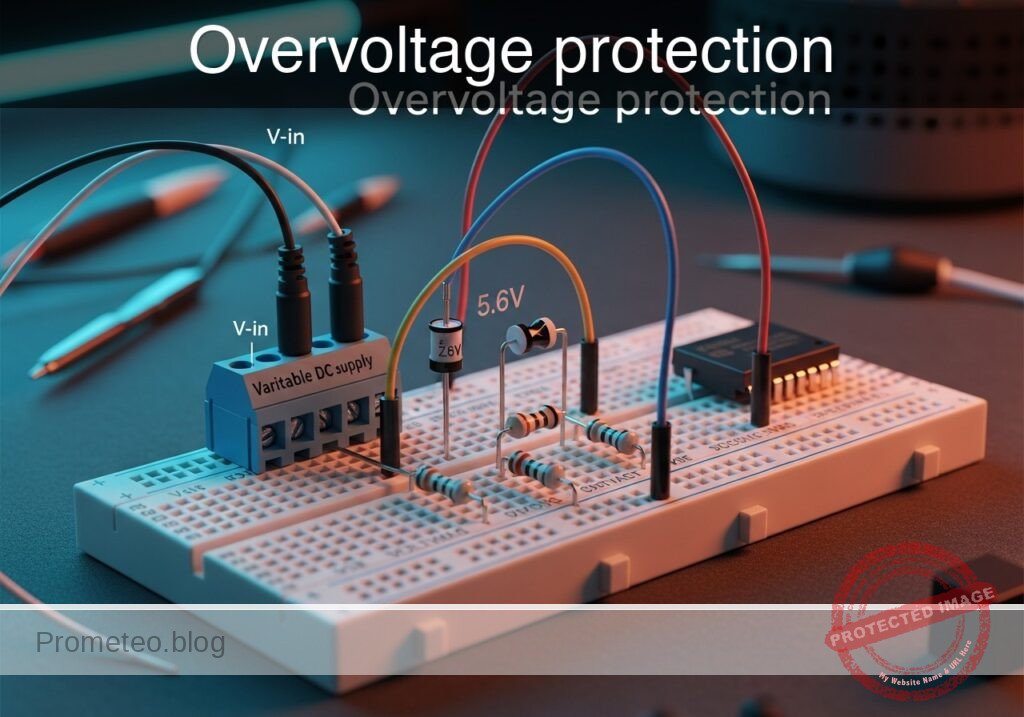
Overvoltage protection prototype (Maker Style)

Level: Medium – Disconnect a critical load using a normally closed relay contact when a voltage threshold is exceeded.

Objective and use case

In this practical case, you will build a hardware-based overvoltage protection circuit. It uses a Zener diode to set a voltage threshold and a bipolar junction transistor (BJT) to actuate an electromechanical relay, mechanically disconnecting power when the voltage spikes to dangerous levels.

This topology is highly useful in real-world scenarios:
– Safeguarding sensitive 5 V microcontrollers from accidental power supply surges.
– Protecting expensive sensors or instruments in automotive environments where alternator spikes occur.
– Ensuring battery-powered or USB-powered devices mechanically cut out during a charger regulator failure.

Expected outcome:
– When the input voltage (v-in) is in the safe range (e.g., 5.0 V), the BJT remains off, the relay is unpowered, and the normally closed (NC) contact feeds power to the load.
– When v-in exceeds the Zener threshold plus the BJT base-emitter drop (around 6.3 V), the Zener conducts.
– Base current flows, the BJT switch turns on, and the relay coil energizes.
– The relay’s NC contact opens, triggering a v-load-disconnect event that drops the load voltage to 0 V.
– Target audience and level: Intermediate electronics students exploring analog voltage thresholds and electromechanical switching.

Materials

  • V1: Variable DC supply (0-9 V), function: provides system input voltage (v-in)
  • D1: 5.6 V Zener diode (e.g., 1N4734 A), function: sets the overvoltage threshold reference
  • R1: 1 kΩ resistor, function: base current limiting for the BJT
  • R2: 10 kΩ resistor, function: base pull-down to ensure the BJT turns off cleanly
  • Q1: 2N3904 NPN transistor, function: relay driver switch
  • D2: 1N4148 or 1N4007 diode, function: flyback protection for the relay coil
  • K1: 5 V SPDT Relay, function: disconnects the load using its normally closed (NC) contact
  • R_LOAD: 100 Ω resistor, function: simulated critical load

Wiring guide

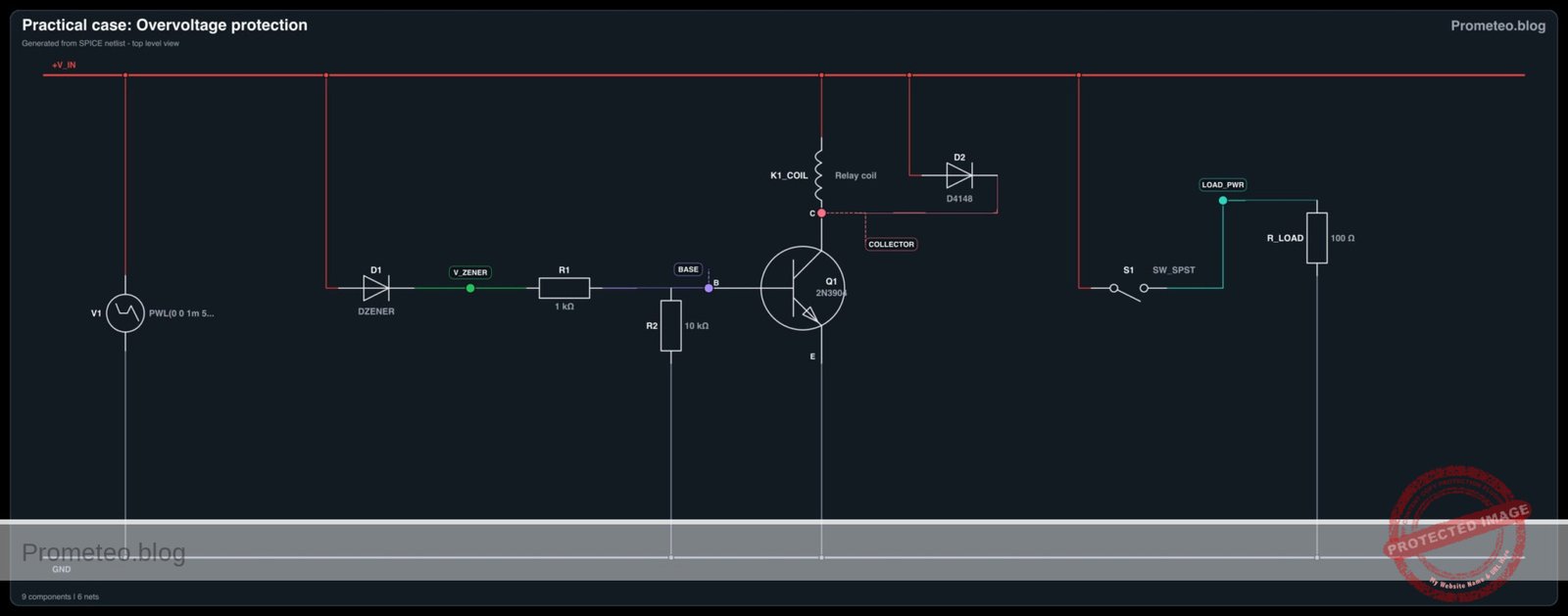
  • V1: positive terminal connects to node V_IN, negative terminal connects to node 0 (GND).
  • D1: cathode connects to node V_IN, anode connects to node V_ZENER.
  • R1: connects between node V_ZENER and node BASE.
  • R2: connects between node BASE and node 0.
  • Q1: collector connects to node COLLECTOR, base connects to node BASE, emitter connects to node 0.
  • K1_COIL: the relay coil connects between node V_IN and node COLLECTOR.
  • D2: cathode connects to node V_IN, anode connects to node COLLECTOR (wired anti-parallel to the relay coil).
  • K1_COM: the relay’s common contact connects to node V_IN.
  • K1_NC: the relay’s normally closed contact connects to node LOAD_PWR.
  • R_LOAD: connects between node LOAD_PWR and node 0.

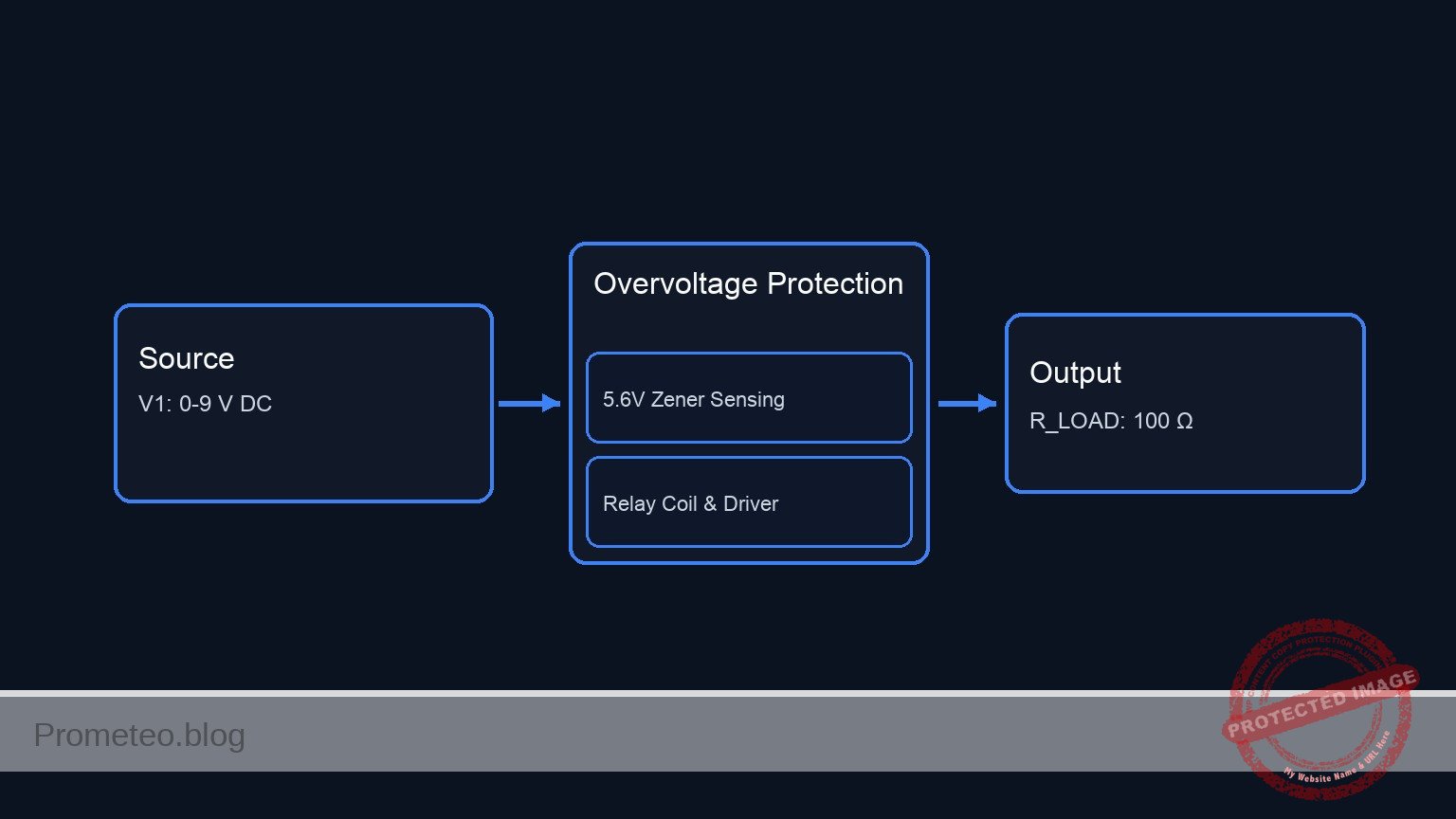
Conceptual block diagram

Conceptual block diagram — Overvoltage Protection
Quick read: inputs → main block → output (actuator or measurement). This summarizes the ASCII schematic below.

Schematic

POWER SOURCE:
[ V1: 0-9 V DC ] --(V_IN)--> System Power
[ V1: Negative ] ---------> GND

1. OVERVOLTAGE SENSING & CONTROL PATH:
V_IN --> [ D1: 5.6 V Zener ] --(V_ZENER)--> [ R1: 1 kΩ ] --(BASE)--> [ Q1:Base ]
                                                             |
                                                        [ R2: 10 kΩ ]
                                                             |
                                                            GND

2. RELAY COIL & DRIVER PATH:
V_IN --> [ K1_COIL || D2: Flyback(Rev) ] --(COLLECTOR)--> [ Q1:Collector ]
                       |                                        |
                (Magnetic Link)                            [ Q1:Emitter ]
                       |                                        |
                       v                                       GND

3. PROTECTED LOAD PATH:
V_IN --> [ K1_COM ] --(Normally Closed)--> [ K1_NC ] --(LOAD_PWR)--> [ R_LOAD: 100 Ω ] --> GND
Electrical Schematic

Electrical diagram

Electrical diagram for case: Overvoltage protection
Generated from the validated SPICE netlist for this case.

🔒 This electrical diagram is premium. With the 7-day pass or the monthly membership you can unlock the complete didactic material and the print-ready PDF pack.🔓 See premium access plans

Measurements and tests

  1. Set the variable power supply V1 to exactly 5.0 V.
  2. Measure v-in relative to ground. Verify it is 5.0 V.
  3. Measure the voltage across the load (LOAD_PWR to 0). It should read 5.0 V, indicating the relay is deactivated and the NC contact is closed.
  4. Slowly increase the voltage of V1. Monitor v-zener (the voltage at the anode of D1). It will remain near 0 V until v-in crosses the ~5.6 V breakdown threshold of the Zener diode.
  5. Push V1 up to 6.5 V. Observe that v-zener rises, pushing current into the base of Q1.
  6. Verify the v-load-disconnect event: listen for the relay click. Measure the voltage at LOAD_PWR; it should instantly drop to 0 V as the NC contact opens, successfully protecting the load.

SPICE netlist and simulation

Reference SPICE Netlist (ngspice) — excerptFull SPICE netlist (ngspice)

* Practical case: Overvoltage protection
.width out=256

* Input Voltage Source (Sweeps from 0V to normal 5V, then overvoltage 9V, then back)
V1 V_IN 0 PWL(0 0 1m 5 4m 5 5m 9 6m 9 7m 5 9m 5 10m 0)

* Zener Diode for threshold detection
D1 V_IN V_ZENER DZENER

* Base resistors for Q1
R1 V_ZENER BASE 1k
R2 BASE 0 10k

* Relay Driver Transistor
Q1 COLLECTOR BASE 0 2N3904

* Relay Coil (Modeled as series inductor and resistor)
L_K1_COIL V_IN K1_COIL_INT 10m
R_K1_COIL K1_COIL_INT COLLECTOR 100

* ... (truncated in public view) ...

Copy this content into a .cir file and run with ngspice.

🔒 Part of this section is premium. With the 7-day pass or the monthly membership you can access the full content (materials, wiring, detailed build, validation, troubleshooting, variants and checklist) and download the complete print-ready PDF pack.

* Practical case: Overvoltage protection
.width out=256

* Input Voltage Source (Sweeps from 0V to normal 5V, then overvoltage 9V, then back)
V1 V_IN 0 PWL(0 0 1m 5 4m 5 5m 9 6m 9 7m 5 9m 5 10m 0)

* Zener Diode for threshold detection
D1 V_IN V_ZENER DZENER

* Base resistors for Q1
R1 V_ZENER BASE 1k
R2 BASE 0 10k

* Relay Driver Transistor
Q1 COLLECTOR BASE 0 2N3904

* Relay Coil (Modeled as series inductor and resistor)
L_K1_COIL V_IN K1_COIL_INT 10m
R_K1_COIL K1_COIL_INT COLLECTOR 100

* Flyback Diode
D2 V_IN COLLECTOR D4148

* Relay Normally Closed (NC) Contact
* Modeled as a voltage-controlled switch controlled by the coil voltage (V_IN - COLLECTOR)
* When Q1 is OFF, coil voltage is 0V -> Switch is CLOSED (roff = 0.1)
* When Q1 is ON, coil voltage is > 6V -> Switch is OPEN (ron = 100meg)
S1 V_IN LOAD_PWR V_IN COLLECTOR RelayNC

* Critical Load
R_LOAD LOAD_PWR 0 100

* Models
.model DZENER D(IS=1e-15 RS=10 N=1 BV=5.6 IBV=5m)
.model D4148 D(IS=1e-14 RS=0.1 N=1)
.model 2N3904 NPN(IS=1E-14 VAF=100 BF=300 IKF=0.4 XTB=1.5 BR=4 CJC=4E-12 CJE=8E-12 RB=20 RC=0.1 RE=0.1 TR=250E-9 TF=350E-12 ITF=1 VTF=2 XTF=3)
.model RelayNC SW(vt=3 vh=0.5 ron=100meg roff=0.1)

* Simulation Directives
.print tran V(V_IN) V(LOAD_PWR) V(BASE) V(COLLECTOR) V(V_ZENER) I(L_K1_COIL)
.tran 10u 10m
.op
.end

Simulation Results (Transient Analysis)

Simulation Results (Transient Analysis)
Analysis: The simulation sweeps the input voltage from 0V to 5V, then up to 9V (overvoltage), and back down. The ngspice results show that when V_IN reaches 9V, the Zener diode conducts, raising V(BASE) to ~1.07V, which turns on Q1. This energizes the relay coil (current reaches ~9mA), opening the NC contact and disconnecting the load (V(LOAD_PWR) drops or follows the switch logic).
Show raw data table (1788 rows)
Index   time            v(v_in)         v(load_pwr)     v(base)         v(collector)    v(v_zener)      l_k1_coil#branc
0	0.000000e+00	0.000000e+00	0.000000e+00	4.369907e-29	1.104363e-28	4.276684e-29	-1.10436e-30
1	1.000000e-07	5.000000e-04	4.995005e-04	2.124049e-05	1.169502e-04	2.124049e-05	3.826672e-09
2	1.128896e-07	5.644481e-04	5.638843e-04	2.436647e-05	1.341994e-04	2.436647e-05	4.380682e-09
3	1.386689e-07	6.933444e-04	6.926518e-04	3.144704e-05	1.734710e-04	3.144704e-05	5.604067e-09
4	1.902274e-07	9.511370e-04	9.501868e-04	5.084817e-05	2.848367e-04	5.084817e-05	8.658258e-09
5	2.933444e-07	1.466722e-03	1.465257e-03	1.084331e-04	6.633002e-04	1.084332e-04	1.622310e-08
6	4.910392e-07	2.455196e-03	2.452743e-03	2.404937e-04	1.923047e-03	2.404937e-04	2.937980e-08
7	6.875077e-07	3.437539e-03	3.434104e-03	3.216141e-04	3.548938e-03	3.216141e-04	3.345128e-08
8	9.631281e-07	4.815640e-03	4.810829e-03	2.723800e-04	5.450903e-03	2.723800e-04	2.308361e-08
9	1.154824e-06	5.774121e-03	5.768352e-03	1.710095e-04	6.210657e-03	1.710095e-04	1.277625e-08
10	1.305686e-06	6.528429e-03	6.521907e-03	1.116498e-04	6.566319e-03	1.116498e-04	9.181046e-09
11	1.495573e-06	7.477865e-03	7.470395e-03	1.085076e-04	7.080935e-03	1.085076e-04	1.256925e-08
12	1.736950e-06	8.684750e-03	8.676074e-03	1.904626e-04	8.232826e-03	1.904626e-04	2.277129e-08
13	2.001986e-06	1.000993e-02	9.999931e-03	2.728041e-04	1.002166e-02	2.728041e-04	2.853663e-08
14	2.256607e-06	1.128304e-02	1.127176e-02	2.568832e-04	1.166727e-02	2.568832e-04	2.342944e-08
15	2.500031e-06	1.250016e-02	1.248767e-02	1.808629e-04	1.277687e-02	1.808630e-04	1.533781e-08
16	2.702903e-06	1.351451e-02	1.350101e-02	1.375223e-04	1.345800e-02	1.375223e-04	1.307538e-08
17	2.944974e-06	1.472487e-02	1.471016e-02	1.562745e-04	1.440894e-02	1.562745e-04	1.754621e-08
18	3.189115e-06	1.594558e-02	1.592965e-02	2.174467e-04	1.574153e-02	2.174467e-04	2.384313e-08
19	3.483820e-06	1.741910e-02	1.740170e-02	2.492948e-04	1.756940e-02	2.492949e-04	2.456373e-08
20	3.789826e-06	1.894913e-02	1.893020e-02	2.050542e-04	1.918736e-02	2.050543e-04	1.855307e-08
21	4.028198e-06	2.014099e-02	2.012087e-02	1.627875e-04	2.016491e-02	1.627876e-04	1.538812e-08
22	4.364653e-06	2.182326e-02	2.180146e-02	1.717346e-04	2.161154e-02	1.717346e-04	1.849039e-08
23	4.749559e-06	2.374779e-02	2.372407e-02	2.249970e-04	2.370014e-02	2.249971e-04	2.340138e-08
... (1764 more rows) ...

Common mistakes and how to avoid them

  • Omitting the flyback diode (D2): Failing to place a diode across the relay coil will result in a massive inductive voltage spike when the transistor turns off, permanently destroying the BJT. Always include the anti-parallel diode.
  • Installing the Zener diode backward: If the Zener is installed forward-biased (anode to V_IN), it will act like a standard diode with a 0.7 V drop. The relay will trigger almost immediately. Ensure the cathode faces the positive input.
  • Wiring the load to the NO contact: If you accidentally connect R_LOAD to the Normally Open (NO) terminal instead of the NC terminal, the load will only receive power during an overvoltage event, which defeats the purpose of the protection circuit.

Troubleshooting

  • Symptom: The relay chatters rapidly or buzzes when the input voltage is right at the threshold (e.g., 6.2 V).
  • Cause: The circuit lacks hysteresis. A slow-moving analog voltage at the exact threshold causes the BJT to partially turn on, putting the relay in an undefined mechanical state.
  • Fix: In a practical setup, overvoltage events are usually fast spikes. For slow-rising voltages, a Schmitt trigger or a latching circuit is required to ensure a clean transition.
  • Symptom: The load never powers on, even at 5.0 V.
  • Cause: The relay might be stuck energized, the BJT is shorted, or the load was mistakenly wired to the NO contact.
  • Fix: Check LOAD_PWR continuity to V_IN while the circuit is unpowered. Replace Q1 if it reads a dead short from collector to emitter.
  • Symptom: The transistor gets exceptionally hot during an overvoltage event.
  • Cause: The input voltage was raised far beyond the threshold (e.g., 12 V into a 5 V relay), causing excessive coil current through the BJT.
  • Fix: Do not exceed the absolute maximum ratings of the relay coil and the 2N3904 transistor. If higher voltages are expected, use a beefier transistor (like a TIP120) or a pre-regulator.

Possible improvements and extensions

  • Add a fault indicator: Connect a red LED with an appropriate current-limiting resistor to the Normally Open (NO) contact. When the overvoltage triggers, the load loses power, and the red LED instantly illuminates to warn the user.
  • Implement a mechanical latch: Wire a secondary contact of the relay (if using a DPDT relay) or an SCR in the base circuit so that once an overvoltage event triggers the relay, it stays locked in the «disconnect» state until the user manually presses a reset button, preventing repeated power cycling.

More Practical Cases on Prometeo.blog

Find this product and/or books on this topic on Amazon

Go to Amazon

As an Amazon Associate, I earn from qualifying purchases. If you buy through this link, you help keep this project running.

Quick Quiz

Question 1: What is the primary objective of the circuit described in the article?


Question 2: Which component is primarily used to set the overvoltage threshold reference?


Question 3: What happens to the relay when the input voltage is in the safe range (e.g., 5.0 V)?


Question 4: At approximately what input voltage does the circuit trigger the overvoltage protection?


Question 5: What happens when the input voltage exceeds the Zener threshold plus the BJT base-emitter drop?


Question 6: How does the load lose power during an overvoltage event?


Question 7: Which of the following is a mentioned use case for this topology?


Question 8: What type of transistor is used to actuate the electromechanical relay?


Question 9: What is the state of the BJT when the input voltage is in the safe range?


Question 10: What is the difficulty level of this practical case as stated in the text?


Carlos Núñez Zorrilla
Electronics & Computer Engineer

Telecommunications Electronics Engineer and Computer Engineer (official degrees in Spain).
Follow me:


Practical case: AND and OR logic using relays

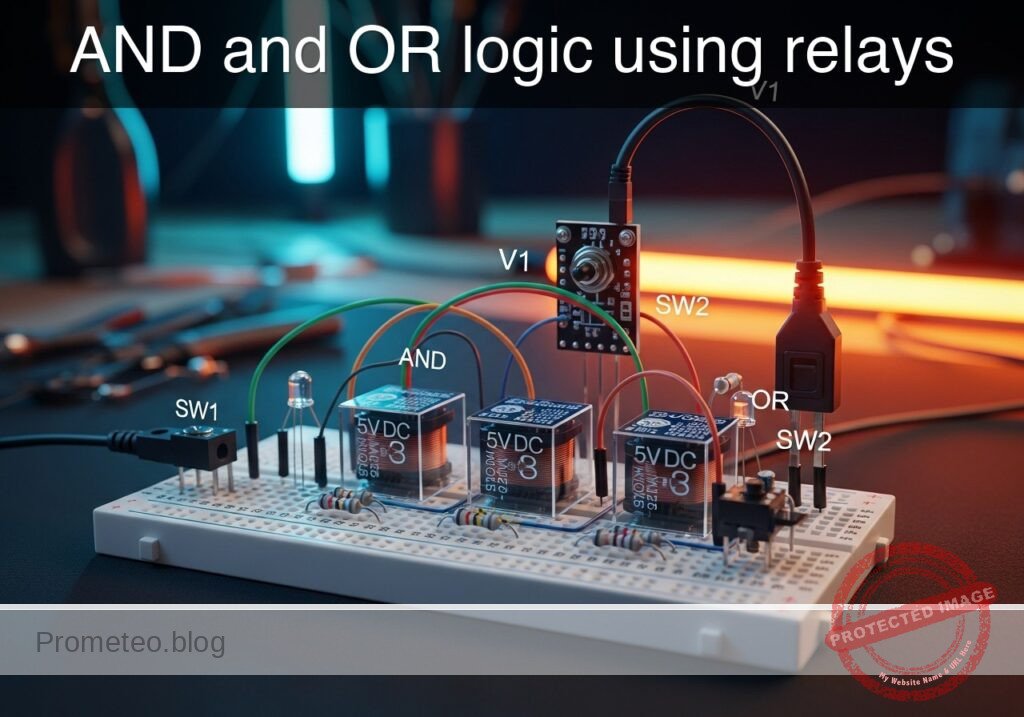
AND and OR logic using relays prototype (Maker Style)

Level: Medium – Build basic logic gates by wiring the contacts of multiple relays in series and parallel.

Objective and use case

  • What you will build: A circuit that utilizes two DPDT (Double Pole Double Throw) electro-mechanical relays to simultaneously demonstrate basic Boolean logic operations (AND and OR gates).
  • Why it is useful:
    • Forms the historical foundation of industrial automation and ladder logic programming.
    • Demonstrates how to handle logic for high-voltage or high-current systems where standard silicon ICs are unsuitable.
    • Provides complete electrical isolation between the control inputs (coils) and the logic outputs (contacts).
    • Illustrates the fundamental fail-safe interlock principles used in heavy machinery and safety circuits.
  • Expected outcome:
    • The AND output (Green LED) will only illuminate when both relay coils are energized (series contacts).
    • The OR output (Red LED) will illuminate when either relay coil is energized (parallel contacts).
    • Successful measurement of control voltages confirming the activation of specific logic paths.
  • Target audience and level: Intermediate electronics students exploring automated control systems and electromechanical switching.

Materials

  • V1: 5 V DC supply, function: power for coils and logic
  • SW1: SPST switch, function: Input A control
  • SW2: SPST switch, function: Input B control
  • K1: 5 V DPDT relay, function: Logic gate element A
  • K2: 5 V DPDT relay, function: Logic gate element B
  • D1: Green LED, function: AND logic output indicator
  • D2: Red LED, function: OR logic output indicator
  • D3: 1N4148 diode, function: K1 flyback protection
  • D4: 1N4148 diode, function: K2 flyback protection
  • R1: 330 Ω resistor, function: D1 current limiting
  • R2: 330 Ω resistor, function: D2 current limiting

Wiring guide

  • V1 connects between VCC and 0.
  • SW1 connects between VCC and node VA.
  • SW2 connects between VCC and node VB.
  • K1 coil connects between node VA and 0.
  • K2 coil connects between node VB and 0.
  • D3 cathode connects to node VA, anode connects to 0 (anti-parallel to K1 coil).
  • D4 cathode connects to node VB, anode connects to 0 (anti-parallel to K2 coil).
  • AND Logic (Series Wiring – Pole 1):
    • K1 Pole 1 Common contact connects to VCC.
    • K1 Pole 1 Normally Open (NO) contact connects to node AND_MID.
    • K2 Pole 1 Common contact connects to node AND_MID.
    • K2 Pole 1 Normally Open (NO) contact connects to node OUT_AND.
  • OR Logic (Parallel Wiring – Pole 2):
    • K1 Pole 2 Common contact connects to VCC.
    • K1 Pole 2 Normally Open (NO) contact connects to node OUT_OR.
    • K2 Pole 2 Common contact connects to VCC.
    • K2 Pole 2 Normally Open (NO) contact connects to node OUT_OR.
  • Outputs:
    • R1 connects between OUT_AND and node D1_ANODE.
    • D1 connects between D1_ANODE and 0 (cathode to ground).
    • R2 connects between OUT_OR and node D2_ANODE.
    • D2 connects between D2_ANODE and 0 (cathode to ground).

Conceptual block diagram

Conceptual block diagram — Relay AND/OR Logic
Quick read: inputs → main block → output (actuator or measurement). This summarizes the ASCII schematic below.

Schematic

[ CONTROL SECTION: RELAY COILS ]

VCC --> [ SW1 (Input A) ] --(VA)--> [ K1 Coil || D3(Rev) ] --> GND
                                          |
                                   (Magnetic Link)
                                          v
                                    (To K1 Poles)

VCC --> [ SW2 (Input B) ] --(VB)--> [ K2 Coil || D4(Rev) ] --> GND
                                          |
                                   (Magnetic Link)
                                          v
                                    (To K2 Poles)


[ AND LOGIC SECTION: SERIES WIRING (POLE 1) ]

VCC --> [ K1 Pole 1 (NO) ] --(AND_MID)--> [ K2 Pole 1 (NO) ] --(OUT_AND)--> [ R1 ] --(D1_ANODE)--> [ D1 (Green LED) ] --> GND


[ OR LOGIC SECTION: PARALLEL WIRING (POLE 2) ]

VCC --> [ K1 Pole 2 (NO) ] --(OUT_OR)--+
                                       |--> [ R2 ] --(D2_ANODE)--> [ D2 (Red LED) ] --> GND
VCC --> [ K2 Pole 2 (NO) ] --(OUT_OR)--+
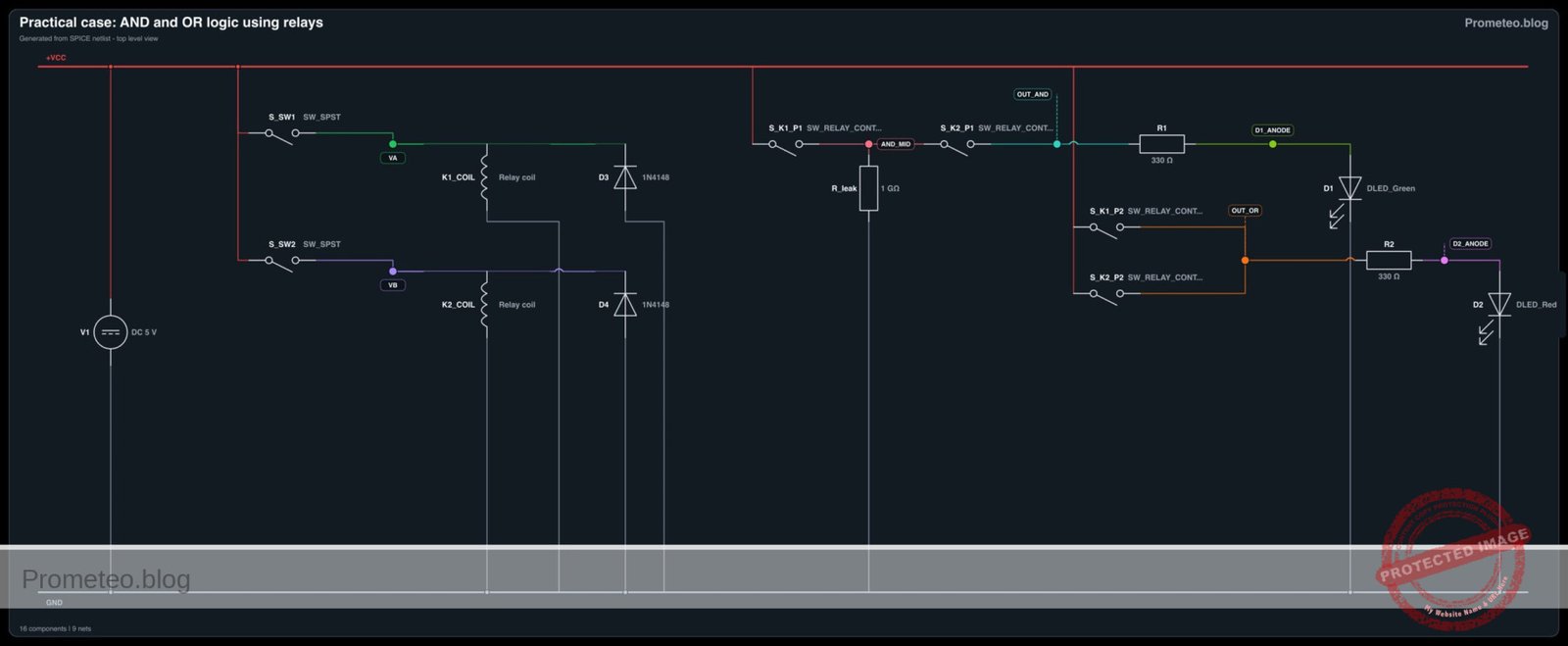
Electrical Schematic

Electrical diagram

Electrical diagram for case: AND and OR logic using relays
Generated from the validated SPICE netlist for this case.

🔒 This electrical diagram is premium. With the 7-day pass or the monthly membership you can unlock the complete didactic material and the print-ready PDF pack.🔓 See premium access plans

Truth table

Switch A (VA) Switch B (VB) K1 State K2 State AND Output (Green LED) OR Output (Red LED)
OFF (0 V) OFF (0 V) Resting Resting OFF (0 V) OFF (0 V)
OFF (0 V) ON (5 V) Resting Energized OFF (0 V) ON (~5 V)
ON (5 V) OFF (0 V) Energized Resting OFF (0 V) ON (~5 V)
ON (5 V) ON (5 V) Energized Energized ON (~5 V) ON (~5 V)

Measurements and tests

  1. Input Verification: Power on V1. Using a multimeter, measure the voltage at nodes VA and VB with respect to 0 (GND). Ensure it reads 0 V when the corresponding switch is open, and 5 V when closed.
  2. Mechanical Operation: Toggle SW1 and SW2 individually. You should hear a distinct mechanical «click» from K1 and K2, confirming coil activation.
  3. OR Gate Testing: Close SW1 only. Measure the voltage at OUT_OR (should be ~5 V) and ensure the Red LED lights up. Repeat this step for SW2 only.
  4. AND Gate Testing: Ensure both SW1 and SW2 are closed. Measure the voltage at OUT_AND (should be ~5 V) and confirm the Green LED lights up. If either switch is opened, the Green LED must turn off.

SPICE netlist and simulation

Reference SPICE Netlist (ngspice) — excerptFull SPICE netlist (ngspice)

* Practical case: AND and OR logic using relays
.width out=256

* Power Supply
V1 VCC 0 DC 5

* Input A Control (SW1)
* Modeled as a voltage-controlled switch toggled by a fast pulse source to simulate user input
S_SW1 VCC VA ctrl_A 0 switch_mod
V_ctrl_A ctrl_A 0 PULSE(0 5 0 1u 1u 100u 200u)

* Input B Control (SW2)
* Modeled as a voltage-controlled switch toggled by a fast pulse source
S_SW2 VCC VB ctrl_B 0 switch_mod
V_ctrl_B ctrl_B 0 PULSE(0 5 0 1u 1u 200u 400u)

* Relay K1 Coil and Flyback Diode
* Coil modeled as an RL series circuit
L_K1 VA K1_mid 1m
R_K1 K1_mid 0 100
* ... (truncated in public view) ...

Copy this content into a .cir file and run with ngspice.

🔒 Part of this section is premium. With the 7-day pass or the monthly membership you can access the full content (materials, wiring, detailed build, validation, troubleshooting, variants and checklist) and download the complete print-ready PDF pack.

* Practical case: AND and OR logic using relays
.width out=256

* Power Supply
V1 VCC 0 DC 5

* Input A Control (SW1)
* Modeled as a voltage-controlled switch toggled by a fast pulse source to simulate user input
S_SW1 VCC VA ctrl_A 0 switch_mod
V_ctrl_A ctrl_A 0 PULSE(0 5 0 1u 1u 100u 200u)

* Input B Control (SW2)
* Modeled as a voltage-controlled switch toggled by a fast pulse source
S_SW2 VCC VB ctrl_B 0 switch_mod
V_ctrl_B ctrl_B 0 PULSE(0 5 0 1u 1u 200u 400u)

* Relay K1 Coil and Flyback Diode
* Coil modeled as an RL series circuit
L_K1 VA K1_mid 1m
R_K1 K1_mid 0 100
D3 0 VA 1N4148

* Relay K2 Coil and Flyback Diode
L_K2 VB K2_mid 1m
R_K2 K2_mid 0 100
D4 0 VB 1N4148

* AND Logic (Series Wiring - Pole 1)
S_K1_P1 VCC AND_MID VA 0 relay_switch
S_K2_P1 AND_MID OUT_AND VB 0 relay_switch
* Anti-floating leak resistor for the midpoint of the series connection
R_leak AND_MID 0 1G 

* OR Logic (Parallel Wiring - Pole 2)
S_K1_P2 VCC OUT_OR VA 0 relay_switch
S_K2_P2 VCC OUT_OR VB 0 relay_switch

* Outputs
R1 OUT_AND D1_ANODE 330
D1 D1_ANODE 0 DLED_Green

R2 OUT_OR D2_ANODE 330
D2 D2_ANODE 0 DLED_Red

* Models
.model switch_mod SW(vt=2.5 vh=0.5 ron=0.1 roff=100MEG)
.model relay_switch SW(vt=2.5 vh=0.5 ron=0.1 roff=100MEG)
.model 1N4148 D(IS=2.682n N=1.836 RS=0.5623 BV=100 IBV=100p CJO=4p M=0.333 VJ=0.5 TT=11.54n)
.model DLED_Green D(IS=1e-20 N=2.2 RS=5)
.model DLED_Red D(IS=1e-15 N=2.0 RS=5)

* Analysis
.tran 1u 500u
.print tran V(VA) V(VB) V(OUT_AND) V(OUT_OR) V(AND_MID) I(L_K1)
.op
.end

Simulation Results (Transient Analysis)

Simulation Results (Transient Analysis)
Analysis: The simulation results match the expected truth table for AND and OR logic. When both inputs are 5V, both outputs are near 5V. When only one input is 5V, only the OR output goes to 5V. The OFF state voltages are non-zero (around 1.6V and 0.9V) due to the finite off-resistance of the switch models, but these are below the LED forward voltages.
Show raw data table (5166 rows)
Index   time            v(va)           v(vb)           v(out_and)      v(out_or)       v(and_mid)      l_k1#branch
0	0.000000e+00	4.999967e-06	4.999967e-06	1.597015e+00	9.421253e-01	3.141436e+00	4.999967e-08
1	1.000000e-08	4.999967e-06	4.999967e-06	1.597015e+00	9.421253e-01	3.141436e+00	4.999967e-08
2	2.000000e-08	4.999967e-06	4.999967e-06	1.597015e+00	9.421253e-01	3.141436e+00	4.999967e-08
3	4.000000e-08	4.999967e-06	4.999967e-06	1.597015e+00	9.421253e-01	3.141436e+00	4.999967e-08
4	8.000000e-08	4.999967e-06	4.999967e-06	1.597015e+00	9.421253e-01	3.141436e+00	4.999967e-08
5	1.600000e-07	4.999967e-06	4.999967e-06	1.597015e+00	9.421253e-01	3.141436e+00	4.999967e-08
6	3.200000e-07	4.999967e-06	4.999967e-06	1.597015e+00	9.421253e-01	3.141436e+00	4.999967e-08
7	3.750000e-07	4.999967e-06	4.999967e-06	1.597015e+00	9.421253e-01	3.141436e+00	4.999967e-08
8	4.712500e-07	4.999967e-06	4.999967e-06	1.597015e+00	9.421253e-01	3.141436e+00	4.999967e-08
9	4.978906e-07	4.999967e-06	4.999967e-06	1.597015e+00	9.421253e-01	3.141436e+00	4.999967e-08
10	5.445117e-07	4.999967e-06	4.999967e-06	1.597015e+00	9.421253e-01	3.141436e+00	4.999967e-08
11	5.574158e-07	4.999967e-06	4.999967e-06	1.597015e+00	9.421253e-01	3.141436e+00	4.999967e-08
12	5.799979e-07	4.999967e-06	4.999967e-06	1.597015e+00	9.421253e-01	3.141436e+00	4.999967e-08
13	6.019875e-07	4.999887e+00	4.999887e+00	4.998416e+00	4.999485e+00	4.999208e+00	5.496234e-05
14	6.174611e-07	5.000094e+00	5.000094e+00	4.998416e+00	4.999485e+00	4.999208e+00	1.321856e-04
15	6.317917e-07	4.999872e+00	4.999872e+00	4.998416e+00	4.999485e+00	4.999208e+00	2.035976e-04
16	6.498539e-07	5.000078e+00	5.000078e+00	4.998416e+00	4.999485e+00	4.999208e+00	2.934595e-04
17	6.859784e-07	4.999845e+00	4.999845e+00	4.998416e+00	4.999485e+00	4.999208e+00	4.726966e-04
18	7.582273e-07	5.000025e+00	5.000025e+00	4.998416e+00	4.999485e+00	4.999208e+00	8.292335e-04
19	9.027252e-07	4.999739e+00	4.999739e+00	4.998416e+00	4.999485e+00	4.999208e+00	1.534627e-03
20	1.000000e-06	4.999907e+00	4.999907e+00	4.998416e+00	4.999485e+00	4.999208e+00	2.003774e-03
21	1.028900e-06	4.999786e+00	4.999786e+00	4.998416e+00	4.999485e+00	4.999208e+00	2.142075e-03
22	1.086699e-06	4.999758e+00	4.999758e+00	4.998416e+00	4.999485e+00	4.999208e+00	2.417880e-03
23	1.202297e-06	4.999704e+00	4.999704e+00	4.998416e+00	4.999485e+00	4.999208e+00	2.964729e-03
... (5142 more rows) ...

Common mistakes and how to avoid them

  • Omitting flyback diodes: Failing to include D3 and D4 can cause high voltage spikes when the switches are opened, which can damage the switches or surrounding sensitive electronics. Always wire them in reverse-bias across the coils.
  • Confusing NO and NC contacts: Accidentally wiring to the Normally Closed (NC) pin instead of the Normally Open (NO) pin will invert the logic, effectively creating NAND/NOR conditions instead of AND/OR. Double-check your relay’s datasheet or pinout.
  • Insufficient power supply current: Relays consume significantly more current than digital ICs (often 50–100 mA per coil). Ensure your 5 V supply can comfortably deliver at least 300 mA to prevent voltage dips when both relays are energized.

Troubleshooting

  • Symptom: Neither LED lights up under any switch combination, and no «clicks» are heard.
    • Cause: Power supply V1 is disconnected, dead, or current-limited.
    • Fix: Verify VCC and 0 connections to the main supply and check the supply limits.
  • Symptom: Relays click when switches are pressed, but LEDs never turn on.
    • Cause: The control side (coils) is working, but the logic side (contacts) is unpowered.
    • Fix: Verify that VCC is properly routed to the Common pins of both poles on K1 and K2.
  • Symptom: Power supply resets or dips severely when a switch is pressed.
    • Cause: A flyback diode (D3 or D4) is installed backward, creating a direct short circuit to ground when the switch closes.
    • Fix: Check diode orientation; the cathode (striped side) must face the positive incoming voltage (VA or VB).
  • Symptom: The AND logic acts like an OR logic.
    • Cause: The contacts for the AND gate were wired in parallel instead of series.
    • Fix: Inspect the node AND_MID. VCC should strictly flow through K1 into K2, not directly to both.

Possible improvements and extensions

  • Implement a NOT Gate (Inverter): Add a third relay or utilize an unused pole. Route VCC through its Normally Closed (NC) contact so that the output turns OFF when the relay is energized.
  • Build an XOR (Exclusive OR) Circuit: Using both poles of two SPDT/DPDT relays, wire the NO contact of K1 to the NC contact of K2, and the NC contact of K1 to the NO contact of K2. This implements a 2-way lighting circuit logic using relays.

More Practical Cases on Prometeo.blog

Find this product and/or books on this topic on Amazon

Go to Amazon

As an Amazon Associate, I earn from qualifying purchases. If you buy through this link, you help keep this project running.

Quick Quiz

Question 1: What is the primary objective of the circuit described in the article?


Question 2: How are the relay contacts wired to create an AND logic gate?


Question 3: Which component is used to indicate the output of the OR logic gate?


Question 4: What type of relays are used as logic gate elements in this circuit?


Question 5: Why is using relays for logic useful in certain industrial applications?


Question 6: What does the circuit provide between the control inputs and the logic outputs?


Question 7: Under what condition will the Green LED (AND output) illuminate?


Question 8: What forms the historical foundation of industrial automation according to the text?


Question 9: How are the relay contacts wired to form an OR gate?


Question 10: What fundamental principle used in heavy machinery and safety circuits does this project illustrate?


Carlos Núñez Zorrilla
Electronics & Computer Engineer

Telecommunications Electronics Engineer and Computer Engineer (official degrees in Spain).
Follow me:


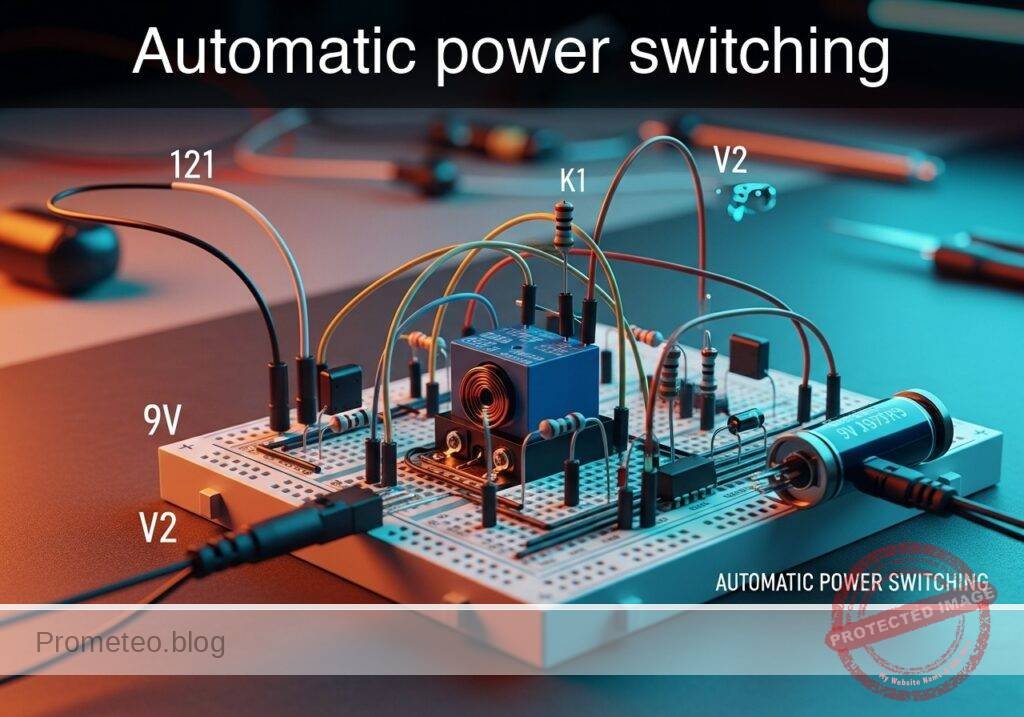
Practical case: Automatic power switching

Automatic power switching prototype (Maker Style)

Level: Medium – Implement an SPDT relay to automatically alternate between a main power supply and a backup battery.

Objective and use case

In this practical case, you will build a power management circuit using a Single Pole Double Throw (SPDT) relay. The circuit will automatically switch a connected load to a backup battery whenever the main power supply fails.

This automated switching topology is highly useful in several real-world applications:
* Uninterruptible Power Supplies (UPS) for routers and critical network equipment.
* Alarm and security systems that require continuous operation during grid power outages.
* Medical monitoring devices that must remain functional during patient transport.
* Solar power systems that automatically switch to battery power after sunset.

Expected outcome:
* When the main supply (V_MAIN) is active, the relay coil energizes, and the load connects to the Normally Open (NO) contact powered by the main supply.
* When the main supply fails (drops to 0 V), the relay de-energizes, seamlessly transferring the load to the Normally Closed (NC) contact powered by the backup battery.
* The load voltage (V_LOAD_OUT) remains continuous, save for a minor mechanical switching delay.
* A visual LED indicator successfully reports the presence of the main power supply.

Target audience: Hobbyists and intermediate electronics students learning about electromechanical relays and power redundancy.

Materials

  • V1: 12 V DC supply, function: main power source
  • V2: 9 V DC supply, function: backup battery source
  • K1: 12 V SPDT relay, function: automatic power switch
  • D1: 1N4007 diode, function: flyback diode to protect against relay coil voltage spikes
  • D2: Red LED, function: main power indicator
  • R1: 1 kΩ resistor, function: LED current limiting
  • R2: 100 Ω resistor, function: simulated system load

Wiring guide

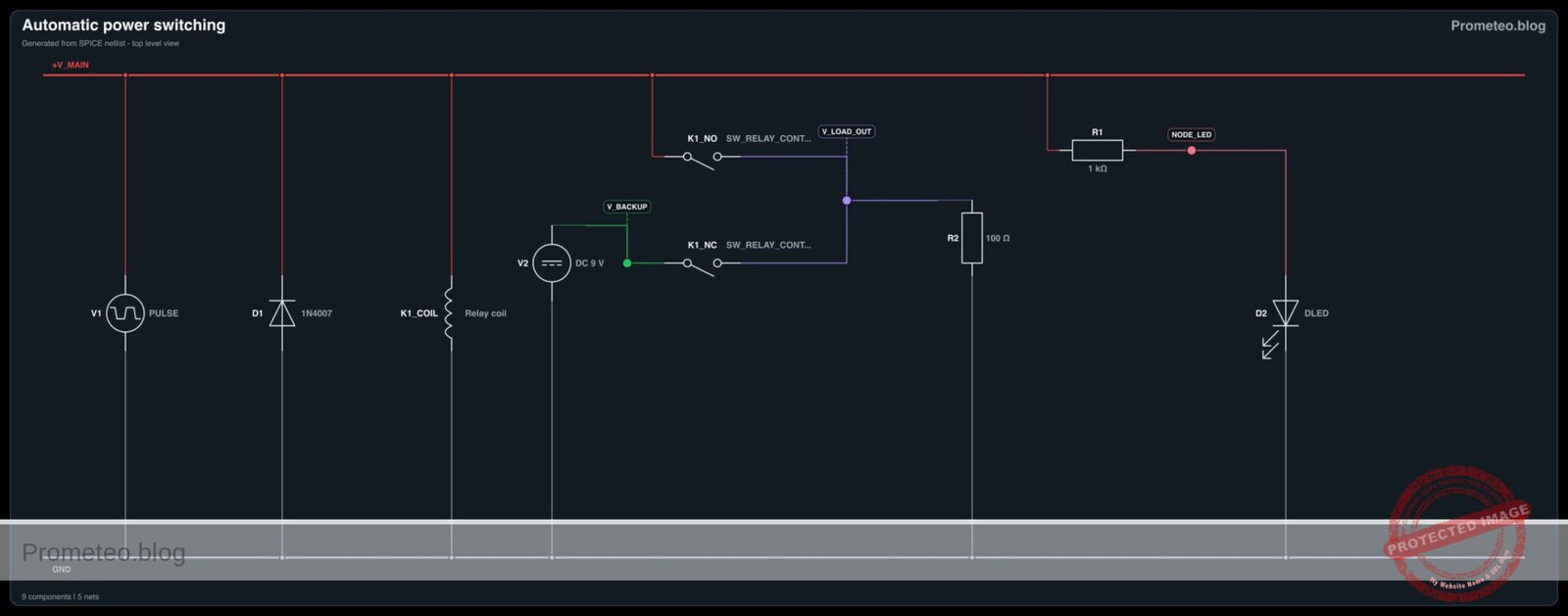
  • V1: Connect positive terminal to V_MAIN and negative terminal to 0 (GND).
  • V2: Connect positive terminal to V_BACKUP and negative terminal to 0 (GND).
  • K1 (Coil): Connect one side to V_MAIN and the other side to 0 (GND).
  • D1: Connect parallel to the K1 coil. Connect the cathode to V_MAIN and the anode to 0 (GND).
  • K1 (NO Contact): Connect the Normally Open terminal to V_MAIN.
  • K1 (NC Contact): Connect the Normally Closed terminal to V_BACKUP.
  • K1 (COM Contact): Connect the Common terminal to V_LOAD_OUT.
  • R2: Connect between V_LOAD_OUT and 0 (GND).
  • R1: Connect between V_MAIN and NODE_LED.
  • D2: Connect the anode to NODE_LED and the cathode to 0 (GND).

Conceptual block diagram

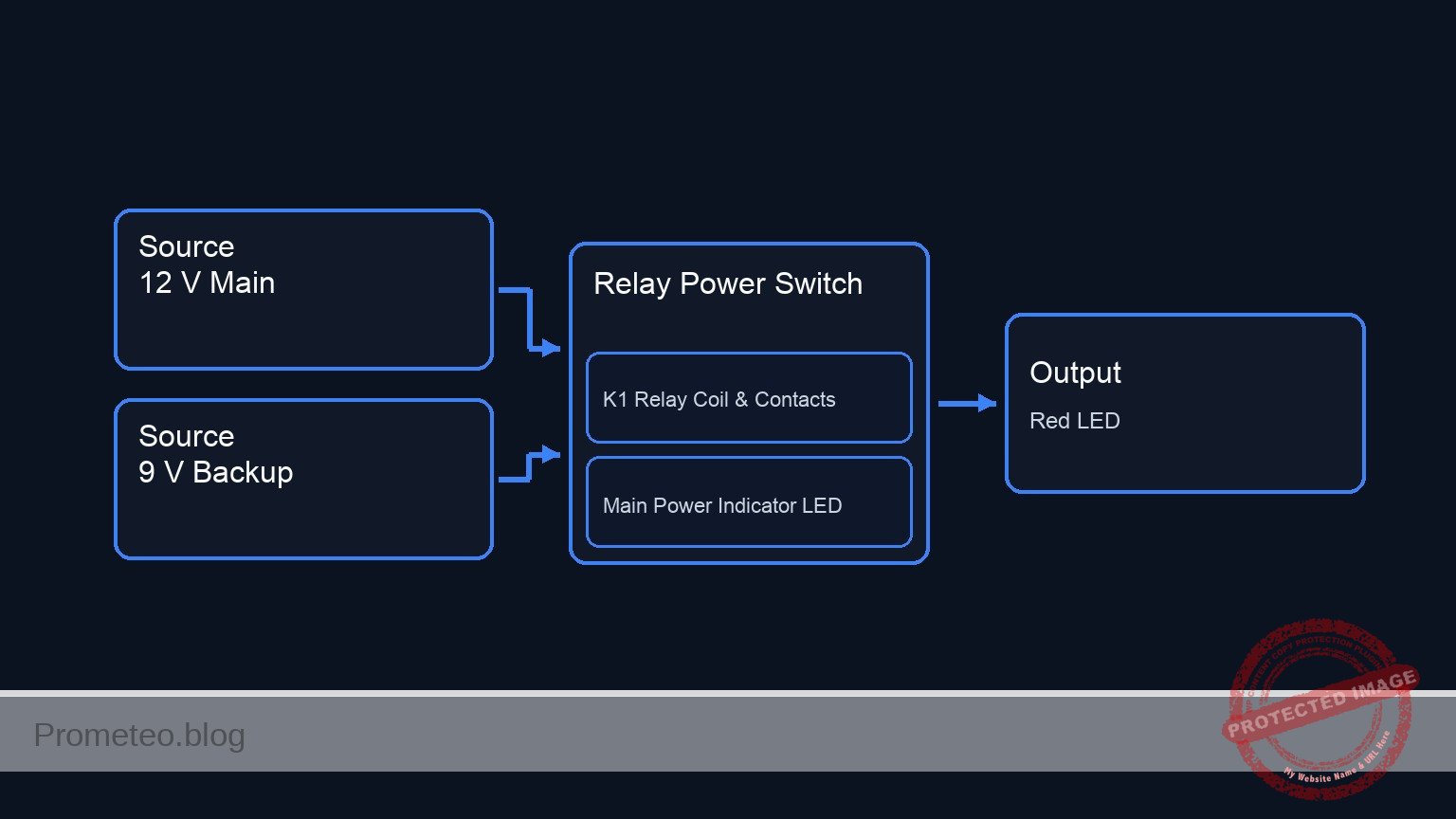
Conceptual block diagram — Relay Power Switch
Quick read: inputs → main block → output (actuator or measurement). This summarizes the ASCII schematic below.

Schematic

[ V1: 12 V Main ] --(V_MAIN)--> [ K1 Coil || D1 (Rev) ] --> GND
                                       |
                                 (Magnetic Link)
                                       v
[ V1: 12 V Main ] --(V_MAIN)--> [ K1: NO Contact ] --+
                                                    |
                                                  (COM)--> [ V_LOAD_OUT ] --> [ R2: 100 Ω Load ] --> GND
                                                    |
[ V2: 9 V Backup ] -(V_BACKUP)-> [ K1: NC Contact ] -+

[ V1: 12 V Main ] --(V_MAIN)--> [ R1: 1 kΩ ] --(NODE_LED)--> [ D2: Red LED ] --> GND
Electrical Schematic

Electrical diagram

Electrical diagram for case: Automatic power switching
Generated from the validated SPICE netlist for this case.

🔒 This electrical diagram is premium. With the 7-day pass or the monthly membership you can unlock the complete didactic material and the print-ready PDF pack.🔓 See premium access plans

Measurements and tests

  1. Connect and activate both V1 (12 V) and V2 (9 V).
  2. Measure the voltage at V_MAIN and V_BACKUP with a multimeter to verify both sources are stable.
  3. Measure the voltage at V_LOAD_OUT. It should read approximately 12 V. The relay should emit an audible «click» upon power-up, and the indicator LED (D2) should be brightly lit.
  4. Disconnect V1 to simulate a power outage (V_MAIN drops to 0 V).
  5. Measure the voltage at V_LOAD_OUT again. It should now read approximately 9 V, confirming the load has successfully transferred to the backup battery. The LED should turn off.
  6. Reconnect V1. Observe the relay clicking again as V_LOAD_OUT returns to 12 V.

SPICE netlist and simulation

Reference SPICE Netlist (ngspice) — excerptFull SPICE netlist (ngspice)

* Automatic power switching
.width out=256

* Power Sources
V1 V_MAIN 0 PULSE(12 0 200u 1u 1u 200u 500u)
V2 V_BACKUP 0 DC 9

* K1 Relay Coil (modeled as series inductor and resistor)
L_K1 V_MAIN K1_COIL_INT 1m
R_K1 K1_COIL_INT 0 400

* K1 Relay Contacts (modeled as voltage-controlled switches)
* Normally Open (NO) contact between V_MAIN and V_LOAD_OUT, controlled by V_MAIN
S_K1_NO V_MAIN V_LOAD_OUT V_MAIN 0 Relay_NO
* Normally Closed (NC) contact between V_BACKUP and V_LOAD_OUT, controlled by inverted V_MAIN
S_K1_NC V_BACKUP V_LOAD_OUT 0 V_MAIN Relay_NC

* D1 Flyback Diode (Anode to 0, Cathode to V_MAIN)
D1 0 V_MAIN 1N4007

* ... (truncated in public view) ...

Copy this content into a .cir file and run with ngspice.

🔒 Part of this section is premium. With the 7-day pass or the monthly membership you can access the full content (materials, wiring, detailed build, validation, troubleshooting, variants and checklist) and download the complete print-ready PDF pack.

* Automatic power switching
.width out=256

* Power Sources
V1 V_MAIN 0 PULSE(12 0 200u 1u 1u 200u 500u)
V2 V_BACKUP 0 DC 9

* K1 Relay Coil (modeled as series inductor and resistor)
L_K1 V_MAIN K1_COIL_INT 1m
R_K1 K1_COIL_INT 0 400

* K1 Relay Contacts (modeled as voltage-controlled switches)
* Normally Open (NO) contact between V_MAIN and V_LOAD_OUT, controlled by V_MAIN
S_K1_NO V_MAIN V_LOAD_OUT V_MAIN 0 Relay_NO
* Normally Closed (NC) contact between V_BACKUP and V_LOAD_OUT, controlled by inverted V_MAIN
S_K1_NC V_BACKUP V_LOAD_OUT 0 V_MAIN Relay_NC

* D1 Flyback Diode (Anode to 0, Cathode to V_MAIN)
D1 0 V_MAIN 1N4007

* Main Power Indicator
R1 V_MAIN NODE_LED 1k
D2 NODE_LED 0 DLED

* Simulated System Load
R2 V_LOAD_OUT 0 100

* Component Models
.model 1N4007 D(IS=7.02767n RS=0.0341512 N=1.80803 EG=1.05743 XTI=5 BV=1000 IBV=5e-08 CJO=1e-11 VJ=0.7 M=0.5 FC=0.5 TT=1e-07)
.model DLED D(IS=1e-15 RS=10 N=2.0)
.model Relay_NO SW(vt=6 vh=0.5 ron=0.05 roff=10Meg)
.model Relay_NC SW(vt=-6 vh=0.5 ron=0.05 roff=10Meg)

* Analysis Directives
.op
.tran 1u 500u
.print tran V(V_MAIN) V(V_LOAD_OUT) V(V_BACKUP) V(NODE_LED) I(L_K1)

.end

Simulation Results (Transient Analysis)

Simulation Results (Transient Analysis)
Analysis: The simulation shows V_MAIN starting at 12V, during which V_LOAD_OUT is approximately 12V. At t=200us, V_MAIN drops to 0V, and V_LOAD_OUT seamlessly switches to the 9V backup supply. When V_MAIN recovers at t=400us, V_LOAD_OUT returns to 12V.
Show raw data table (557 rows)
Index   time            v(v_main)       v(v_load_out)   v(v_backup)     v(node_led)     l_k1#branch
0	0.000000e+00	1.200000e+01	1.199400e+01	9.000000e+00	1.653685e+00	3.000000e-02
1	1.000000e-08	1.200000e+01	1.199400e+01	9.000000e+00	1.653685e+00	3.000000e-02
2	2.000000e-08	1.200000e+01	1.199400e+01	9.000000e+00	1.653685e+00	3.000000e-02
3	4.000000e-08	1.200000e+01	1.199400e+01	9.000000e+00	1.653685e+00	3.000000e-02
4	8.000000e-08	1.200000e+01	1.199400e+01	9.000000e+00	1.653685e+00	3.000000e-02
5	1.600000e-07	1.200000e+01	1.199400e+01	9.000000e+00	1.653685e+00	3.000000e-02
6	3.200000e-07	1.200000e+01	1.199400e+01	9.000000e+00	1.653685e+00	3.000000e-02
7	6.400000e-07	1.200000e+01	1.199400e+01	9.000000e+00	1.653685e+00	3.000000e-02
8	1.280000e-06	1.200000e+01	1.199400e+01	9.000000e+00	1.653685e+00	3.000000e-02
9	2.280000e-06	1.200000e+01	1.199400e+01	9.000000e+00	1.653685e+00	3.000000e-02
10	3.280000e-06	1.200000e+01	1.199400e+01	9.000000e+00	1.653685e+00	3.000000e-02
11	4.280000e-06	1.200000e+01	1.199400e+01	9.000000e+00	1.653685e+00	3.000000e-02
12	5.280000e-06	1.200000e+01	1.199400e+01	9.000000e+00	1.653685e+00	3.000000e-02
13	6.280000e-06	1.200000e+01	1.199400e+01	9.000000e+00	1.653685e+00	3.000000e-02
14	7.280000e-06	1.200000e+01	1.199400e+01	9.000000e+00	1.653685e+00	3.000000e-02
15	8.280000e-06	1.200000e+01	1.199400e+01	9.000000e+00	1.653685e+00	3.000000e-02
16	9.280000e-06	1.200000e+01	1.199400e+01	9.000000e+00	1.653685e+00	3.000000e-02
17	1.028000e-05	1.200000e+01	1.199400e+01	9.000000e+00	1.653685e+00	3.000000e-02
18	1.128000e-05	1.200000e+01	1.199400e+01	9.000000e+00	1.653685e+00	3.000000e-02
19	1.228000e-05	1.200000e+01	1.199400e+01	9.000000e+00	1.653685e+00	3.000000e-02
20	1.328000e-05	1.200000e+01	1.199400e+01	9.000000e+00	1.653685e+00	3.000000e-02
21	1.428000e-05	1.200000e+01	1.199400e+01	9.000000e+00	1.653685e+00	3.000000e-02
22	1.528000e-05	1.200000e+01	1.199400e+01	9.000000e+00	1.653685e+00	3.000000e-02
23	1.628000e-05	1.200000e+01	1.199400e+01	9.000000e+00	1.653685e+00	3.000000e-02
... (533 more rows) ...

Common mistakes and how to avoid them

  • Relay coil voltage mismatch: Using a 5 V relay on a 12 V line will cause the coil to overheat and fail quickly. Always ensure the relay’s rated coil voltage matches the main supply voltage exactly.
  • Omitting the flyback diode: Failing to install the reverse-biased diode across the relay coil can result in high-voltage spikes when the main power is abruptly disconnected, potentially damaging parallel components on the main power bus.
  • Reversing NO and NC contacts: Wiring the backup battery to the NO contact and the main supply to the NC contact will result in a dead system when the main power fails. Verify the relay pinout before soldering or powering the circuit.

Troubleshooting

  • Symptom: The load completely loses power when the main supply drops.
    • Cause: The backup battery is either dead or connected to the Normally Open (NO) terminal instead of the Normally Closed (NC) terminal.
    • Fix: Measure the battery voltage independently, then verify its connection to the NC terminal of the relay.
  • Symptom: The relay chatters or buzzes continuously instead of switching cleanly.
    • Cause: The main power supply cannot provide enough current for both the relay coil and the load, causing the voltage to repeatedly dip below the relay’s hold threshold.
    • Fix: Upgrade the main power supply to a higher current rating, or add a large smoothing capacitor across the V_MAIN line.
  • Symptom: The indicator LED does not light up, but the switching works.
    • Cause: The LED is inserted with reverse polarity, or the current limiting resistor is disconnected.
    • Fix: Verify that the flat side (cathode) of the LED is connected to ground.

Possible improvements and extensions

  • Add a large electrolytic capacitor (e.g., 1000 µF) in parallel with the load (R2) to smooth out the brief power interruption (brownout) caused by the mechanical switching time of the relay contacts.
  • Replace the mechanical relay with a solid-state diode OR-ing circuit (using Schottky diodes) for completely seamless, zero-delay switching without any moving parts.

More Practical Cases on Prometeo.blog

Find this product and/or books on this topic on Amazon

Go to Amazon

As an Amazon Associate, I earn from qualifying purchases. If you buy through this link, you help keep this project running.

Quick Quiz

Question 1: What is the primary function of the SPDT relay in this circuit?


Question 2: What does SPDT stand for in the context of relays?


Question 3: Which contact does the load connect to when the main supply (V_MAIN) is active?


Question 4: What happens to the relay coil when the main power supply fails?


Question 5: Which contact is powered by the backup battery in this circuit?


Question 6: Which of the following is a real-world application for this automated switching topology?


Question 7: What is the expected behavior of the load voltage (V_LOAD_OUT) during the switch?


Question 8: Why is this circuit useful for alarm and security systems?


Question 9: In a solar power system using this topology, when does the system automatically switch to battery power?


Question 10: What triggers the relay to switch the load back to the main power supply?


Carlos Núñez Zorrilla
Electronics & Computer Engineer

Telecommunications Electronics Engineer and Computer Engineer (official degrees in Spain).

Follow me:


Practical case: Noise suppression with RF choke

Level: Medium – Demonstrate the high impedance of the inductor at high frequencies to block noise in power lines.

Objective and use case

You will construct an LR low-pass filter using an RF choke to isolate a DC power line from high-frequency AC noise. By superimposing an AC signal onto a DC voltage supply, you will observe how the inductor’s frequency-dependent reactance permits DC to pass while heavily attenuating high-frequency noise before it reaches the load.

This circuit concept is highly useful in the real world for:
* Preventing high-frequency switching noise from entering sensitive analog sensor circuits.
* Filtering out radio frequency interference (RFI) from long power supply lines.
* Isolating different functional blocks that share a common power rail on a PCB.
* Protecting automotive audio and communication electronics from alternator whine.

Expected outcome:
* The mixed input signal (V_IN_MIX) will display a steady DC offset combined with significant high-frequency ripples.
* The output voltage (V_OUT_CLEAN) across the load will show a stable DC level with the AC noise vastly reduced.
* An FFT (Fast Fourier Transform) analysis of the input will reveal a large 0 Hz (DC) component and a prominent high-frequency peak.
* An FFT analysis of the output will show the high-frequency peak almost completely suppressed, confirming the choke’s blocking action.

Target audience: Intermediate electronics students learning about reactive components and AC/DC superimposition.

Materials

  • V1: 5 V DC source, function: main DC power supply
  • V2: 500 mV peak sine wave AC source at 100 kHz, function: high-frequency noise simulator
  • L1: 1 mH inductor, function: RF choke to block high-frequency noise
  • R1: 100 Ω resistor, function: load simulation

Wiring guide

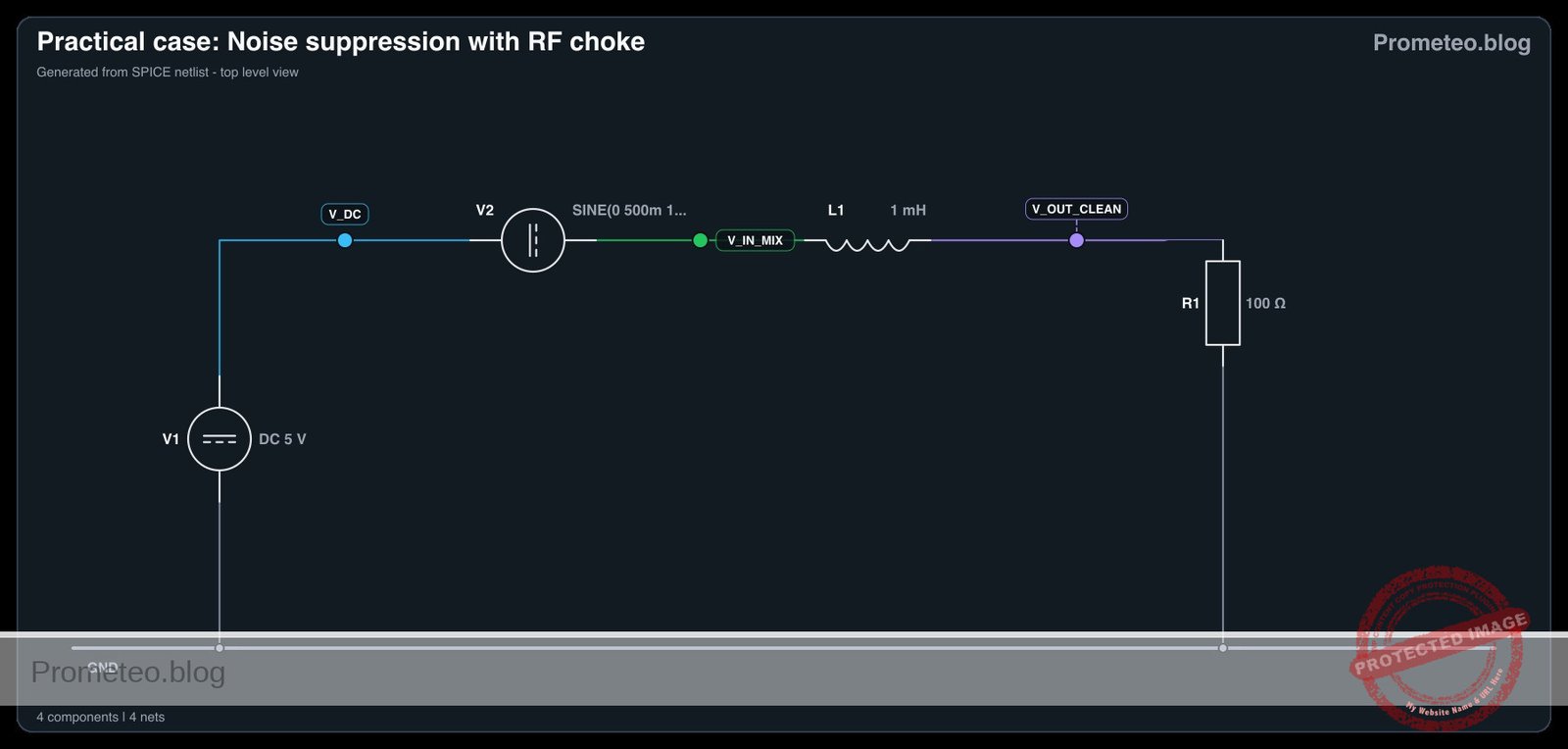
  • V1: connects between V_DC and 0
  • V2: connects between V_IN_MIX and V_DC
  • L1: connects between V_IN_MIX and V_OUT_CLEAN
  • R1: connects between V_OUT_CLEAN and 0

Conceptual block diagram

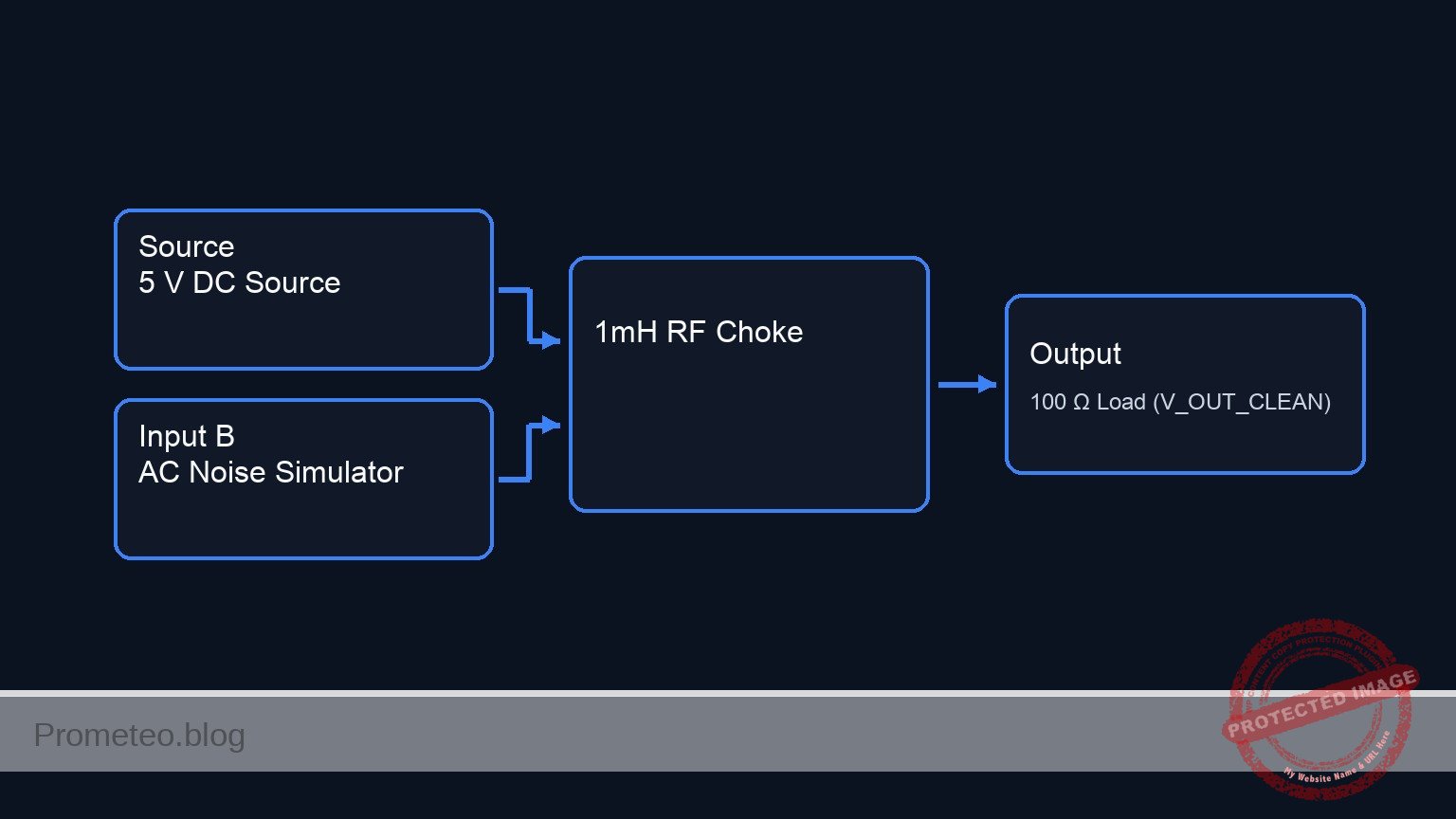
Conceptual block diagram — 1mH RF Choke
Quick read: inputs → main block → output (actuator or measurement). This summarizes the ASCII schematic below.

Schematic

[ V1: 5 V DC Source ] --(V_DC)--> [ V2: AC Noise Simulator ] --(V_IN_MIX)--> [ L1: 1mH RF Choke ] --(V_OUT_CLEAN)--> [ R1: 100 Ω Load ] --> GND
Electrical Schematic

Electrical diagram

Electrical diagram for case: Practical case: Noise suppression with RF choke
Generated from the validated SPICE netlist for this case.

🔒 This electrical diagram is premium. With the 7-day pass or the monthly membership you can unlock the complete didactic material and the print-ready PDF pack.🔓 See premium access plans

Measurements and tests

  1. Connect an oscilloscope probe to V_IN_MIX with the ground clip attached to node 0. Set the channel coupling to DC. You should observe a 5 V DC baseline with a 1 V peak-to-peak 100 kHz sine wave riding on top of it.
  2. Connect a second oscilloscope probe to V_OUT_CLEAN. Observe that the DC voltage remains at approximately 5 V, but the high-frequency 100 kHz ripple is drastically attenuated due to the high inductive reactance (XL = 2\pi fL) of the choke.
  3. Activate the FFT (Fast Fourier Transform) math function on the oscilloscope for the V_IN_MIX channel. Note the massive spike at 0 Hz (representing the 5 V DC component) and the distinct noise spike at 100 kHz.
  4. Apply the FFT function to the V_OUT_CLEAN channel. Compare the magnitude of the 100 kHz spike against the input measurement; it should be significantly reduced, successfully proving the inductor’s high-frequency blocking capabilities.

SPICE netlist and simulation

Reference SPICE Netlist (ngspice) — excerptFull SPICE netlist (ngspice)

* Noise suppression with RF choke
.width out=256

* Main DC power supply (5V)
V1 V_DC 0 DC 5

* High-frequency noise simulator (500mV peak, 100kHz sine wave superimposed on DC)
V2 V_IN_MIX V_DC SINE(0 500m 100k)

* RF choke to block high-frequency noise (1mH)
L1 V_IN_MIX V_OUT_CLEAN 1m

* Load simulation (100 ohms)
* ... (truncated in public view) ...

Copy this content into a .cir file and run with ngspice.

🔒 Part of this section is premium. With the 7-day pass or the monthly membership you can access the full content (materials, wiring, detailed build, validation, troubleshooting, variants and checklist) and download the complete print-ready PDF pack.

* Noise suppression with RF choke
.width out=256

* Main DC power supply (5V)
V1 V_DC 0 DC 5

* High-frequency noise simulator (500mV peak, 100kHz sine wave superimposed on DC)
V2 V_IN_MIX V_DC SINE(0 500m 100k)

* RF choke to block high-frequency noise (1mH)
L1 V_IN_MIX V_OUT_CLEAN 1m

* Load simulation (100 ohms)
R1 V_OUT_CLEAN 0 100

* Analysis directives
.op
* Simulate for 100us to capture 10 full cycles of the 100kHz noise
.tran 0.1u 100u
.print tran V(V_IN_MIX) V(V_OUT_CLEAN) V(V_DC) I(L1)

.end

Simulation Results (Transient Analysis)

Simulation Results (Transient Analysis)
Analysis: The simulation shows a 5V DC signal with a superimposed 500mV peak 100kHz sine wave at the input (V_IN_MIX ranges from 4.5V to 5.5V). At the output (V_OUT_CLEAN), the voltage ranges from 4.92V to 5.12V, indicating that the 1mH RF choke significantly attenuates the high-frequency noise while passing the DC component to the 100-ohm load.
Show raw data table (1008 rows)
Index   time            v(v_in_mix)     v(v_out_clean)  v(v_dc)         l1#branch
0	0.000000e+00	5.000000e+00	5.000000e+00	5.000000e+00	5.000000e-02
1	1.000000e-09	5.000314e+00	5.000000e+00	5.000000e+00	5.000000e-02
2	2.000000e-09	5.000628e+00	5.000000e+00	5.000000e+00	5.000000e-02
3	4.000000e-09	5.001257e+00	5.000000e+00	5.000000e+00	5.000000e-02
4	8.000000e-09	5.002513e+00	5.000001e+00	5.000000e+00	5.000001e-02
5	1.600000e-08	5.005026e+00	5.000004e+00	5.000000e+00	5.000004e-02
6	3.200000e-08	5.010052e+00	5.000016e+00	5.000000e+00	5.000016e-02
7	6.400000e-08	5.020101e+00	5.000064e+00	5.000000e+00	5.000064e-02
8	1.280000e-07	5.040169e+00	5.000256e+00	5.000000e+00	5.000256e-02
9	2.280000e-07	5.071384e+00	5.000808e+00	5.000000e+00	5.000808e-02
10	3.280000e-07	5.102316e+00	5.001665e+00	5.000000e+00	5.001665e-02
11	4.280000e-07	5.132845e+00	5.002818e+00	5.000000e+00	5.002818e-02
12	5.280000e-07	5.162850e+00	5.004261e+00	5.000000e+00	5.004261e-02
13	6.280000e-07	5.192212e+00	5.005985e+00	5.000000e+00	5.005985e-02
14	7.280000e-07	5.220816e+00	5.007980e+00	5.000000e+00	5.007980e-02
15	8.280000e-07	5.248548e+00	5.010236e+00	5.000000e+00	5.010236e-02
16	9.280000e-07	5.275299e+00	5.012741e+00	5.000000e+00	5.012741e-02
17	1.028000e-06	5.300963e+00	5.015481e+00	5.000000e+00	5.015481e-02
18	1.128000e-06	5.325440e+00	5.018443e+00	5.000000e+00	5.018443e-02
19	1.228000e-06	5.348633e+00	5.021613e+00	5.000000e+00	5.021613e-02
20	1.328000e-06	5.370449e+00	5.024976e+00	5.000000e+00	5.024976e-02
21	1.428000e-06	5.390804e+00	5.028515e+00	5.000000e+00	5.028515e-02
22	1.528000e-06	5.409616e+00	5.032213e+00	5.000000e+00	5.032213e-02
23	1.628000e-06	5.426812e+00	5.036054e+00	5.000000e+00	5.036054e-02
... (984 more rows) ...

Common mistakes and how to avoid them

  • Using an inductor with a low self-resonant frequency (SRF): All inductors have parasitic winding capacitance. If the noise frequency exceeds the inductor’s SRF, the component behaves like a capacitor and allows high-frequency noise to pass straight through. Always verify the SRF is well above your target noise frequency.
  • Neglecting the inductor’s DC resistance (DCR): Inductors are made of coiled wire which naturally possesses resistance. High load currents passing through an inductor with high DCR will cause an unacceptable DC voltage drop. Choose a choke with an appropriately low DCR for your load.
  • Core saturation due to high DC current: If the load draws more continuous current than the inductor’s saturation rating (Isat), the core’s magnetic flux saturates. This causes the inductance to drop sharply, destroying its filtering capability. Always check the saturation current rating.

Troubleshooting

  • Symptom: High-frequency noise is still heavily present at V_OUT_CLEAN.
  • Cause: The inductor value is too low to provide significant reactance at the simulated noise frequency, or its SRF has been exceeded.
  • Fix: Increase the inductance value (e.g., scale from 10 µH to 1 mH) or verify the frequency limits of the specific choke being used.
  • Symptom: Significant DC voltage drop at V_OUT_CLEAN under load (e.g., reading 4 V instead of 5 V).
  • Cause: The inductor’s internal DC resistance (DCR) is too high relative to the load resistor R1.
  • Fix: Replace the inductor with a physically larger one that uses thicker wire, which lowers the DCR, or increase the load resistance if it’s drawing more current than intended.
  • Symptom: The choke gets excessively hot during operation.
  • Cause: The DC current drawn by the load exceeds the continuous thermal current rating (Irms) of the inductor.
  • Fix: Select a higher-rated power inductor capable of safely handling the steady-state load current.

Possible improvements and extensions

  • Form an LC Low-Pass Filter: Add a decoupling capacitor (e.g., 100 nF or 1 µF) parallel to the load (between V_OUT_CLEAN and 0). This creates a second-order filter, providing a much steeper roll-off and vastly superior noise attenuation compared to the simple LR configuration.
  • Implement a Pi-Filter: Use a Capacitor-Inductor-Capacitor (C-L-C) arrangement to provide bidirectional noise suppression. This not only cleans the power entering the load but also prevents any switching noise generated by the load from polluting the main DC supply line.

More Practical Cases on Prometeo.blog

Find this product and/or books on this topic on Amazon

Go to Amazon

As an Amazon Associate, I earn from qualifying purchases. If you buy through this link, you help keep this project running.

Quick Quiz

Question 1: What is the primary purpose of the inductor in the described circuit?


Question 2: What type of filter is constructed in this experiment?


Question 3: How does the inductor react to the DC portion of the signal?


Question 4: Which of the following is a real-world application of this circuit concept mentioned in the text?


Question 5: What will the mixed input signal (V_IN_MIX) display according to the expected outcomes?


Question 6: Based on the expected outcomes, what is the effect of the circuit on the output voltage (V_OUT_CLEAN)?


Question 7: What is the stated difficulty level of demonstrating the high impedance of the inductor in this context?


Question 8: What specific type of interference can this circuit filter out from long power supply lines?


Question 9: How does the circuit help different functional blocks that share a common power rail on a PCB?


Question 10: What component is specifically used as an RF choke in this low-pass filter circuit?


Carlos Núñez Zorrilla
Electronics & Computer Engineer

Telecommunications Electronics Engineer and Computer Engineer (official degrees in Spain).
Follow me:


Practical case: Resonance in LC tank circuit

Level: Medium | Analyze the energy exchange and determine the resonant frequency of an AC-driven LC tank.

Objective and use case

In this practical case, you will build a parallel LC tank circuit driven by an AC sine wave source through a series resistor. By sweeping the input frequency, you will observe the precise point where inductive and capacitive reactances cancel out, maximizing the circuit’s impedance.

Understanding LC resonance is essential in modern electronics because these circuits are the fundamental building blocks of frequency selection. Real-world applications include:
* Radio frequency (RF) tuning: Selecting a specific station’s frequency while rejecting others.
* Audio and signal filtering: Creating band-pass or band-stop (notch) filters to eliminate noise.
* Wireless power transfer: Maximizing the efficiency of inductive coupling between transmitter and receiver coils.
* Oscillator circuits: Generating stable clock signals for microcontrollers and transceivers.

Expected outcome:
* You will calculate the theoretical resonant frequency based on the chosen $L$ and $C$ values.
* The total current drawn from the source (Itotal) will drop to its minimum value at resonance.
* The voltage across the LC tank (VLC) will peak at the resonant frequency.
* You will observe how energy continuously sloshes back and forth between the capacitor’s electric field and the inductor’s magnetic field.

Target audience: Intermediate electronics students transitioning from DC basics to AC reactive circuits.

Materials

  • V1: 5 V peak-to-peak AC voltage source, function: sine wave generator for frequency sweep
  • R1: 1 kΩ resistor, function: source impedance to allow voltage variations across the tank
  • L1: 10 mH inductor, function: magnetic energy storage
  • C1: 100 nF ceramic or film capacitor, function: electric energy storage

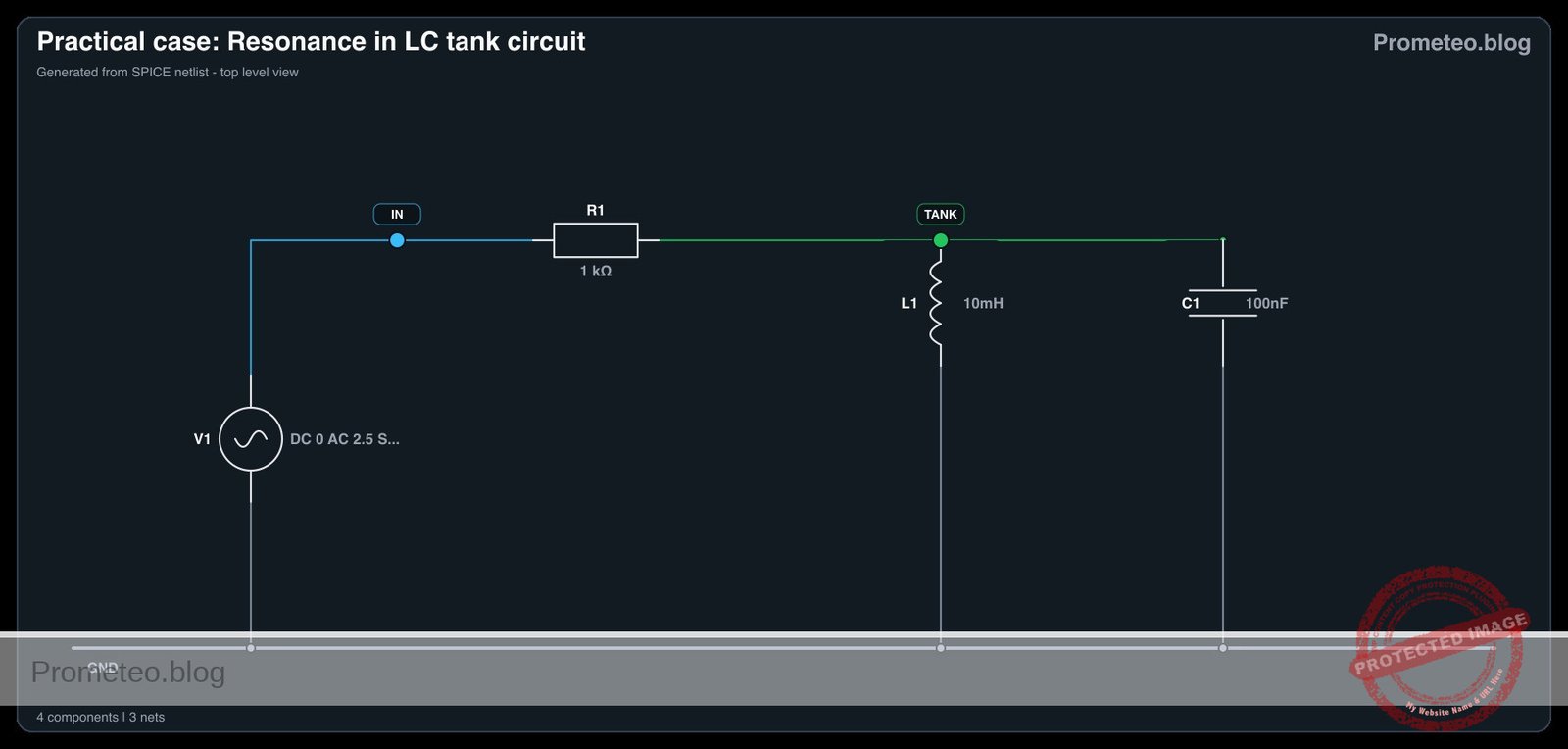
Wiring guide

  • V1: Connect the positive terminal to node IN and the negative terminal to node 0 (GND).
  • R1: Connect one pin to node IN and the other pin to node TANK.
  • L1: Connect one pin to node TANK and the other pin to node 0 (GND).
  • C1: Connect one pin to node TANK and the other pin to node 0 (GND).

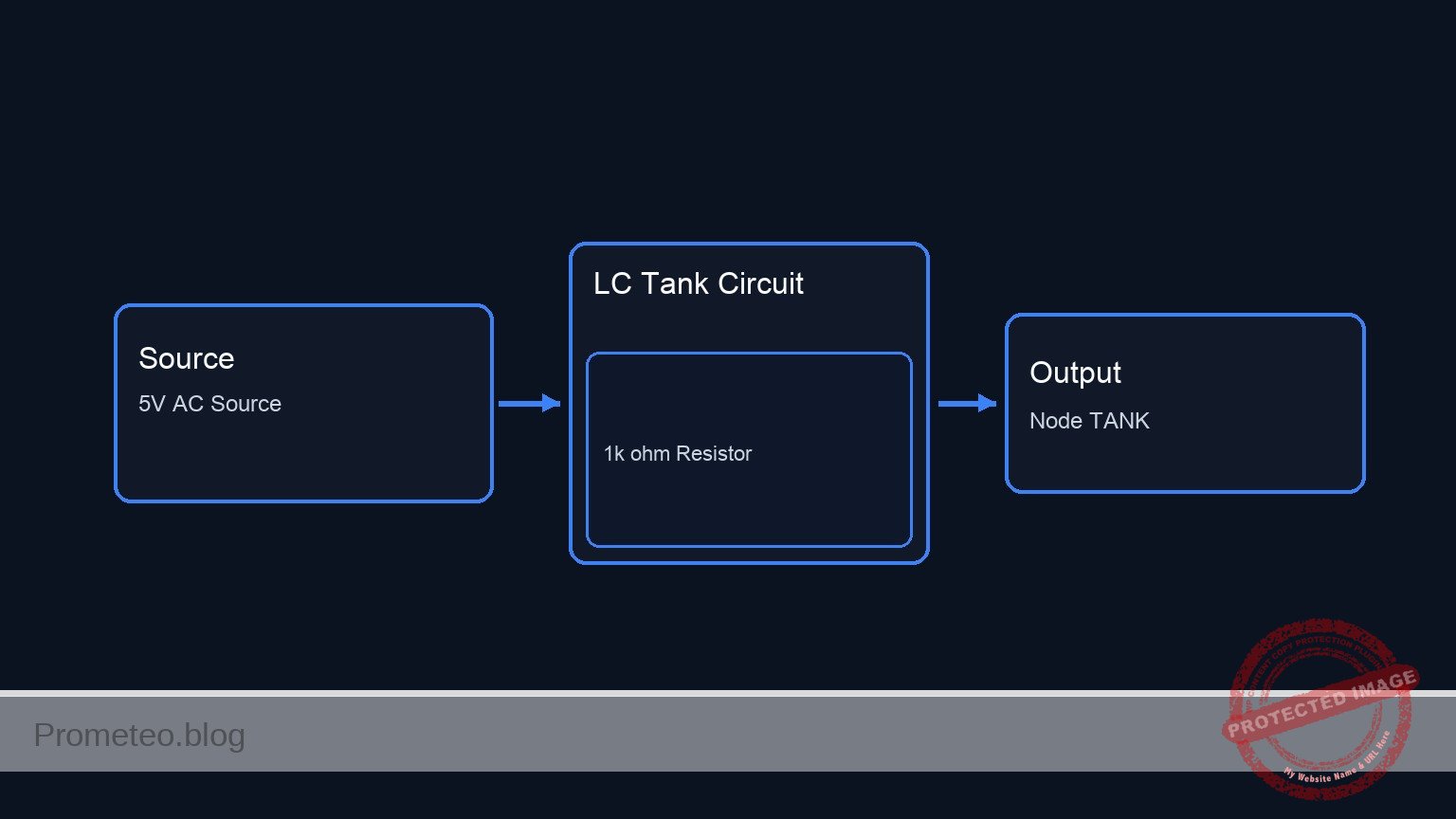
Conceptual block diagram

Conceptual block diagram — LC Tank Circuit
Quick read: inputs → main block → output (actuator or measurement). This summarizes the ASCII schematic below.

Schematic

[ V1: 5 V AC ] --(IN)--> [ R1: 1k ohm ] --(Node TANK)--+--> [ L1: 10mH ] --> GND
                                                      |
                                                      +--> [ C1: 100nF ] --> GND
Electrical Schematic

Electrical diagram

Electrical diagram for case: Practical case: Resonance in LC tank circuit
Generated from the validated SPICE netlist for this case.

🔒 This electrical diagram is premium. With the 7-day pass or the monthly membership you can unlock the complete didactic material and the print-ready PDF pack.🔓 See premium access plans

Measurements and tests

  1. Calculate the theoretical resonant frequency (fr):
    Use the formula fr = (1 / 2\pi\sqrtLC). With L = 10 mH and C = 100 nF, the expected resonant frequency is approximately 5032 Hz.
  2. Set up the frequency sweep:
    Configure V1 to output a 5 V peak-to-peak sine wave. Begin with a frequency of 1 kHz and gradually increase it up to 10 kHz.
  3. Measure VLC (Tank Voltage):
    Monitor the voltage amplitude at node TANK relative to node 0 (GND) using an oscilloscope or an AC voltmeter. As you approach 5 kHz, the voltage amplitude will rise steadily, hitting a sharp maximum exactly at resonance, and then fall as the frequency increases further.
  4. Measure Itotal (Source Current):
    Measure the current flowing through R1 (this can be done by observing the voltage difference between IN and TANK and applying Ohm’s law: Itotal = ((VIN – VTANK) / R1)). Note that at resonance, the parallel LC tank exhibits maximum impedance, meaning Itotal will drop to its minimum.
  5. Calculate the circuit’s Q-factor:
    Identify the -3dB (half-power) frequencies above and below the resonance peak to find the bandwidth ($BW$). The Quality Factor is Q = (fr / BW).

SPICE netlist and simulation

Reference SPICE Netlist (ngspice) — excerptFull SPICE netlist (ngspice)

* Practical case: Resonance in LC tank circuit
.width out=256

* 5V peak-to-peak implies an amplitude of 2.5V. 
* The resonant frequency of 10mH and 100nF is approximately 5033 Hz.
* We configure V1 with both a transient sine wave at resonance and an AC magnitude for optional AC analysis.
V1 IN 0 DC 0 AC 2.5 SIN(0 2.5 5033)

* Source impedance
R1 IN TANK 1k

* LC Tank circuit components
L1 TANK 0 10mH
* ... (truncated in public view) ...

Copy this content into a .cir file and run with ngspice.

🔒 Part of this section is premium. With the 7-day pass or the monthly membership you can access the full content (materials, wiring, detailed build, validation, troubleshooting, variants and checklist) and download the complete print-ready PDF pack.

* Practical case: Resonance in LC tank circuit
.width out=256

* 5V peak-to-peak implies an amplitude of 2.5V. 
* The resonant frequency of 10mH and 100nF is approximately 5033 Hz.
* We configure V1 with both a transient sine wave at resonance and an AC magnitude for optional AC analysis.
V1 IN 0 DC 0 AC 2.5 SIN(0 2.5 5033)

* Source impedance
R1 IN TANK 1k

* LC Tank circuit components
L1 TANK 0 10mH
C1 TANK 0 100nF

* Operating point and Transient analysis
.op
.tran 1u 2m

* Print directives for logging the input and output (resonance) nodes
.print tran V(IN) V(TANK) I(L1)

.end

Simulation Results (Transient Analysis)

Simulation Results (Transient Analysis)
Analysis: The transient simulation shows the input voltage V(IN) oscillating as a sine wave with a 2.5V amplitude (5V peak-to-peak). The voltage at the tank node V(TANK) closely follows V(IN) with nearly the same amplitude, and the inductor current oscillates, confirming the resonant behavior of the LC tank circuit at the specified frequency.
Show raw data table (2015 rows)
Index   time            v(in)           v(tank)         l1#branch
0	0.000000e+00	0.000000e+00	0.000000e+00	0.000000e+00
1	1.000000e-08	7.905818e-04	7.905026e-08	7.905026e-14
2	1.084006e-08	8.569951e-04	8.624878e-08	8.629565e-14
3	1.252017e-08	9.898217e-04	1.017615e-07	1.020896e-13
4	1.588039e-08	1.255475e-03	1.394809e-07	1.426210e-13
5	2.260084e-08	1.786781e-03	2.416948e-07	2.707046e-13
6	3.604174e-08	2.849394e-03	5.532131e-07	8.049184e-13
7	5.708432e-08	4.512980e-03	1.327631e-06	2.783809e-12
8	8.603868e-08	6.802053e-03	2.965106e-06	8.998482e-12
9	1.305078e-07	1.031768e-02	6.769425e-06	3.064276e-11
10	1.955195e-07	1.545732e-02	1.514065e-05	1.018634e-10
11	2.946313e-07	2.329267e-02	3.431881e-05	3.469641e-10
12	4.417944e-07	3.492633e-02	7.707420e-05	1.166612e-09
13	6.644501e-07	5.252635e-02	1.741480e-04	3.963414e-09
14	9.972436e-07	7.882720e-02	3.917455e-04	1.337970e-08
15	1.499113e-06	1.184727e-01	8.834917e-04	4.537981e-08
16	2.252017e-06	1.778899e-01	1.987598e-03	1.534626e-07
17	3.252017e-06	2.566456e-01	4.126641e-03	4.591745e-07
18	4.252017e-06	3.351447e-01	7.022468e-03	1.016630e-06
19	5.252017e-06	4.133086e-01	1.066173e-02	1.900840e-06
20	6.252017e-06	4.910592e-01	1.502968e-02	3.185410e-06
21	7.252017e-06	5.683189e-01	2.011023e-02	4.942405e-06
22	8.252017e-06	6.450102e-01	2.588597e-02	7.242215e-06
23	9.252017e-06	7.210565e-01	3.233820e-02	1.015342e-05
... (1991 more rows) ...

Common mistakes and how to avoid them

  • Using a polarized capacitor in an AC circuit: Electrolytic capacitors are generally polarized and can fail or explode if subjected to reversing AC voltages. Always use non-polarized capacitors (like ceramic or film) for an LC tank.
  • Ignoring the inductor’s Equivalent Series Resistance (ESR): Real inductors consist of long coils of wire, adding parasitic DC resistance to the tank. If the measured Q-factor is much lower than expected (resulting in a wider, flatter peak), inductor ESR is usually the culprit.
  • Confusing angular frequency (\omega) with standard frequency ($f$): Remember that \omega = (1 / \sqrtLC) yields results in radians per second. You must divide by 2\pi to get the frequency in Hertz.

Troubleshooting

  • Symptom: The measured resonant frequency is significantly higher or lower than the calculated 5032 Hz.
    • Cause: Component tolerances. Standard ceramic capacitors can have a ±20% tolerance, and inductors often have ±10%.
    • Fix: Measure the exact values of L1 and C1 using an LCR meter and recalculate the expected frequency.
  • Symptom: VLC shows no noticeable peak during the sweep; the voltage remains relatively flat.
    • Cause: The chosen frequency sweep range does not cover the resonant point, or R1 is too small, effectively shorting the tank to the rigid voltage source.
    • Fix: Double-check the math for your specific $L$ and $C$ values to ensure the sweep range encompasses fr. Ensure R1 is adequately sized (1 kΩ is a good starting point).
  • Symptom: Signal distortion or clipping is observed at node TANK.
    • Cause: The AC source might be overdriving the circuit, or core saturation is occurring in the inductor (if using a very small ferrite core at high currents).
    • Fix: Reduce the amplitude of V1 from 5 V to 1 V peak-to-peak and check if the sine wave becomes clean again.

Possible improvements and extensions

  • Vary the damping resistor: Swap R1 for different values (e.g., 470 Ω, 10 kΩ) or add a resistor directly in parallel with the LC tank. Observe and chart how this affects the sharpness of the resonance peak (the Q-factor).
  • Build an active oscillator: Remove the AC source and connect the LC tank to a transistor or an op-amp with positive feedback (such as a Colpitts or Hartley configuration) to create a standalone circuit that generates its own continuous sine wave at the resonant frequency.

More Practical Cases on Prometeo.blog

Find this product and/or books on this topic on Amazon

Go to Amazon

As an Amazon Associate, I earn from qualifying purchases. If you buy through this link, you help keep this project running.

Quick Quiz

Question 1: What is the primary objective of sweeping the input frequency in the described LC tank circuit?


Question 2: In a parallel LC tank circuit at resonance, what happens to the total current drawn from the source?


Question 3: What happens to the voltage across the LC tank at the resonant frequency?


Question 4: How does energy behave in an LC tank circuit at resonance?


Question 5: Which of the following is a real-world application of LC resonance mentioned in the text?


Question 6: What is the function of the series resistor (R1) in this practical case?


Question 7: What type of source is used to drive the LC tank circuit in this practical case?


Question 8: In the context of audio and signal filtering, what can LC circuits be used to create?


Question 9: Why is understanding LC resonance essential for wireless power transfer?


Question 10: Who is the target audience for this practical case?


Carlos Núñez Zorrilla
Electronics & Computer Engineer

Telecommunications Electronics Engineer and Computer Engineer (official degrees in Spain).
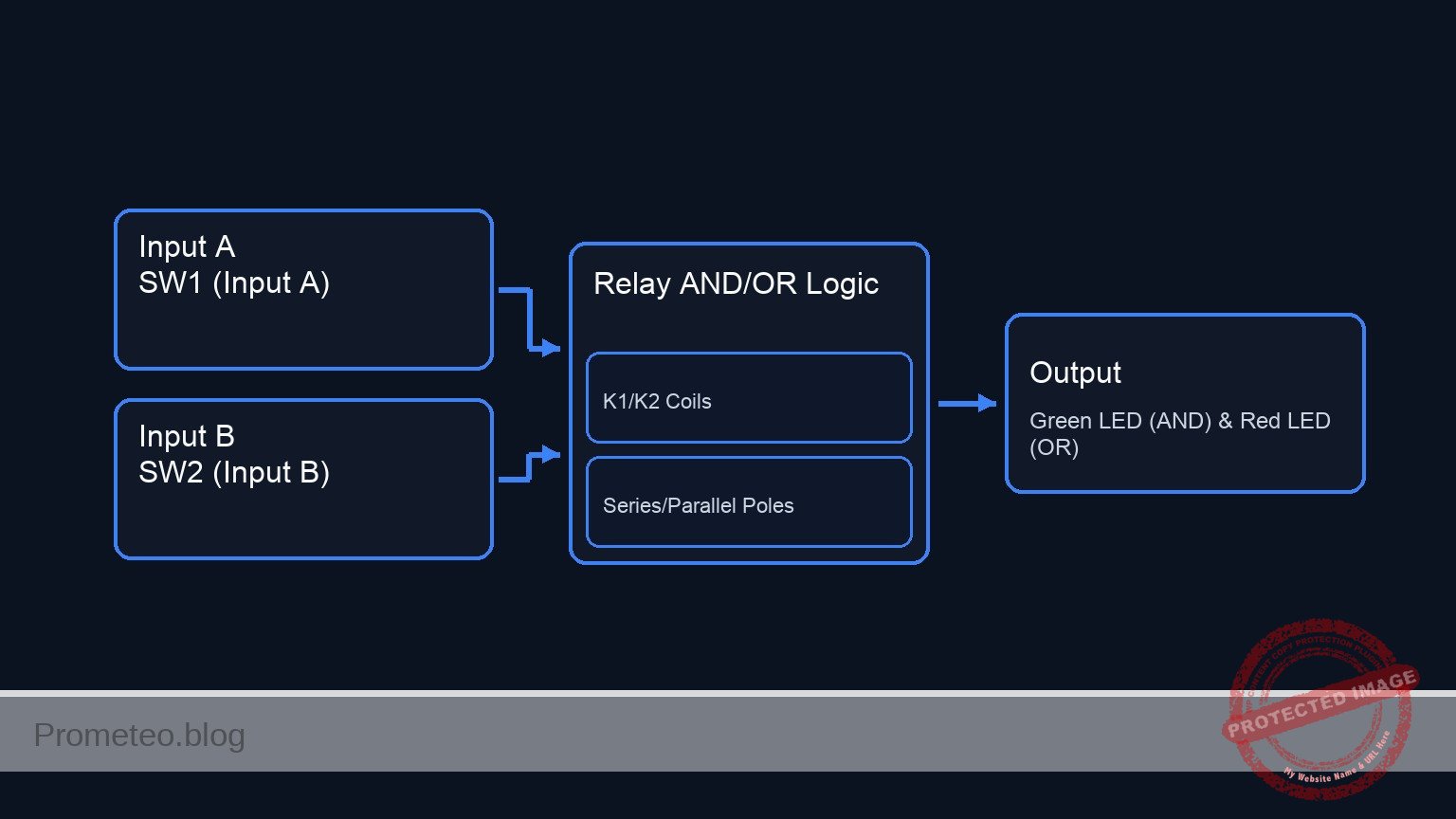
Follow me: