Practical case: Simple voltage divider

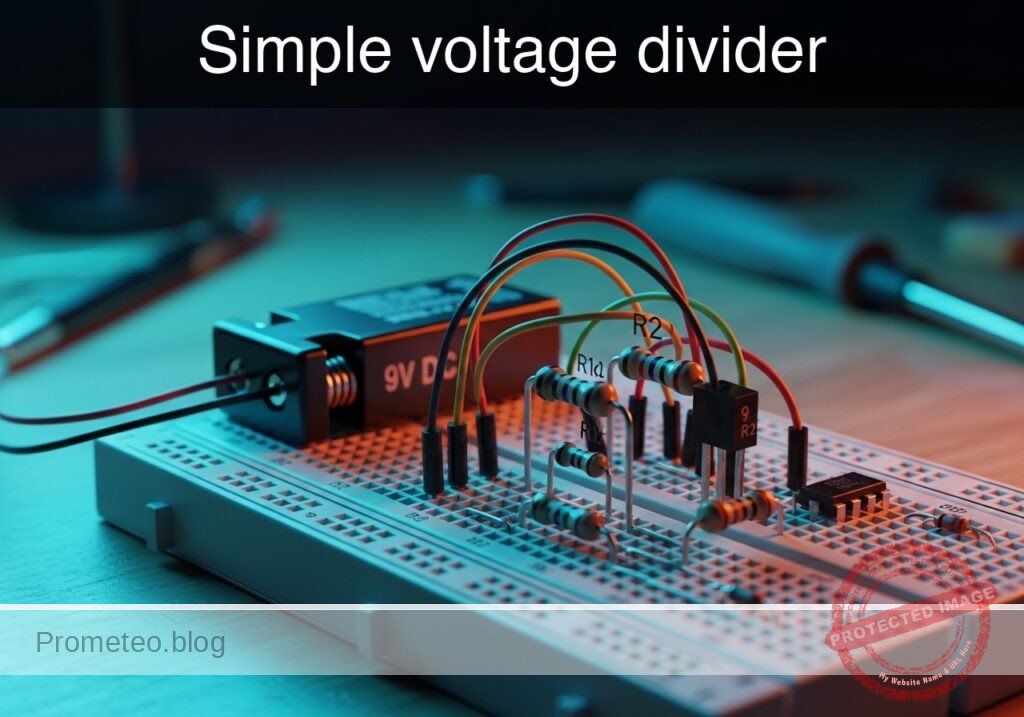
Simple voltage divider prototype (Maker Style)

Level: Basic. Demonstrate how two resistors in series divide the input voltage into predictable proportions.

Objective and use case

In this practical case, you will build a fundamental circuit that uses two resistors in series to reduce a higher DC source voltage to a specific lower voltage level.

  • Why it is useful:

    • Sensor interfacing: Adapts high-voltage sensors (e.g., 12 V automotive sensors) to low-voltage microcontrollers (e.g., 3.3 V or 5 V logic).
    • Biasing: Provides stable reference voltages for transistor bases or operational amplifier inputs.
    • Level shifting: Simple method to step down signal levels between different circuit stages.
  • Expected outcome:

    • Input Voltage (Vin): Measured at the full 9 V supply.
    • Output Voltage (Vout): Measured at the junction between the resistors; expecting exactly 4.5 V (50% of input).
    • Current: A small, safe current flows continuously from the source to ground through the series path.
    • Ratio verification: The output voltage follows the formula Vout = Vin × (R2 / (R1 + R2)).
  • Target audience and level: Students starting with Ohm’s Law and Series Circuits (Level: Basic).

Materials

  • V1: 9 V DC voltage source (battery or power supply).
  • R1: 10 kΩ resistor, function: high-side element (drops half the voltage).
  • R2: 10 kΩ resistor, function: low-side element (measurement resistor).
  • M1: Digital Multimeter (Voltmeter mode), function: measurement tool.

Wiring guide

Construct the circuit using the following node connections. Ensure the power supply is turned off while assembling components.

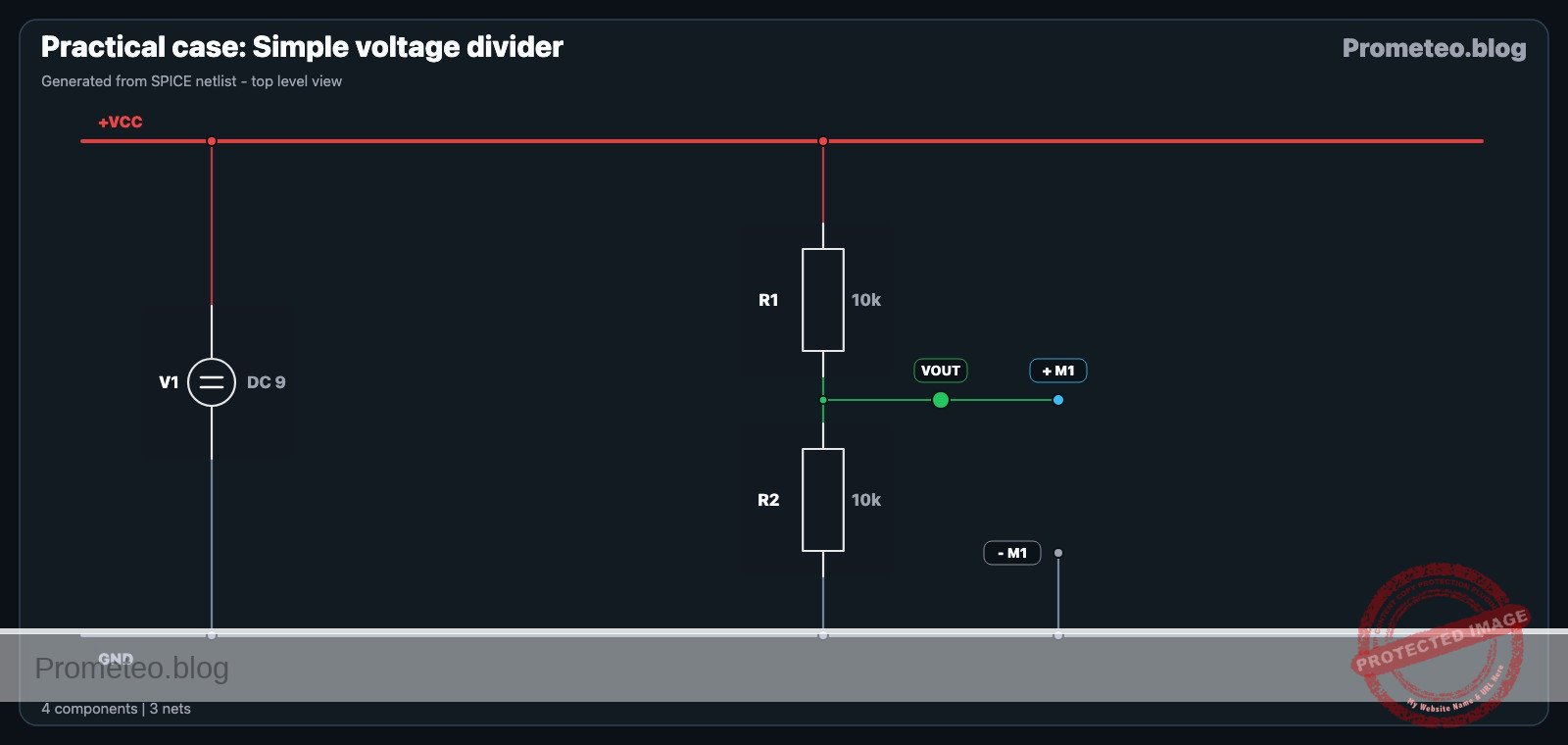
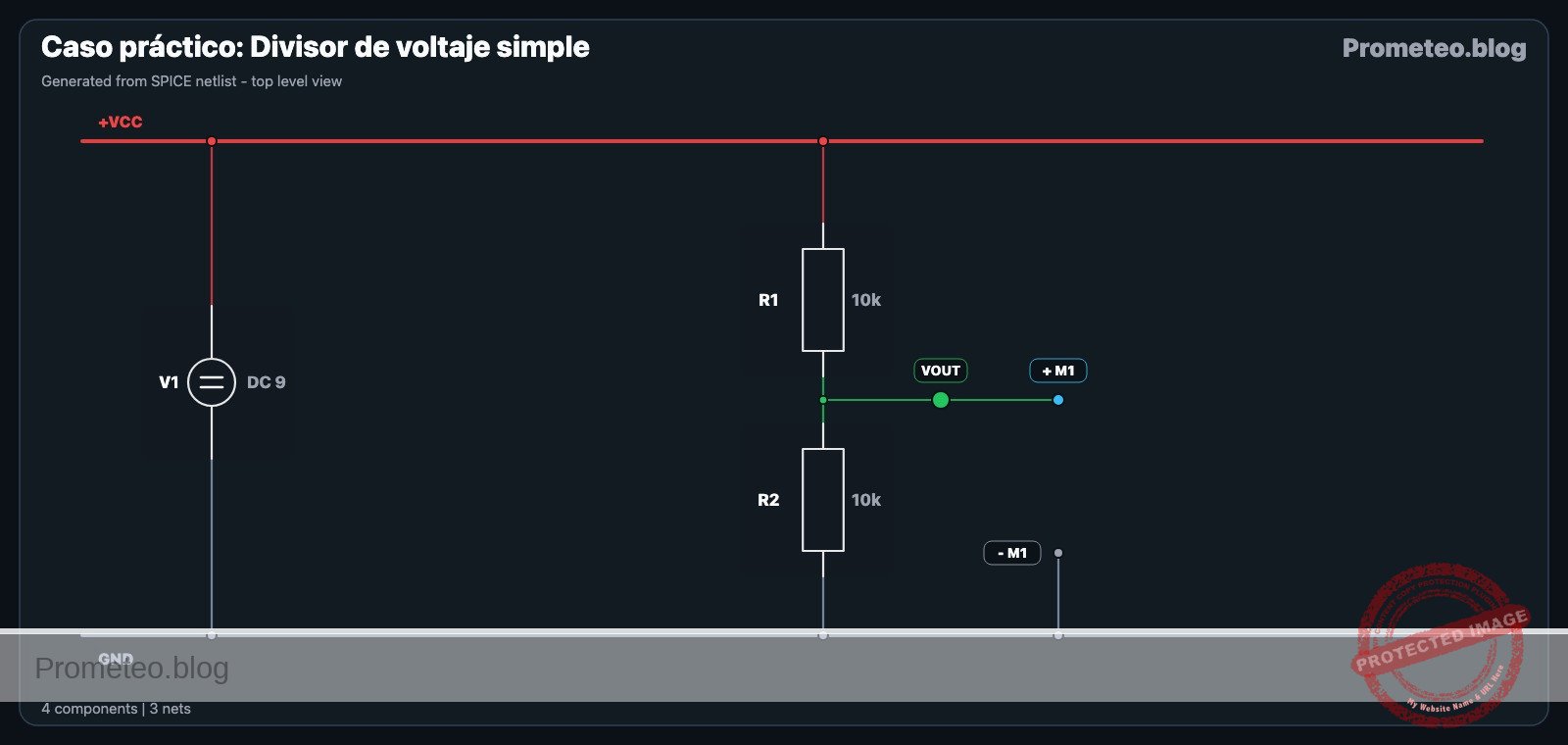
  • V1: Connect the positive terminal to node VCC and the negative terminal to node 0 (GND).
  • R1: Connect between node VCC and node VOUT.
  • R2: Connect between node VOUT and node 0 (GND).

Conceptual block diagram

Conceptual block diagram — Voltage Divider
Quick read: inputs → main block → output (actuator or measurement). This summarizes the ASCII schematic below.

Schematic

[ INPUT ]                    [ PROCESSING ]                    [ OUTPUT ]

 [ 9V Source (V1) ] --(VCC)--> [ R1: High-Side 10k ] --(VOUT)--> [ Multimeter (M1) ]
                                          |
                                          v
                                 [ R2: Low-Side 10k ]
                                          |
                                          v
                                    [ Node 0 (GND) ]
Schematic (ASCII)

Electrical diagram

Electrical diagram for the practical case: Simple voltage divider
Generated from the validated SPICE netlist for this case.

🔒 This electrical diagram is premium. With the 7-day pass or the monthly membership you can unlock the complete didactic material and the print-ready PDF pack.🔓 See premium access plans

Measurements and tests

Perform the following steps to validate the circuit behavior.

  1. Set up the Multimeter: Switch your multimeter to DC Voltage mode (20 V range or auto-range).
  2. Measure Input (Vin): Place the red probe on node VCC and the black probe on node 0. Verify the reading is approximately 9 V.
  3. Measure Output (Vout): Place the red probe on node VOUT (the junction between R1 and R2) and the black probe on node 0.
  4. Validate Result: The reading should be approximately 4.5 V.
    • Calculation: Vout = 9V × (10kΩ / (10kΩ + 10kΩ)) = 9V × 0.5 = 4.5V.

SPICE netlist and simulation

Reference SPICE Netlist (ngspice) — excerptFull SPICE netlist (ngspice)

* Title: Simple voltage divider

* --- Power Supply ---
* V1: 9 V DC voltage source
* Connected positive to VCC, negative to 0 (GND)
V1 VCC 0 DC 9

* --- Components ---
* R1: 10 kOhm resistor (High-side)
* Connected between VCC and VOUT
R1 VCC VOUT 10k

* R2: 10 kOhm resistor (Low-side)
* Connected between VOUT and 0 (GND)
R2 VOUT 0 10k

* M1: Digital Multimeter (Voltmeter mode)
* Function: Measurement tool across R2 (VOUT to GND)
* Modeled as a high-impedance resistor (10 MegOhm) to represent input impedance
R_M1 VOUT 0 10Meg
* ... (truncated in public view) ...

Copy this content into a .cir file and run with ngspice.

🔒 Part of this section is premium. With the 7-day pass or the monthly membership you can access the full content (materials, wiring, detailed build, validation, troubleshooting, variants and checklist) and download the complete print-ready PDF pack.

* Title: Simple voltage divider

* --- Power Supply ---
* V1: 9 V DC voltage source
* Connected positive to VCC, negative to 0 (GND)
V1 VCC 0 DC 9

* --- Components ---
* R1: 10 kOhm resistor (High-side)
* Connected between VCC and VOUT
R1 VCC VOUT 10k

* R2: 10 kOhm resistor (Low-side)
* Connected between VOUT and 0 (GND)
R2 VOUT 0 10k

* M1: Digital Multimeter (Voltmeter mode)
* Function: Measurement tool across R2 (VOUT to GND)
* Modeled as a high-impedance resistor (10 MegOhm) to represent input impedance
R_M1 VOUT 0 10Meg

* --- Simulation and Output ---
* Operating point analysis for DC steady state
.op

* Transient analysis (required for .print tran)
* Simulating for 5ms to show steady DC levels
.tran 100u 5ms

* Print directives
.print tran V(VCC) V(VOUT)

.end

Simulation Results (Transient Analysis)

Simulation Results (Transient Analysis)
Show raw data table (59 rows)
Index   time            v(vcc)          v(vout)
0	0.000000e+00	9.000000e+00	4.497751e+00
1	5.000000e-07	9.000000e+00	4.497751e+00
2	1.000000e-06	9.000000e+00	4.497751e+00
3	2.000000e-06	9.000000e+00	4.497751e+00
4	4.000000e-06	9.000000e+00	4.497751e+00
5	8.000000e-06	9.000000e+00	4.497751e+00
6	1.600000e-05	9.000000e+00	4.497751e+00
7	3.200000e-05	9.000000e+00	4.497751e+00
8	6.400000e-05	9.000000e+00	4.497751e+00
9	1.280000e-04	9.000000e+00	4.497751e+00
10	2.280000e-04	9.000000e+00	4.497751e+00
11	3.280000e-04	9.000000e+00	4.497751e+00
12	4.280000e-04	9.000000e+00	4.497751e+00
13	5.280000e-04	9.000000e+00	4.497751e+00
14	6.280000e-04	9.000000e+00	4.497751e+00
15	7.280000e-04	9.000000e+00	4.497751e+00
16	8.280000e-04	9.000000e+00	4.497751e+00
17	9.280000e-04	9.000000e+00	4.497751e+00
18	1.028000e-03	9.000000e+00	4.497751e+00
19	1.128000e-03	9.000000e+00	4.497751e+00
20	1.228000e-03	9.000000e+00	4.497751e+00
21	1.328000e-03	9.000000e+00	4.497751e+00
22	1.428000e-03	9.000000e+00	4.497751e+00
23	1.528000e-03	9.000000e+00	4.497751e+00
... (35 more rows) ...

Common mistakes and how to avoid them

  1. Connecting a heavy load: Connecting a motor or low-resistance load to VOUT will cause the voltage to drop significantly below 4.5 V (loading effect). Solution: Only connect high-impedance loads (like microcontroller inputs) or use a buffer.
  2. Using incorrect resistor ratios: Using random resistor values will result in a random output voltage. Solution: Always calculate the required ratio using the voltage divider formula before building.
  3. Overheating resistors: Using very low resistance values (e.g., 10 Ω) connects the supply almost directly to ground, causing high current. Solution: Use values in the kΩ range for signal reference voltages to minimize power waste.

Troubleshooting

  • Symptom: VOUT reads 0 V.
    • Cause: R1 is open (broken) or R2 is shorted to ground.
    • Fix: Check continuity of R1 and ensure R2 legs are not touching.
  • Symptom: VOUT equals VCC (9 V).
    • Cause: R2 is open (broken) or R1 is shorted.
    • Fix: Ensure R2 is correctly inserted into the breadboard rails.
  • Symptom: VOUT is slightly off (e.g., 4.6 V instead of 4.5 V).
    • Cause: Resistor tolerance (standard resistors vary by ±5%).
    • Fix: This is normal behavior. Use 1% precision resistors if exact values are critical.

Possible improvements and extensions

  1. Variable Divider: Replace R1 and R2 with a single 10 kΩ potentiometer (wiper to output) to create a variable voltage source from 0 V to 9 V.
  2. Buffered Output: Connect the VOUT node to an Operational Amplifier configured as a voltage follower to drive loads like LEDs without dropping the voltage.

More Practical Cases on Prometeo.blog

Find this product and/or books on this topic on Amazon

Go to Amazon

As an Amazon Associate, I earn from qualifying purchases. If you buy through this link, you help keep this project running.

Quick Quiz

Question 1: What is the primary objective of the circuit described in this practical case?


Question 2: Which formula correctly represents the output voltage (Vout) in a voltage divider circuit?


Question 3: If the input voltage is 9 V and both resistors are equal (e.g., 10 kΩ), what is the expected output voltage?


Question 4: What is a practical use case for this voltage divider circuit mentioned in the text?


Question 5: In the context of the expected outcome, what role does the resistor R1 play?


Question 6: Which component would be used to verify the voltage levels in this experiment?


Question 7: Where is the Output Voltage (Vout) measured in this circuit?


Question 8: What is the target audience level for this practical case?


Question 9: How is the current flow described in this series circuit?


Question 10: Why is this circuit useful for 'Biasing'?


Carlos Núñez Zorrilla
Electronics & Computer Engineer

Telecommunications Electronics Engineer and Computer Engineer (official degrees in Spain).
Follow me:


Caso práctico: Divisor de voltaje simple

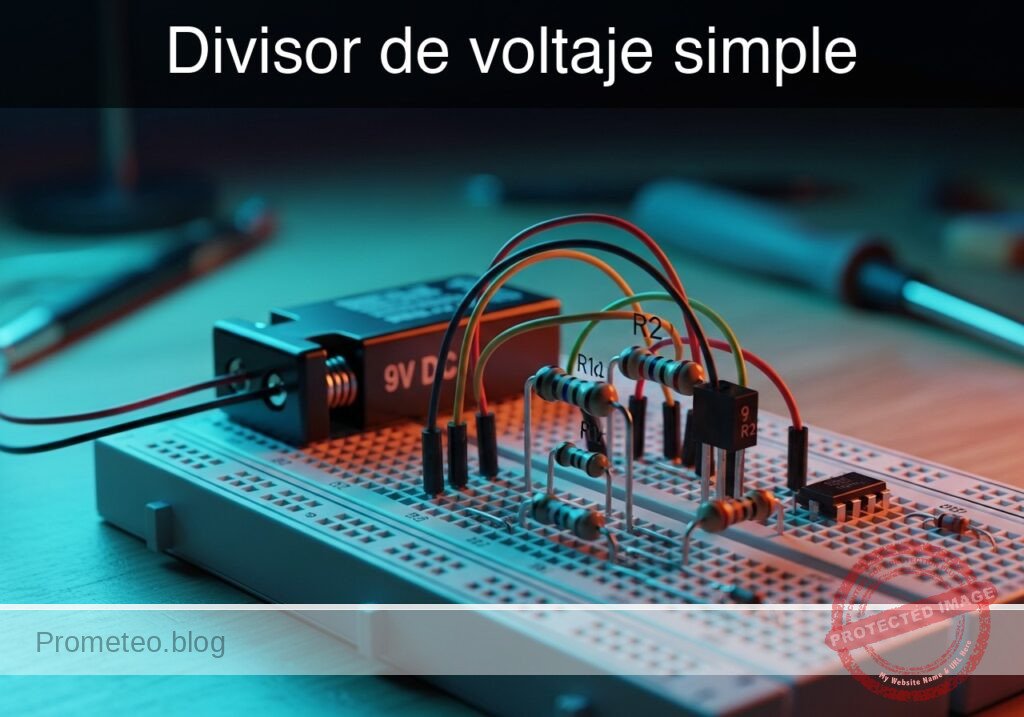
Prototipo de Divisor de voltaje simple (Maker Style)

Nivel: Básico. Demuestra cómo dos resistencias en serie dividen el voltaje de entrada en proporciones predecibles.

Objetivo y caso de uso

En este caso práctico, construirá un circuito fundamental que utiliza dos resistencias en serie para reducir un voltaje de fuente de CC más alto a un nivel de voltaje más bajo específico.

  • Por qué es útil:

    • Interfaz de sensores: Adapta sensores de alto voltaje (por ejemplo, sensores automotrices de 12 V) a microcontroladores de bajo voltaje (por ejemplo, lógica de 3.3 V o 5 V).
    • Polarización: Proporciona voltajes de referencia estables para bases de transistores o entradas de amplificadores operacionales.
    • Desplazamiento de nivel: Método simple para reducir los niveles de señal entre diferentes etapas del circuito.
  • Resultado esperado:

    • Voltaje de entrada (Vin): Medido en la fuente de alimentación completa de 9 V.
    • Voltaje de salida (Vout): Medido en la unión entre las resistencias; esperando exactamente 4.5 V (50% de la entrada).
    • Corriente: Una corriente pequeña y segura fluye continuamente desde la fuente a tierra a través de la ruta en serie.
    • Verificación de la relación: El voltaje de salida sigue la fórmula Vout = Vin × (R2 / (R1 + R2)).
  • Público objetivo y nivel: Estudiantes que comienzan con la Ley de Ohm y Circuitos en Serie (Nivel: Básico).

Materiales

  • V1: Fuente de voltaje de 9 V CC (batería o fuente de alimentación).
  • R1: Resistencia de 10 kΩ, función: elemento del lado alto (cae la mitad del voltaje).
  • R2: Resistencia de 10 kΩ, función: elemento del lado bajo (resistencia de medición).
  • M1: Multímetro digital (modo voltímetro), función: herramienta de medición.

Guía de conexionado

Construya el circuito utilizando las siguientes conexiones de nodos. Asegúrese de que la fuente de alimentación esté apagada mientras ensambla los componentes.

  • V1: Conecte el terminal positivo al nodo VCC y el terminal negativo al nodo 0 (GND).
  • R1: Conecte entre el nodo VCC y el nodo VOUT.
  • R2: Conecte entre el nodo VOUT y el nodo 0 (GND).

Diagrama de bloques conceptual

Conceptual block diagram — Voltage Divider
Lectura rápida: entradas → bloque principal → salida (actuador o medida). Resume el esquemático ASCII de la siguiente sección.

Esquemático

[ INPUT ]                    [ PROCESSING ]                    [ OUTPUT ]

 [ 9V Source (V1) ] --(VCC)--> [ R1: High-Side 10k ] --(VOUT)--> [ Multimeter (M1) ]
                                          |
                                          v
                                 [ R2: Low-Side 10k ]
                                          |
                                          v
                                    [ Node 0 (GND) ]
Esquema Eléctrico

Diagrama eléctrico

Diagrama eléctrico del caso práctico: Divisor de voltaje simple
Generado desde la netlist SPICE validada del caso.

🔒 Este diagrama eléctrico es premium. Con el pase de 7 días o la suscripción mensual podrás desbloquear el material didáctico completo y el pack PDF listo para imprimir.🔓 Ver planes de acceso premium

Mediciones y pruebas

Realice los siguientes pasos para validar el comportamiento del circuito.

  1. Configurar el multímetro: Cambie su multímetro al modo de voltaje de CC (rango de 20 V o rango automático).
  2. Medir la entrada (Vin): Coloque la sonda roja en el nodo VCC y la sonda negra en el nodo 0. Verifique que la lectura sea de aproximadamente 9 V.
  3. Medir la salida (Vout): Coloque la sonda roja en el nodo VOUT (la unión entre R1 y R2) y la sonda negra en el nodo 0.
  4. Validar el resultado: La lectura debe ser de aproximadamente 4.5 V.
    • Cálculo: Vout = 9V × (10kΩ / (10kΩ + 10kΩ)) = 9V × 0.5 = 4.5V.

Netlist SPICE y simulación

Netlist SPICE de referencia (ngspice) — extractoNetlist SPICE completo (ngspice)

* Title: Simple voltage divider

* --- Power Supply ---
* V1: 9 V DC voltage source
* Connected positive to VCC, negative to 0 (GND)
V1 VCC 0 DC 9

* --- Components ---
* R1: 10 kOhm resistor (High-side)
* Connected between VCC and VOUT
R1 VCC VOUT 10k

* R2: 10 kOhm resistor (Low-side)
* Connected between VOUT and 0 (GND)
R2 VOUT 0 10k

* M1: Digital Multimeter (Voltmeter mode)
* Function: Measurement tool across R2 (VOUT to GND)
* Modeled as a high-impedance resistor (10 MegOhm) to represent input impedance
R_M1 VOUT 0 10Meg
* ... (truncated in public view) ...

Copia este contenido en un archivo .cir y ejecútalo con ngspice.

🔒 Parte del contenido de esta sección es premium. Con el pase de 7 días o la suscripción mensual tendrás acceso al contenido completo (materiales, conexionado, compilación detallada, validación paso a paso, troubleshooting, mejoras/variantes y checklist) y podrás descargar el pack PDF listo para imprimir.

* Title: Simple voltage divider

* --- Power Supply ---
* V1: 9 V DC voltage source
* Connected positive to VCC, negative to 0 (GND)
V1 VCC 0 DC 9

* --- Components ---
* R1: 10 kOhm resistor (High-side)
* Connected between VCC and VOUT
R1 VCC VOUT 10k

* R2: 10 kOhm resistor (Low-side)
* Connected between VOUT and 0 (GND)
R2 VOUT 0 10k

* M1: Digital Multimeter (Voltmeter mode)
* Function: Measurement tool across R2 (VOUT to GND)
* Modeled as a high-impedance resistor (10 MegOhm) to represent input impedance
R_M1 VOUT 0 10Meg

* --- Simulation and Output ---
* Operating point analysis for DC steady state
.op

* Transient analysis (required for .print tran)
* Simulating for 5ms to show steady DC levels
.tran 100u 5ms

* Print directives
.print tran V(VCC) V(VOUT)

.end

Resultados de Simulación (Transitorio)

Resultados de Simulación (Transitorio)
Show raw data table (59 rows)
Index   time            v(vcc)          v(vout)
0	0.000000e+00	9.000000e+00	4.497751e+00
1	5.000000e-07	9.000000e+00	4.497751e+00
2	1.000000e-06	9.000000e+00	4.497751e+00
3	2.000000e-06	9.000000e+00	4.497751e+00
4	4.000000e-06	9.000000e+00	4.497751e+00
5	8.000000e-06	9.000000e+00	4.497751e+00
6	1.600000e-05	9.000000e+00	4.497751e+00
7	3.200000e-05	9.000000e+00	4.497751e+00
8	6.400000e-05	9.000000e+00	4.497751e+00
9	1.280000e-04	9.000000e+00	4.497751e+00
10	2.280000e-04	9.000000e+00	4.497751e+00
11	3.280000e-04	9.000000e+00	4.497751e+00
12	4.280000e-04	9.000000e+00	4.497751e+00
13	5.280000e-04	9.000000e+00	4.497751e+00
14	6.280000e-04	9.000000e+00	4.497751e+00
15	7.280000e-04	9.000000e+00	4.497751e+00
16	8.280000e-04	9.000000e+00	4.497751e+00
17	9.280000e-04	9.000000e+00	4.497751e+00
18	1.028000e-03	9.000000e+00	4.497751e+00
19	1.128000e-03	9.000000e+00	4.497751e+00
20	1.228000e-03	9.000000e+00	4.497751e+00
21	1.328000e-03	9.000000e+00	4.497751e+00
22	1.428000e-03	9.000000e+00	4.497751e+00
23	1.528000e-03	9.000000e+00	4.497751e+00
... (35 more rows) ...

Errores comunes y cómo evitarlos

  1. Conectar una carga pesada: Conectar un motor o una carga de baja resistencia a VOUT hará que el voltaje caiga significativamente por debajo de 4.5 V (efecto de carga). Solución: Conecte solo cargas de alta impedancia (como entradas de microcontrolador) o use un búfer.
  2. Usar relaciones de resistencia incorrectas: Usar valores de resistencia aleatorios dará como resultado un voltaje de salida aleatorio. Solución: Calcule siempre la relación requerida utilizando la fórmula del divisor de voltaje antes de construir.
  3. Sobrecalentamiento de resistencias: El uso de valores de resistencia muy bajos (por ejemplo, 10 Ω) conecta la fuente casi directamente a tierra, causando una alta corriente. Solución: Use valores en el rango de kΩ para voltajes de referencia de señal para minimizar el desperdicio de energía.

Solución de problemas

  • Síntoma: VOUT marca 0 V.
    • Causa: R1 está abierta (rota) o R2 está en cortocircuito a tierra.
    • Solución: Verifique la continuidad de R1 y asegúrese de que las patas de R2 no se toquen.
  • Síntoma: VOUT es igual a VCC (9 V).
    • Causa: R2 está abierta (rota) o R1 está en cortocircuito.
    • Solución: Asegúrese de que R2 esté insertada correctamente en los rieles de la protoboard.
  • Síntoma: VOUT está ligeramente desviado (por ejemplo, 4.6 V en lugar de 4.5 V).
    • Causa: Tolerancia de la resistencia (las resistencias estándar varían en ±5%).
    • Solución: Este es un comportamiento normal. Use resistencias de precisión del 1% si los valores exactos son críticos.

Posibles mejoras y extensiones

  1. Divisor variable: Reemplace R1 y R2 con un solo potenciómetro de 10 kΩ (cursor a la salida) para crear una fuente de voltaje variable de 0 V a 9 V.
  2. Salida con búfer: Conecte el nodo VOUT a un amplificador operacional configurado como seguidor de voltaje para manejar cargas como LED sin que caiga el voltaje.

Más Casos Prácticos en Prometeo.blog

Encuentra este producto y/o libros sobre este tema en Amazon

Ir a Amazon

Como afiliado de Amazon, gano con las compras que cumplan los requisitos. Si compras a través de este enlace, ayudas a mantener este proyecto.

Quiz rápido

Pregunta 1: ¿Cuál es el objetivo principal del circuito divisor de voltaje descrito?


Pregunta 2: ¿Qué componentes fundamentales se utilizan para crear este circuito?


Pregunta 3: Según el texto, ¿cuál es una aplicación útil de este circuito para sensores?


Pregunta 4: Si el voltaje de entrada (Vin) es de 9 V y se espera un Vout de 4.5 V, ¿qué relación tienen las resistencias?


Pregunta 5: ¿Qué fórmula general describe el comportamiento del voltaje de salida (Vout) en un divisor de voltaje?


Pregunta 6: ¿Qué se espera que ocurra con la corriente en este circuito?


Pregunta 7: ¿Para qué nivel de habilidad está diseñado este caso práctico?


Pregunta 8: ¿Dónde se debe medir el voltaje de salida (Vout) en este circuito?


Pregunta 9: ¿Qué utilidad tiene este circuito en relación con los transistores?


Pregunta 10: ¿Qué voltaje de entrada (Vin) se utiliza en el ejemplo práctico del texto?


Carlos Núñez Zorrilla
Electronics & Computer Engineer

Ingeniero Superior en Electrónica de Telecomunicaciones e Ingeniero en Informática (titulaciones oficiales en España).

Sígueme:


Practical case: Current limiting in an LED

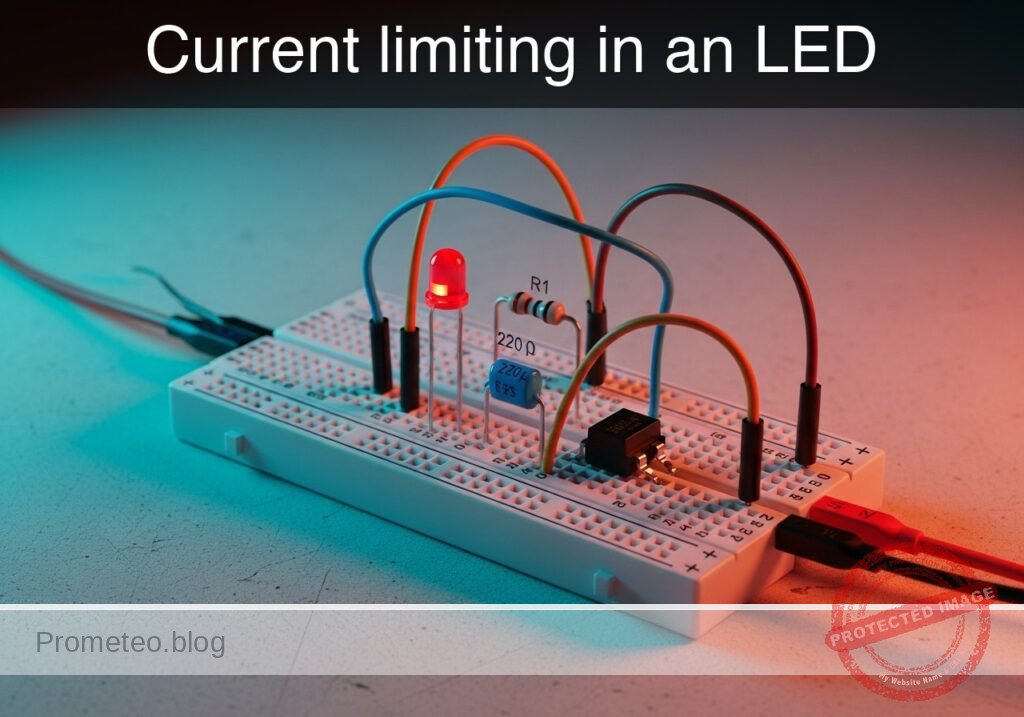
Current limiting in an LED prototype (Maker Style)

Level: Basic. Demonstrate how a resistor protects a sensitive component (LED) by limiting current flow according to Ohm’s Law.

Objective and use case

In this case, you will build a fundamental series circuit connecting a DC voltage source, a current-limiting resistor, and a Light Emitting Diode (LED).

Why it is useful:
* Component Protection: Prevents the LED from drawing excessive current and burning out instantly.
* Ohm’s Law Application: Visually demonstrates the relationship between Voltage, Current, and Resistance ($I = V/R$).
* Status Indication: Forms the basis for power indicators on almost every electronic device.
* Diagnostic Tooling: Simple LED circuits are often used to debug logic levels in complex systems.

Expected outcome:
* The LED lights up steadily without overheating.
* The current flowing through the circuit remains within the safe range (typically 10–20 mA).
* The voltage drop across the resistor corresponds to the supply voltage minus the LED forward voltage.

Target audience and level: Beginners and students starting with basic component analysis.

Materials

  • V1: 5 V DC supply
  • R1: 220 Ω resistor, function: current limiting
  • D1: Red LED, function: light emission
  • M1: Multimeter, function: current measurement (A)
  • M2: Multimeter, function: voltage measurement (V)

Wiring guide

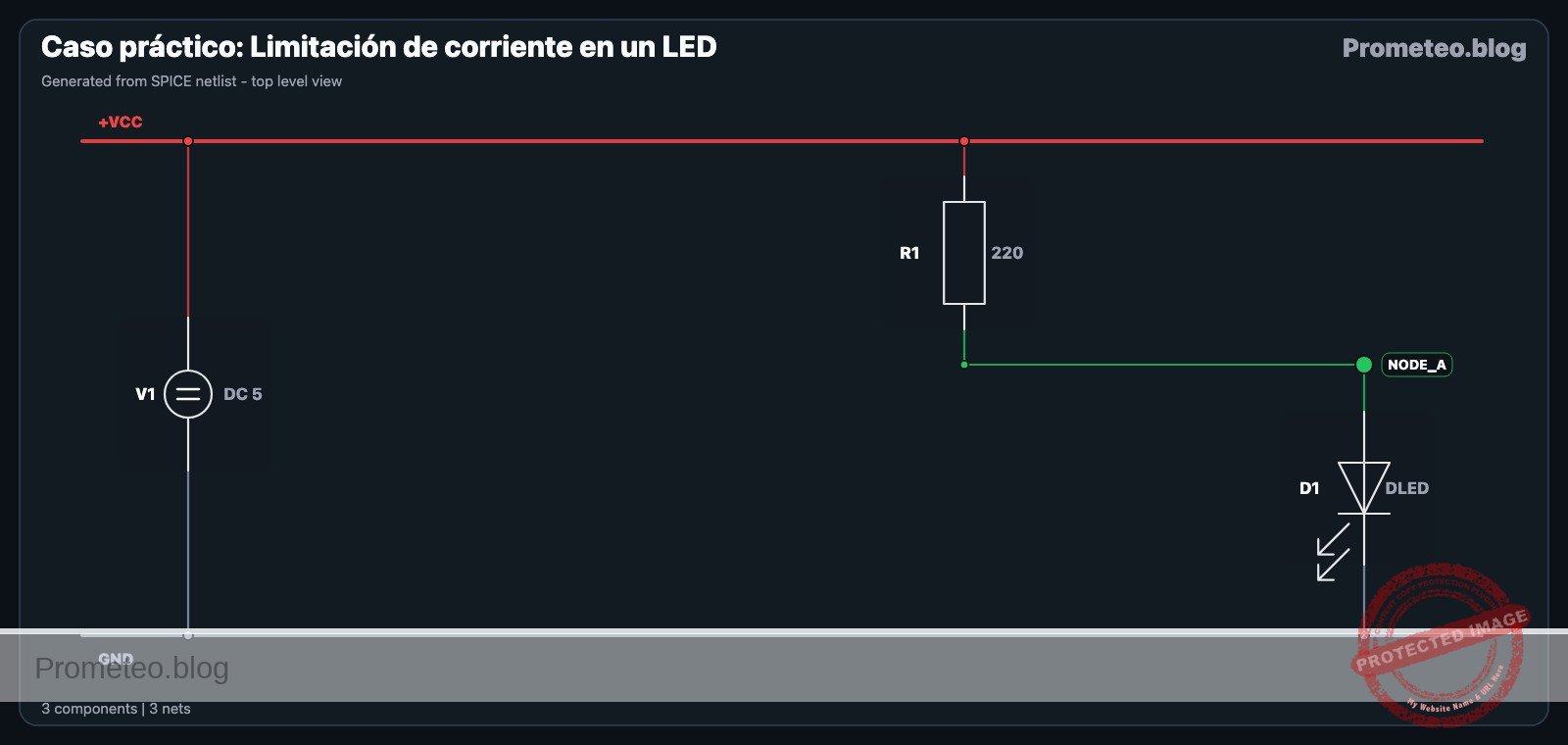
This circuit uses a series topology. We define the nodes as VCC (5V Source), 0 (Ground), and NODE_A (Intermediate connection).

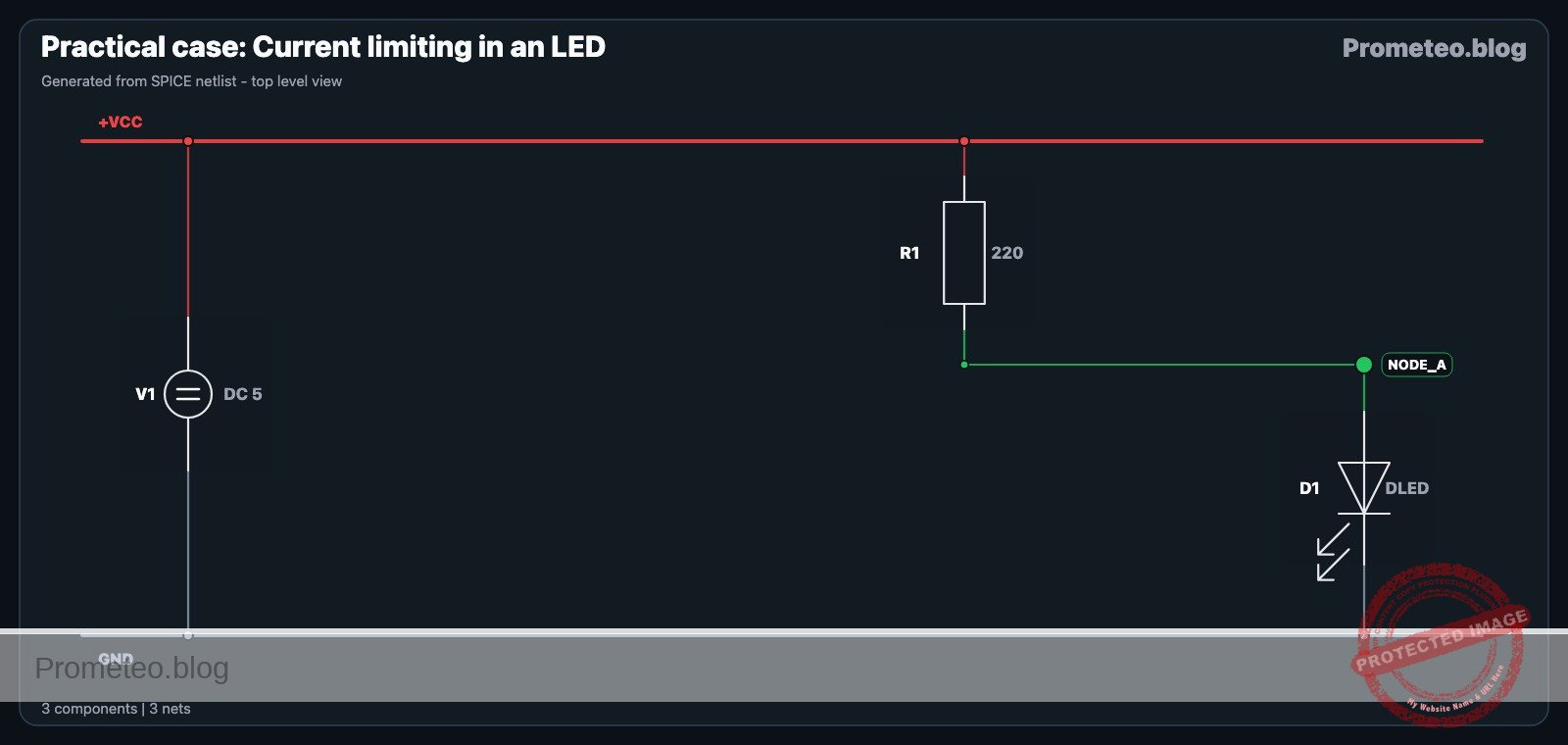
  • V1 (DC Source): Positive terminal connects to node VCC. Negative terminal connects to node 0.
  • R1 (Resistor): Connects between node VCC and node NODE_A.
  • D1 (LED): Anode connects to node NODE_A. Cathode connects to node 0.

Conceptual block diagram

Conceptual block diagram — Current Limiting
Quick read: inputs → main block → output (actuator or measurement). This summarizes the ASCII schematic below.

Schematic

[ SOURCE ]                  [ CURRENT CONTROL ]              [ OUTPUT / LOAD ]

    [ V1: 5V DC ] --(VCC)--> [ R1: 220 Ohm ] --(Node A)--> [ D1: Red LED ] --(0)--> [ GND ]
Schematic (ASCII)

Electrical diagram

Electrical diagram for current limiting in an LED
Generated from the validated SPICE netlist for this case.

🔒 This electrical diagram is premium. With the 7-day pass or the monthly membership you can unlock the complete didactic material and the print-ready PDF pack.🔓 See premium access plans

Measurements and tests

To validate Ohm’s Law and component safety:

  1. Calculate Expected Current:
    • Assume LED Forward Voltage ($V_f$) $\approx$ 2.0 V.
    • Voltage across R1: $V_{R1} = V_{source} – V_f = 5V – 2V = 3V$.
    • Expected Current: $I = V_{R1} / R1 = 3V / 220\Omega \approx 13.6 mA$.
  2. Voltage Measurement: Set multimeter M2 to DC Volts. Measure across R1 (leads on VCC and NODE_A). The reading should be approximately 3 V.
  3. Current Measurement: Break the circuit at node VCC or 0 and insert multimeter M1 in series (Amperemeter mode). The reading should be close to 13–14 mA.
  4. Visual Check: The LED should emit a steady, bright red light.

SPICE netlist and simulation

Reference SPICE Netlist (ngspice) — excerptFull SPICE netlist (ngspice)

* Practical case: Current limiting in an LED

* --- Power Supply ---
* V1: 5V DC Supply connected between VCC and 0 (GND)
V1 VCC 0 DC 5

* --- Components ---
* R1: 220 Ohm Resistor
* Function: Current limiting
* Connected between VCC and NODE_A
R1 VCC NODE_A 220

* D1: Red LED
* Function: Light emission
* Anode connected to NODE_A, Cathode connected to 0 (GND)
D1 NODE_A 0 DLED

* --- Models ---
* Model for D1 (Red LED)
* Parameters: IS (Saturation Current), N (Emission Coefficient), RS (Series Resistance)
* ... (truncated in public view) ...

Copy this content into a .cir file and run with ngspice.

🔒 Part of this section is premium. With the 7-day pass or the monthly membership you can access the full content (materials, wiring, detailed build, validation, troubleshooting, variants and checklist) and download the complete print-ready PDF pack.

* Practical case: Current limiting in an LED

* --- Power Supply ---
* V1: 5V DC Supply connected between VCC and 0 (GND)
V1 VCC 0 DC 5

* --- Components ---
* R1: 220 Ohm Resistor
* Function: Current limiting
* Connected between VCC and NODE_A
R1 VCC NODE_A 220

* D1: Red LED
* Function: Light emission
* Anode connected to NODE_A, Cathode connected to 0 (GND)
D1 NODE_A 0 DLED

* --- Models ---
* Model for D1 (Red LED)
* Parameters: IS (Saturation Current), N (Emission Coefficient), RS (Series Resistance)
* Tuned for approximately 1.8V - 2.0V forward voltage drop
.model DLED D (IS=1e-14 N=2.5 RS=5 BV=5 IBV=10u)

* --- Analysis Directives ---
* Calculate DC operating point
.op

* Transient analysis (Required for .print output generation)
* Step: 100us, Stop: 10ms
.tran 100u 10m

* --- Output / Measurements ---
* Simulating M2 (Multimeter - Voltage): Probing NODE_A (Voltage across LED)
* Simulating M1 (Multimeter - Current): Probing I(V1) (Total circuit current)
* Note: I(V1) will be negative as current flows out of the voltage source.
.print tran V(VCC) V(NODE_A) I(V1)

.end

Simulation Results (Transient Analysis)

Simulation Results (Transient Analysis)
Show raw data table (108 rows)
Index   time            v(vcc)          v(node_a)       v1#branch
0	0.000000e+00	5.000000e+00	1.880179e+00	-1.41810e-02
1	1.000000e-06	5.000000e+00	1.880178e+00	-1.41810e-02
2	2.000000e-06	5.000000e+00	1.880178e+00	-1.41810e-02
3	4.000000e-06	5.000000e+00	1.880178e+00	-1.41810e-02
4	8.000000e-06	5.000000e+00	1.880178e+00	-1.41810e-02
5	1.600000e-05	5.000000e+00	1.880178e+00	-1.41810e-02
6	3.200000e-05	5.000000e+00	1.880178e+00	-1.41810e-02
7	6.400000e-05	5.000000e+00	1.880178e+00	-1.41810e-02
8	1.280000e-04	5.000000e+00	1.880178e+00	-1.41810e-02
9	2.280000e-04	5.000000e+00	1.880178e+00	-1.41810e-02
10	3.280000e-04	5.000000e+00	1.880178e+00	-1.41810e-02
11	4.280000e-04	5.000000e+00	1.880178e+00	-1.41810e-02
12	5.280000e-04	5.000000e+00	1.880178e+00	-1.41810e-02
13	6.280000e-04	5.000000e+00	1.880178e+00	-1.41810e-02
14	7.280000e-04	5.000000e+00	1.880178e+00	-1.41810e-02
15	8.280000e-04	5.000000e+00	1.880178e+00	-1.41810e-02
16	9.280000e-04	5.000000e+00	1.880178e+00	-1.41810e-02
17	1.028000e-03	5.000000e+00	1.880178e+00	-1.41810e-02
18	1.128000e-03	5.000000e+00	1.880178e+00	-1.41810e-02
19	1.228000e-03	5.000000e+00	1.880178e+00	-1.41810e-02
20	1.328000e-03	5.000000e+00	1.880178e+00	-1.41810e-02
21	1.428000e-03	5.000000e+00	1.880178e+00	-1.41810e-02
22	1.528000e-03	5.000000e+00	1.880178e+00	-1.41810e-02
23	1.628000e-03	5.000000e+00	1.880178e+00	-1.41810e-02
... (84 more rows) ...

Common mistakes and how to avoid them

  1. Reversed LED Polarity: Connecting the LED cathode to positive. Solution: Ensure the longer leg (Anode) faces the positive voltage side (towards R1).
  2. Omitting the Resistor: Connecting the LED directly to 5V. Solution: Always verify the resistor is in series before applying power to prevent destroying the LED.
  3. Measuring Current in Parallel: Attempting to measure current by probing across the LED like a voltmeter. Solution: Always break the circuit path and place the meter in series for current measurements.

Troubleshooting

  • Symptom: LED does not light up.
    • Cause: LED connected backwards or broken circuit.
    • Fix: Check orientation (Anode/Cathode) and ensure all breadboard connections are tight.
  • Symptom: LED flashes once and dies.
    • Cause: No current limiting resistor used (LED burned out).
    • Fix: Replace the LED and ensure R1 (220 Ω) is correctly installed.
  • Symptom: LED is very dim.
    • Cause: Resistance value is too high (e.g., using 10 kΩ instead of 220 Ω).
    • Fix: Verify the resistor color bands or measure R1 with a multimeter.
  • Symptom: Multimeter reads 0 A.
    • Cause: Blown fuse in the multimeter or improper mode selection.
    • Fix: Check probe connections (Com/mA) and ensure the meter dial is set to DC Current.

Possible improvements and extensions

  1. Variable Brightness: Replace R1 with a 1 kΩ potentiometer in series with a 100 Ω safety resistor to manually adjust the brightness.
  2. Multiple Colors: Swap the Red LED for Blue or Green and measure the change in current (different colors have different forward voltages, affecting the calculation).

More Practical Cases on Prometeo.blog

Find this product and/or books on this topic on Amazon

Go to Amazon

As an Amazon Associate, I earn from qualifying purchases. If you buy through this link, you help keep this project running.

Quick Quiz

Question 1: What is the primary function of the resistor (R1) in this circuit?


Question 2: Which fundamental law is visually demonstrated by this circuit?


Question 3: What is the expected outcome regarding the LED if the circuit is built correctly?


Question 4: What is the typical safe current range for the LED mentioned in the text?


Question 5: What is the voltage of the DC supply (V1) used in this circuit?


Question 6: Which topology is used to wire this circuit?


Question 7: What determines the voltage drop across the resistor in this circuit?


Question 8: What is a common use case for this type of simple LED circuit mentioned in the text?


Question 9: Why is this circuit useful for component protection?


Question 10: What is the resistance value of R1 specified in the materials list?


Carlos Núñez Zorrilla
Electronics & Computer Engineer

Telecommunications Electronics Engineer and Computer Engineer (official degrees in Spain).
Follow me:


Caso práctico: Limitación de corriente en un LED

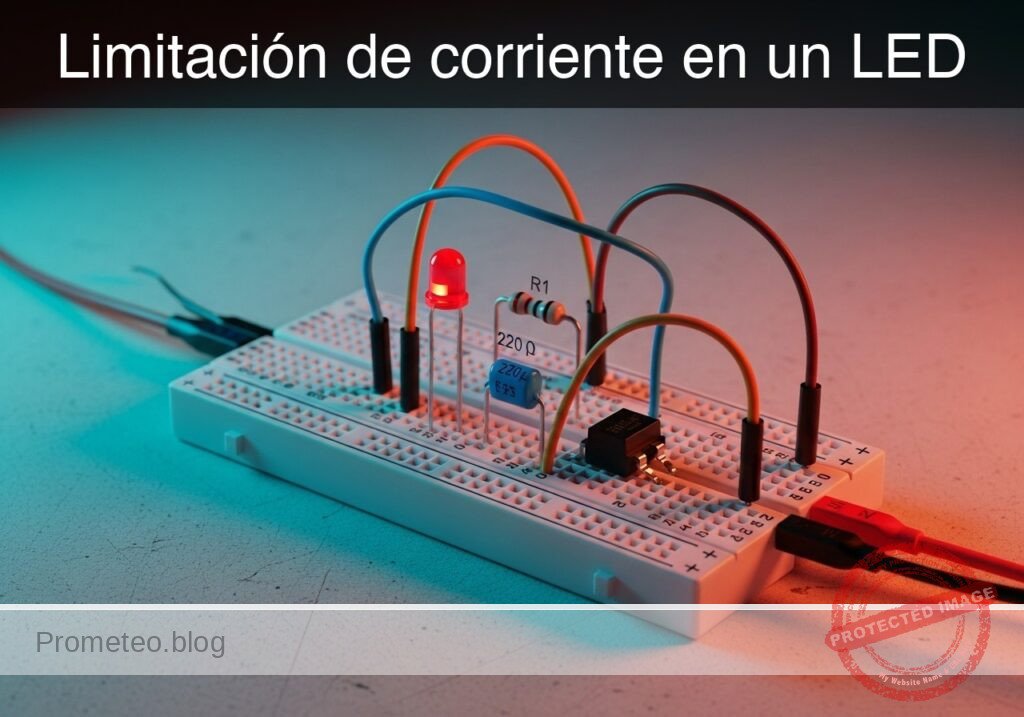
Prototipo de Limitación de corriente en un LED (Maker Style)

Nivel: Básico. Demostrar cómo una resistencia protege un componente sensible (LED) limitando el flujo de corriente según la Ley de Ohm.

Objetivo y caso de uso

En este caso, construirá un circuito en serie fundamental conectando una fuente de voltaje de CC, una resistencia limitadora de corriente y un Diodo Emisor de Luz (LED).

Por qué es útil:
* Protección de componentes: Evita que el LED consuma una corriente excesiva y se queme instantáneamente.
* Aplicación de la Ley de Ohm: Demuestra visualmente la relación entre Voltaje, Corriente y Resistencia ($I = V/R$).
* Indicación de estado: Forma la base para los indicadores de encendido en casi todos los dispositivos electrónicos.
* Herramientas de diagnóstico: Los circuitos LED simples se utilizan a menudo para depurar niveles lógicos en sistemas complejos.

Resultado esperado:
* El LED se enciende de forma constante sin sobrecalentarse.
* La corriente que fluye a través del circuito permanece dentro del rango seguro (típicamente 10–20 mA).
* La caída de voltaje a través de la resistencia corresponde al voltaje de alimentación menos el voltaje directo del LED.

Público objetivo y nivel: Principiantes y estudiantes que comienzan con el análisis básico de componentes.

Materiales

  • V1: Fuente de 5 V CC
  • R1: Resistencia de 220 Ω, función: limitación de corriente
  • D1: LED rojo, función: emisión de luz
  • M1: Multímetro, función: medición de corriente (A)
  • M2: Multímetro, función: medición de voltaje (V)

Guía de conexionado

Este circuito utiliza una topología en serie. Definimos los nodos como VCC (Fuente de 5V), 0 (Tierra) y NODE_A (Conexión intermedia).

  • V1 (Fuente de CC): El terminal positivo se conecta al nodo VCC. El terminal negativo se conecta al nodo 0.
  • R1 (Resistencia): Se conecta entre el nodo VCC y el nodo NODE_A.
  • D1 (LED): El ánodo se conecta al nodo NODE_A. El cátodo se conecta al nodo 0.

Diagrama de bloques conceptual

Conceptual block diagram — Current Limiting
Lectura rápida: entradas → bloque principal → salida (actuador o medida). Resume el esquemático ASCII de la siguiente sección.

Esquemático

[ SOURCE ]                  [ CURRENT CONTROL ]              [ OUTPUT / LOAD ]

    [ V1: 5V DC ] --(VCC)--> [ R1: 220 Ohm ] --(Node A)--> [ D1: Red LED ] --(0)--> [ GND ]
Esquema Eléctrico

Diagrama eléctrico

Diagrama eléctrico de limitación de corriente en un LED
Generado desde la netlist SPICE validada del caso.

🔒 Este diagrama eléctrico es premium. Con el pase de 7 días o la suscripción mensual podrás desbloquear el material didáctico completo y el pack PDF listo para imprimir.🔓 Ver planes de acceso premium

Mediciones y pruebas

Para validar la Ley de Ohm y la seguridad de los componentes:

  1. Calcular la corriente esperada:
    • Asumir Voltaje Directo del LED ($V_f$) $\approx$ 2.0 V.
    • Voltaje a través de R1: $V_{R1} = V_{source} – V_f = 5V – 2V = 3V$.
    • Corriente esperada: $I = V_{R1} / R1 = 3V / 220\Omega \approx 13.6 mA$.
  2. Medición de voltaje: Configure el multímetro M2 en Voltios de CC. Mida a través de R1 (puntas en VCC y NODE_A). La lectura debe ser de aproximadamente 3 V.
  3. Medición de corriente: Abra el circuito en el nodo VCC o 0 e inserte el multímetro M1 en serie (modo Amperímetro). La lectura debe estar cerca de 13–14 mA.
  4. Comprobación visual: El LED debe emitir una luz roja brillante y constante.

Netlist SPICE y simulación

Netlist SPICE de referencia (ngspice) — extractoNetlist SPICE completo (ngspice)

* Practical case: Current limiting in an LED

* --- Power Supply ---
* V1: 5V DC Supply connected between VCC and 0 (GND)
V1 VCC 0 DC 5

* --- Components ---
* R1: 220 Ohm Resistor
* Function: Current limiting
* Connected between VCC and NODE_A
R1 VCC NODE_A 220

* D1: Red LED
* Function: Light emission
* Anode connected to NODE_A, Cathode connected to 0 (GND)
D1 NODE_A 0 DLED

* --- Models ---
* Model for D1 (Red LED)
* Parameters: IS (Saturation Current), N (Emission Coefficient), RS (Series Resistance)
* ... (truncated in public view) ...

Copia este contenido en un archivo .cir y ejecútalo con ngspice.

🔒 Parte del contenido de esta sección es premium. Con el pase de 7 días o la suscripción mensual tendrás acceso al contenido completo (materiales, conexionado, compilación detallada, validación paso a paso, troubleshooting, mejoras/variantes y checklist) y podrás descargar el pack PDF listo para imprimir.

* Practical case: Current limiting in an LED

* --- Power Supply ---
* V1: 5V DC Supply connected between VCC and 0 (GND)
V1 VCC 0 DC 5

* --- Components ---
* R1: 220 Ohm Resistor
* Function: Current limiting
* Connected between VCC and NODE_A
R1 VCC NODE_A 220

* D1: Red LED
* Function: Light emission
* Anode connected to NODE_A, Cathode connected to 0 (GND)
D1 NODE_A 0 DLED

* --- Models ---
* Model for D1 (Red LED)
* Parameters: IS (Saturation Current), N (Emission Coefficient), RS (Series Resistance)
* Tuned for approximately 1.8V - 2.0V forward voltage drop
.model DLED D (IS=1e-14 N=2.5 RS=5 BV=5 IBV=10u)

* --- Analysis Directives ---
* Calculate DC operating point
.op

* Transient analysis (Required for .print output generation)
* Step: 100us, Stop: 10ms
.tran 100u 10m

* --- Output / Measurements ---
* Simulating M2 (Multimeter - Voltage): Probing NODE_A (Voltage across LED)
* Simulating M1 (Multimeter - Current): Probing I(V1) (Total circuit current)
* Note: I(V1) will be negative as current flows out of the voltage source.
.print tran V(VCC) V(NODE_A) I(V1)

.end

Resultados de Simulación (Transitorio)

Resultados de Simulación (Transitorio)
Show raw data table (108 rows)
Index   time            v(vcc)          v(node_a)       v1#branch
0	0.000000e+00	5.000000e+00	1.880179e+00	-1.41810e-02
1	1.000000e-06	5.000000e+00	1.880178e+00	-1.41810e-02
2	2.000000e-06	5.000000e+00	1.880178e+00	-1.41810e-02
3	4.000000e-06	5.000000e+00	1.880178e+00	-1.41810e-02
4	8.000000e-06	5.000000e+00	1.880178e+00	-1.41810e-02
5	1.600000e-05	5.000000e+00	1.880178e+00	-1.41810e-02
6	3.200000e-05	5.000000e+00	1.880178e+00	-1.41810e-02
7	6.400000e-05	5.000000e+00	1.880178e+00	-1.41810e-02
8	1.280000e-04	5.000000e+00	1.880178e+00	-1.41810e-02
9	2.280000e-04	5.000000e+00	1.880178e+00	-1.41810e-02
10	3.280000e-04	5.000000e+00	1.880178e+00	-1.41810e-02
11	4.280000e-04	5.000000e+00	1.880178e+00	-1.41810e-02
12	5.280000e-04	5.000000e+00	1.880178e+00	-1.41810e-02
13	6.280000e-04	5.000000e+00	1.880178e+00	-1.41810e-02
14	7.280000e-04	5.000000e+00	1.880178e+00	-1.41810e-02
15	8.280000e-04	5.000000e+00	1.880178e+00	-1.41810e-02
16	9.280000e-04	5.000000e+00	1.880178e+00	-1.41810e-02
17	1.028000e-03	5.000000e+00	1.880178e+00	-1.41810e-02
18	1.128000e-03	5.000000e+00	1.880178e+00	-1.41810e-02
19	1.228000e-03	5.000000e+00	1.880178e+00	-1.41810e-02
20	1.328000e-03	5.000000e+00	1.880178e+00	-1.41810e-02
21	1.428000e-03	5.000000e+00	1.880178e+00	-1.41810e-02
22	1.528000e-03	5.000000e+00	1.880178e+00	-1.41810e-02
23	1.628000e-03	5.000000e+00	1.880178e+00	-1.41810e-02
... (84 more rows) ...

Errores comunes y cómo evitarlos

  1. Polaridad del LED invertida: Conectar el cátodo del LED al positivo. Solución: Asegúrese de que la pata más larga (Ánodo) esté orientada hacia el lado del voltaje positivo (hacia R1).
  2. Omitir la resistencia: Conectar el LED directamente a 5V. Solución: Verifique siempre que la resistencia esté en serie antes de aplicar energía para evitar destruir el LED.
  3. Medir corriente en paralelo: Intentar medir la corriente colocando las puntas a través del LED como un voltímetro. Solución: Abra siempre la ruta del circuito y coloque el medidor en serie para las mediciones de corriente.

Solución de problemas

  • Síntoma: El LED no se enciende.
    • Causa: LED conectado al revés o circuito abierto.
    • Solución: Verifique la orientación (Ánodo/Cátodo) y asegúrese de que todas las conexiones de la placa de pruebas (breadboard) estén firmes.
  • Síntoma: El LED parpadea una vez y muere.
    • Causa: No se utilizó resistencia limitadora de corriente (el LED se quemó).
    • Solución: Reemplace el LED y asegúrese de que R1 (220 Ω) esté instalada correctamente.
  • Síntoma: El LED es muy tenue.
    • Causa: El valor de la resistencia es demasiado alto (por ejemplo, usando 10 kΩ en lugar de 220 Ω).
    • Solución: Verifique las bandas de color de la resistencia o mida R1 con un multímetro.
  • Síntoma: El multímetro lee 0 A.
    • Causa: Fusible fundido en el multímetro o selección de modo incorrecta.
    • Solución: Verifique las conexiones de las puntas de prueba (Com/mA) y asegúrese de que el dial del medidor esté configurado en Corriente CC.

Posibles mejoras y extensiones

  1. Brillo variable: Reemplace R1 con un potenciómetro de 1 kΩ en serie con una resistencia de seguridad de 100 Ω para ajustar manualmente el brillo.
  2. Múltiples colores: Cambie el LED rojo por uno azul o verde y mida el cambio en la corriente (los diferentes colores tienen diferentes voltajes directos, lo que afecta el cálculo).

Más Casos Prácticos en Prometeo.blog

Encuentra este producto y/o libros sobre este tema en Amazon

Ir a Amazon

Como afiliado de Amazon, gano con las compras que cumplan los requisitos. Si compras a través de este enlace, ayudas a mantener este proyecto.

Quiz rápido

Pregunta 1: ¿Cuál es el objetivo principal de la resistencia en el circuito descrito?


Pregunta 2: ¿Qué ley fundamental de la electrónica se demuestra visualmente en este circuito?


Pregunta 3: ¿Cuál es el rango de corriente seguro típico para el LED mencionado en el texto?


Pregunta 4: ¿Qué topología de circuito se utiliza para conectar los componentes?


Pregunta 5: ¿Cómo se calcula la caída de voltaje a través de la resistencia según el texto?


Pregunta 6: ¿Cuál es una aplicación práctica mencionada para este tipo de circuito simple?


Pregunta 7: ¿Qué resultado visual se espera si el circuito funciona correctamente?


Pregunta 8: ¿Qué tipo de fuente de voltaje se utiliza en este circuito fundamental?


Pregunta 9: ¿Qué función adicional, aparte de iluminar, se menciona para los circuitos LED simples?


Pregunta 10: ¿Qué relación matemática define la Ley de Ohm aplicada en este contexto?


Carlos Núñez Zorrilla
Electronics & Computer Engineer

Ingeniero Superior en Electrónica de Telecomunicaciones e Ingeniero en Informática (titulaciones oficiales en España).

Sígueme: