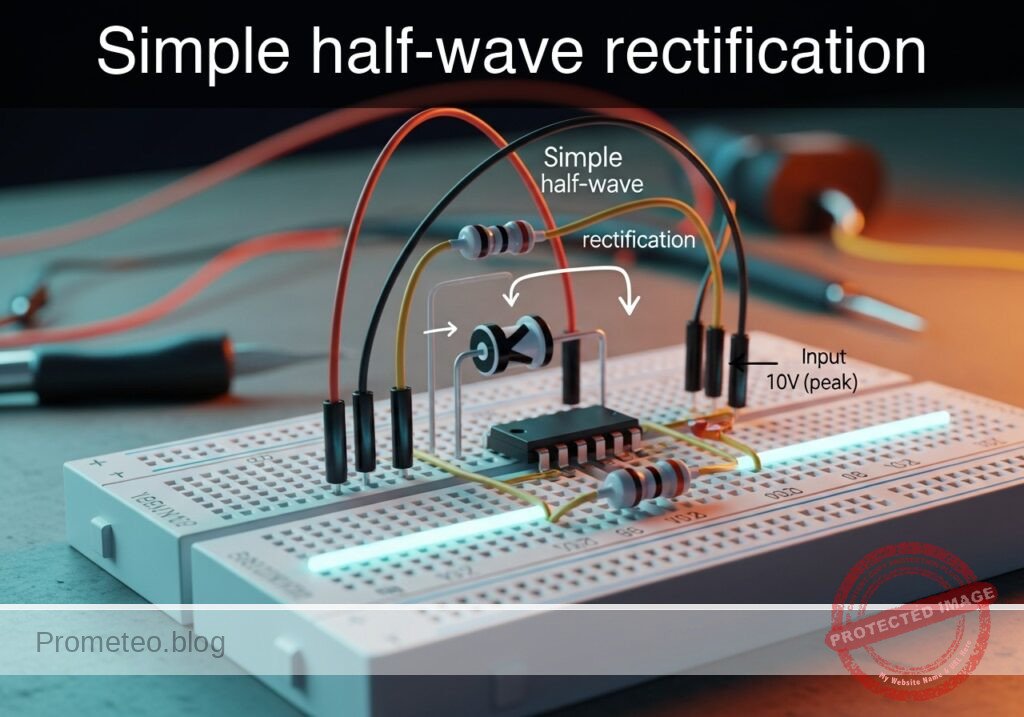
Practical case: Simple half-wave rectification

Simple half-wave rectification prototype (Maker Style)

Level: Basic. Visualizing how a diode converts AC to pulsating DC by removing the negative half-cycle.

Objective and use case

You will build a fundamental analog circuit that uses a single semiconductor diode to block the negative portion of an alternating current (AC) signal, passing only the positive portion to a resistive load.

Why it is useful:
* Power conversion: It represents the first stage in converting AC mains power to DC for electronic devices.
* Signal demodulation: Used in AM radios to extract audio signals from radio frequency carriers (envelope detector).
* Polarity protection: Similar logic prevents damage to DC circuits if batteries are inserted backward.

Expected outcome:
* Input Signal: A complete sine wave swinging between positive and negative voltages (e.g., +10 V to -10 V).
* Output Signal: A pulsating waveform showing only the positive «humps» of the sine wave; the voltage sits at 0 V during the negative cycle.
* Voltage Drop: The peak output voltage will be approximately 0.7 V lower than the input peak due to the silicon diode forward voltage drop.
* Frequency: The output frequency remains identical to the input frequency.

Target audience and level: Students and hobbyists learning basic analog components.

Materials

  • V1: 10 V (peak), 60 Hz AC voltage source (sine wave), function: main power input.
  • D1: 1N4007 (or 1N4148), function: rectifier diode.
  • R1: 1 kΩ resistor, function: resistive load.

Wiring guide

This guide defines the connections between components using specific node names (VIN, VOUT, 0).

  • V1 (Source): Connect the positive terminal to node VIN and the negative terminal to node 0 (GND).
  • D1 (Diode): Connect the Anode to node VIN and the Cathode (marked with a stripe) to node VOUT.
  • R1 (Load): Connect one terminal to node VOUT and the other terminal to node 0 (GND).

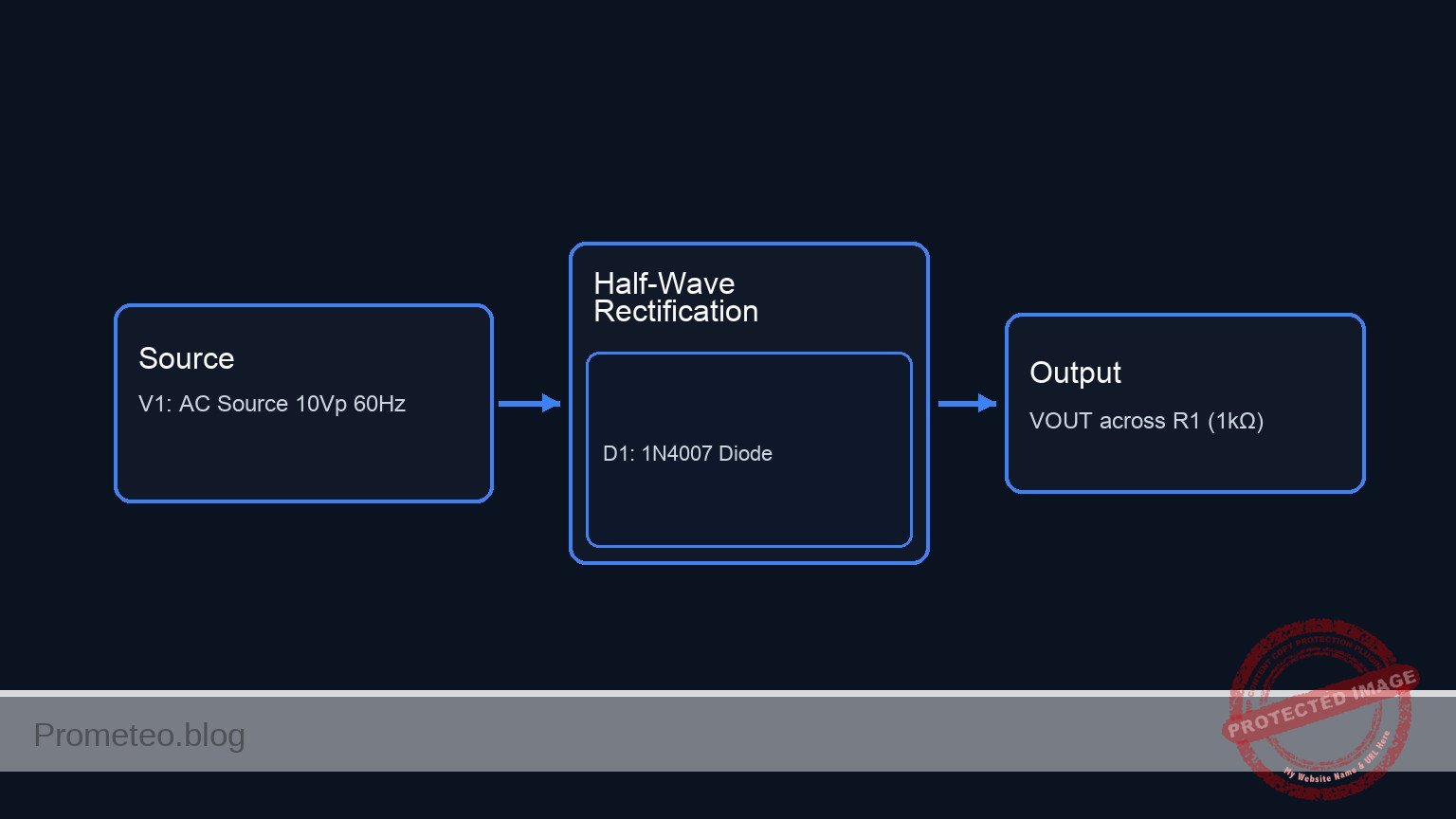
Conceptual block diagram

Conceptual block diagram — Half-Wave Rectification
Quick read: inputs → main block → output (actuator or measurement). This summarizes the ASCII schematic below.

Schematic

[ SOURCE / INPUT ]             [ RECTIFICATION ]               [ LOAD / OUTPUT ]

[ V1: AC Source    ]           +----------------------+           [ R1: Resistor   ]
[ 10 V Peak, 60Hz   ] --(VIN)-->| Anode (A) -> Cathode | --(VOUT)--> [ 1 kΩ         ] --> GND
                               | D1: 1N4007           |
                               +----------------------+
Schematic (ASCII)

Measurements and tests

To validate the circuit, you will need a dual-channel oscilloscope or a simulation tool.

  1. Setup Probes:
    • Connect Channel A (Yellow) to VIN to monitor the source.
    • Connect Channel B (Blue) to VOUT to monitor the voltage across the resistor.
    • Ensure the ground clips of both probes are connected to node 0 (GND).
  2. Visual Inspection:
    • Observe that VIN is a full sine wave centered at 0 V.
    • Observe that VOUT follows VIN during the positive cycle but stays flat at 0 V during the negative cycle.
  3. Cursor Measurement:
    • Measure the peak voltage of VIN (e.g., 10.0 V).
    • Measure the peak voltage of VOUT. It should be approximately 9.3 V.
    • Calculate the difference (Vin – Vout). This confirms the roughly 0.7 V forward voltage drop of the silicon diode.

SPICE netlist and simulation

Reference SPICE Netlist (ngspice) — excerptFull SPICE netlist (ngspice)

* Practical case: Simple half-wave rectification

* --- Circuit Description ---
* V1 (Source): 10V Peak, 60Hz Sine Wave
* D1 (Diode): 1N4007 Rectifier
* R1 (Load): 1k Ohm Resistor

* --- Components ---

* V1: Main power input
* Connected: Positive -> VIN, Negative -> 0 (GND)
* Syntax: SIN(Voffset Vamp Freq)
V1 VIN 0 SIN(0 10 60)

* D1: Rectifier diode (1N4007)
* Connected: Anode -> VIN, Cathode -> VOUT
D1 VIN VOUT 1N4007

* R1: Resistive load
* Connected: VOUT -> 0 (GND)
* ... (truncated in public view) ...

Copy this content into a .cir file and run with ngspice.

🔒 Part of this section is premium. With the 7-day pass or the monthly membership you can access the full content (materials, wiring, detailed build, validation, troubleshooting, variants and checklist) and download the complete print-ready PDF pack.

* Practical case: Simple half-wave rectification

* --- Circuit Description ---
* V1 (Source): 10V Peak, 60Hz Sine Wave
* D1 (Diode): 1N4007 Rectifier
* R1 (Load): 1k Ohm Resistor

* --- Components ---

* V1: Main power input
* Connected: Positive -> VIN, Negative -> 0 (GND)
* Syntax: SIN(Voffset Vamp Freq)
V1 VIN 0 SIN(0 10 60)

* D1: Rectifier diode (1N4007)
* Connected: Anode -> VIN, Cathode -> VOUT
D1 VIN VOUT 1N4007

* R1: Resistive load
* Connected: VOUT -> 0 (GND)
R1 VOUT 0 1k

* --- Models ---
* Standard model for 1N4007 Diode
.model 1N4007 D (IS=7.69n RS=0.042 N=1.45 BV=1000 IBV=5u CJO=14.2p VJ=0.5 M=0.333 TT=4.32u)

* --- Analysis Commands ---
* Transient analysis
* Frequency is 60Hz (Period ~16.67ms).
* Simulate for 50ms to capture approximately 3 full cycles.
.tran 0.1ms 50ms

* Operating Point for initial check
.op

* --- Output Directives ---
* Print input voltage and rectified output voltage
.print tran V(VIN) V(VOUT)

.end

Simulation Results (Transient Analysis)

Simulation Results (Transient Analysis)
Show raw data table (515 rows)
Index   time            v(vin)          v(vout)
0	0.000000e+00	0.000000e+00	-2.01593e-21
1	1.000000e-06	3.769911e-03	5.704546e-05
2	2.000000e-06	7.539822e-03	5.927562e-05
3	4.000000e-06	1.507964e-02	6.305993e-05
4	8.000000e-06	3.015924e-02	7.111847e-05
5	1.600000e-05	6.031821e-02	1.021853e-04
6	3.200000e-05	1.206342e-01	3.070797e-04
7	5.378437e-05	2.027484e-01	2.167324e-03
8	7.424258e-05	2.798514e-01	1.250260e-02
9	9.741093e-05	3.671480e-01	4.715921e-02
10	1.262516e-04	4.757778e-01	1.182339e-01
11	1.839330e-04	6.928557e-01	2.983890e-01
12	2.467131e-04	9.287461e-01	5.130162e-01
13	3.467131e-04	1.303359e+00	8.676123e-01
14	4.467131e-04	1.676120e+00	1.226655e+00
15	5.467131e-04	2.046499e+00	1.587509e+00
16	6.467131e-04	2.413969e+00	1.947514e+00
17	7.467131e-04	2.778010e+00	2.305173e+00
18	8.467131e-04	3.138102e+00	2.659882e+00
19	9.467131e-04	3.493735e+00	3.010809e+00
20	1.046713e-03	3.844404e+00	3.357375e+00
21	1.146713e-03	4.189609e+00	3.698904e+00
22	1.246713e-03	4.528861e+00	4.034877e+00
23	1.346713e-03	4.861677e+00	4.364712e+00
... (491 more rows) ...

Common mistakes and how to avoid them

  1. Reversing the diode:
    • Error: The diode is installed with the cathode pointing toward the source.
    • Result: The circuit produces negative voltage pulses instead of positive ones.
    • Solution: Verify the stripe (cathode) points toward the load resistor.
  2. Ignoring power ratings:
    • Error: Using a very small resistor (e.g., 10 Ω) with a standard 1/4W resistor.
    • Result: The resistor overheats and burns.
    • Solution: Calculate power (P = V^2 / R) or use a resistor value like 1 kΩ or higher for demonstration purposes.
  3. Floating Ground:
    • Error: Measuring VOUT without a common ground reference between the source and the oscilloscope.
    • Result: Noisy or floating signals on the screen.
    • Solution: Ensure all grounds (Source, Resistor, Oscilloscope) are tied to node 0.

Troubleshooting

  • Symptom: No output voltage (0 V flatline).
    • Cause: Diode is open (blown) or disconnected.
    • Fix: Check continuity with a multimeter; replace the diode.
  • Symptom: Output is identical to Input (full sine wave).
    • Cause: Diode is shorted internally.
    • Fix: Replace the diode; a shorted diode acts like a wire.
  • Symptom: Output peak is significantly lower than expected (e.g., 5 V drop).
    • Cause: High internal resistance of the source or an incorrect component (e.g., using a Zener diode in reverse breakdown).
    • Fix: Verify the diode part number is a standard rectifier (1N400x series).

Possible improvements and extensions

  1. Filter Capacitor: Connect a capacitor (e.g., 10 µF) in parallel with R1 to observe how the capacitor fills in the gaps between pulses, smoothing the DC output.
  2. Full-Wave Bridge: Replace the single diode with four diodes (bridge configuration) to utilize both the positive and negative halves of the AC cycle, improving efficiency.

More Practical Cases on Prometeo.blog

Find this product and/or books on this topic on Amazon

Go to Amazon

As an Amazon Associate, I earn from qualifying purchases. If you buy through this link, you help keep this project running.

Quick Quiz

Question 1: What is the primary function of the semiconductor diode in this circuit?


Question 2: What is the expected shape of the output signal?


Question 3: How does the output frequency compare to the input frequency in this half-wave rectifier?


Question 4: Why is the peak output voltage slightly lower than the input peak voltage?


Question 5: Approximately how much voltage is typically dropped across a standard silicon diode?


Question 6: In a standard schematic for this circuit, which component typically acts as the load?


Question 7: What happens to the voltage at the output during the negative cycle of the input?


Question 8: Which of the following is a practical use case for this type of circuit mentioned in the text?


Question 9: To allow positive current to flow from the source to the load, how should the diode be oriented?


Question 10: If the input signal swings between +10 V and -10 V, what is the approximate peak output voltage?


Carlos Núñez Zorrilla
Electronics & Computer Engineer

Telecommunications Electronics Engineer and Computer Engineer (official degrees in Spain).

Follow me:


Practical case: Forward and Reverse Diode Biasing

Forward and Reverse Diode Biasing prototype (Maker Style)

Level: Basic. Verify the diode’s behavior as a unidirectional switch by measuring current and voltage in both polarities.

Objective and use case

In this experiment, you will build a simple series circuit consisting of a DC voltage source, a current-limiting resistor, and a silicon diode. You will measure the voltage drop across the diode and the current flowing through the circuit to confirm how the component blocks or conducts electricity based on its orientation.

  • Reverse polarity protection: Prevents damage to sensitive electronics if a battery is inserted backwards.
  • AC to DC Rectification: Converts alternating current into direct current in power supplies.
  • Signal clipping: Limits voltage levels to protect downstream components in communication circuits.
  • Logic implementation: Forms the basis of DTL (Diode-Transistor Logic) gates.

Expected outcome:
* Forward Bias: The diode conducts current; voltage across the diode (VD) stays near 0.7 V.
* Reverse Bias: The diode blocks current (I ≈ 0 A); voltage across the diode equals the supply voltage (Vsupply).
* Unidirectional flow: Confirmation that electrons only flow effectively in one direction (Anode to Cathode).

Target audience: Students and beginners in basic analog electronics.

Materials

  • V1: 9 V DC supply (battery or bench power supply).
  • R1: 1 kΩ resistor, function: current limiting and current sensing.
  • D1: 1N4148 silicon diode (or 1N4007), function: Device Under Test (DUT).
  • Multimeter: Digital multimeter, function: measuring DC voltage and DC current.

Wiring guide

This guide describes the Forward Bias configuration. The nodes are defined as VCC (9 V), N1 (junction), and 0 (GND).

  • V1: Connect the positive terminal to node VCC and the negative terminal to node 0.
  • R1: Connect one leg to node VCC and the other leg to node N1.
  • D1: Connect the Anode (side without the stripe) to node N1 and the Cathode (side with the stripe) to node 0.

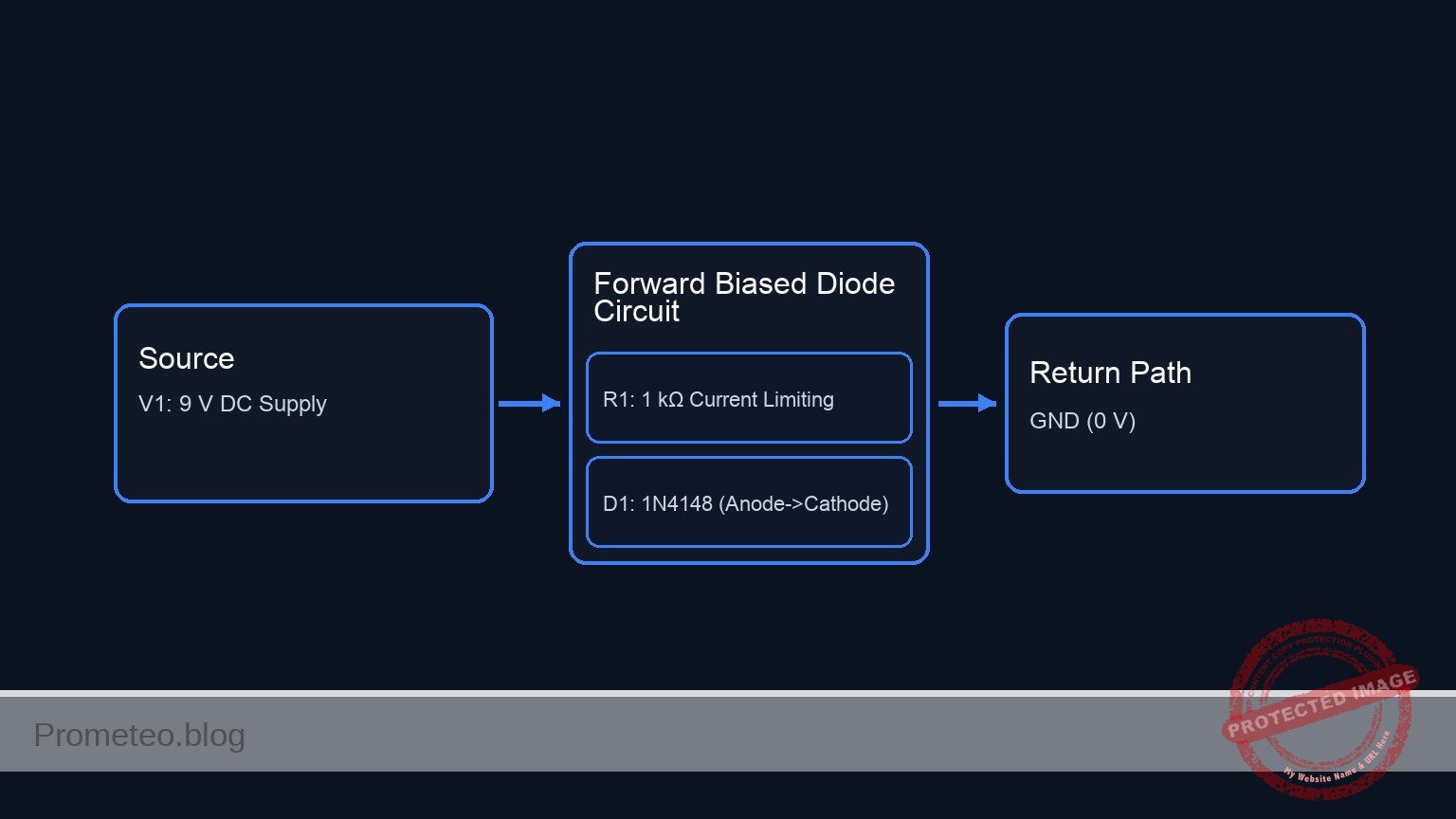
Conceptual block diagram

Conceptual block diagram — Forward Biased Diode Circuit
Quick read: inputs → main block → output (actuator or measurement). This summarizes the ASCII schematic below.

Schematic

[ POWER SOURCE ]               [ CIRCUIT PROCESSING ]                [ RETURN PATH ]

[ V1: 9 V DC Supply ] --(+9 V)--> [ R1: 1 kΩ Resistor ] --(Node N1)--> [ D1: 1N4148 Diode ] --(0 V)--> [ GND ]
                                (Current Limiting)    (Measurement)    (Anode -> Cathode)
                                                                        (Forward Biased)
Schematic (ASCII)

Measurements and tests

To validate the diode behavior, perform the following measurements using the multimeter.

1. Forward Bias Test (Anode to Positive)
* Voltage Measurement (VD): Set the multimeter to DC Volts. Place the red probe on the Anode (Node N1) and the black probe on the Cathode (Node 0).
* Result: You should read approximately 0.6 V to 0.7 V.
* Current Measurement (ID): Set the multimeter to DC mA. Break the circuit between R1 and D1, and insert the multimeter in series.
* Result: Using Ohm’s Law (I = (Vsource – VD) / R1), the current should be approximately 8.3 mA.

2. Reverse Bias Test (Cathode to Positive)
* Re-wiring: Disconnect D1, flip it 180 degrees, and reconnect it. Now the Cathode (stripe) connects to N1 and the Anode connects to 0.
* Voltage Measurement (VD): Measure across the diode again.
* Result: You should read a value very close to the source voltage (9 V), indicating the diode is acting as an open switch.
* Current Measurement (ID): Measure the current in the loop.
* Result: The reading should be 0 mA (or negligible leakage current in the nano-amp range).

SPICE netlist and simulation

Reference SPICE Netlist (ngspice) — excerptFull SPICE netlist (ngspice)

* Practical case: Forward and Reverse Diode Biasing
* Based on Wiring Guide: Forward Bias Configuration

* --- Power Supply ---
* V1: 9 V DC supply connected between VCC and GND (Node 0)
V1 VCC 0 DC 9

* --- Components ---
* R1: 1 kΩ resistor between VCC and Node N1
R1 VCC N1 1k

* D1: 1N4148 Diode
* Anode connected to N1, Cathode connected to GND (0)
D1 N1 0 D1N4148

* --- Models ---
* Standard 1N4148 Model
.model D1N4148 D (IS=2.682n N=1.836 RS=0.5664 BV=100 IBV=100p CJO=4p TT=11.54n)

* --- Analysis Directives ---
* ... (truncated in public view) ...

Copy this content into a .cir file and run with ngspice.

🔒 Part of this section is premium. With the 7-day pass or the monthly membership you can access the full content (materials, wiring, detailed build, validation, troubleshooting, variants and checklist) and download the complete print-ready PDF pack.

* Practical case: Forward and Reverse Diode Biasing
* Based on Wiring Guide: Forward Bias Configuration

* --- Power Supply ---
* V1: 9 V DC supply connected between VCC and GND (Node 0)
V1 VCC 0 DC 9

* --- Components ---
* R1: 1 kΩ resistor between VCC and Node N1
R1 VCC N1 1k

* D1: 1N4148 Diode
* Anode connected to N1, Cathode connected to GND (0)
D1 N1 0 D1N4148

* --- Models ---
* Standard 1N4148 Model
.model D1N4148 D (IS=2.682n N=1.836 RS=0.5664 BV=100 IBV=100p CJO=4p TT=11.54n)

* --- Analysis Directives ---
* Operating Point analysis to see DC bias values
.op

* Transient analysis to log data (1ms duration)
.tran 10u 1m

* --- Output Directives ---
* Print supply voltage and diode forward voltage
.print tran V(VCC) V(N1)

.end

Simulation Results (Transient Analysis)

Simulation Results (Transient Analysis)
Show raw data table (108 rows)
Index   time            v(vcc)          v(n1)
0	0.000000e+00	9.000000e+00	7.143329e-01
1	1.000000e-07	9.000000e+00	7.143290e-01
2	2.000000e-07	9.000000e+00	7.143286e-01
3	4.000000e-07	9.000000e+00	7.143286e-01
4	8.000000e-07	9.000000e+00	7.143286e-01
5	1.600000e-06	9.000000e+00	7.143286e-01
6	3.200000e-06	9.000000e+00	7.143286e-01
7	6.400000e-06	9.000000e+00	7.143286e-01
8	1.280000e-05	9.000000e+00	7.143286e-01
9	2.280000e-05	9.000000e+00	7.143286e-01
10	3.280000e-05	9.000000e+00	7.143286e-01
11	4.280000e-05	9.000000e+00	7.143286e-01
12	5.280000e-05	9.000000e+00	7.143286e-01
13	6.280000e-05	9.000000e+00	7.143286e-01
14	7.280000e-05	9.000000e+00	7.143286e-01
15	8.280000e-05	9.000000e+00	7.143286e-01
16	9.280000e-05	9.000000e+00	7.143286e-01
17	1.028000e-04	9.000000e+00	7.143286e-01
18	1.128000e-04	9.000000e+00	7.143286e-01
19	1.228000e-04	9.000000e+00	7.143286e-01
20	1.328000e-04	9.000000e+00	7.143286e-01
21	1.428000e-04	9.000000e+00	7.143286e-01
22	1.528000e-04	9.000000e+00	7.143286e-01
23	1.628000e-04	9.000000e+00	7.143286e-01
... (84 more rows) ...

Common mistakes and how to avoid them

  • Measuring current in parallel: Never connect the multimeter across the diode while in «Current/Amps» mode. This creates a short circuit and may blow the multimeter’s fuse. Always measure current in series.
  • Omitting the resistor: Connecting a diode directly to a voltage source (above 0.7 V) without a resistor will cause unlimited current flow, instantly destroying the diode (and potentially the power supply).
  • Misidentifying terminals: The stripe on the diode body indicates the Cathode. In forward bias, the Cathode must point toward the lower potential (GND).

Troubleshooting

  • 0 V measured across D1 in Forward Bias: The diode might be shorted internally or the power supply is off. Check V1 voltage first.
  • 0 mA in Forward Bias: The circuit is open. Check if the breadboard connections are loose or if the resistor value is too high (e.g., 1 MΩ instead of 1 kΩ).
  • 9 V across R1 in Reverse Bias: The diode is conducting when it should not. Ensure D1 is actually reversed (stripe facing positive voltage) or check if D1 is damaged (shorted).
  • Diode gets hot: The current is too high. Ensure R1 is at least 330 Ω for a 9 V supply.

Possible improvements and extensions

  • Visual Indicator: Replace the standard silicon diode (D1) with an LED. The light will visually confirm when current is flowing (Forward Bias) and turn off when blocked (Reverse Bias).
  • I-V Curve Tracing: Use a variable power supply (0 V to 10 V) and record the current at 0.1 V steps to plot the characteristic exponential curve of the diode.

More Practical Cases on Prometeo.blog

Find this product and/or books on this topic on Amazon

Go to Amazon

As an Amazon Associate, I earn from qualifying purchases. If you buy through this link, you help keep this project running.

Quick Quiz

Question 1: What is the primary objective of this experiment?


Question 2: In a forward bias configuration, what is the expected voltage drop across a silicon diode?


Question 3: What happens to the current when the diode is in reverse bias?


Question 4: Which component functions as the Device Under Test (DUT) in this experiment?


Question 5: What is the purpose of the resistor in this circuit?


Question 6: Which of the following is a use case mentioned for diodes in the text?


Question 7: In reverse bias, what voltage value is expected across the diode?


Question 8: What specific logic family is mentioned as a use case for diodes?


Question 9: How does the diode assist in power supplies according to the text?


Question 10: What function does a diode perform in signal clipping?


Carlos Núñez Zorrilla
Electronics & Computer Engineer

Telecommunications Electronics Engineer and Computer Engineer (official degrees in Spain).
Follow me:


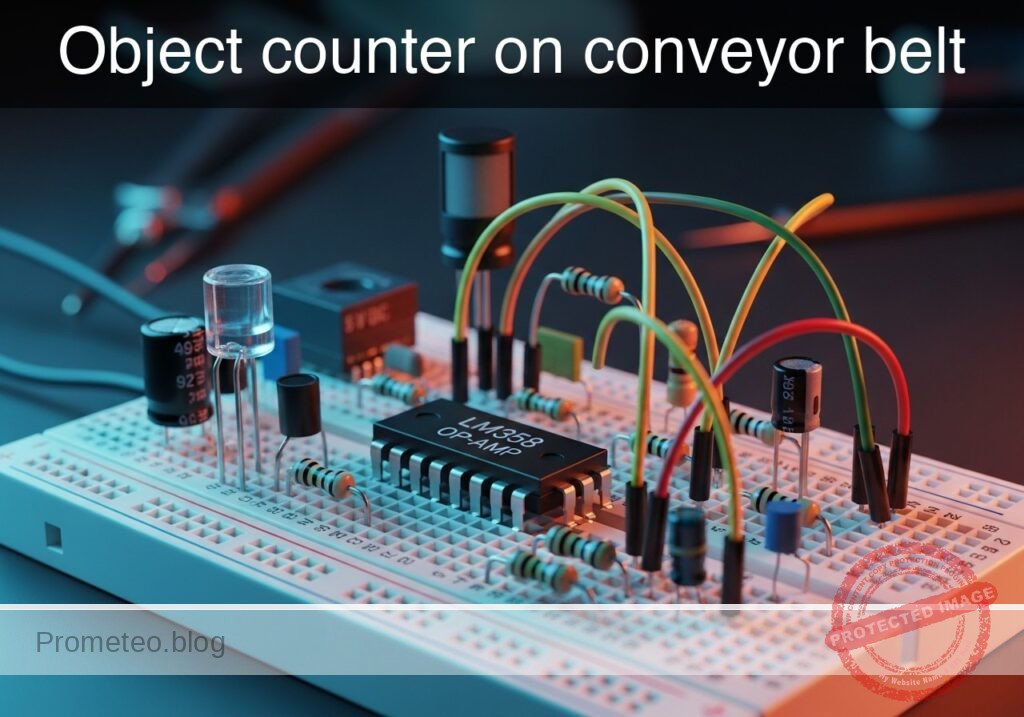
Practical case: Object counter on conveyor belt

Object counter on conveyor belt prototype (Maker Style)

Level: Basic – Build a light interruption sensor system to detect objects moving on a line.

Objective and use case

In this practical case, you will build an optical barrier using a photoresistor (LDR) and an operational amplifier configured as a voltage comparator. The circuit detects when an opaque object interrupts a continuous beam of light, triggering a signal that can be counted or processed.

Why it is useful:
* Industrial automation: Used to count products moving on a conveyor belt.
* Safety barriers: Detects if a person or object crosses a dangerous boundary.
* Intruder alarms: Triggers a warning when a beam of invisible or visible light is broken.
* Parking systems: Detects the presence of a vehicle in a specific spot.

Expected outcome:
* State A (Light path clear): The sensor receives light, and the output indicator (Red LED) remains OFF (Logic Low).
* State B (Object detected): The object blocks the light, increasing LDR resistance. The output indicator turns ON (Logic High).
* Signal Threshold: The comparator switches states when the sensor voltage crosses the adjustable reference voltage (approx. 2.5 V).

Target audience: Level Basic

Materials

  • V1: 5 V DC power supply, function: main circuit power.
  • R1: 10 kΩ resistor, function: voltage divider top for reference.
  • R2: 10 kΩ resistor, function: voltage divider bottom for reference.
  • R3: 10 kΩ resistor, function: pull-up resistor for the sensor node.
  • R4: Photoresistor (LDR), function: light detection sensor.
  • R5: 330 Ω resistor, function: current limiting for output indicator LED.
  • R6: 330 Ω resistor, function: current limiting for emitter LED.
  • D1: White LED, function: light emitter (simulates the beam source).
  • D2: Red LED, function: output indicator (object detected).
  • U1: LM358 or similar OpAmp, function: voltage comparator.

Wiring guide

This circuit relies on comparing two voltages: a fixed reference (V_REF) and a variable sensor voltage (V_SENSE).

Power Connections
* V1 (+) connects to node VCC.
* V1 (-) connects to node 0 (GND).
* U1 (Pin 8 / VCC) connects to VCC.
* U1 (Pin 4 / GND) connects to 0.

Reference Voltage (V_REF)
* R1 connects between VCC and V_REF.
* R2 connects between V_REF and 0.
* U1 (Pin 2 / Inverting Input) connects to V_REF.
* Note: This sets a fixed threshold of 2.5 V.

Sensor Voltage (V_SENSE)
* R3 connects between VCC and V_SENSE.
* R4 (LDR) connects between V_SENSE and 0.
* U1 (Pin 3 / Non-Inverting Input) connects to V_SENSE.
* Logic: When light is blocked, R4 resistance increases, V_SENSE rises. If V_SENSE > V_REF, Output goes High.

Light Emitter (Source)
* R6 connects between VCC and NODE_EMIT.
* D1 (Anode) connects to NODE_EMIT.
* D1 (Cathode) connects to 0.
* Place D1 physically facing R4 (LDR).

Output Stage
* U1 (Pin 1 / Output) connects to V_OUT.
* R5 connects between V_OUT and NODE_LED.
* D2 (Anode) connects to NODE_LED.
* D2 (Cathode) connects to 0.

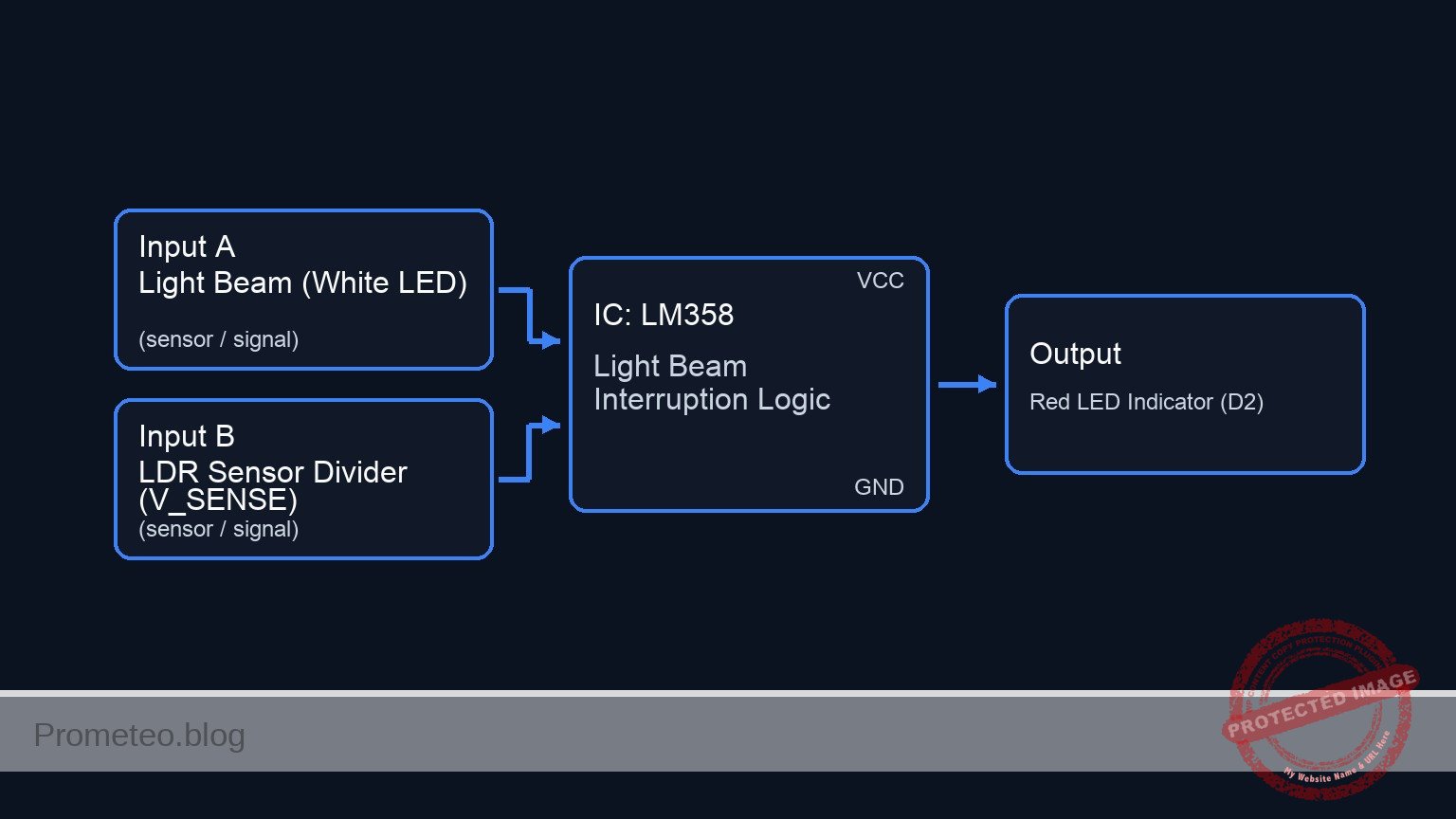
Conceptual block diagram

Conceptual block diagram — LM358 Light Beam Interruption Logic
Quick read: inputs → main block → output (actuator or measurement). This summarizes the ASCII schematic below.

Schematic

[ INPUTS / SENSORS ]                     [ LOGIC / PROCESSING ]             [ OUTPUTS ]

    [ LIGHT SOURCE ]
    [ VCC -> R6 -> D1 (White) ]
             |
      (Light Beam Path)
             |
             V
    [ SENSOR DIVIDER ]
    [ VCC -> R3 -> Node -> R4 ] --(V_SENSE)-->+----------------+
    [ (R4=LDR, varies w/ light)]              |   Pin 3 (+)    |
                                              |                |
                                              |    U1 LM358    |
                                              |   (Comparator) | --(Pin 1)--> [ R5 (330) ] --> [ D2 (Red LED) ] --> GND
                                              |                |
    [ REFERENCE DIVIDER ]                     |                |
    [ VCC -> R1 -> Node -> R2 ] --(V_REF)---->|   Pin 2 (-)    |
    [ (Fixed 2.5 V Threshold)  ]               +----------------+
Schematic (ASCII)

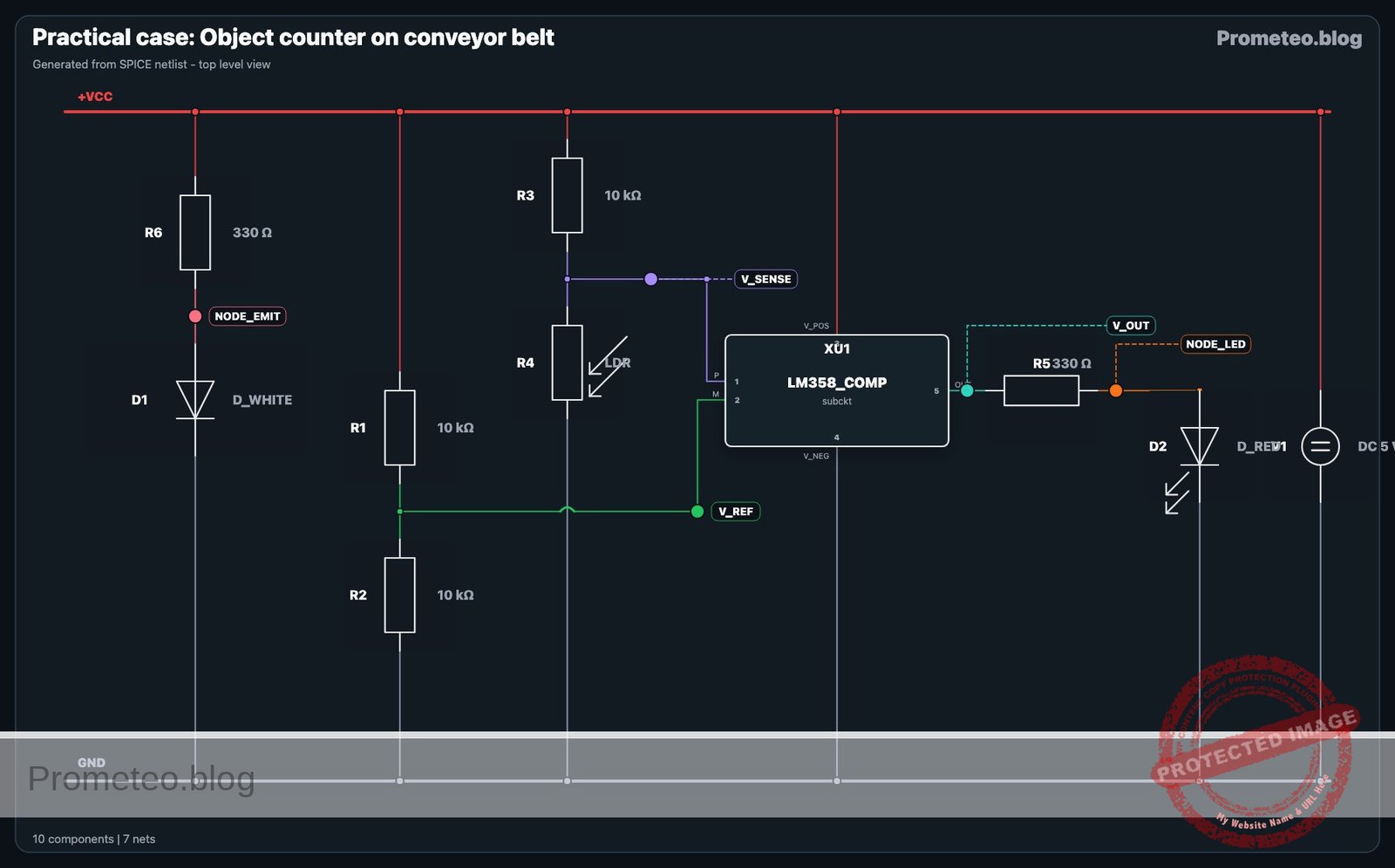
Electrical diagram

Electrical diagram — Object counter on conveyor belt
Generated from the validated SPICE netlist for this case.

🔒 This electrical diagram is premium. With the 7-day pass or the monthly membership you can unlock the complete didactic material and the print-ready PDF pack.🔓 See premium access plans

Measurements and tests

  1. Reference Check: Use a multimeter to measure the voltage between V_REF and 0. It should be approximately 2.5 V (half of VCC).
  2. Light Condition (Clear Path): Ensure the Emitter LED (D1) shines on the LDR (R4). Measure V_SENSE. It should be lower than V_REF (e.g., < 2.0 V). The Output LED (D2) should be OFF.
  3. Dark Condition (Object Detected): Place an object (cardboard or finger) between D1 and R4. Measure V_SENSE. It should rise higher than V_REF (e.g., > 3.0 V). The Output LED (D2) should turn ON.
  4. Comparator Output: Measure V_OUT relative to 0. In the «Dark» state, it should be close to 3.5 V – 4 V (High). In the «Light» state, it should be close to 0 V (Low).

SPICE netlist and simulation

Reference SPICE Netlist (ngspice) — excerptFull SPICE netlist (ngspice)

* Practical case: Object counter on conveyor belt

* -----------------------------------------------------------------------------
* Power Supply
* Wiring: V1 (+) to VCC, V1 (-) to 0 (GND)
* -----------------------------------------------------------------------------
V1 VCC 0 DC 5

* -----------------------------------------------------------------------------
* Reference Voltage Divider
* Wiring: R1 between VCC and V_REF, R2 between V_REF and 0
* Function: Sets threshold voltage (approx 2.5V)
* -----------------------------------------------------------------------------
R1 VCC V_REF 10k
R2 V_REF 0 10k

* -----------------------------------------------------------------------------
* Sensor Network
* Wiring: R3 between VCC and V_SENSE, R4 (LDR) between V_SENSE and 0
* Simulation Note: R4 is modeled as a behavioral resistor to simulate the
* ... (truncated in public view) ...

Copy this content into a .cir file and run with ngspice.

🔒 Part of this section is premium. With the 7-day pass or the monthly membership you can access the full content (materials, wiring, detailed build, validation, troubleshooting, variants and checklist) and download the complete print-ready PDF pack.

* Practical case: Object counter on conveyor belt

* -----------------------------------------------------------------------------
* Power Supply
* Wiring: V1 (+) to VCC, V1 (-) to 0 (GND)
* -----------------------------------------------------------------------------
V1 VCC 0 DC 5

* -----------------------------------------------------------------------------
* Reference Voltage Divider
* Wiring: R1 between VCC and V_REF, R2 between V_REF and 0
* Function: Sets threshold voltage (approx 2.5V)
* -----------------------------------------------------------------------------
R1 VCC V_REF 10k
R2 V_REF 0 10k

* -----------------------------------------------------------------------------
* Sensor Network
* Wiring: R3 between VCC and V_SENSE, R4 (LDR) between V_SENSE and 0
* Simulation Note: R4 is modeled as a behavioral resistor to simulate the
* changing resistance of an LDR when an object blocks the light.
* -----------------------------------------------------------------------------
R3 VCC V_SENSE 10k

* R4 (LDR) Implementation:
* Resistance = 1k (Light/No Object) to 100k (Dark/Object Detected)
* Controlled by dummy voltage source V_OBJ_CTRL
R4 V_SENSE 0 R='1k + 99k / (1 + exp(-50 * (V(V_OBJ_CTRL) - 2.5)))'

* -----------------------------------------------------------------------------
* Light Emitter (Source)
* Wiring: R6 between VCC and NODE_EMIT, D1 Anode to NODE_EMIT, Cathode to 0
* -----------------------------------------------------------------------------
R6 VCC NODE_EMIT 330
D1 NODE_EMIT 0 D_WHITE

* -----------------------------------------------------------------------------
* Comparator (U1: LM358)
* Wiring: Pin 8=VCC, Pin 4=0, Pin 3=V_SENSE (+), Pin 2=V_REF (-), Pin 1=V_OUT
* -----------------------------------------------------------------------------
XU1 V_SENSE V_REF VCC 0 V_OUT LM358_COMP

* -----------------------------------------------------------------------------
* Output Stage
* Wiring: R5 between V_OUT and NODE_LED, D2 Anode to NODE_LED, Cathode to 0
* -----------------------------------------------------------------------------
R5 V_OUT NODE_LED 330
D2 NODE_LED 0 D_RED

* -----------------------------------------------------------------------------
* Dynamic Stimuli (Object Simulation)
* This source drives the behavioral LDR (R4).
* Logic: 0V = Clear (Light), 5V = Object (Dark)
* Timing: Wait 50us, Pulse High for 100us, Repeat every 300us
* -----------------------------------------------------------------------------
V_OBJ V_OBJ_CTRL 0 PULSE(0 5 50u 10u 10u 100u 300u)

* -----------------------------------------------------------------------------
* Models and Subcircuits
* -----------------------------------------------------------------------------
.model D_WHITE D(IS=1e-14 N=4 RS=10) ; High Vf simulation for White LED
.model D_RED D(IS=1e-12 N=2 RS=5)    ; Standard Red LED

* Behavioral OpAmp Subcircuit (Comparator)
* Pinout Order: Non-Inv(+), Inv(-), VCC, GND, Output
.subckt LM358_COMP P M V_POS V_NEG OUT
  * Sigmoid function for robust switching behavior (Rail-to-Rail logic approx)
  * V(OUT) approaches V_POS when P > M, V_NEG when P < M
  B1 OUT 0 V = V(V_POS) * (1 / (1 + exp(-100 * (V(P) - V(M)))))
.ends

* -----------------------------------------------------------------------------
* Analysis Directives
* -----------------------------------------------------------------------------
.op
.tran 1u 500u

* Print required signals for batch processing
.print tran V(V_SENSE) V(V_REF) V(V_OUT) V(V_OBJ_CTRL)

Simulation Results (Transient Analysis)

Simulation Results (Transient Analysis)
Show raw data table (1064 rows)
Index   time            v(v_sense)      v(v_ref)        v(v_out)
0	0.000000e+00	4.545455e-01	2.500000e+00	7.345271e-89
1	1.000000e-08	4.545455e-01	2.500000e+00	7.345271e-89
2	2.000000e-08	4.545455e-01	2.500000e+00	7.345271e-89
3	4.000000e-08	4.545455e-01	2.500000e+00	7.345271e-89
4	8.000000e-08	4.545455e-01	2.500000e+00	7.345271e-89
5	1.600000e-07	4.545455e-01	2.500000e+00	7.345271e-89
6	3.200000e-07	4.545455e-01	2.500000e+00	7.345271e-89
7	6.400000e-07	4.545455e-01	2.500000e+00	7.345271e-89
8	1.280000e-06	4.545455e-01	2.500000e+00	7.345271e-89
9	2.280000e-06	4.545455e-01	2.500000e+00	7.345271e-89
10	3.280000e-06	4.545455e-01	2.500000e+00	7.345271e-89
11	4.280000e-06	4.545455e-01	2.500000e+00	7.345271e-89
12	5.280000e-06	4.545455e-01	2.500000e+00	7.345271e-89
13	6.280000e-06	4.545455e-01	2.500000e+00	7.345271e-89
14	7.280000e-06	4.545455e-01	2.500000e+00	7.345271e-89
15	8.280000e-06	4.545455e-01	2.500000e+00	7.345271e-89
16	9.280000e-06	4.545455e-01	2.500000e+00	7.345271e-89
17	1.028000e-05	4.545455e-01	2.500000e+00	7.345271e-89
18	1.128000e-05	4.545455e-01	2.500000e+00	7.345271e-89
19	1.228000e-05	4.545455e-01	2.500000e+00	7.345271e-89
20	1.328000e-05	4.545455e-01	2.500000e+00	7.345271e-89
21	1.428000e-05	4.545455e-01	2.500000e+00	7.345271e-89
22	1.528000e-05	4.545455e-01	2.500000e+00	7.345271e-89
23	1.628000e-05	4.545455e-01	2.500000e+00	7.345271e-89
... (1040 more rows) ...

Common mistakes and how to avoid them

  • Swapping OpAmp inputs: Connecting the Reference to the Non-Inverting (+) input instead of the Inverting (-) input will reverse the logic (LED turns OFF when object is detected). Ensure V_SENSE goes to the Non-Inverting (+) pin for «Dark Detection».
  • Ambient Light interference: The LDR is very sensitive. If the room is bright, the «Dark» state might not be dark enough to trigger the threshold. Use a small tube or tape to shield the LDR.
  • Incorrect LDR placement: If the LDR (R4) is placed in the top leg of the voltage divider (swapped with R3), the logic is inverted. Ensure R4 connects to Ground (0).

Troubleshooting

  • Output LED never turns ON:
    • Check if the object actually blocks the light completely.
    • Measure V_SENSE. If it never exceeds 2.5 V, increase the value of R3 (e.g., to 22 kΩ) to raise the voltage sensitivity.
  • Output LED never turns OFF:
    • The LDR might be receiving insufficient light from the Emitter.
    • Check alignment of D1 and R4.
    • Measure V_REF. If R1 is disconnected, V_REF might be 0 V, causing the output to stay High.
  • Output flickers:
    • The light source might be unstable, or the voltage is hovering exactly at the threshold. Add a decoupling capacitor (e.g., 100 nF) across the power rails near the OpAmp.

Possible improvements and extensions

  1. Adjustable Sensitivity: Replace R1 or R2 with a 10 kΩ potentiometer. This allows you to fine-tune the V_REF threshold to work in different ambient light conditions.
  2. Hysteresis (Schmidt Trigger): Add a high-value feedback resistor (e.g., 1 MΩ) between the Output (V_OUT) and the Non-Inverting input (V_SENSE). This prevents the LED from flickering if the object moves slowly across the beam.

More Practical Cases on Prometeo.blog

Find this product and/or books on this topic on Amazon

Go to Amazon

As an Amazon Associate, I earn from qualifying purchases. If you buy through this link, you help keep this project running.

Quick Quiz

Question 1: What is the primary component used to detect light intensity in this circuit?


Question 2: What is the specific role of the operational amplifier in this project?


Question 3: According to the expected outcome, what defines 'State B'?


Question 4: What is the status of the Red LED output indicator when an object is detected?


Question 5: What is the approximate reference voltage threshold for the comparator to switch states?


Question 6: How does the LDR's resistance change when an opaque object blocks the light beam?


Question 7: Which of the following is a listed industrial use case for this sensor system?


Question 8: In 'State A' (Light path clear), what is the logic state of the output?


Question 9: What type of safety application is mentioned for this optical barrier?


Question 10: What triggers the intruder alarm function in this system?


Carlos Núñez Zorrilla
Electronics & Computer Engineer

Telecommunications Electronics Engineer and Computer Engineer (official degrees in Spain).

Follow me:


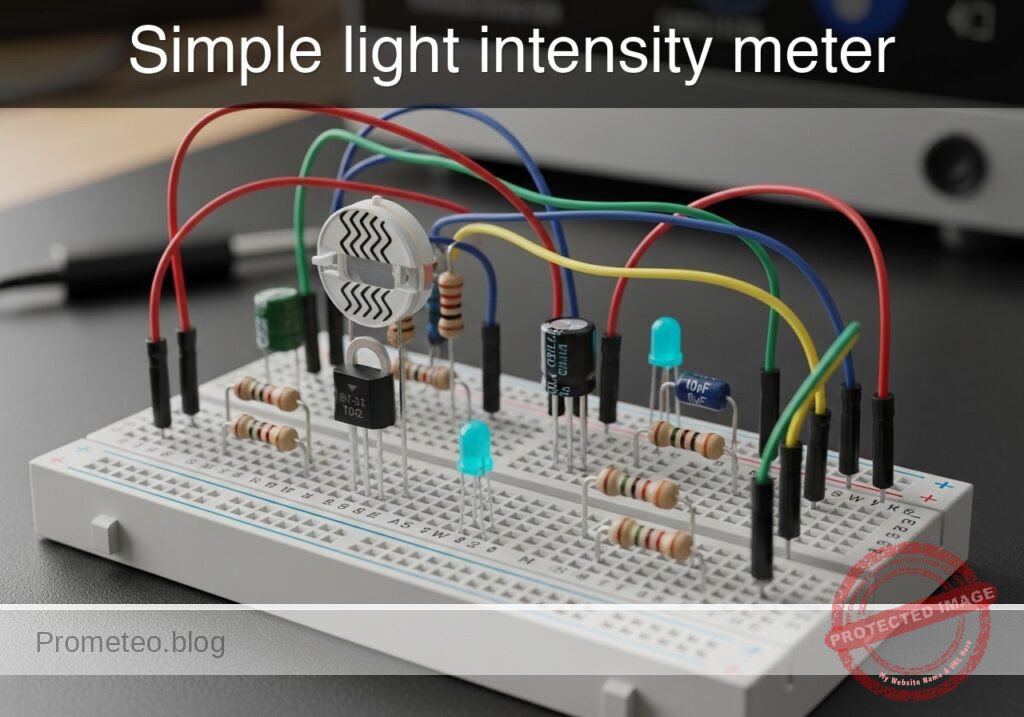
Practical case: Simple light intensity meter

Simple light intensity meter prototype (Maker Style)

Level: Basic – Build a circuit where an LED dims as ambient light increases.

Objective and use case

You will construct a simple analog light sensor circuit using a photoresistor (LDR) in a configuration where the light output is inversely proportional to the ambient light intensity. This creates a «Dark Sensor» effect without using transistors.

Why it is useful:
* Automatic Lighting: Simulates street lamps or night lights that turn on automatically when it gets dark.
* Battery Efficiency: Ensures indicators are only active during low-light conditions when visibility is poor.
* Security Systems: Can detect if a sealed container or dark room has been breached by light.
* Concept Demonstration: Demonstrates current division and non-linear resistance components in parallel circuits.

Expected outcome:
* Dark condition: The LDR resistance is high, forcing current through the LED. The Red LED turns ON.
* Bright condition: The LDR resistance drops significantly, shunting current away from the LED. The Red LED turns OFF or dims significantly.
* Voltage shift: You will measure a voltage drop at the shared node as light increases.
* Target audience: Beginners and students familiar with basic breadboarding.

Materials

  • V1: 5 V DC supply, function: main power source
  • R1: 470 Ω resistor, function: current limiting and voltage divider upper leg
  • R2: LDR (GL5528 or similar), function: ambient light sensor (variable resistor)
  • D1: Red LED, function: low-light indicator

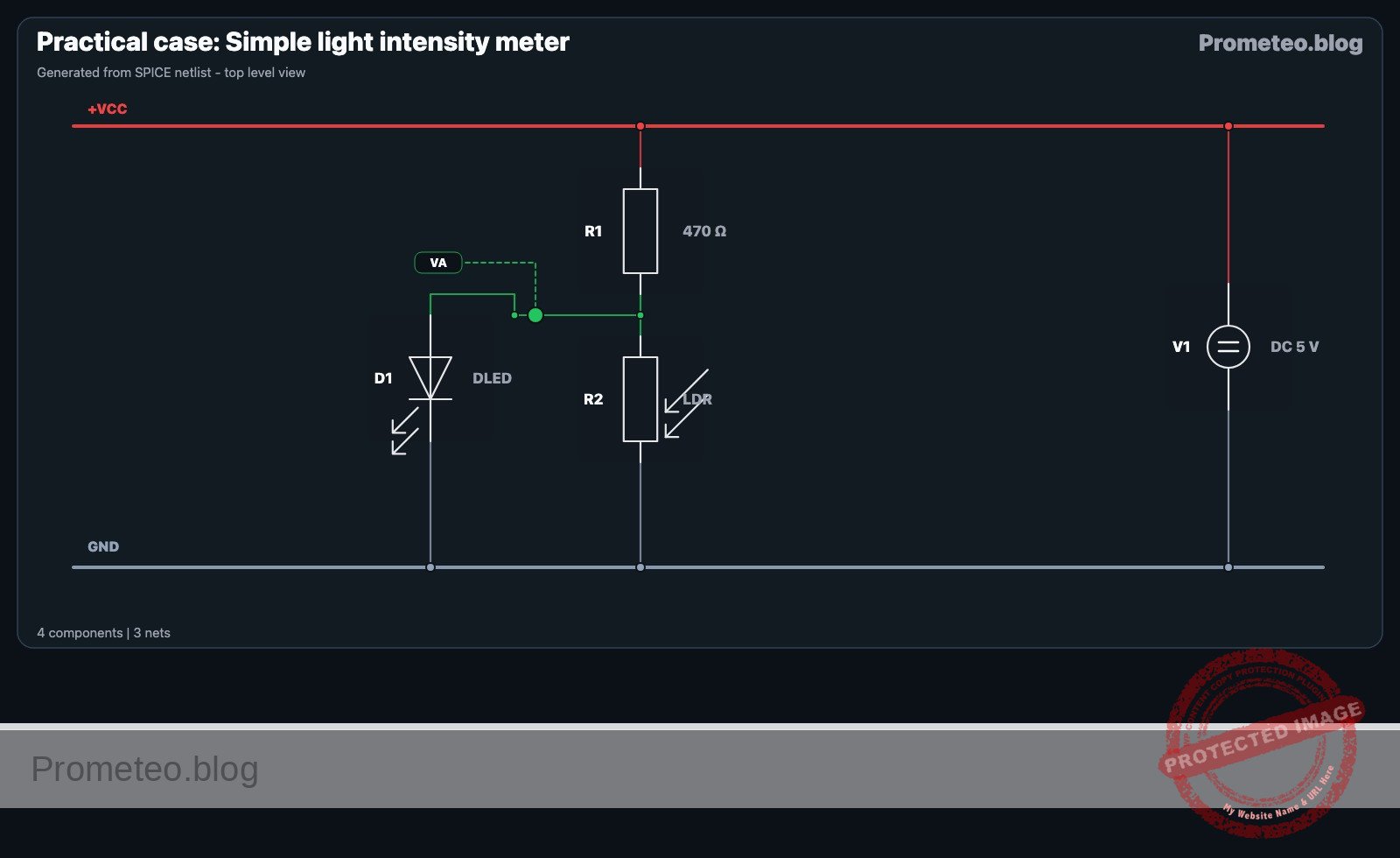
Wiring guide

We will use a «current shunt» topology. The LDR is placed in parallel with the LED.

  • VCC: Connect positive terminal of V1 to one side of R1.
  • VA: Connect the other side of R1 to the Anode (long leg) of D1.
  • VA: Connect one leg of R2 (LDR) to the same node (Anode of D1).
  • 0 (GND): Connect the Cathode (flat side/short leg) of D1 to the negative terminal of V1.
  • 0 (GND): Connect the remaining leg of R2 (LDR) to the negative terminal of V1.

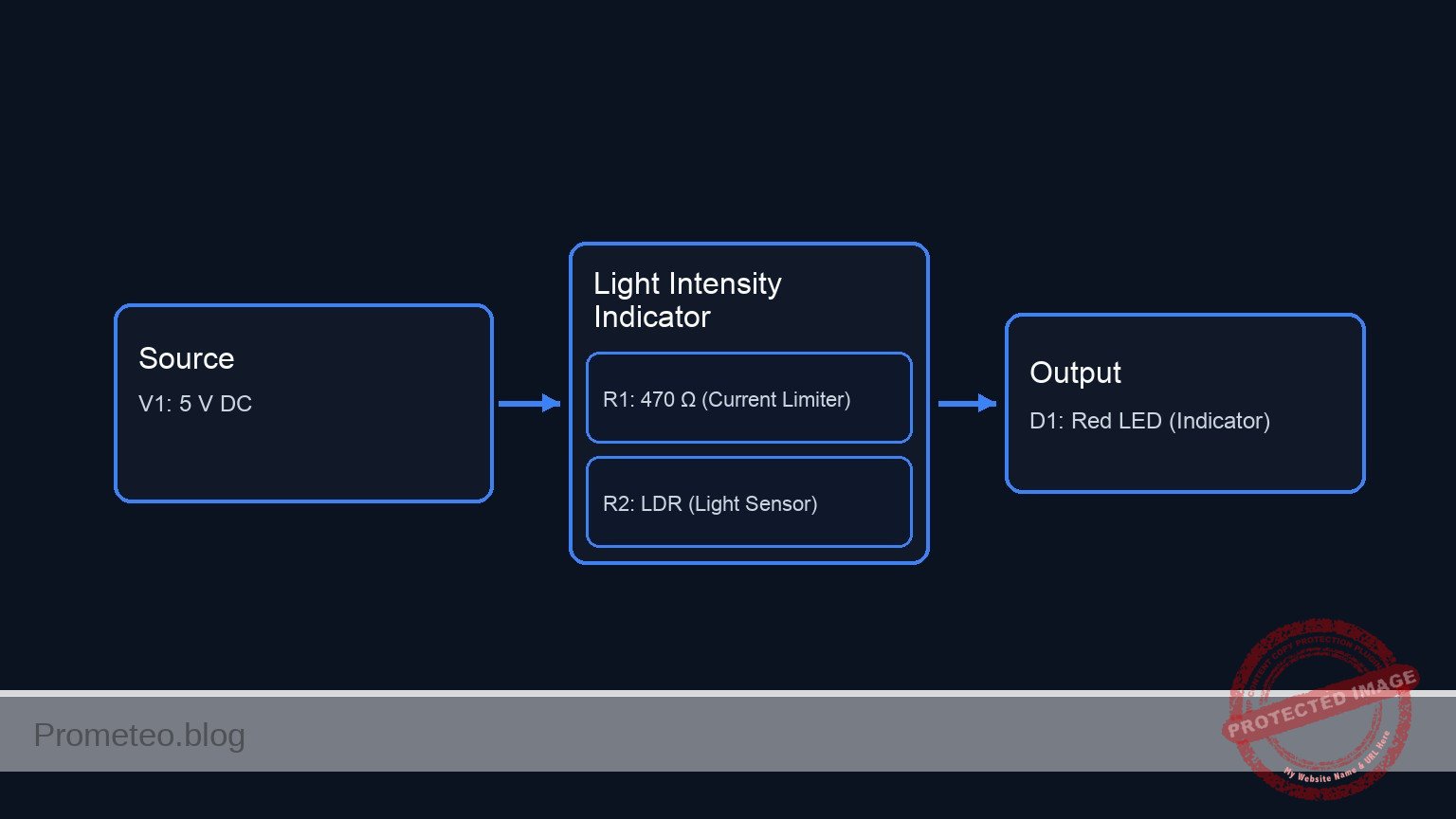
Conceptual block diagram

Conceptual block diagram — Light Intensity Indicator
Quick read: inputs → main block → output (actuator or measurement). This summarizes the ASCII schematic below.

Schematic

[ POWER SOURCE ]              [ CURRENT LIMITER ]               [ SHUNT TOPOLOGY ]

                                                              +--> [ D1: Red LED ] --> GND
                                                              |    (Output Indicator)
    [ V1: 5 V DC ] --(+)--> [ R1: 470 Ω ] --(Node VA)--> [ + ]
                                                              |
                                                              +--> [ R2: LDR ] --> GND
                                                                   (Light Sensor)
Schematic (ASCII)

Electrical diagram

Electrical diagram for case: Simple light intensity meter
Generated from the validated SPICE netlist for this case.

🔒 This electrical diagram is premium. With the 7-day pass or the monthly membership you can unlock the complete didactic material and the print-ready PDF pack.🔓 See premium access plans

Measurements and tests

To validate that the circuit behaves inversely to light intensity:

  1. Set up the multimeter: Select DC Voltage mode (20 V range).
  2. Connect probes: Place the Red probe on node VA (Anode of LED) and Black probe on 0 (GND).
  3. Test 1 (Ambient/Bright Light):
    • Expose the LDR to bright light.
    • Observation: The LED should be DIM or OFF.
    • Measurement: The voltage at VA should drop below the LED forward voltage (likely < 1.5 V). The low resistance of the LDR shunts the current to ground.
  4. Test 2 (Darkness):
    • Cover the LDR completely with your finger or a cap.
    • Observation: The LED should light up BRIGHTLY.
    • Measurement: The voltage at VA should rise to the LED’s forward voltage (approx. 1.8 V to 2.0 V for a red LED). The high resistance of the LDR forces current through the LED.

SPICE netlist and simulation

Reference SPICE Netlist (ngspice) — excerptFull SPICE netlist (ngspice)

* Practical case: Simple light intensity meter

* --- Models ---
* Generic Red LED Model
* Parameters: IS=saturation current, N=emission coefficient, RS=series resistance
* BV=breakdown voltage, IBV=breakdown current, CJO=junction capacitance
.model DLED D(IS=1e-14 N=2 RS=10 BV=5 IBV=10u CJO=20p)

* --- Power Supply ---
* V1: 5V DC supply (Main power source)
* Connected between VCC and GND (0)
V1 VCC 0 DC 5

* --- Circuit Components ---
* R1: 470 Ohm resistor
* Function: Current limiting and voltage divider upper leg
* Wiring: Connects Positive Terminal of V1 (VCC) to Node VA
R1 VCC VA 470

* D1: Red LED
* ... (truncated in public view) ...

Copy this content into a .cir file and run with ngspice.

🔒 Part of this section is premium. With the 7-day pass or the monthly membership you can access the full content (materials, wiring, detailed build, validation, troubleshooting, variants and checklist) and download the complete print-ready PDF pack.

* Practical case: Simple light intensity meter

* --- Models ---
* Generic Red LED Model
* Parameters: IS=saturation current, N=emission coefficient, RS=series resistance
* BV=breakdown voltage, IBV=breakdown current, CJO=junction capacitance
.model DLED D(IS=1e-14 N=2 RS=10 BV=5 IBV=10u CJO=20p)

* --- Power Supply ---
* V1: 5V DC supply (Main power source)
* Connected between VCC and GND (0)
V1 VCC 0 DC 5

* --- Circuit Components ---
* R1: 470 Ohm resistor
* Function: Current limiting and voltage divider upper leg
* Wiring: Connects Positive Terminal of V1 (VCC) to Node VA
R1 VCC VA 470

* D1: Red LED
* Function: Low-light indicator
* Wiring: Anode to Node VA, Cathode to Negative Terminal of V1 (0)
D1 VA 0 DLED

* R2: LDR (GL5528 or similar)
* Function: Ambient light sensor (variable resistor)
* Wiring: Connects Node VA to Negative Terminal of V1 (0)
* Note: Modeled as a behavioral resistor where Resistance = V(V_LDR_CTRL).
* This allows simulating the change from Light (Low R) to Dark (High R).
R2 VA 0 R='V(V_LDR_CTRL)'

* --- Dynamic Stimuli (Simulation Only) ---
* V_LDR_SRC: Generates a voltage signal representing the LDR resistance in Ohms.
* Logic: 
*   - 100V (representing 100 Ohms) = Bright Light -> V(VA) drops -> LED OFF
*   - 10kV (representing 10k Ohms) = Dark -> V(VA) rises -> LED ON
* Timing: Fast pulse to demonstrate switching.
* PULSE(v1 v2 td tr tf pw per)
V_LDR_SRC V_LDR_CTRL 0 PULSE(100 10000 10u 100u 100u 500u 1000u)

* --- Analysis Directives ---
* Transient analysis: 5us step size, 2ms duration
.tran 5u 2ms

* Print specific nodes to verify operation
* V(VA): Voltage at the LED/LDR node (Should swing between ~0.8V and ~1.8V)
* V(V_LDR_CTRL): The resistance value being simulated
.print tran V(VA) V(V_LDR_CTRL)

.op
.end

Simulation Results (Transient Analysis)

Simulation Results (Transient Analysis)
Show raw data table (441 rows)
Index   time            v(va)           v(v_ldr_ctrl)
0	0.000000e+00	8.771739e-01	1.000000e+02
1	5.000000e-08	8.771739e-01	1.000000e+02
2	1.000000e-07	8.771739e-01	1.000000e+02
3	2.000000e-07	8.771739e-01	1.000000e+02
4	4.000000e-07	8.771739e-01	1.000000e+02
5	8.000000e-07	8.771739e-01	1.000000e+02
6	1.600000e-06	8.771739e-01	1.000000e+02
7	3.200000e-06	8.771739e-01	1.000000e+02
8	6.400000e-06	8.771739e-01	1.000000e+02
9	1.000000e-05	8.771739e-01	1.000000e+02
10	1.016024e-05	9.861073e-01	1.158634e+02
11	1.048071e-05	1.182699e+00	1.475902e+02
12	1.112165e-05	1.342799e+00	2.110437e+02
13	1.175485e-05	1.386540e+00	2.737299e+02
14	1.276008e-05	1.418826e+00	3.732481e+02
15	1.399489e-05	1.436968e+00	4.954940e+02
16	1.646450e-05	1.455127e+00	7.399857e+02
17	2.140373e-05	1.468889e+00	1.228969e+03
18	2.640373e-05	1.474732e+00	1.723969e+03
19	3.140373e-05	1.478748e+00	2.218969e+03
20	3.640373e-05	1.480441e+00	2.713969e+03
21	4.140373e-05	1.481529e+00	3.208969e+03
22	4.640373e-05	1.482571e+00	3.703969e+03
23	5.140373e-05	1.483189e+00	4.198969e+03
... (417 more rows) ...

Common mistakes and how to avoid them

  1. Placing components in Series:
    • Mistake: Wiring Source -> Resistor -> LDR -> LED -> Ground.
    • Result: This creates a «Light Sensor» (brighter light = brighter LED), which is the opposite of the objective.
    • Solution: Ensure the LDR is in parallel with the LED (sharing the same start and end nodes).
  2. Using a resistor value that is too high for R1:
    • Mistake: Using a 10 kΩ resistor for R1.
    • Result: The LED never turns on brightly even in total darkness because the current is too restricted.
    • Solution: Use 330 Ω to 470 Ω for a 5 V source to ensure sufficient current for the LED when the LDR is high-resistance.
  3. Expecting a «Hard» On/Off switch:
    • Mistake: Expecting digital-like switching.
    • Result: The LED dims gradually rather than snapping off.
    • Solution: Understand that this is a passive analog circuit. For a hard «snap» action, a transistor or comparator would be required.

Troubleshooting

  • Symptom: LED is always ON, even in bright light.
    • Cause: R1 value is too low, or LDR has very high resistance even in light (or is disconnected).
    • Fix: Check LDR connections. If correct, increase R1 to 1 kΩ to make it easier for the LDR to pull the voltage down.
  • Symptom: LED is always OFF.
    • Cause: LED wired backwards or R1 is too high.
    • Fix: Flip the LED orientation. Ensure R1 is < 1 kΩ.
  • Symptom: Source gets hot.
    • Cause: Short circuit. Likely R1 was bypassed, connecting VCC directly to the LDR or LED.
    • Fix: Ensure R1 is strictly between VCC and the VA node.

Possible improvements and extensions

  1. Sensitivity Adjustment: Replace R1 with a 1 kΩ potentiometer to tune exactly how dark it needs to be before the LED turns on.
  2. Color Mixing: Put a Green LED in series with the LDR (instead of parallel). As light increases, the Green LED gets brighter while the Red LED (parallel) gets dimmer, creating a color-shifting light monitor.

More Practical Cases on Prometeo.blog

Find this product and/or books on this topic on Amazon

Go to Amazon

As an Amazon Associate, I earn from qualifying purchases. If you buy through this link, you help keep this project running.

Quick Quiz

Question 1: What is the primary objective of the circuit described in the text?


Question 2: Which component acts as the ambient light sensor in this circuit?


Question 3: What happens to the Red LED in a 'Dark condition'?


Question 4: Why is this circuit useful for battery efficiency?


Question 5: What electrical concept does this circuit demonstrate?


Question 6: How does the circuit achieve the 'Dark Sensor' effect without transistors?


Question 7: What happens to the LDR resistance in a 'Bright condition'?


Question 8: Which of the following is a listed use case for this circuit?


Question 9: What happens to the voltage at the shared node as light increases?


Question 10: In the 'Dark condition', why does the LED turn on?


Carlos Núñez Zorrilla
Electronics & Computer Engineer

Telecommunications Electronics Engineer and Computer Engineer (official degrees in Spain).
Follow me:


Practical case: Secret drawer alarm sensor

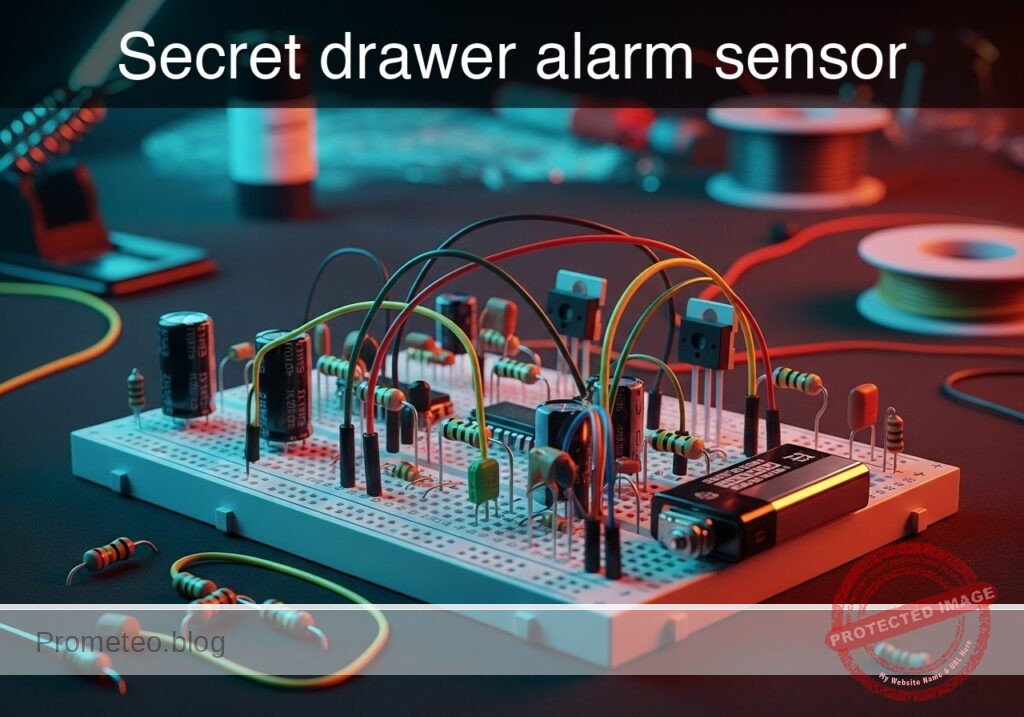
Secret drawer alarm sensor prototype (Maker Style)

Level: Basic — Build a circuit that activates a buzzer when it detects light upon opening a dark drawer.

Objective and use case

In this practical case, you will build a light-sensitive alarm system using a photoresistor (LDR) and a transistor driver. The circuit remains silent in the dark but activates an audible alarm immediately when light hits the sensor.

  • Security: Protects private drawers or boxes by alerting you if they are opened.
  • Safety: Can be used to signal if a refrigerator or pantry door is not fully closed.
  • Automation: Demonstrates how to use environmental inputs (light) to control output devices (sound).

Expected outcome:
* Darkness (Drawer closed): The buzzer remains OFF (0 V across the buzzer).
* Light (Drawer open): The buzzer turns ON immediately.
* Threshold: The transistor switches the load when the base voltage exceeds approximately 0.6 V–0.7 V.
* Target Audience: Beginners and hobbyists learning about sensor interfacing.

Materials

  • V1: 9 V DC battery or power supply, function: Main power source.
  • R1: Photoresistor (LDR) GL5528, function: Detects light intensity (variable resistance).
  • R2: 10 kΩ resistor, function: Pull-down resistor to form a voltage divider.
  • Q1: 2N2222 NPN Transistor, function: Electronic switch to drive the buzzer.
  • LS1: 9 V Active Piezo Buzzer, function: Audible alarm output.
  • SW1: SPST Toggle Switch, function: Master On/Off switch (optional).

Wiring guide

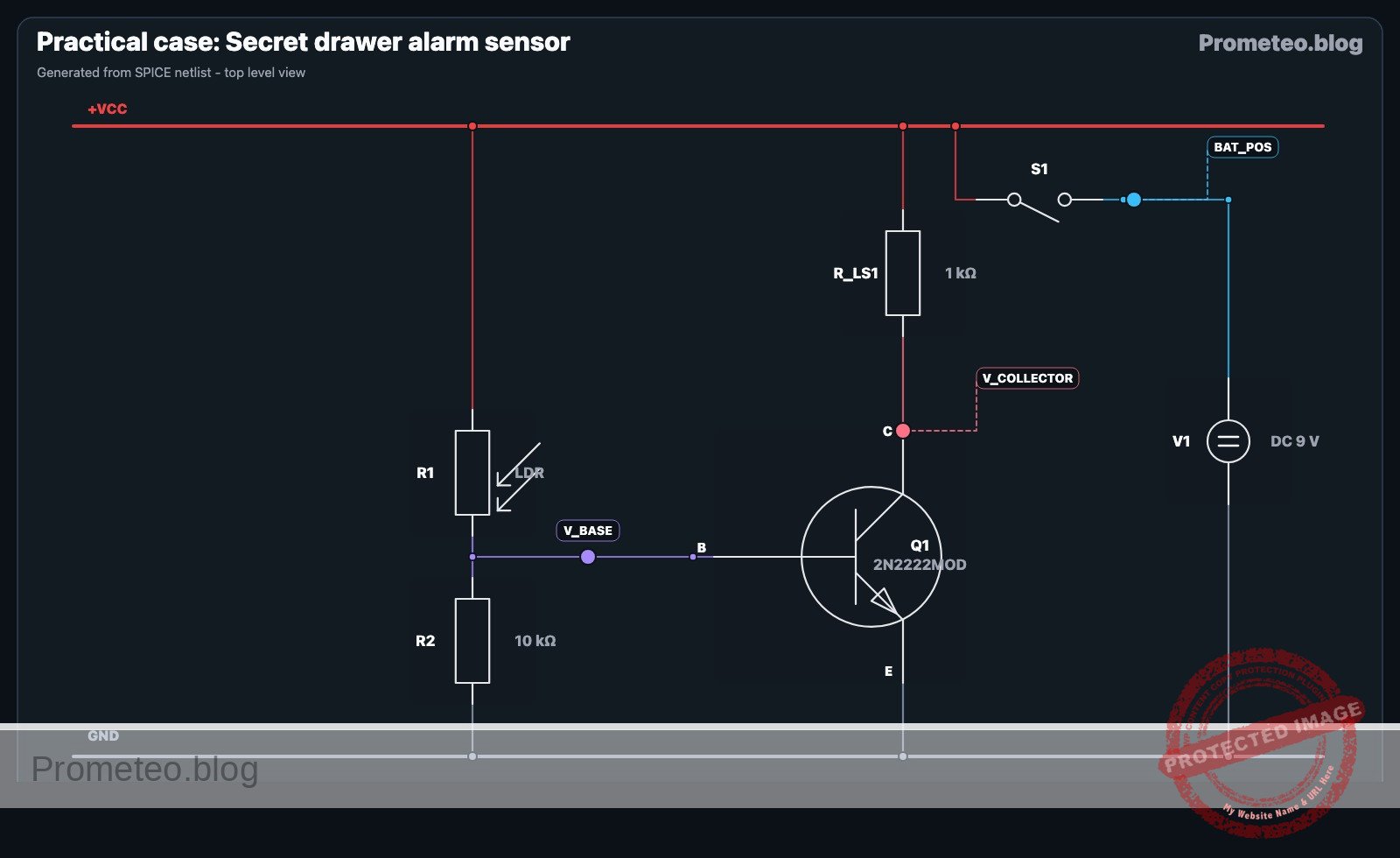
Construct the circuit connecting the components between the specific nodes defined below. Use a breadboard for easy assembly.

  • VCC: Connect the positive terminal of V1 and one side of SW1. Connect the other side of SW1 to the main VCC rail.
  • 0 (GND): Connect the negative terminal of V1, the Emitter of Q1, and one leg of R2.
  • V_BASE: Connect the other leg of R2, one leg of R1, and the Base of Q1.
  • VCC (Connection): Connect the other leg of R1 to the VCC rail.
  • V_COLLECTOR: Connect the Collector of Q1 to the negative wire of LS1.
  • VCC (Load): Connect the positive wire of LS1 to the VCC rail.

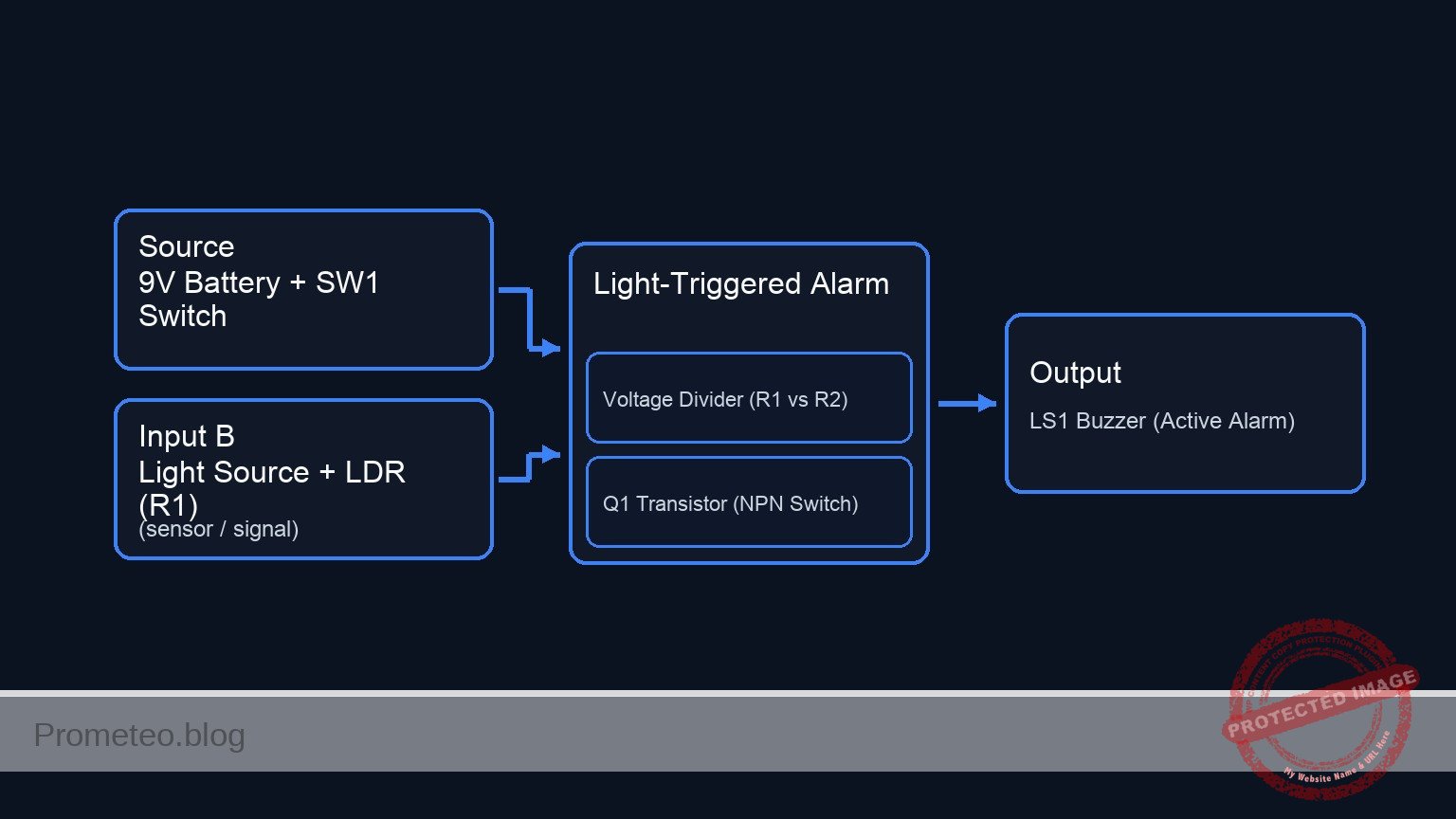
Conceptual block diagram

Conceptual block diagram — Light-Triggered Alarm
Quick read: inputs → main block → output (actuator or measurement). This summarizes the ASCII schematic below.

Schematic

[ INPUTS / POWER ]                  [ LOGIC / CONTROL ]                     [ OUTPUT ]

                                             (VCC Rail)
    [ 9 V Battery ] --> [ SW1 Switch ] --+------->+----------------------------------+
                                        |        |                                  |
                                        |        v                                  v
    [ Light Source ] --> [ LDR (R1) ] --+--> [ Voltage Divider ]                    |
                         (Sensor)            [ (Node: V_BASE)  ] --(Trigger)--> [ Q1 Transistor ]
                                        +--> [ R1 vs R2 Logic  ]                [ (NPN Switch)  ] --(Ground Path)--> [ LS1 Buzzer ]
                                        |                                       [ Collector Pin ]                    (Active Alarm)
    [ Resistor R2 ] ----(Pull-Down)-----+                                           |
    (10k Ohm)                                                                       v
                                                                                 [ GND ]
Schematic (ASCII)

Electrical diagram

Electrical diagram for case: Secret drawer alarm sensor
Generated from the validated SPICE netlist for this case.

🔒 This electrical diagram is premium. With the 7-day pass or the monthly membership you can unlock the complete didactic material and the print-ready PDF pack.🔓 See premium access plans

Measurements and tests

Follow these steps to validate the circuit operation:

  1. LDR Resistance Check:
    • Set your multimeter to measure Resistance (Ω).
    • Measure R1 in full light; it should read a low value (e.g., 500 Ω – 2 kΩ).
    • Cover R1 completely; it should read a high value (e.g., > 100 kΩ).
  2. Voltage Divider Test:
    • Power on the circuit (VCC = 9 V).
    • Set multimeter to DC Voltage. Connect the black probe to 0 (GND) and the red probe to V_BASE.
    • In Dark: The voltage should be close to 0 V (below 0.6 V).
    • In Light: The voltage should rise significantly (above 0.7 V).
  3. Output Verification:
    • Expose the sensor to light. The buzzer LS1 should sound.
    • Cover the sensor with your hand. The buzzer should stop immediately.

SPICE netlist and simulation

Reference SPICE Netlist (ngspice) — excerptFull SPICE netlist (ngspice)

* Practical case: Secret drawer alarm sensor
* Ngspice Netlist
*
* Circuit Description:
* A light-activated alarm using a photoresistor (LDR) and an NPN transistor.
* When the drawer opens (Light), LDR resistance drops, Base voltage rises,
* Q1 turns ON, and the Buzzer sounds.
*
* Simulation Scenario:
* 0ms - 2ms: System OFF (Master Switch Open).
* 2ms: Master Switch closes (System Armed). Drawer is Closed (Dark).
* 5ms: Drawer Opens (Light hits LDR). Alarm triggers.

* --- Power Supply (V1) ---
* 9V DC Battery
V1 BAT_POS 0 DC 9

* --- Master Switch (SW1) ---
* Connects Battery Positive to Main VCC Rail.
* Modeled as a voltage-controlled switch closing at t=2ms.
* ... (truncated in public view) ...

Copy this content into a .cir file and run with ngspice.

🔒 Part of this section is premium. With the 7-day pass or the monthly membership you can access the full content (materials, wiring, detailed build, validation, troubleshooting, variants and checklist) and download the complete print-ready PDF pack.

* Practical case: Secret drawer alarm sensor
* Ngspice Netlist
*
* Circuit Description:
* A light-activated alarm using a photoresistor (LDR) and an NPN transistor.
* When the drawer opens (Light), LDR resistance drops, Base voltage rises,
* Q1 turns ON, and the Buzzer sounds.
*
* Simulation Scenario:
* 0ms - 2ms: System OFF (Master Switch Open).
* 2ms: Master Switch closes (System Armed). Drawer is Closed (Dark).
* 5ms: Drawer Opens (Light hits LDR). Alarm triggers.

* --- Power Supply (V1) ---
* 9V DC Battery
V1 BAT_POS 0 DC 9

* --- Master Switch (SW1) ---
* Connects Battery Positive to Main VCC Rail.
* Modeled as a voltage-controlled switch closing at t=2ms.
S1 BAT_POS VCC CTRL_SW 0 SW_MODEL
V_SW_CTRL CTRL_SW 0 PULSE(0 5 2ms 1u 1u 100ms)
.model SW_MODEL SW(Vt=2.5 Ron=0.01 Roff=100Meg)

* --- Photoresistor (R1 / LDR) ---
* LDR GL5528 connecting VCC to Base.
* Modeled as a behavioral resistor B_R1.
* Resistance logic controlled by V_LDR_RES:
*   Dark (Closed) = 1 MegOhm
*   Light (Open)  = 2 kOhm
* Simulation: Transitions from Dark to Light at t=5ms.
V_LDR_RES RES_CTRL 0 PWL(0 1Meg 4.99ms 1Meg 5ms 2k)
B_R1 VCC V_BASE I=(V(VCC) - V(V_BASE)) / V(RES_CTRL)

* --- Resistor (R2) ---
* 10k Ohm pull-down resistor from Base to Ground.
R2 V_BASE 0 10k

* --- Transistor (Q1) ---
* 2N2222 NPN Transistor acting as the switch for the buzzer.
* Connections: Collector=V_COLLECTOR, Base=V_BASE, Emitter=0
Q1 V_COLLECTOR V_BASE 0 2N2222MOD

* --- Buzzer (LS1) ---
* 9V Active Piezo Buzzer.
* Modeled as a 1k Ohm resistive load connected between VCC and Collector.
* (Not modeled as a voltage source per requirements).
R_LS1 VCC V_COLLECTOR 1k

* --- Component Models ---
.model 2N2222MOD NPN(Is=14.34f Xti=3 Eg=1.11 Vaf=74.03 Bf=255.9 Ne=1.307 Ise=14.34f Ikf=.2847 Xtb=1.5 Br=6.092 Nc=2 Isc=0 Ikr=0 Rc=1 Cjc=7.306p Mjc=.3416 Vjc=.75 Fc=.5 Cje=22.01p Mje=.377 Vje=.75 Tr=46.91n Tf=411.1p Itf=.6 Vtf=1.7 Xtf=3 Rb=10)

* --- Analysis Directives ---
.op
* Transient analysis for 10ms to capture the sequence.
.tran 10u 10ms

* Print directives to verify operation
* V(VCC): Power rail status
* V(V_BASE): Transistor drive voltage (Low=Dark, High=Light)
* V(V_COLLECTOR): Output node (High=Off, Low=Alarm On)
.print tran V(VCC) V(V_BASE) V(V_COLLECTOR)

.end

Simulation Results (Transient Analysis)

Simulation Results (Transient Analysis)
Show raw data table (1057 rows)
Index   time            v(vcc)          v(v_base)       v(v_collector)
0	0.000000e+00	8.999090e-02	8.909999e-04	8.999089e-02
1	1.000000e-07	8.999090e-02	8.909999e-04	8.999089e-02
2	2.000000e-07	8.999090e-02	8.909999e-04	8.999089e-02
3	4.000000e-07	8.999090e-02	8.909999e-04	8.999089e-02
4	8.000000e-07	8.999090e-02	8.909999e-04	8.999089e-02
5	1.600000e-06	8.999090e-02	8.909999e-04	8.999089e-02
6	3.200000e-06	8.999090e-02	8.909999e-04	8.999089e-02
7	6.400000e-06	8.999090e-02	8.909999e-04	8.999089e-02
8	1.280000e-05	8.999090e-02	8.909999e-04	8.999089e-02
9	2.280000e-05	8.999090e-02	8.909999e-04	8.999089e-02
10	3.280000e-05	8.999090e-02	8.909999e-04	8.999089e-02
11	4.280000e-05	8.999090e-02	8.909999e-04	8.999089e-02
12	5.280000e-05	8.999090e-02	8.909999e-04	8.999089e-02
13	6.280000e-05	8.999090e-02	8.909999e-04	8.999089e-02
14	7.280000e-05	8.999090e-02	8.909999e-04	8.999089e-02
15	8.280000e-05	8.999090e-02	8.909999e-04	8.999089e-02
16	9.280000e-05	8.999090e-02	8.909999e-04	8.999089e-02
17	1.028000e-04	8.999090e-02	8.909999e-04	8.999089e-02
18	1.128000e-04	8.999090e-02	8.909999e-04	8.999089e-02
19	1.228000e-04	8.999090e-02	8.909999e-04	8.999089e-02
20	1.328000e-04	8.999090e-02	8.909999e-04	8.999089e-02
21	1.428000e-04	8.999090e-02	8.909999e-04	8.999089e-02
22	1.528000e-04	8.999090e-02	8.909999e-04	8.999089e-02
23	1.628000e-04	8.999090e-02	8.909999e-04	8.999089e-02
... (1033 more rows) ...

Common mistakes and how to avoid them

  1. Reversing the Voltage Divider: If you swap R1 (LDR) and R2 (Fixed Resistor), the alarm will sound in the dark and stop in the light (Inverse logic). Ensure R1 is connected to VCC and R2 to GND.
  2. Using a Passive Buzzer: A passive buzzer requires an oscillating AC signal to make sound. This circuit provides DC. You must use an Active Buzzer (which has an internal oscillator).
  3. Transistor Pinout Errors: Confusing the Collector (C) and Emitter (E) is common. For the 2N2222 in a TO-92 package, verify the pinout datasheet; usually, with the flat side facing you, the pins are E-B-C or E-B-C depending on the manufacturer.

Troubleshooting

  • Buzzer sounds continuously (even in dark):
    • Ambient light is too strong. Place the circuit in a box.
    • R2 value is too high. Try replacing R2 with a lower value (e.g., 4.7 kΩ) to pull the base voltage down harder.
  • Buzzer never sounds:
    • R2 value is too low.
    • LS1 is connected backwards (check polarity).
    • Q1 is damaged or connected incorrectly.
  • Buzzer is too quiet:
    • Battery voltage might be low.
    • Ensure the buzzer is rated for the supply voltage used (9 V).

Possible improvements and extensions

  1. Sensitivity Control: Replace the fixed resistor R2 with a 50 kΩ potentiometer. This allows you to fine-tune exactly how much light is needed to trigger the alarm.
  2. Latching Alarm: Add a Silicon Controlled Rectifier (SCR) instead of the NPN transistor, or add a feedback loop. This would keep the alarm sounding even if the thief quickly closes the drawer again, forcing a manual reset.

More Practical Cases on Prometeo.blog

Find this product and/or books on this topic on Amazon

Go to Amazon

As an Amazon Associate, I earn from qualifying purchases. If you buy through this link, you help keep this project running.

Quick Quiz

Question 1: What is the primary function of the circuit described in the text?


Question 2: Which component is used to detect light intensity in this project?


Question 3: What is the expected behavior of the buzzer when the drawer is closed (in darkness)?


Question 4: What is the role of the Q1 (2N2222 NPN Transistor) in the circuit?


Question 5: At approximately what base voltage does the transistor switch the load?


Question 6: What is the function of the R2 (10 kΩ resistor) in this specific voltage divider configuration?


Question 7: Which component serves as the main power source for the circuit?


Question 8: What is a practical safety use case mentioned for this circuit?


Question 9: How is the master On/Off switch (SW1) typically connected in this type of circuit?


Question 10: Who is the stated target audience for this project?


Carlos Núñez Zorrilla
Electronics & Computer Engineer

Telecommunications Electronics Engineer and Computer Engineer (official degrees in Spain).
Follow me:


Practical case: Automatic twilight switch

Automatic twilight switch prototype (Maker Style)

Level: Basic. Build a circuit that automatically turns on an LED when ambient light drops below a specific level.

Objective and use case

You will design and assemble a light-sensing circuit using a photoresistor (LDR) and a transistor to control an LED based on environmental brightness. The circuit acts as a logical NOT gate relative to light intensity: Light = Output OFF, Dark = Output ON.

Why it is useful:
* Street lighting: Automating street lamps to turn on only at night to save energy.
* Garden lights: Solar-powered garden fixtures that activate at dusk.
* Security systems: Triggering low-light recording or illumination.
* Display efficiency: Adjusting screen brightness or backlighting based on room conditions.

Expected outcome:
* When the LDR is exposed to bright light, the LED remains OFF.
* When the LDR is covered (simulating darkness), the LED turns ON.
* The voltage at the transistor base (V_BASE) increases as light intensity decreases.

Target audience: Beginners learning about sensors and transistor switching.

Materials

  • V1: 9 V DC battery or power supply.
  • R1: 10 kΩ resistor, function: upper leg of voltage divider (pull-up).
  • R2: LDR (Light Dependent Resistor), GL5528 or similar, function: light sensor (lower leg).
  • R3: 470 Ω resistor, function: LED current limiting.
  • Q1: 2N3904 NPN transistor, function: electronic switch.
  • D1: Red LED, function: output indicator.

Wiring guide

Construct the circuit following these connections using the specific node names:

  • Power Supply:

    • V1 (+): Connects to node VCC.
    • V1 (-): Connects to node 0 (GND).
  • Sensor Stage (Voltage Divider):

    • R1 (10 kΩ): Connects between VCC and node V_BASE.
    • R2 (LDR): Connects between node V_BASE and 0 (GND).
  • Switching Stage:

    • Q1 (Base): Connects to node V_BASE.
    • Q1 (Emitter): Connects to node 0 (GND).
    • Q1 (Collector): Connects to node N_LED_CATHODE.
  • Output Stage:

    • R3 (470 Ω): Connects between VCC and node N_LED_ANODE.
    • D1 (Anode): Connects to node N_LED_ANODE.
    • D1 (Cathode): Connects to node N_LED_CATHODE.

Conceptual block diagram

Conceptual block diagram — Light-Controlled Switch
Quick read: inputs → main block → output (actuator or measurement). This summarizes the ASCII schematic below.

Schematic

[ SENSOR STAGE ]                   [ SWITCHING STAGE ]                 [ OUTPUT STAGE ]

   [ VCC 9 V Source ]
          |
          v
   [ R1: 10k Pull-Up ]
          |
          v
   [ Node: V_BASE  ] --(Trigger)--> [ Base: Q1 (2N3904)   ]
          |                         [                     ]
          v                         [ Coll: N_LED_CATHODE ] --(Sink)--> [ Cathode: D1 LED ]
   [ R2: LDR Sensor ]               [                     ]             [ Node: N_LED_ANODE ]
          |                         [ Emit: GND           ]             [ Anode:   D1 LED   ]
          v                                                             [         ^         ]
       [ GND ]                                                          [         |         ]
                                                                        [ R3: 470 Resistor  ]
                                                                                  ^
                                                                                  |
                                                                             [ VCC 9 V ]
Schematic (ASCII)

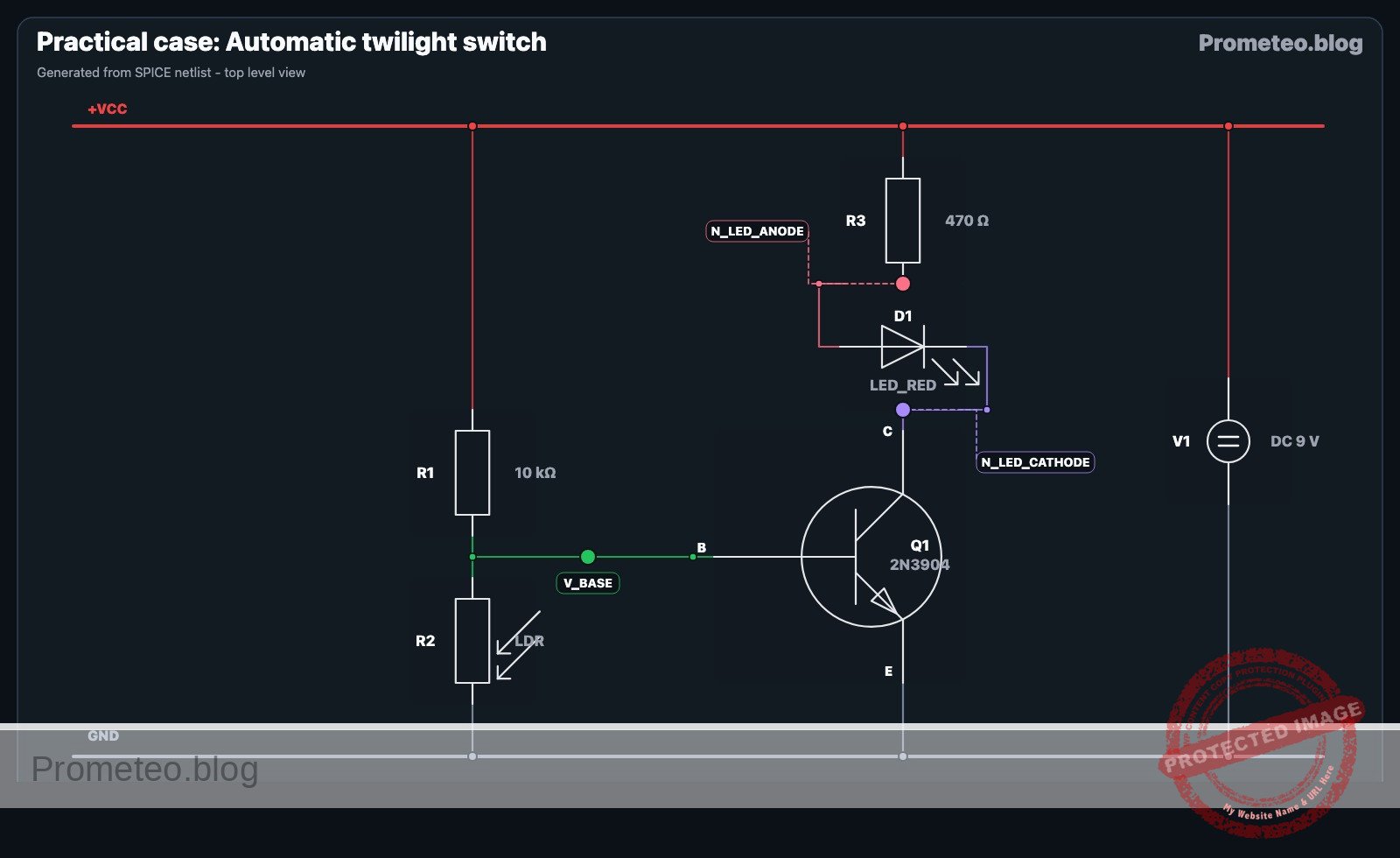
Electrical diagram

Electrical diagram for case: Automatic twilight switch
Generated from the validated SPICE netlist for this case.

🔒 This electrical diagram is premium. With the 7-day pass or the monthly membership you can unlock the complete didactic material and the print-ready PDF pack.🔓 See premium access plans

Measurements and tests

To validate the circuit operation, perform the following steps with a multimeter:

  1. Light Condition (Simulation): Shine a flashlight on R2 (LDR) or ensure the room is bright.

    • Measure voltage at V_BASE relative to 0 (GND). It should be low (< 0.6 V).
    • Observe D1: It should be OFF.
    • Measure voltage at N_LED_CATHODE relative to 0 (GND). It should be close to VCC (floating high through the LED).
  2. Dark Condition (Simulation): Cover R2 (LDR) completely with your finger or a cap.

    • Measure voltage at V_BASE. It should rise above 0.7 V.
    • Observe D1: It should turn ON.
    • Measure voltage at N_LED_CATHODE (Collector). It should drop to near 0 V (Saturation voltage, approx 0.1 V – 0.2 V).

SPICE netlist and simulation

Reference SPICE Netlist (ngspice) — excerptFull SPICE netlist (ngspice)

* Practical case: Automatic twilight switch
* 
* This netlist implements a twilight switch where an LED turns ON
* when the light level drops (simulated by increasing LDR resistance).

* --- Models ---
* Standard NPN Transistor Model
.model 2N3904 NPN(IS=1E-14 VAF=100 BF=200 IKF=0.3 XTB=1.5 BR=3 CJC=8E-12 CJE=25E-12 TR=460E-9 TF=400E-12 ITF=0.6 VTF=10 XTF=30 RB=10 RC=1 RE=0.1)
* Generic Red LED Model (Vf approx 1.8V)
.model LED_RED D(IS=1e-14 N=2.5 RS=5 BV=5 IBV=10u)

* --- Power Supply ---
* V1: 9 V DC source connected to VCC and GND (0)
V1 VCC 0 DC 9

* --- Sensor Stage (Voltage Divider) ---
* R1: 10 kΩ Pull-up resistor
R1 VCC V_BASE 10k

* R2: LDR (Light Dependent Resistor)
* ... (truncated in public view) ...

Copy this content into a .cir file and run with ngspice.

🔒 Part of this section is premium. With the 7-day pass or the monthly membership you can access the full content (materials, wiring, detailed build, validation, troubleshooting, variants and checklist) and download the complete print-ready PDF pack.

* Practical case: Automatic twilight switch
* 
* This netlist implements a twilight switch where an LED turns ON
* when the light level drops (simulated by increasing LDR resistance).

* --- Models ---
* Standard NPN Transistor Model
.model 2N3904 NPN(IS=1E-14 VAF=100 BF=200 IKF=0.3 XTB=1.5 BR=3 CJC=8E-12 CJE=25E-12 TR=460E-9 TF=400E-12 ITF=0.6 VTF=10 XTF=30 RB=10 RC=1 RE=0.1)
* Generic Red LED Model (Vf approx 1.8V)
.model LED_RED D(IS=1e-14 N=2.5 RS=5 BV=5 IBV=10u)

* --- Power Supply ---
* V1: 9 V DC source connected to VCC and GND (0)
V1 VCC 0 DC 9

* --- Sensor Stage (Voltage Divider) ---
* R1: 10 kΩ Pull-up resistor
R1 VCC V_BASE 10k

* R2: LDR (Light Dependent Resistor)
* Modeled as a behavioral resistor to simulate changing light conditions.
* Low Resistance = Bright Light (LED OFF), High Resistance = Dark (LED ON).
* Simulation: Resistance ramps from 100 Ohm to 3000 Ohm over 5ms.
* The switching threshold (Vbe ~ 0.65V) occurs around R2 = 780 Ohms.
R2 V_BASE 0 R='100 + 2900 * (time / 0.005)'

* --- Switching Stage ---
* Q1: 2N3904 NPN Transistor
* Base -> V_BASE, Collector -> N_LED_CATHODE, Emitter -> GND (0)
Q1 N_LED_CATHODE V_BASE 0 2N3904

* --- Output Stage ---
* R3: 470 Ω LED current limiting resistor
R3 VCC N_LED_ANODE 470

* D1: Red LED
* Anode -> N_LED_ANODE, Cathode -> N_LED_CATHODE
D1 N_LED_ANODE N_LED_CATHODE LED_RED

* --- Simulation Directives ---
* Perform a transient analysis for 5ms to observe the switching behavior
.tran 10u 5m

* Print required voltages for verification
* V_BASE: Shows the sensor voltage rising.
* N_LED_CATHODE: Shows the collector voltage dropping when Q1 turns ON.
.print tran V(V_BASE) V(N_LED_CATHODE) V(N_LED_ANODE)

.op
.end

Simulation Results (Transient Analysis)

Simulation Results (Transient Analysis)
Show raw data table (508 rows)
Index   time            v(v_base)       v(n_led_cathode v(n_led_anode)
0	0.000000e+00	8.910891e-02	8.519679e+00	9.000000e+00
1	1.000000e-07	8.915880e-02	8.519729e+00	9.000000e+00
2	2.000000e-07	8.920993e-02	8.519780e+00	9.000000e+00
3	4.000000e-07	8.931227e-02	8.519882e+00	9.000000e+00
4	8.000000e-07	8.951694e-02	8.520087e+00	9.000000e+00
5	1.600000e-06	8.992625e-02	8.520496e+00	9.000000e+00
6	3.200000e-06	9.074475e-02	8.521314e+00	9.000000e+00
7	6.400000e-06	9.238131e-02	8.522950e+00	9.000000e+00
8	1.280000e-05	9.565263e-02	8.526219e+00	9.000000e+00
9	2.280000e-05	1.007592e-01	8.531319e+00	9.000000e+00
10	3.280000e-05	1.058600e-01	8.536410e+00	9.000000e+00
11	4.280000e-05	1.109549e-01	8.541491e+00	9.000000e+00
12	5.280000e-05	1.160440e-01	8.546563e+00	9.000000e+00
13	6.280000e-05	1.211273e-01	8.551627e+00	9.000000e+00
14	7.280000e-05	1.262047e-01	8.556682e+00	9.000000e+00
15	8.280000e-05	1.312764e-01	8.561728e+00	9.000000e+00
16	9.280000e-05	1.363422e-01	8.566765e+00	9.000000e+00
17	1.028000e-04	1.414023e-01	8.571793e+00	9.000000e+00
18	1.128000e-04	1.464566e-01	8.576812e+00	9.000000e+00
19	1.228000e-04	1.515051e-01	8.581823e+00	9.000000e+00
20	1.328000e-04	1.565479e-01	8.586824e+00	9.000000e+00
21	1.428000e-04	1.615849e-01	8.591815e+00	9.000000e+00
22	1.528000e-04	1.666162e-01	8.596796e+00	9.000000e+00
23	1.628000e-04	1.716418e-01	8.601767e+00	9.000000e+00
... (484 more rows) ...

Common mistakes and how to avoid them

  1. Swapping the Resistor and LDR: Placing the LDR on top and R1 on the bottom creates a «Morning Alarm» (turns on when light detected) instead of a twilight switch. Ensure R1 connects to VCC and the LDR connects to 0.
  2. LED Polarity Reversed: The LED will not light up if the anode and cathode are swapped. Ensure the flat side (Cathode) connects to the transistor collector.
  3. Transistor Pinout Confusion: Confusing Collector, Base, and Emitter on the 2N3904 is common. Verify the datasheet for your specific package (usually E-B-C from left to right when flat side faces you).

Troubleshooting

  • LED is always ON:
    • Ambient light might be too low. Use a flashlight to test the sensor.
    • R1 (Pull-up) value is too low, providing too much base current even in light. Increase R1 to 22 kΩ or 47 kΩ.
  • LED is always OFF:
    • Check transistor orientation.
    • R1 might be too high, preventing the base voltage from reaching 0.7 V even in darkness.
    • LDR might be shorted.
  • LED is dim in darkness:
    • The battery voltage (V1) is low.
    • R3 (Current limiting) is too high; try reducing it slightly (do not go below 220 Ω).

Possible improvements and extensions

  1. Sensitivity Adjustment: Replace R1 with a 50 kΩ or 100 kΩ potentiometer to manually tune the exact darkness level required to trigger the LED.
  2. Hysteresis: Add a feedback resistor between the Collector and the Base to create a «Schmitt Trigger» effect, preventing the LED from flickering at the twilight threshold.

More Practical Cases on Prometeo.blog

Find this product and/or books on this topic on Amazon

Go to Amazon

As an Amazon Associate, I earn from qualifying purchases. If you buy through this link, you help keep this project running.

Quick Quiz

Question 1: What is the primary objective of the circuit described in the text?


Question 2: Which component acts as the light sensor in this circuit?


Question 3: How does the circuit behave logically relative to light intensity?


Question 4: What is a common real-world use case for this type of circuit mentioned in the text?


Question 5: What happens to the voltage at the transistor base (V_BASE) as light intensity decreases?


Question 6: Which component functions as the electronic switch in the circuit?


Question 7: What is the function of the resistor R3 (470 Ω) typically found in this circuit?


Question 8: What is the role of the 10 kΩ resistor (R1) in the materials list?


Question 9: What is the expected state of the LED when the LDR is exposed to bright light?


Question 10: Who is the target audience for this circuit project?


Carlos Núñez Zorrilla
Electronics & Computer Engineer

Telecommunications Electronics Engineer and Computer Engineer (official degrees in Spain).
Follow me: