Practical case: Automatic darkness sensor

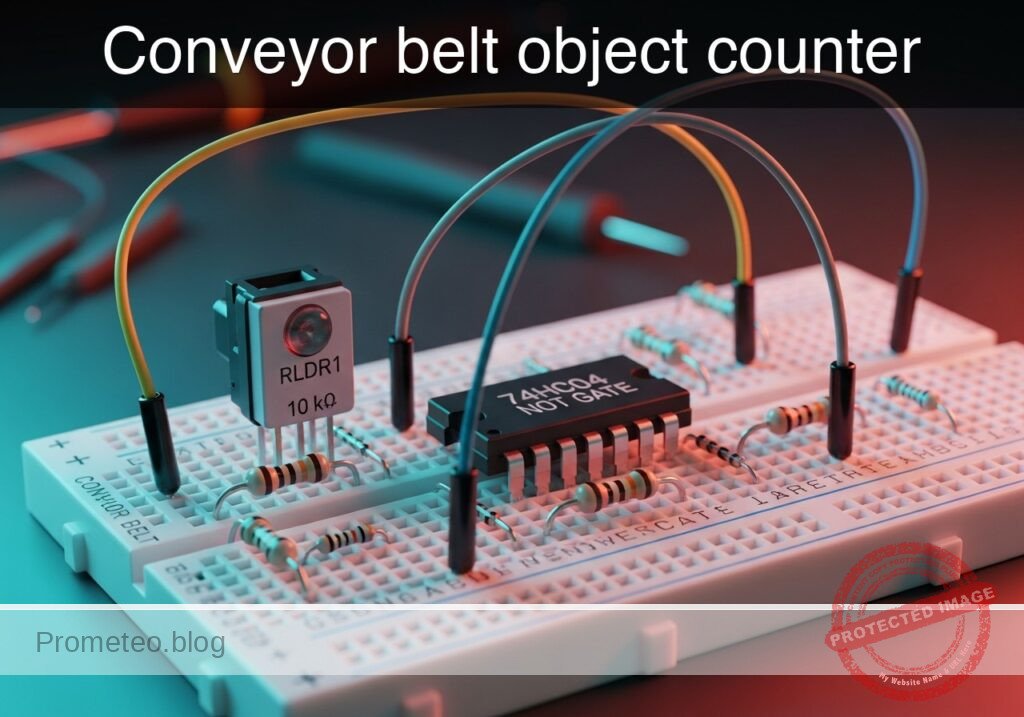
Automatic darkness sensor prototype (Maker Style)

Level: Basic — Use a 74HC04 inverter and an LDR to automatically switch on an LED when ambient light drops.

Objective and use case

You will build an automatic light control circuit that detects darkness using a Light Dependent Resistor (LDR) and activates an LED using a 74HC04 digital inverter.

  • Why it is useful:
    • Automating streetlights to turn on only at night to save energy.
    • Activating emergency pathway lighting during power failures or darkness.
    • Controlling garden solar lights automatically.
    • Adjusting screen brightness on mobile devices based on ambient light.
  • Expected outcome:
    • When the LDR is exposed to bright light, the LED remains OFF.
    • When the LDR is covered (darkness), the LED turns ON.
    • The voltage at the logic gate input transitions from Logic High (5V) to Logic Low (0V) as it gets darker.
  • Target audience and level: Students and hobbyists familiar with basic breadboarding.

Materials

  • V1: 5 V DC supply, function: Main power source.
  • R1: LDR (GL5528 or similar), function: Light sensor (Variable resistor).
  • R2: 10 kΩ potentiometer, function: Sensitivity calibration (Pull-down).
  • U1: 74HC04, function: Hex Inverter (NOT gate).
  • R3: 330 Ω resistor, function: LED current limiting.
  • D1: Red LED, function: Visual output indicator.

Pin-out of the IC used

Chip: 74HC04 (Hex Inverter)

Pin Name Logic function Connection in this case
14 VCC Power (+) Connect to VCC (5V)
7 GND Ground (-) Connect to 0 (GND)
1 1A Input Connect to sensor node VSENSE
2 1Y Output Connect to LED node VOUT

(Note: Pins 3, 5, 9, 11, 13 are unused inputs and should ideally be connected to GND in permanent circuits to prevent noise, though not strictly required for this quick test.)

Wiring guide

Use the following explicit node connections to build the circuit on your breadboard:

  • Power Supply:
    • V1 positive terminal connects to node VCC.
    • V1 negative terminal connects to node 0 (GND).
  • Sensor Stage (Voltage Divider):
    • R1 (LDR) connects between VCC and node VSENSE.
    • R2 (Potentiometer) connects between node VSENSE and 0 (GND).
    • Note: Adjust R2 so the voltage at VSENSE varies when light changes.
  • Logic Stage (Inverter):
    • U1 Pin 14 connects to VCC.
    • U1 Pin 7 connects to 0.
    • U1 Pin 1 (Input) connects to node VSENSE.
    • U1 Pin 2 (Output) connects to node VOUT.
  • Output Stage:
    • R3 connects between node VOUT and node LED_ANODE.
    • D1 connects between node LED_ANODE (Anode/Long leg) and 0 (Cathode/Short leg).

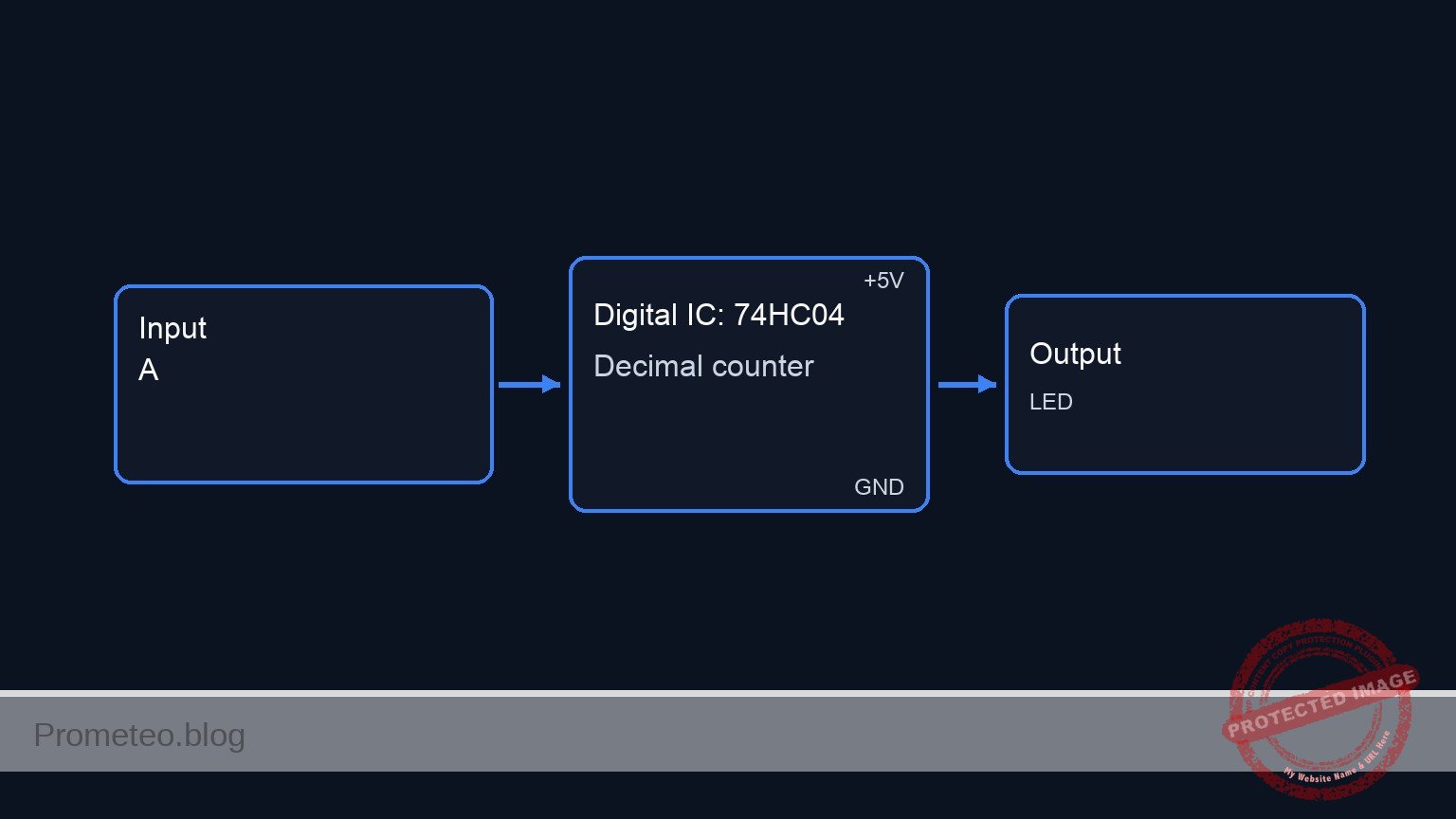
Conceptual block diagram

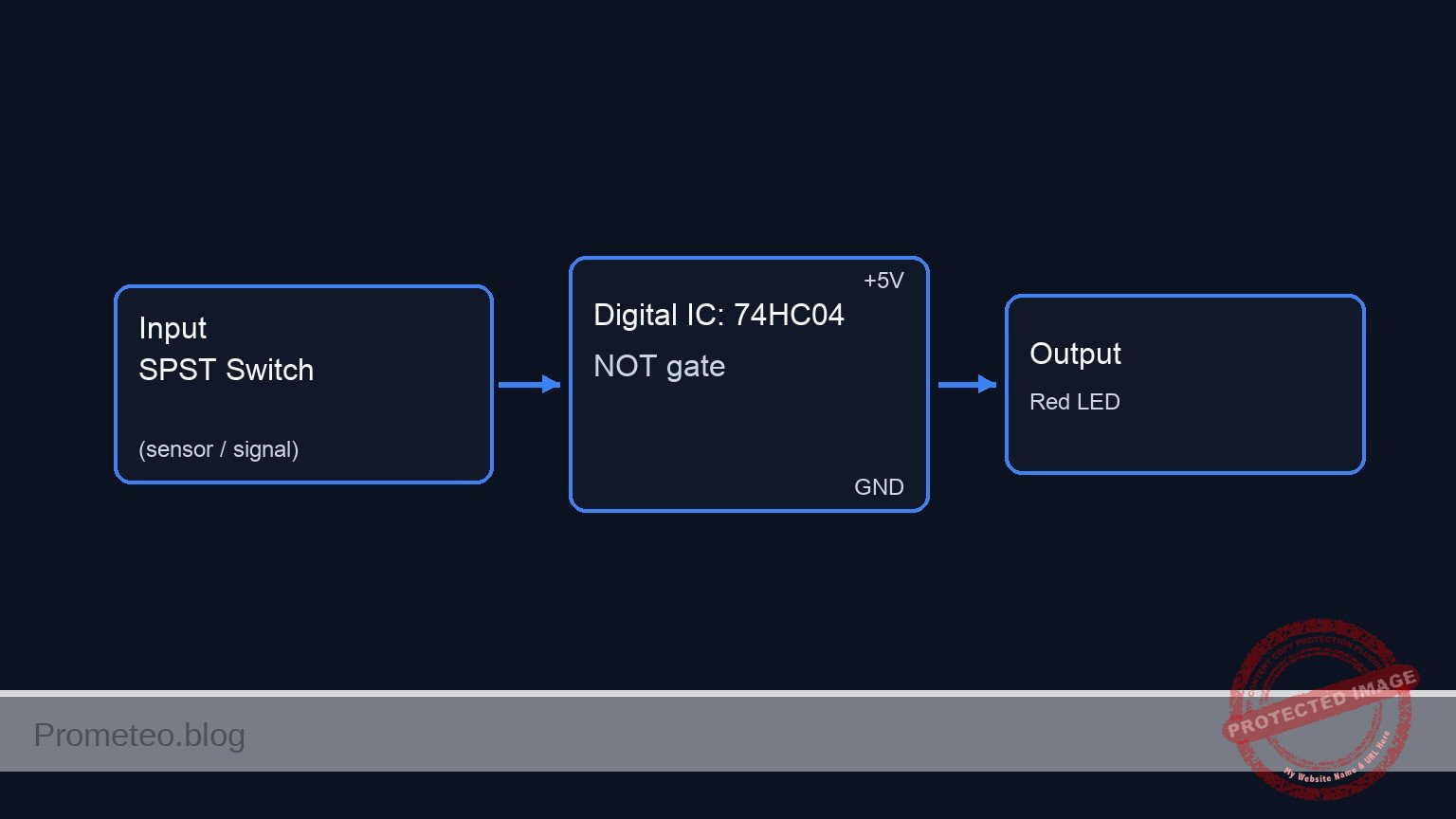
Conceptual block diagram — 74HC04 NOT gate

Schematic

[ INPUT / SENSOR STAGE ]               [ LOGIC STAGE ]                  [ OUTPUT STAGE ]

 [ VCC ] --> [ R1: LDR (Sensor) ] --+
                                    |
                                    v
                               [ VSENSE ] --(Pin 1)--> [ U1: 74HC04 ] --(Pin 2)--> [ R3: 330 Ohm ] --> [ D1: LED ] --> GND
                                    ^                  [  NOT Gate  ]
                                    |
 [ GND ] --> [ R2: Pot (Calib) ] ---+
Schematic (ASCII)

Truth table

The 74HC04 inverts the input signal. We configure the sensors so that «Bright» creates a HIGH input.

Ambient Condition LDR Resistance Voltage at VSENSE (Input) Logic Input Logic Output (VOUT) LED State
Bright Low High (> 2.5V) 1 0 (GND) OFF
Dark High Low (< 1.5V) 0 1 (5V) ON

Measurements and tests

  1. Calibration: Expose the LDR to normal room light. Adjust potentiometer R2 until the LED turns OFF.
  2. Voltage Check (Bright): Measure voltage between VSENSE and GND. It should be close to 5V (Logic 1). The output at VOUT should be near 0V.
  3. Activation: Cover the LDR with your hand to simulate darkness.
  4. Voltage Check (Dark): Measure VSENSE again. It should drop towards 0V (Logic 0). The output VOUT should jump to approx. 5V, turning the LED ON.

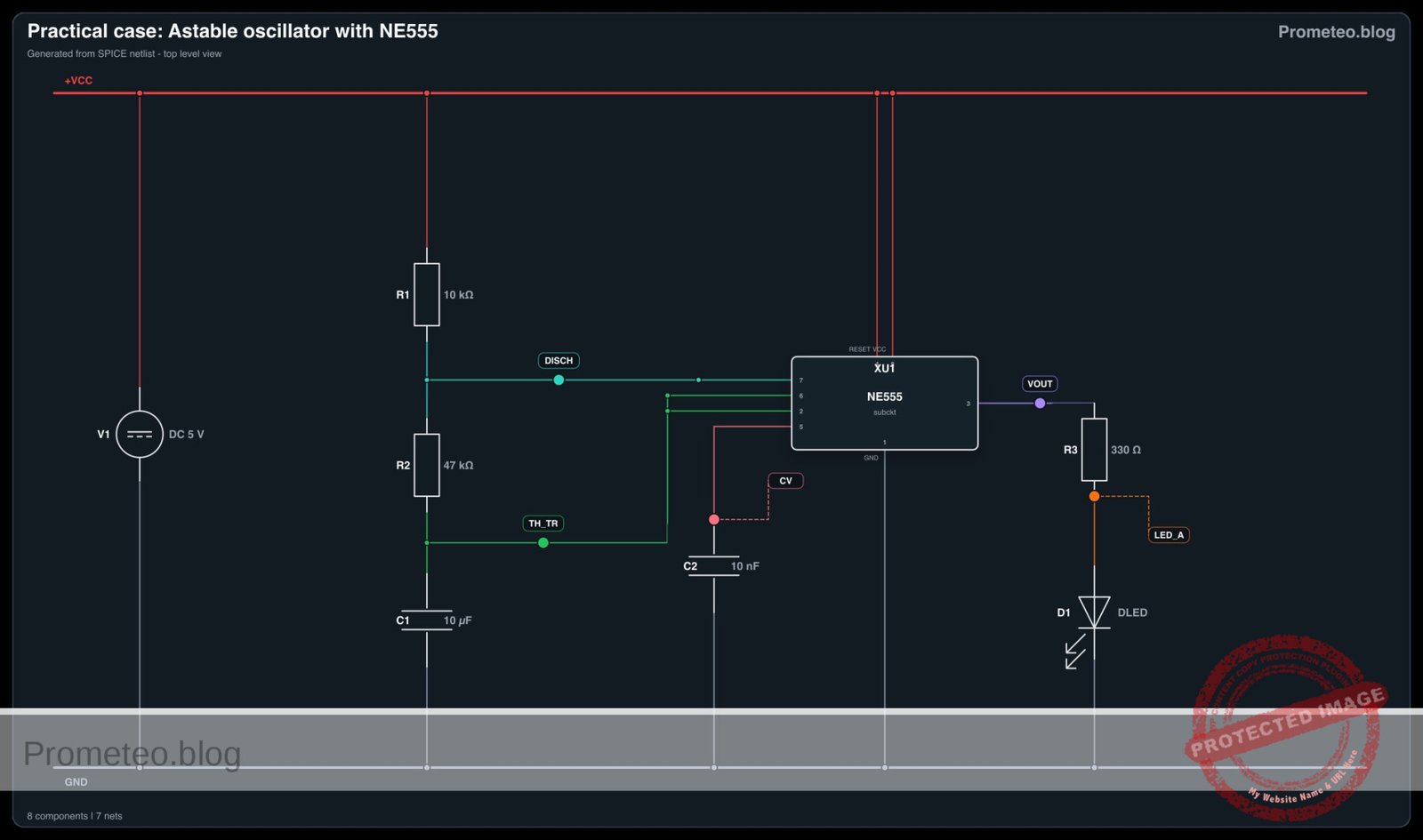
SPICE netlist and simulation

Reference SPICE Netlist (ngspice) — excerptFull SPICE netlist (ngspice)

* Practical case: Automatic darkness sensor

* --- Models ---
* Generic Red LED Model
.model DLED D (IS=1e-22 N=1.5 RS=5 BV=5 IBV=10u CJO=10p)

* --- Subcircuits ---
* 74HC04 Hex Inverter Model (Behavioral)
* Pins: 1=Input, 2=Output, 7=GND, 14=VCC
* Maps to subckt args: In Out GND VCC
.subckt 74HC04 In Out GND VCC
  * Robust Sigmoid Transfer Function for Inverter
  * Threshold is VCC/2. Output swings between GND and VCC.
  * Formula: Vout = VCC * (1 / (1 + exp(50 * (V(In) - V(VCC)/2))))
  B_INV Out GND V = V(VCC) * (1 / (1 + exp(50 * (V(In) - V(VCC)/2))))
.ends

* --- Main Circuit Components ---

* 1. Power Supply
* ... (truncated in public view) ...

Copy this content into a .cir file and run with ngspice.

🔒 Part of this section is premium. With the 7-day pass or the monthly membership you can access the full content (materials, wiring, detailed build, validation, troubleshooting, variants and checklist) and download the complete print-ready PDF pack.

* Practical case: Automatic darkness sensor

* --- Models ---
* Generic Red LED Model
.model DLED D (IS=1e-22 N=1.5 RS=5 BV=5 IBV=10u CJO=10p)

* --- Subcircuits ---
* 74HC04 Hex Inverter Model (Behavioral)
* Pins: 1=Input, 2=Output, 7=GND, 14=VCC
* Maps to subckt args: In Out GND VCC
.subckt 74HC04 In Out GND VCC
  * Robust Sigmoid Transfer Function for Inverter
  * Threshold is VCC/2. Output swings between GND and VCC.
  * Formula: Vout = VCC * (1 / (1 + exp(50 * (V(In) - V(VCC)/2))))
  B_INV Out GND V = V(VCC) * (1 / (1 + exp(50 * (V(In) - V(VCC)/2))))
.ends

* --- Main Circuit Components ---

* 1. Power Supply
* V1: 5V DC supply
V1 VCC 0 DC 5

* 2. Sensor Stage (Voltage Divider)
* R1: LDR (Light Dependent Resistor)
* Implementation: A dummy R1 is placed to satisfy the BOM.
* A parallel behavioral source (B_LDR) implements the dynamic resistance change.
R1 VCC VSENSE 100Meg
B_LDR VCC VSENSE I = V(VCC, VSENSE) / V(RES_CTRL)

* R2: 10k Potentiometer (Sensitivity Calibration)
R2 VSENSE 0 10k

* Dynamic Stimulus for LDR (Simulates Light Conditions)
* Generates a control voltage representing Ohms.
* Pulse sweeps from 1k (Light) to 100k (Dark).
* Logic: Light(1k) -> VSENSE High -> LED OFF. Dark(100k) -> VSENSE Low -> LED ON.
V_LDR_CTRL RES_CTRL 0 PULSE(1k 100k 0 200u 200u 400u 2ms)

* 3. Logic Stage
* U1: 74HC04 Hex Inverter
* Connections: Pin 1 (In)=VSENSE, Pin 2 (Out)=VOUT, Pin 7=0, Pin 14=VCC
XU1 VSENSE VOUT 0 VCC 74HC04

* 4. Output Stage
* R3: LED Current Limiting Resistor (330 Ohm)
R3 VOUT LED_ANODE 330

* D1: Red LED
D1 LED_ANODE 0 DLED

* --- Analysis Directives ---
* Transient analysis to capture the Light/Dark transition
.tran 10u 2ms

* Print specific node voltages for validation
.print tran V(VSENSE) V(VOUT) V(LED_ANODE)

* Compute DC operating point
.op

.end

Simulation Results (Transient Analysis)

Simulation Results (Transient Analysis)
Show raw data table (224 rows)
Index   time            v(vsense)       v(vout)         v(led_anode)
0	0.000000e+00	4.545459e+00	1.916016e-44	6.555013e-37
1	1.000000e-07	4.525005e+00	3.875543e-44	2.124754e-38
2	2.000000e-07	4.504821e+00	1.070470e-43	-1.98700e-38
3	4.000000e-07	4.464726e+00	4.391831e-43	-3.30922e-39
4	8.000000e-07	4.386087e+00	5.351931e-42	4.963938e-40
5	1.600000e-06	4.240174e+00	7.789996e-38	7.726704e-38
6	3.200000e-06	3.973321e+00	1.292803e-32	1.287493e-32
7	6.400000e-06	3.529123e+00	-6.61237e-21	-6.59876e-21
8	1.280000e-05	2.884261e+00	2.263832e-08	2.262430e-08
9	1.905731e-05	2.447108e+00	4.668386e+00	1.823995e+00
10	2.344117e-05	2.212214e+00	4.999997e+00	1.833723e+00
11	2.751655e-05	2.030989e+00	5.000000e+00	1.833029e+00
12	3.266976e-05	1.840361e+00	5.000000e+00	1.833116e+00
13	4.266976e-05	1.556825e+00	5.000000e+00	1.833028e+00
14	5.266976e-05	1.349010e+00	5.000000e+00	1.833116e+00
15	6.266976e-05	1.190157e+00	5.000000e+00	1.833028e+00
16	7.266976e-05	1.064784e+00	5.000000e+00	1.833116e+00
17	8.266976e-05	9.633175e-01	5.000000e+00	1.833028e+00
18	9.266976e-05	8.795141e-01	5.000000e+00	1.833116e+00
19	1.026698e-04	8.091310e-01	5.000000e+00	1.833028e+00
20	1.126698e-04	7.491835e-01	5.000000e+00	1.833116e+00
21	1.226698e-04	6.975110e-01	5.000000e+00	1.833028e+00
22	1.326698e-04	6.525106e-01	5.000000e+00	1.833116e+00
23	1.426698e-04	6.129684e-01	5.000000e+00	1.833028e+00
... (200 more rows) ...

Common mistakes and how to avoid them

  1. Swapping LDR and Potentiometer: If you swap R1 and R2, the logic inverts: the light will turn ON when it is bright and OFF when it is dark. Ensure the LDR is connected to VCC and the Potentiometer to GND.
  2. LED inserted backwards: If D1 does not light up when VOUT is high, check the polarity. The longer leg (anode) must face the resistor R3.
  3. Sensitivity too low: If the LED never turns off, R2 might be set to too high a resistance, keeping voltage at VSENSE always high. Turn the knob to lower the resistance.

Troubleshooting

  • LED is always ON:
    • Cause: Potentiometer resistance is too high or LDR is broken (open circuit).
    • Fix: Decrease R2 value by turning the knob. Check LDR connections.
  • LED is always OFF:
    • Cause: Potentiometer resistance is too low (shorting input to ground) or U1 is not powered.
    • Fix: Verify Pin 14 has 5V. Increase R2 resistance slightly.
  • LED flickers:
    • Cause: The light level is right at the switching threshold of the 74HC04.
    • Fix: Adjust R2 slightly to move away from the threshold or shade the LDR more decisively.

Possible improvements and extensions

  1. Add Hysteresis: Replace the 74HC04 with a 74HC14 (Schmidt Trigger Inverter). This prevents flickering when the light transitions slowly (dusk/dawn).
  2. High Power Load: Connect the output pin to a transistor (like a 2N2222) and a relay module to switch a 110V/220V desk lamp instead of a small LED.

More Practical Cases on Prometeo.blog

Find this product and/or books on this topic on Amazon

Go to Amazon

As an Amazon Associate, I earn from qualifying purchases. If you buy through this link, you help keep this project running.

Quick Quiz

Question 1: What is the primary function of the LDR in this circuit?


Question 2: Which component is used to calibrate the sensitivity of the light detection?


Question 3: What happens to the LED when the LDR is exposed to bright light?


Question 4: Which logic gate is contained within the 74HC04 chip?


Question 5: What is the expected voltage transition at the logic gate input as the environment gets darker?


Question 6: To which pin of the 74HC04 IC should the main power (VCC) be connected?


Question 7: What is the purpose of the 330 Ω resistor (R3) in this circuit?


Question 8: Which pin on the 74HC04 is typically used as the Ground (GND) connection?


Question 9: What is a practical application mentioned for this circuit?


Question 10: In this specific circuit configuration, where is the sensor node `VSENSE` connected on the IC?


Carlos Núñez Zorrilla
Electronics & Computer Engineer

Telecommunications Electronics Engineer and Computer Engineer (official degrees in Spain).

Follow me:


Practical case: Open door alarm

Open door alarm prototype (Maker Style)

Level: Basic. Objective: Build a logic circuit using a NOT gate that activates an LED when a switch contact is opened.

Objective and use use case

You will build a digital monitoring circuit that illuminates an LED indicator whenever a switch (representing a door sensor) breaks contact. This demonstrates the fundamental operation of the NOT gate (Inverter) in security logic.

  • Why it is useful:

    • Home Security: Basic principle behind magnetic reed switches used on windows and doors.
    • Appliance Safety: Ensures devices like microwaves or washing machines do not run if the door is open.
    • Industrial Interlocks: Visual warning systems for machine guards.
  • Expected outcome:

    • Door Closed (Switch Closed): Input logic High (5V), Output logic Low (0V), LED OFF.
    • Door Open (Switch Open): Input logic Low (0V), Output logic High (5V), LED ON.
    • Target audience and level: Introductory Electronics Students (Basic).

Materials

  • V1: 5 V DC supply, function: Main power source
  • U1: 74HC04, function: Hex Inverter (NOT gate logic)
  • SW1: SPST Switch, function: Simulates door sensor (Closed = Door Closed)
  • R1: 10 kΩ resistor, function: Pull-down for U1 input
  • R2: 330 Ω resistor, function: LED current limiting
  • D1: Red LED, function: Visual alarm indicator

Pin-out of the IC used

Chip: 74HC04 (Hex Inverter)

Pin Name Logic function Connection in this case
1 1A Input Connected to SW1 and R1
2 1Y Output Connected to LED resistor R2
7 GND Ground Connected to 0V (Power Supply Ground)
14 VCC Power Connected to 5V (Power Supply Positive)

Wiring guide

  • VCC connects to V1 positive terminal, U1 pin 14, and one side of SW1.
  • 0 (GND) connects to V1 negative terminal, U1 pin 7, R1, and cathode of D1.
  • DOOR_STATUS (Node A) connects to the other side of SW1, the other side of R1, and U1 pin 1.
  • ALARM_OUT (Node Y) connects to U1 pin 2 and one side of R2.
  • LED_ANODE connects to the other side of R2 and the anode of D1.

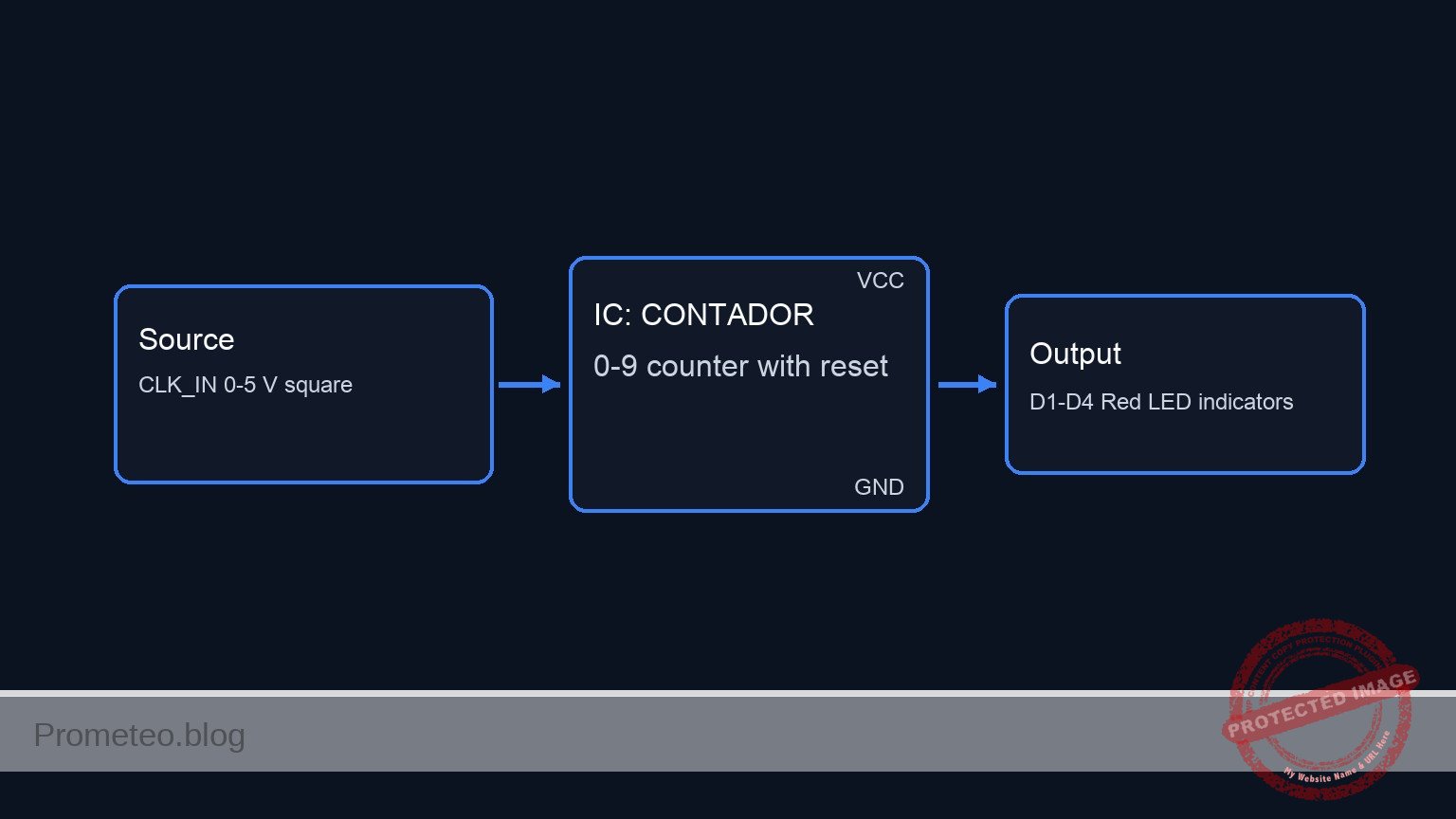
Conceptual block diagram

Conceptual block diagram — 74HC04 NOT gate

Schematic

[ INPUT / SENSOR ]                 [ LOGIC PROCESSING ]               [ OUTPUT / ALARM ]

    [ VCC (5V Source) ]
             |
             v
    [ SW1 (Door Switch) ]
             |
             v
          (Node A) -------------------->+------------------+
             |                          |    U1: 74HC04    |
             v                          |    (NOT Gate)    | --(Pin 2)--> [ R2: 330Ω ] --> [ D1: LED ] --> GND
    [ R1 (10k Pull-down) ]              |  Input: Pin 1    |
             |                          +------------------+
             v
            GND
Schematic (ASCII)

Truth table

Door Status Switch (SW1) Input Voltage (Pin 1) Logic Input Logic Output (Pin 2) LED Status
Closed Closed 5 V (High) 1 0 OFF
Open Open 0 V (Low) 0 1 ON

Measurements and tests

  1. Supply Check: Before inserting the IC, verify V1 provides exactly 5 V.
  2. State 1 (Secure): Close SW1. Measure voltage at Pin 1 (Input). It should be ~5 V. Measure Pin 2 (Output). It should be ~0 V. Verify LED is OFF.
  3. State 2 (Alarm): Open SW1. Measure voltage at Pin 1 (Input). It should drop to 0 V (pulled down by R1). Measure Pin 2 (Output). It should rise to ~5 V. Verify LED is ON.

SPICE netlist and simulation

Reference SPICE Netlist (ngspice) — excerptFull SPICE netlist (ngspice)

* Practical case: Open door alarm
*
* BILL OF MATERIALS:
* V1: 5V DC Supply
* U1: 74HC04 Hex Inverter (Behavioral Model)
* SW1: SPST Switch (Modeled as Voltage-Controlled Switch)
* R1: 10k Pull-down Resistor
* R2: 330 Ohm Current Limiting Resistor
* D1: Red LED
*
* WIRING CONNECTIONS:
* VCC: V1(+), U1(14), SW1(1)
* GND: V1(-), U1(7), R1(2), D1(Cathode)
* DOOR_STATUS: SW1(2), R1(1), U1(1)
* ALARM_OUT: U1(2), R2(1)
* LED_ANODE: R2(2), D1(Anode)

* --- Main Power Supply ---
V1 VCC 0 DC 5

* ... (truncated in public view) ...

Copy this content into a .cir file and run with ngspice.

🔒 Part of this section is premium. With the 7-day pass or the monthly membership you can access the full content (materials, wiring, detailed build, validation, troubleshooting, variants and checklist) and download the complete print-ready PDF pack.

* Practical case: Open door alarm
*
* BILL OF MATERIALS:
* V1: 5V DC Supply
* U1: 74HC04 Hex Inverter (Behavioral Model)
* SW1: SPST Switch (Modeled as Voltage-Controlled Switch)
* R1: 10k Pull-down Resistor
* R2: 330 Ohm Current Limiting Resistor
* D1: Red LED
*
* WIRING CONNECTIONS:
* VCC: V1(+), U1(14), SW1(1)
* GND: V1(-), U1(7), R1(2), D1(Cathode)
* DOOR_STATUS: SW1(2), R1(1), U1(1)
* ALARM_OUT: U1(2), R2(1)
* LED_ANODE: R2(2), D1(Anode)

* --- Main Power Supply ---
V1 VCC 0 DC 5

* --- User Interaction (Door Sensor) ---
* Model SW1 as a voltage-controlled switch S1 driven by a pulse source.
* Logic: Control High = Switch Closed (Door Closed). Control Low = Switch Open (Door Open).
* Pulse: Starts 0V (Open/Alarm ON), goes to 5V (Closed/Alarm OFF) at 1ms, stays for 2ms.
V_SW_CTRL SW_CTRL 0 PULSE(0 5 1m 10u 10u 2m 5m)

* S1 connects VCC to DOOR_STATUS when SW_CTRL is High.
S1 VCC DOOR_STATUS SW_CTRL 0 SW_DOOR
.model SW_DOOR SW(Vt=2.5 Ron=0.1 Roff=100Meg)

* --- Pull-down Resistor ---
R1 DOOR_STATUS 0 10k

* --- 74HC04 Hex Inverter (U1) ---
* Implements NOT gate logic: ALARM_OUT = NOT(DOOR_STATUS)
* Pin mapping: 1=In, 2=Out, 7=GND, 14=VCC
XU1 DOOR_STATUS ALARM_OUT 0 VCC 74HC04_GATE

* --- Output Stage ---
R2 ALARM_OUT LED_ANODE 330
D1 LED_ANODE 0 D_RED

* --- Models and Subcircuits ---

* LED Model
.model D_RED D(IS=1e-22 RS=6 N=1.5 CJO=50p BV=5 IBV=10u)

* 74HC04 Single Gate Behavioral Model
* Pins: In Out GND VCC
.subckt 74HC04_GATE 1 2 7 14
* Continuous sigmoid function for robust NOT logic
* Vout goes Low when Vin > 2.5V, High when Vin < 2.5V
B_INV 2 7 V = V(14,7) * (1 / (1 + exp(50 * (V(1,7) - 2.5))))
.ends

* --- Simulation Directives ---
.tran 10u 5ms
.op

* --- Output Printing ---
.print tran V(DOOR_STATUS) V(ALARM_OUT) V(LED_ANODE) V(SW_CTRL)

.end

Simulation Results (Transient Analysis)

Simulation Results (Transient Analysis)
Show raw data table (1126 rows)
Index   time            v(door_status)  v(alarm_out)    v(led_anode)
0	0.000000e+00	4.999500e-04	5.000000e+00	1.842385e+00
1	1.000000e-07	4.999500e-04	5.000000e+00	1.842385e+00
2	2.000000e-07	4.999500e-04	5.000000e+00	1.842385e+00
3	4.000000e-07	4.999500e-04	5.000000e+00	1.842385e+00
4	8.000000e-07	4.999500e-04	5.000000e+00	1.842385e+00
5	1.600000e-06	4.999500e-04	5.000000e+00	1.842385e+00
6	3.200000e-06	4.999500e-04	5.000000e+00	1.842385e+00
7	6.400000e-06	4.999500e-04	5.000000e+00	1.842385e+00
8	1.280000e-05	4.999500e-04	5.000000e+00	1.842385e+00
9	2.280000e-05	4.999500e-04	5.000000e+00	1.842385e+00
10	3.280000e-05	4.999500e-04	5.000000e+00	1.842385e+00
11	4.280000e-05	4.999500e-04	5.000000e+00	1.842385e+00
12	5.280000e-05	4.999500e-04	5.000000e+00	1.842385e+00
13	6.280000e-05	4.999500e-04	5.000000e+00	1.842385e+00
14	7.280000e-05	4.999500e-04	5.000000e+00	1.842385e+00
15	8.280000e-05	4.999500e-04	5.000000e+00	1.842385e+00
16	9.280000e-05	4.999500e-04	5.000000e+00	1.842385e+00
17	1.028000e-04	4.999500e-04	5.000000e+00	1.842385e+00
18	1.128000e-04	4.999500e-04	5.000000e+00	1.842385e+00
19	1.228000e-04	4.999500e-04	5.000000e+00	1.842385e+00
20	1.328000e-04	4.999500e-04	5.000000e+00	1.842385e+00
21	1.428000e-04	4.999500e-04	5.000000e+00	1.842385e+00
22	1.528000e-04	4.999500e-04	5.000000e+00	1.842385e+00
23	1.628000e-04	4.999500e-04	5.000000e+00	1.842385e+00
... (1102 more rows) ...

Common mistakes and how to avoid them

  1. Floating Input: Forgetting the pull-down resistor (R1). Without R1, when the switch opens, the input pin floats and the LED may flicker or remain in an unpredictable state. Always tie CMOS inputs to a defined logic level.
  2. No LED Resistor: Connecting the LED directly to the 74HC04 output without R2. This can burn out the LED or damage the IC output stage due to excessive current.
  3. Wrong Polarity: Inserting the LED backwards (anode to ground). The LED will never light up. Ensure the longer leg (anode) faces the resistor coming from the IC.

Troubleshooting

  • LED always ON: Check if SW1 is actually closing. If using a push-button, ensure it is connected to VCC. Verify R1 is connected to Ground.
  • LED always OFF: Check if the 74HC04 has power (Pin 14) and Ground (Pin 7). Check LED polarity. Ensure SW1 is actually disconnecting VCC when «Open».
  • LED is dim: The value of R2 might be too high (e.g., 10kΩ instead of 330Ω) or the 5V supply is sagging.
  • IC gets hot: Immediate disconnect power. Check for short circuits between Output (Pin 2) and Ground, or if the chip is inserted backwards.

Possible improvements and extensions

  1. Audible Alarm: Connect an NPN transistor and a buzzer to the output to generate sound alongside the light when the door opens.
  2. Latch Circuit: Add a feedback loop or a Flip-Flop so that once the alarm triggers, it stays ON even if the door is closed again, requiring a manual reset button.

More Practical Cases on Prometeo.blog

Find this product and/or books on this topic on Amazon

Go to Amazon

As an Amazon Associate, I earn from qualifying purchases. If you buy through this link, you help keep this project running.

Quick Quiz

Question 1: What is the primary objective of the circuit described in the text?


Question 2: Which logic gate is used to build this monitoring circuit?


Question 3: In the expected outcome, what is the state of the LED when the door (switch) is closed?


Question 4: What real-world application uses the principle described in this circuit?


Question 5: What is the function of the 10 kΩ resistor (R1) in this circuit?


Question 6: Which specific IC chip is listed in the materials for the inverter function?


Question 7: According to standard pinouts for the 74HC04 chip, where is Ground (GND) typically connected?


Question 8: What voltage level represents a Logic High input in this specific circuit?


Question 9: What is the function of the 330 Ω resistor (R2)?


Question 10: When the switch is open (Door Open), what is the logic state at the input?


Carlos Núñez Zorrilla
Electronics & Computer Engineer

Telecommunications Electronics Engineer and Computer Engineer (official degrees in Spain).
Follow me:


Practical case: Multi-perimeter intrusion detection

Multi-perimeter intrusion detection prototype (Maker Style)

Level: Advanced — Implement a 4-zone security system using cascaded OR logic to trigger a centralized alarm.

Objective and use case

In this project, you will build a centralized security monitoring system that supervises four distinct access points (windows or doors). The system uses magnetic reed switches and a 74HC32 Quad 2-input OR gate IC to consolidate multiple sensor signals into a single alarm trigger.

Why it is useful:
* Home Security: Monitors multiple entry points (front door, back door, garage, window) simultaneously.
* Server Rooms: Ensures all rack doors are closed; alerts if any single cabinet is breached.
* Industrial Safety: Prevents machine operation if any safety guard perimeter is open.

Expected outcome:
* Secure State: When all doors/windows are closed, the relay remains off (0 V at coil).
* Alarm State: If any single zone (or multiple zones) is breached, the relay activates.
* Voltage Levels: Logic Low (≈ 0 V) represents a secure zone; Logic High (≈ 5 V) represents a breach.
* Indication: A relay clicks and activates a connected load (simulated by a high-power LED or siren).

Target audience: Advanced electronics students and security system prototypers.

Materials

  • V1: 5 V DC voltage source, function: Main power supply
  • U1: 74HC32, function: Quad 2-input OR gate Logic IC
  • S1: SPST Switch (Reed Switch), function: Zone 1 sensor (Normally Open, closed by magnet)
  • S2: SPST Switch (Reed Switch), function: Zone 2 sensor
  • S3: SPST Switch (Reed Switch), function: Zone 3 sensor
  • S4: SPST Switch (Reed Switch), function: Zone 4 sensor
  • R1: 10 kΩ resistor, function: Pull-up for Zone 1
  • R2: 10 kΩ resistor, function: Pull-up for Zone 2
  • R3: 10 kΩ resistor, function: Pull-up for Zone 3
  • R4: 10 kΩ resistor, function: Pull-up for Zone 4
  • R5: 1 kΩ resistor, function: Transistor base current limiting
  • Q1: 2N2222 NPN Transistor, function: Relay driver
  • D1: 1N4007 Diode, function: Flyback protection for relay coil
  • RL1: 5 V Relay (SPDT), function: High-power switching interface
  • C1: 100 nF capacitor, function: Decoupling for U1

Pin-out of the IC used

Chip: 74HC32 (Quad 2-Input OR Gate)

Pin Name Logic Function Connection in this case
1 1A Input OR Gate 1 Connect to Node ZONE1
2 1B Input OR Gate 1 Connect to Node ZONE2
3 1Y Output OR Gate 1 Connect to Node INT_A (Input to Gate 3)
4 2A Input OR Gate 2 Connect to Node ZONE3
5 2B Input OR Gate 2 Connect to Node ZONE4
6 2Y Output OR Gate 2 Connect to Node INT_B (Input to Gate 3)
7 GND Ground Connect to Node 0
9 3A Input OR Gate 3 Connect to Node INT_A
10 3B Input OR Gate 3 Connect to Node INT_B
8 3Y Output OR Gate 3 Connect to Node LOGIC_OUT
14 VCC Power Supply Connect to Node VCC

Note: Pins 11, 12, and 13 (Gate 4) are unused and should be grounded if strictly following best CMOS practices, though often left floating in simple prototypes.

Wiring guide

This circuit uses «Active High» logic for alarms. The sensors are wired as Pull-ups. When a door is closed (magnet present), the switch closes to ground (Logic 0). When a door opens, the resistor pulls the line to VCC (Logic 1).

  • Power Supply
  • V1 positive terminal connects to node VCC.
  • V1 negative terminal connects to node 0 (GND).
  • C1 connects between VCC and 0 (near U1).

  • Zone Sensors (Inputs)

  • R1 connects between VCC and ZONE1.
  • S1 connects between ZONE1 and 0.
  • R2 connects between VCC and ZONE2.
  • S2 connects between ZONE2 and 0.
  • R3 connects between VCC and ZONE3.
  • S3 connects between ZONE3 and 0.
  • R4 connects between VCC and ZONE4.
  • S4 connects between ZONE4 and 0.

  • Logic Processing (Cascading)

  • U1 Pin 1 (1A) connects to ZONE1.
  • U1 Pin 2 (1B) connects to ZONE2.
  • U1 Pin 3 (1Y) connects to INT_A.
  • U1 Pin 4 (2A) connects to ZONE3.
  • U1 Pin 5 (2B) connects to ZONE4.
  • U1 Pin 6 (2Y) connects to INT_B.
  • U1 Pin 9 (3A) connects to INT_A.
  • U1 Pin 10 (3B) connects to INT_B.
  • U1 Pin 8 (3Y) connects to LOGIC_OUT.

  • Output Driver Stage

  • R5 connects between LOGIC_OUT and node BASE.
  • Q1 Base connects to BASE.
  • Q1 Emitter connects to 0.
  • Q1 Collector connects to node RELAY_COIL_NEG.
  • RL1 Coil positive connects to VCC.
  • RL1 Coil negative connects to RELAY_COIL_NEG.
  • D1 Anode connects to RELAY_COIL_NEG.
  • D1 Cathode connects to VCC (Parallel to coil, reverse biased).

Conceptual block diagram

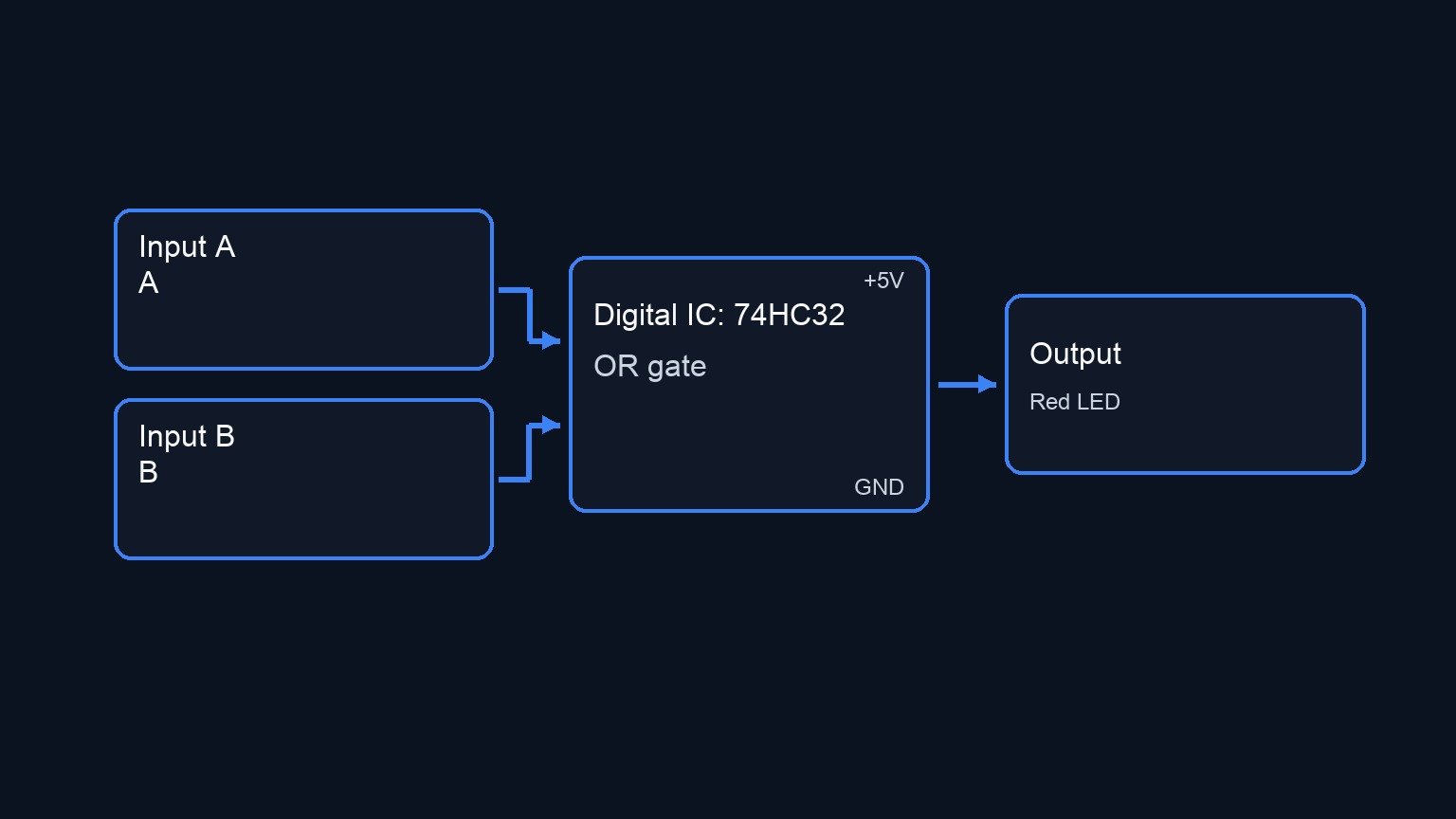
Conceptual block diagram — 74HC32 OR gate

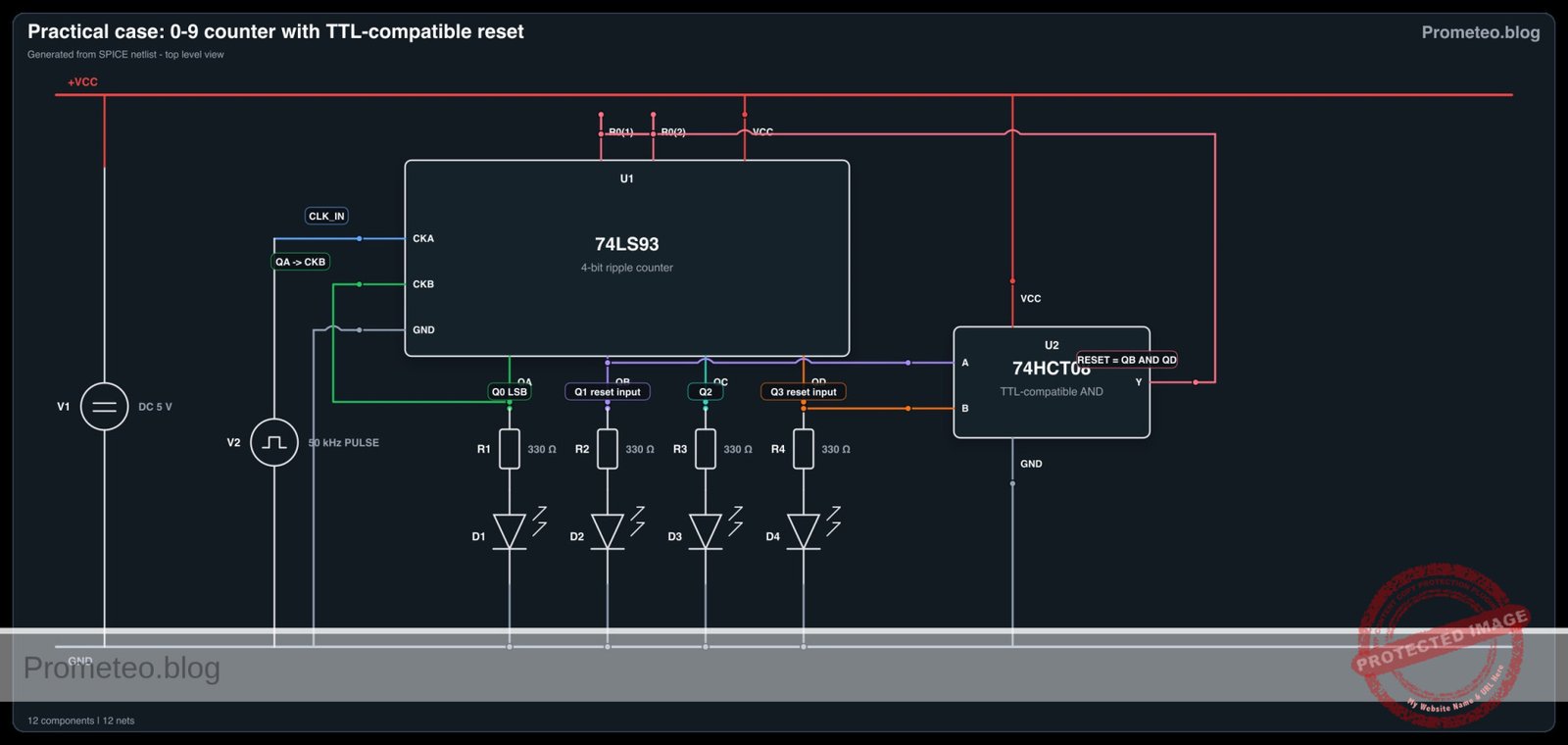
Schematic

Title: Practical case: Multi-perimeter intrusion detection

      [ INPUT STAGE ]                  [ LOGIC STAGE (U1: 74HC32) ]                 [ OUTPUT STAGE ]

   (VCC)                                                                               (VCC)
     |                                                                                   |
   [ R1 ]                                                                            +---+---+
     +----(Zone 1)-------->+-------------+                                           |       |
     |                     |  OR GATE 1  |                                         [D1]    [RL1]
   [ S1 ]                  | (Pins 1,2)  |--(Int A)------>+                        (Diode) (Coil)
     |                     +-------------+                |                          |       |
   (GND)                   ^                              |                          +---+---+
                           |                              |                              |
   (VCC)                   |                              v                              |
     |                     |                       +-------------+                       |
   [ R2 ]                  |                       |  OR GATE 3  |                       |
     +----(Zone 2)---------+                       | (Pins 9,10) |                       |
     |                                             +-------------+                       |
   [ S2 ]                                                 |                              |
     |                                                    +----(Logic Out)--> [ R5 ] --> +
   (GND)                                                  ^                              |
                                                          |                         [ Q1 Base ]
   (VCC)                                                  |                              |
     |                                                    |                        [ Q1 (NPN) ]
   [ R3 ]                                                 |                              |
     +----(Zone 3)-------->+-------------+                |                         (Emitter)
     |                     |  OR GATE 2  |                |                              |
   [ S3 ]                  | (Pins 4,5)  |--(Int B)-------+                            (GND)
     |                     +-------------+
   (GND)                   ^
                           |
   (VCC)                   |
     |                     |
   [ R4 ]                  |
     +----(Zone 4)---------+
     |
   [ S4 ]
     |
   (GND)
Schematic (ASCII)

Truth table

The logic is cascaded. Gates 1 and 2 handle the zones; Gate 3 combines their results.
Logic 0 = Secure (Door Closed). Logic 1 = Breach (Door Open).

Zone 1 Zone 2 Zone 3 Zone 4 Int A (Z1+Z2) Int B (Z3+Z4) Final Output System State
0 0 0 0 0 0 0 Secure
1 0 0 0 1 0 1 ALARM
0 1 0 0 1 0 1 ALARM
0 0 1 0 0 1 1 ALARM
0 0 0 1 0 1 1 ALARM
1 1 1 1 1 1 1 ALARM

Note: Any combination containing at least one «1» results in a Final Output of «1».

Measurements and tests

  1. Static Logic Check:
    • Ensure all switches are closed (magnets present). Measure voltage at LOGIC_OUT. It should be < 0.1 V.
    • Open switch S1 only. Measure voltage at ZONE1 (should be ≈ 5 V) and LOGIC_OUT (should be ≈ 5 V).
    • Verify the Relay clicks ON.
  2. Threshold Verification:
    • With S1 open, measure the voltage at node BASE (Q1 Base). It should be approx 0.7 V (Vbe of the transistor).
  3. Cascading Check:
    • Close S1 (Secure). Open S3.
    • Verify INT_A is Low (0 V) and INT_B is High (5 V).
    • Verify LOGIC_OUT remains High.

SPICE netlist and simulation

Reference SPICE Netlist (ngspice) — excerptFull SPICE netlist (ngspice)

* Multi-perimeter intrusion detection
* NGSPICE Netlist
* Created based on Bill of Materials and Wiring Guide

* =============================================================================
* COMPONENT MODELS
* =============================================================================

* NPN Transistor Model (2N2222)
.model 2N2222 NPN(Is=14.34f Xti=3 Eg=1.11 Vaf=74.03 Bf=255.9 Ne=1.307 Ise=14.34f 
+ Ikf=.2847 Xtb=1.5 Br=6.092 Nc=2 Isc=0 Ikr=0 Rc=1 Cjc=7.306p Mjc=.3416 Vjc=.75 
+ Fc=.5 Cje=22.01p Mje=.377 Vje=.75 Tr=46.91n Tf=411.1p Itf=.6 Vtf=1.7 Xtf=3 Rb=10)

* Diode Model (1N4007)
.model 1N4007 D(IS=7.027n RS=0.034 N=1.26 TT=4.32u CJO=4p)

* Voltage Controlled Switch Model (for Reed Switches)
* Vt=2.5V: Control > 2.5V is CLOSED (Low R), Control < 2.5V is OPEN (High R)
.model SW_REED SW(Vt=2.5 Ron=0.1 Roff=10Meg)

* ... (truncated in public view) ...

Copy this content into a .cir file and run with ngspice.

🔒 Part of this section is premium. With the 7-day pass or the monthly membership you can access the full content (materials, wiring, detailed build, validation, troubleshooting, variants and checklist) and download the complete print-ready PDF pack.

* Multi-perimeter intrusion detection
* NGSPICE Netlist
* Created based on Bill of Materials and Wiring Guide

* =============================================================================
* COMPONENT MODELS
* =============================================================================

* NPN Transistor Model (2N2222)
.model 2N2222 NPN(Is=14.34f Xti=3 Eg=1.11 Vaf=74.03 Bf=255.9 Ne=1.307 Ise=14.34f 
+ Ikf=.2847 Xtb=1.5 Br=6.092 Nc=2 Isc=0 Ikr=0 Rc=1 Cjc=7.306p Mjc=.3416 Vjc=.75 
+ Fc=.5 Cje=22.01p Mje=.377 Vje=.75 Tr=46.91n Tf=411.1p Itf=.6 Vtf=1.7 Xtf=3 Rb=10)

* Diode Model (1N4007)
.model 1N4007 D(IS=7.027n RS=0.034 N=1.26 TT=4.32u CJO=4p)

* Voltage Controlled Switch Model (for Reed Switches)
* Vt=2.5V: Control > 2.5V is CLOSED (Low R), Control < 2.5V is OPEN (High R)
.model SW_REED SW(Vt=2.5 Ron=0.1 Roff=10Meg)

* =============================================================================
* POWER SUPPLY
* =============================================================================
V1 VCC 0 DC 5

* =============================================================================
* SENSORS (ZONES 1-4)
* Logic: Door Closed (Magnet Present) -> Switch Closed to GND -> Zone Low (Safe)
*        Door Open (Magnet Removed) -> Switch Open -> Zone Pulled High (Alarm)
* Simulation: Control Voltage 5V = Door Closed. Control Voltage 0V = Door Open.
* =============================================================================

* --- ZONE 1 ---
R1 VCC ZONE1 10k
S1 ZONE1 0 CTRL1 0 SW_REED
* Stimulus: Door 1 opens briefly at 100us
V_S1_CTRL CTRL1 0 PULSE(5 0 100u 1u 1u 50u 10m)

* --- ZONE 2 ---
R2 VCC ZONE2 10k
S2 ZONE2 0 CTRL2 0 SW_REED
* Stimulus: Door 2 opens briefly at 300us
V_S2_CTRL CTRL2 0 PULSE(5 0 300u 1u 1u 50u 10m)

* --- ZONE 3 ---
R3 VCC ZONE3 10k
S3 ZONE3 0 CTRL3 0 SW_REED
* Stimulus: Door 3 opens briefly at 500us
V_S3_CTRL CTRL3 0 PULSE(5 0 500u 1u 1u 50u 10m)

* --- ZONE 4 ---
R4 VCC ZONE4 10k
S4 ZONE4 0 CTRL4 0 SW_REED
* Stimulus: Door 4 opens briefly at 700us
V_S4_CTRL CTRL4 0 PULSE(5 0 700u 1u 1u 50u 10m)

* =============================================================================
* LOGIC PROCESSING (U1: 74HC32 Quad OR Gate)
* =============================================================================

* Subcircuit for 74HC32 using robust behavioral sources (tanh)
* Pinout: 1=1A, 2=1B, 3=1Y, 4=2A, 5=2B, 6=2Y, 7=GND, 8=3Y, 9=3A, 10=3B, 11=4Y, 12=4A, 13=4B, 14=VCC
.subckt 74HC32 1A 1B 1Y 2A 2B 2Y GND 3Y 3A 3B 4Y 4A 4B VCC
    * Gate 1 (1A, 1B -> 1Y)
    B1 1Y GND V = 2.5 * (1 + tanh(10 * (V(1A) + V(1B) - 2.5)))
    * Gate 2 (2A, 2B -> 2Y)
    B2 2Y GND V = 2.5 * (1 + tanh(10 * (V(2A) + V(2B) - 2.5)))
    * Gate 3 (3A, 3B -> 3Y)
    B3 3Y GND V = 2.5 * (1 + tanh(10 * (V(3A) + V(3B) - 2.5)))
    * Gate 4 (4A, 4B -> 4Y) - Unused but modeled
    B4 4Y GND V = 2.5 * (1 + tanh(10 * (V(4A) + V(4B) - 2.5)))
.ends

* Decoupling Capacitor for U1
C1 VCC 0 100n

* Instantiate U1
* Connections based on Wiring Guide:
* 1->ZONE1, 2->ZONE2, 3->INT_A
* 4->ZONE3, 5->ZONE4, 6->INT_B
* 9->INT_A, 10->INT_B, 8->LOGIC_OUT
* 14->VCC, 7->0
* Unused inputs (12, 13) grounded to avoid floating nodes
XU1 ZONE1 ZONE2 INT_A ZONE3 ZONE4 INT_B 0 LOGIC_OUT INT_A INT_B NC_4Y 0 0 VCC 74HC32

* =============================================================================
* OUTPUT DRIVER STAGE
* =============================================================================

* Base Resistor
R5 LOGIC_OUT BASE 1k

* Driver Transistor Q1
Q1 RELAY_COIL_NEG BASE 0 2N2222

* Relay RL1 (Modeled as Coil Inductance + Resistance)
* Coil Positive -> VCC, Negative -> Collector
L_RL1 VCC RELAY_NODE_INT 100m
R_RL1 RELAY_NODE_INT RELAY_COIL_NEG 70

* Flyback Diode D1 (Parallel to coil, Reverse Biased)
* Anode -> Collector (Low side), Cathode -> VCC
D1 RELAY_COIL_NEG VCC 1N4007

* =============================================================================
* SIMULATION COMMANDS
* =============================================================================

.tran 10u 1000u

* Print required signals for validation
.print tran V(ZONE1) V(ZONE2) V(INT_A) V(INT_B) V(LOGIC_OUT) V(RELAY_COIL_NEG)

.op
.end

Simulation Results (Transient Analysis)

Simulation Results (Transient Analysis)
Show raw data table (742 rows)
Index   time            v(zone1)        v(zone2)        v(int_a)
0	0.000000e+00	4.999950e-05	4.999950e-05	0.000000e+00
1	1.000000e-07	4.999950e-05	4.999950e-05	0.000000e+00
2	2.000000e-07	4.999950e-05	4.999950e-05	0.000000e+00
3	4.000000e-07	4.999950e-05	4.999950e-05	0.000000e+00
4	8.000000e-07	4.999950e-05	4.999950e-05	0.000000e+00
5	1.600000e-06	4.999950e-05	4.999950e-05	0.000000e+00
6	3.200000e-06	4.999950e-05	4.999950e-05	0.000000e+00
7	6.400000e-06	4.999950e-05	4.999950e-05	0.000000e+00
8	1.280000e-05	4.999950e-05	4.999950e-05	0.000000e+00
9	2.280000e-05	4.999950e-05	4.999950e-05	0.000000e+00
10	3.280000e-05	4.999950e-05	4.999950e-05	0.000000e+00
11	4.280000e-05	4.999950e-05	4.999950e-05	0.000000e+00
12	5.280000e-05	4.999950e-05	4.999950e-05	0.000000e+00
13	6.280000e-05	4.999950e-05	4.999950e-05	0.000000e+00
14	7.280000e-05	4.999950e-05	4.999950e-05	0.000000e+00
15	8.280000e-05	4.999950e-05	4.999950e-05	0.000000e+00
16	9.280000e-05	4.999950e-05	4.999950e-05	0.000000e+00
17	1.000000e-04	4.999950e-05	4.999950e-05	0.000000e+00
18	1.001000e-04	4.999950e-05	4.999950e-05	0.000000e+00
19	1.002600e-04	4.999950e-05	4.999950e-05	0.000000e+00
20	1.003075e-04	4.999950e-05	4.999950e-05	0.000000e+00
21	1.003906e-04	4.999950e-05	4.999950e-05	0.000000e+00
22	1.004136e-04	4.999950e-05	4.999950e-05	0.000000e+00
23	1.004539e-04	4.999950e-05	4.999950e-05	0.000000e+00
... (718 more rows) ...

Common mistakes and how to avoid them

  1. Directly driving the relay with the IC:
    • Error: Connecting the relay coil directly to the 74HC32 output pin. The chip cannot supply enough current (usually max 25mA, while relays need 70mA+).
    • Solution: Always use a transistor (Q1) as a driver stage.
  2. Omitting the Flyback Diode (D1):
    • Error: Leaving out D1 across the relay coil.
    • Consequence: The high-voltage spike generated when the relay turns off can destroy the transistor Q1.
  3. Floating Inputs:
    • Error: Forgetting the pull-up resistors (R1-R4) or the ground connection on the switches.
    • Consequence: The CMOS inputs will float, causing erratic alarms or random switching due to electromagnetic noise.

Troubleshooting

  • Symptom: Relay chatters (rapid clicking) or activates randomly.
    • Cause: Noisy power supply or floating input pin.
    • Fix: Check C1 is installed. Verify all unused inputs (if any) are tied to GND. Ensure pull-up resistors R1-R4 are securely connected.
  • Symptom: Alarm does not trigger when Door 1 opens.
    • Cause: Switch is stuck «Closed» or wiring error at U1 pin 1/2.
    • Fix: Measure voltage at ZONE1. If it stays 0 V when the door opens, the pull-up R1 is missing or shorted to ground.
  • Symptom: Transistor Q1 gets hot or fails instantly.
    • Cause: Missing base resistor R5.
    • Fix: Ensure R5 (1 kΩ) is in series with the base to limit current.

Possible improvements and extensions

  1. Latching Alarm: Add a flip-flop or feedback loop (SCR logic) so that once the alarm triggers, it stays on even if the intruder closes the door again. A reset button would be required.
  2. Zone Indicators: Add an individual LED buffered from nodes ZONE1 through ZONE4. This allows the user to see exactly which specific window or door caused the alarm.

More Practical Cases on Prometeo.blog

Find this product and/or books on this topic on Amazon

Go to Amazon

As an Amazon Associate, I earn from qualifying purchases. If you buy through this link, you help keep this project running.

Quick Quiz

Question 1: What is the primary objective of the project described in the text?


Question 2: Which specific logic gate IC is used to consolidate the sensor signals?


Question 3: In the 'Secure State', what is the expected status of the relay?


Question 4: What logic voltage level represents a breached zone in this system?


Question 5: Which component functions as the sensor for the zones?


Question 6: What happens if any single zone is breached?


Question 7: What logic level represents a secure zone in this system?


Question 8: Which of the following is NOT listed as a use case for this system?


Question 9: What is the target audience level for this project?


Question 10: How many distinct access points does this system supervise?


Carlos Núñez Zorrilla
Electronics & Computer Engineer

Telecommunications Electronics Engineer and Computer Engineer (official degrees in Spain).
Follow me:


Practical case: Simple electronic voting system

Simple electronic voting system prototype (Maker Style)

Level: Advanced — Design a circuit to approve a motion if at least one of three judges emits a positive vote, integrating combinational logic and signal debouncing.

Objective and use case

You will build a digital logic circuit that processes signals from three independent momentary switches representing judges. The system uses a cascaded OR topology to drive a visual indicator if any single input (or combination of inputs) is active.

Why it is useful:
* Safety Interlocks: Similar logic is used in machine guards where breaking any single beam or opening any door must trigger a stop or alarm.
* Fault Detection: In automotive dashboards, multiple sensors (oil, tire pressure, engine heat) feed into a central warning light (Check Engine) via OR logic.
* Access Control: Systems where multiple different credentials (card, code, or biometric) can grant entry to the same door.
* Interrupt Requests: In microcontrollers, multiple peripherals can trigger a single interrupt line to the CPU using this logic.

Expected outcome:
* The output LED turns ON (Logic High) if Judge A, Judge B, Judge C, or any combination presses their button.
* The output LED remains OFF (Logic Low) only when all buttons are released.
* Input signals are conditioned (debounced) to prevent rapid flickering caused by mechanical switch bounce.
* Verification of signal propagation through cascaded logic gates.

Target audience: Engineering students and advanced electronics enthusiasts.

Materials

  • V1: 5 V DC supply
  • S1: Momentary push-button (Normally Open), function: Judge A Input
  • S2: Momentary push-button (Normally Open), function: Judge B Input
  • S3: Momentary push-button (Normally Open), function: Judge C Input
  • R1: 10 kΩ resistor, function: pull-down for Node A
  • R2: 10 kΩ resistor, function: pull-down for Node B
  • R3: 10 kΩ resistor, function: pull-down for Node C
  • R4: 1 kΩ resistor, function: RC debounce series resistance (Input A)
  • R5: 1 kΩ resistor, function: RC debounce series resistance (Input B)
  • R6: 1 kΩ resistor, function: RC debounce series resistance (Input C)
  • C1: 100 nF capacitor, function: debounce filtering (Input A)
  • C2: 100 nF capacitor, function: debounce filtering (Input B)
  • C3: 100 nF capacitor, function: debounce filtering (Input C)
  • U1: 74HC32 (Quad 2-Input OR Gate IC)
  • R7: 330 Ω resistor, function: LED current limiting
  • D1: Red LED, function: Outcome indicator

Pin-out of the IC used

Chip Selected: 74HC32 (Quad 2-Input OR Gate).
Note: Since we have 3 inputs and the chip contains 2-input gates, we will cascade two gates to create the logic function $Y = (A + B) + C$.

Pin Name Logic function Connection in this case
1 1A Input Connects to Debounced Signal A
2 1B Input Connects to Debounced Signal B
3 1Y Output Connects to Pin 4 (Cascade to next gate)
4 2A Input Connects to Pin 3 (Result of A+B)
5 2B Input Connects to Debounced Signal C
6 2Y Output Connects to Output LED circuit
7 GND Ground Connects to 0 (GND)
14 VCC Power Connects to VCC (+5V)

Wiring guide

This guide uses SPICE-friendly node names.
* Power Supply:
* V1 connects between node VCC and node 0 (GND).
* U1 pin 14 connects to VCC.
* U1 pin 7 connects to 0.

  • Input Stage (Judge A) – Pull-down & Debounce:
  • S1 connects between VCC and node RAW_A.
  • R1 connects between RAW_A and 0.
  • R4 connects between RAW_A and node IN_A.
  • C1 connects between IN_A and 0.

  • Input Stage (Judge B) – Pull-down & Debounce:

  • S2 connects between VCC and node RAW_B.
  • R2 connects between RAW_B and 0.
  • R5 connects between RAW_B and node IN_B.
  • C2 connects between IN_B and 0.

  • Input Stage (Judge C) – Pull-down & Debounce:

  • S3 connects between VCC and node RAW_C.
  • R3 connects between RAW_C and 0.
  • R6 connects between RAW_C and node IN_C.
  • C3 connects between IN_C and 0.

  • Logic Processing (Cascaded OR):

  • U1 pin 1 connects to IN_A.
  • U1 pin 2 connects to IN_B.
  • U1 pin 3 (Gate 1 Output) connects to node GATE1_OUT.
  • U1 pin 4 connects to node GATE1_OUT (Cascading signal).
  • U1 pin 5 connects to IN_C.
  • U1 pin 6 (Final Output) connects to node LOGIC_OUT.

  • Output Stage:

  • R7 connects between LOGIC_OUT and node LED_ANODE.
  • D1 connects between LED_ANODE (Anode) and 0 (Cathode).

Conceptual block diagram

Conceptual block diagram — 74HC32 OR gate

Schematic

[ INPUT / CONDITIONING ]                  [ LOGIC PROCESSING (74HC32) ]             [ OUTPUT ]

                                                +-------------------------+
    [ S1: Judge A ]                             |        U1: Gate 1       |
    (VCC -> RAW_A) -> [ R1/R4/C1 ] --(Pin 1)--->| Input A                 |
                      (Debounce)                |           OR            |
                                                | Input B       (Output)  |
    [ S2: Judge B ]                    +------->| Pin 2          Pin 3    |--+
    (VCC -> RAW_B) -> [ R2/R5/C2 ] ----+        +-------------------------+  |
                      (Debounce)                                             |
                                                                             |
                                                                             |
                                                +-------------------------+  |
                                                |        U1: Gate 2       |  |
                                                | (Cascade In)   Pin 4    |< +
                                                |           OR            |
    [ S3: Judge C ]                    +------->| Input C        (Output) |
    (VCC -> RAW_C) -> [ R3/R6/C3 ] ----+        | Pin 5          Pin 6    |-----> [ R7: 330 Ohm ]
                      (Debounce)                +-------------------------+           |
                                                                                      v
                                                                                 [ D1: Red LED ]
                                                                                      |
                                                                                      v
                                                                                     GND
Schematic (ASCII)

Truth table

The system creates a 3-Input OR function: $Q = A + B + C$.

Input A Input B Input C Output Q (LED) Note
0 0 0 0 Motion Rejected
0 0 1 1 Motion Approved
0 1 0 1 Motion Approved
0 1 1 1 Motion Approved
1 0 0 1 Motion Approved
1 0 1 1 Motion Approved
1 1 0 1 Motion Approved
1 1 1 1 Motion Approved

Measurements and tests

  1. Static Logic Check: Ensure no buttons are pressed. Measure voltage at U1 Pin 6. It should be close to 0 V. Press S1. The voltage should rise to ~5 V. Repeat for S2 and S3 individually.
  2. Debounce Validation: Connect an oscilloscope to RAW_A and IN_A. Press S1. RAW_A may show sharp voltage spikes/noise on contact. IN_A should show a smooth exponential rise curve, filtering out the noise before it hits the logic gate.
  3. Cascaded Delay: This is an advanced measurement. Measure the propagation delay between IN_A and LOGIC_OUT versus IN_C and LOGIC_OUT. Because IN_A must pass through two gates (Gate 1 then Gate 2), the total propagation delay will be slightly longer than IN_C, which only passes through Gate 2.

SPICE netlist and simulation

Reference SPICE Netlist (ngspice) — excerptFull SPICE netlist (ngspice)

* Simple electronic voting system
* Based on Practical Case BOM and Wiring Guide

* --- Power Supply ---
* V1 connects between node VCC and node 0 (GND).
V1 VCC 0 DC 5

* --- User Input Stimuli (Button Presses) ---
* We simulate the physical push-buttons using Voltage Controlled Switches (S1-S3)
* controlled by independent PULSE sources (V_CTRL_A, etc.) to mimic user behavior.
* The timing is staggered to test inputs A, B, and C sequentially with sufficient 
* time for the RC debounce circuits to charge and discharge.

* Judge A: Press at 1ms, hold for 2ms (releases at 3ms)
V_CTRL_A CTRL_A 0 PULSE(0 5 1m 1u 1u 2m 20m)

* Judge B: Press at 6ms, hold for 2ms (releases at 8ms)
V_CTRL_B CTRL_B 0 PULSE(0 5 6m 1u 1u 2m 20m)

* Judge C: Press at 11ms, hold for 2ms (releases at 13ms)
* ... (truncated in public view) ...

Copy this content into a .cir file and run with ngspice.

🔒 Part of this section is premium. With the 7-day pass or the monthly membership you can access the full content (materials, wiring, detailed build, validation, troubleshooting, variants and checklist) and download the complete print-ready PDF pack.

* Simple electronic voting system
* Based on Practical Case BOM and Wiring Guide

* --- Power Supply ---
* V1 connects between node VCC and node 0 (GND).
V1 VCC 0 DC 5

* --- User Input Stimuli (Button Presses) ---
* We simulate the physical push-buttons using Voltage Controlled Switches (S1-S3)
* controlled by independent PULSE sources (V_CTRL_A, etc.) to mimic user behavior.
* The timing is staggered to test inputs A, B, and C sequentially with sufficient 
* time for the RC debounce circuits to charge and discharge.

* Judge A: Press at 1ms, hold for 2ms (releases at 3ms)
V_CTRL_A CTRL_A 0 PULSE(0 5 1m 1u 1u 2m 20m)

* Judge B: Press at 6ms, hold for 2ms (releases at 8ms)
V_CTRL_B CTRL_B 0 PULSE(0 5 6m 1u 1u 2m 20m)

* Judge C: Press at 11ms, hold for 2ms (releases at 13ms)
V_CTRL_C CTRL_C 0 PULSE(0 5 11m 1u 1u 2m 20m)

* --- Input Stage: Judge A ---
* S1 connects between VCC and node RAW_A
S1 VCC RAW_A CTRL_A 0 SW_PB
* R1 (10k) pull-down for Node A (RAW_A to 0)
R1 RAW_A 0 10k
* R4 (1k) RC debounce series resistance (RAW_A to IN_A)
R4 RAW_A IN_A 1k
* C1 (100nF) debounce filtering (IN_A to 0)
C1 IN_A 0 100n

* --- Input Stage: Judge B ---
* S2 connects between VCC and node RAW_B
S2 VCC RAW_B CTRL_B 0 SW_PB
* R2 (10k) pull-down for Node B (RAW_B to 0)
R2 RAW_B 0 10k
* R5 (1k) RC debounce series resistance (RAW_B to IN_B)
R5 RAW_B IN_B 1k
* C2 (100nF) debounce filtering (IN_B to 0)
C2 IN_B 0 100n

* --- Input Stage: Judge C ---
* S3 connects between VCC and node RAW_C
S3 VCC RAW_C CTRL_C 0 SW_PB
* R3 (10k) pull-down for Node C (RAW_C to 0)
R3 RAW_C 0 10k
* R6 (1k) RC debounce series resistance (RAW_C to IN_C)
R6 RAW_C IN_C 1k
* C3 (100nF) debounce filtering (IN_C to 0)
C3 IN_C 0 100n

* --- Logic Processing: U1 (74HC32 Quad 2-Input OR Gate) ---
* Implemented using Behavioral Voltage Sources (B-sources) for robust simulation.
* Logic Transfer Function: Continuous Sigmoid approximation of OR gate.
* Vout = VCC * Sigmoid( max(Input1, Input2) - Threshold )
* Threshold set to 2.5V (Mid-rail).
* U1 Pin 14 (VCC) and Pin 7 (GND) are functionally represented by the V(VCC) term and node 0 reference.

* Gate 1: Inputs IN_A (Pin 1), IN_B (Pin 2) -> Output GATE1_OUT (Pin 3)
* Corresponds to wiring: U1 pin 1 to IN_A, U1 pin 2 to IN_B, U1 pin 3 to GATE1_OUT
B_U1_G1 GATE1_OUT 0 V = V(VCC) * (1 / (1 + exp(-20 * (max(V(IN_A), V(IN_B)) - 2.5))))

* Cascading Connection:
* Wiring: U1 pin 4 connects to node GATE1_OUT.

* Gate 2: Inputs GATE1_OUT (Pin 4), IN_C (Pin 5) -> Output LOGIC_OUT (Pin 6)
* Corresponds to wiring: U1 pin 4 to GATE1_OUT, U1 pin 5 to IN_C, U1 pin 6 to LOGIC_OUT
B_U1_G2 LOGIC_OUT 0 V = V(VCC) * (1 / (1 + exp(-20 * (max(V(GATE1_OUT), V(IN_C)) - 2.5))))

* --- Output Stage ---
* R7 connects between LOGIC_OUT and node LED_ANODE
R7 LOGIC_OUT LED_ANODE 330
* D1 connects between LED_ANODE (Anode) and 0 (Cathode)
D1 LED_ANODE 0 D_LED

* --- Models ---
* Switch model for push buttons (Active High control)
.model SW_PB SW(Vt=2.5 Ron=0.1 Roff=10Meg)
* Generic LED model (Red)
.model D_LED D(IS=1n N=2 RS=10 BV=5)

* --- Simulation Directives ---
* Transient analysis for 15ms to capture all button presses and RC discharge curves.
* Step size 10us is sufficient for the 100us/1.1ms time constants.
.tran 10u 15m

* Print required nodes for validation
.print tran V(IN_A) V(IN_B) V(IN_C) V(GATE1_OUT) V(LOGIC_OUT) V(LED_ANODE)

.op
.end

Simulation Results (Transient Analysis)

Simulation Results (Transient Analysis)
Show raw data table (3274 rows)
Index   time            v(in_a)         v(in_b)         v(in_c)
0	0.000000e+00	4.995005e-03	4.995005e-03	4.995005e-03
1	1.000000e-07	4.995005e-03	4.995005e-03	4.995005e-03
2	2.000000e-07	4.995005e-03	4.995005e-03	4.995005e-03
3	4.000000e-07	4.995005e-03	4.995005e-03	4.995005e-03
4	8.000000e-07	4.995005e-03	4.995005e-03	4.995005e-03
5	1.600000e-06	4.995005e-03	4.995005e-03	4.995005e-03
6	3.200000e-06	4.995005e-03	4.995005e-03	4.995005e-03
7	6.400000e-06	4.995005e-03	4.995005e-03	4.995005e-03
8	1.280000e-05	4.995005e-03	4.995005e-03	4.995005e-03
9	2.280000e-05	4.995005e-03	4.995005e-03	4.995005e-03
10	3.280000e-05	4.995005e-03	4.995005e-03	4.995005e-03
11	4.280000e-05	4.995005e-03	4.995005e-03	4.995005e-03
12	5.280000e-05	4.995005e-03	4.995005e-03	4.995005e-03
13	6.280000e-05	4.995005e-03	4.995005e-03	4.995005e-03
14	7.280000e-05	4.995005e-03	4.995005e-03	4.995005e-03
15	8.280000e-05	4.995005e-03	4.995005e-03	4.995005e-03
16	9.280000e-05	4.995005e-03	4.995005e-03	4.995005e-03
17	1.028000e-04	4.995005e-03	4.995005e-03	4.995005e-03
18	1.128000e-04	4.995005e-03	4.995005e-03	4.995005e-03
19	1.228000e-04	4.995005e-03	4.995005e-03	4.995005e-03
20	1.328000e-04	4.995005e-03	4.995005e-03	4.995005e-03
21	1.428000e-04	4.995005e-03	4.995005e-03	4.995005e-03
22	1.528000e-04	4.995005e-03	4.995005e-03	4.995005e-03
23	1.628000e-04	4.995005e-03	4.995005e-03	4.995005e-03
... (3250 more rows) ...

Common mistakes and how to avoid them

  1. Floating Inputs: Failing to install the pull-down resistors (R1, R2, R3). Without them, the 74HC32 inputs act as antennas, causing the LED to flicker randomly or stay stuck High. Solution: Always reference inputs to GND when the switch is open.
  2. Ignoring Pinout: Connecting Input C to Pin 3 (which is an output). This creates a short circuit when the gate tries to drive Low while the button drives High. Solution: Double-check the datasheet pin diagram before powering up.
  3. Excessive RC Time Constant: Using a capacitor that is too large (e.g., 100 µF) for the debounce circuit. This creates a very slow voltage rise that causes the digital gate to oscillate linearly during the threshold crossing. Solution: Stick to 100 nF – 1 µF for simple logic inputs.

Troubleshooting

  • LED is always ON: Check pull-down resistors. If measured voltage at pins 1, 2, or 5 is floating (not 0 V), the gate interprets it as Logic High.
  • LED does not light up for Judge A or B: Verify the cascade connection. Pin 3 (Output of first gate) must be physically wired to Pin 4 (Input of second gate).
  • Erratic behavior when touching wires: Indicates missing ground connections on unused inputs (if any) or floating operational inputs. Ensure all grounds share a common point.
  • Gate gets hot: Check for output-to-output short circuits or output-to-VCC shorts. Disconnect power immediately.

Possible improvements and extensions

  1. Majority Vote Extension: Modify the logic to require at least two positive votes to approve the motion (using a combination of AND and OR gates: $AB + BC + AC$).
  2. Latch functionality: Add a D Flip-Flop (e.g., 74HC74) after the output. Once the motion is approved (LED ON), the light stays ON until a dedicated «Reset» button is pressed by a supervisor.

More Practical Cases on Prometeo.blog

        <div class="amazon-affiliate">
          <p><strong>Find this product and/or books on this topic on Amazon</strong></p>
          <p><a class="amazon-affiliate-btn" href="https://amzn.to/4mt8r4C" target="_blank" rel="nofollow sponsored noopener">Go to Amazon</a></p>
          <p class="amazon-affiliate-disclaimer">As an Amazon Associate, I earn from qualifying purchases. If you buy through this link, you help keep this project running.</p>
        </div>

Quick Quiz

Question 1: What is the primary logic topology used in the described circuit to process the judges' votes?


Question 2: Under what condition will the output LED turn ON?


Question 3: Which of the following is NOT listed as a useful application for this type of logic circuit?


Question 4: What specific issue does signal debouncing address in this circuit?


Question 5: What type of switches are specified for the judges' inputs?


Question 6: How is this logic applied in the context of microcontroller interrupt requests?


Question 7: Based on the OR logic described, what is the state of the output LED when all buttons are released?


Question 8: In an automotive dashboard application, how does this logic function?


Question 9: What is the primary purpose of using this logic in safety interlocks?


Question 10: Which access control scenario utilizes the logic described in the text?


Carlos Núñez Zorrilla
Electronics & Computer Engineer

Telecommunications Electronics Engineer and Computer Engineer (official degrees in Spain).

Follow me:


Practical case: Production Line Fault Monitoring

Production Line Fault Monitoring prototype (Maker Style)

Level: Medium. Implement a safety system that stops a conveyor belt if either the temperature sensor OR the jam sensor detects an anomaly.

Objective and use case

You will build a logic control circuit using an OR gate to combine signals from two distinct safety sensors (Temperature and Optical Jam). When either sensor detects a fault (Logic High), the system will output an active signal to trigger an indicator or stop mechanism.

Why it is useful:
* Industrial Safety: Prevents machinery from operating under dangerous conditions.
* Equipment Protection: Stops motors immediately if they overheat to prevent permanent damage.
* Process Efficiency: Detects physical jams on conveyor belts automatically, reducing waste.
* Redundancy: Allows multiple different error types to trigger the same emergency stop routine.

Expected outcome:
* System Standby: When both sensors are Low (0V), the output LED is OFF.
* Temperature Fault: If the temperature sensor triggers (High/5V), the LED turns ON.
* Jam Fault: If the jam sensor triggers (High/5V), the LED turns ON.
* Critical Failure: If both sensors trigger simultaneously, the LED remains ON.

Target audience and level: Electronics students and hobbyists, Level Medium.

Materials

  • V1: 5 V DC power supply, function: Main circuit power.
  • U1: 74HC32, function: Quad 2-input OR gate IC.
  • S1: SPST Toggle Switch, function: Simulates Temperature Sensor (Open=Normal, Closed=Overheat).
  • S2: SPST Toggle Switch, function: Simulates Jam Sensor (Open=Clear, Closed=Jam).
  • R1: 10 kΩ resistor, function: Pull-down for Temperature Input.
  • R2: 10 kΩ resistor, function: Pull-down for Jam Input.
  • R3: 330 Ω resistor, function: Current limiting for indicator LED.
  • D1: Red LED, function: Visual Fault Indicator.

Pin-out of the IC used

Selected Chip: 74HC32 (Quad 2-Input OR Gate)

Pin Name Logic function Connection in this case
1 1A Input A Connected to Temperature Sensor (S1)
2 1B Input B Connected to Jam Sensor (S2)
3 1Y Output Connected to LED driver (R3 + D1)
7 GND Ground Connected to Power Supply Negative (0V)
14 VCC Power (+) Connected to Power Supply Positive (5V)

Wiring guide

  • VCC: Connect V1 positive terminal to U1 pin 14.
  • 0 (GND): Connect V1 negative terminal to U1 pin 7.
  • VA (Temp Signal): Connect S1 terminal 2 to U1 pin 1.
  • VA (Temp Signal): Connect R1 between U1 pin 1 and 0.
  • VCC: Connect S1 terminal 1 to VCC.
  • VB (Jam Signal): Connect S2 terminal 2 to U1 pin 2.
  • VB (Jam Signal): Connect R2 between U1 pin 2 and 0.
  • VCC: Connect S2 terminal 1 to VCC.
  • V_OUT: Connect U1 pin 3 to R3 terminal 1.
  • LED_NODE: Connect R3 terminal 2 to D1 Anode.
  • 0 (GND): Connect D1 Cathode to 0.

Conceptual block diagram

Conceptual block diagram — 74HC32 OR gate

Schematic

Title: Production Line Fault Monitoring (OR Logic)

      [ INPUT SENSORS ]                       [ LOGIC PROCESSING ]                 [ VISUAL OUTPUT ]

                                                 (Pin 14: VCC)
                                                       |
                                                       v
[ VCC ] --> [ S1: Temp Switch ] --+--(Pin 1)-->+---------------+
                                  |            |               |
                             [ R1: 10k ]       |   U1: 74HC32  |
                                  |            |   (OR Gate)   |--(Pin 3)--> [ R3: 330 ] --> [ D1: LED ] --> [ GND ]
                               [ GND ]         |               |
                                               |               |
[ VCC ] --> [ S2: Jam Switch  ] --+--(Pin 2)-->+---------------+
                                  |                    ^
                             [ R2: 10k ]               |
                                  |               (Pin 7: GND)
                               [ GND ]
Schematic (ASCII)

Truth table

This circuit utilizes positive logic (Active High).

Sensor A (Temp) Sensor B (Jam) Output (Fault Indicator) LED State
Low (0) Low (0) Low (0) OFF
Low (0) High (1) High (1) ON
High (1) Low (0) High (1) ON
High (1) High (1) High (1) ON

Measurements and tests

  1. Standby Check: Ensure both switches S1 and S2 are open. Measure voltage at U1 Pin 3 relative to GND. It should be ~0 V. LED should be OFF.
  2. Temperature Fault Simulation: Close S1 while keeping S2 open. Measure voltage at Pin 1 (Input A). It should be 5 V. The Output Pin 3 should go to High (~5 V) and the LED must light up.
  3. Jam Fault Simulation: Open S1 and close S2. Measure voltage at Pin 2 (Input B). It should be 5 V. The LED must light up.
  4. Simultaneous Fault: Close both S1 and S2. The LED must remain ON.

SPICE netlist and simulation

Reference SPICE Netlist (ngspice) — excerptFull SPICE netlist (ngspice)

* Practical case: Production Line Fault Monitoring

* --- Component Models ---
* Generic Red LED Model
.model DLED D (IS=1e-14 N=2 RS=10 BV=5 IBV=10u CJO=10p)

* --- Subcircuits ---
* 74HC32 Quad 2-input OR Gate
* Pinout: 1=InputA, 2=InputB, 3=Output, 7=GND, 14=VCC
* Implemented using a robust behavioral source with continuous functions
.subckt 74HC32 1 2 3 7 14
* Logic: Output = VCC if (A > 2.5V OR B > 2.5V)
* Using sigmoid function for smooth convergence: S(x) = 1/(1+exp(-k*(x-thresh)))
* max(V(1), V(2)) selects the higher voltage to compare against threshold (2.5V)
B_OR 3 7 V = V(14) * (1 / (1 + exp(-20 * (max(V(1), V(2)) - 2.5))))
.ends

* --- Main Power Supply ---
* V1: 5V DC Supply
* Wiring: Positive -> Node 14 (VCC), Negative -> Node 0 (GND)
V1 14 0 DC 5

* --- Input Sensors (Simulated Switches) ---
* S1: Temperature Sensor Switch
* Wiring: Connects VCC to VA (Pin 1). Modeled as Pulse Source to simulate toggling.
* Logic Sequence: High (Overheat) / Low (Normal)
VS1 VA 0 PULSE(0 5 0 1u 1u 200u 400u)

* S2: Jam Sensor Switch
* Wiring: Connects VCC to VB (Pin 2). Modeled as Pulse Source with faster period.
* ... (truncated in public view) ...

Copy this content into a .cir file and run with ngspice.

🔒 Part of this section is premium. With the 7-day pass or the monthly membership you can access the full content (materials, wiring, detailed build, validation, troubleshooting, variants and checklist) and download the complete print-ready PDF pack.

* Practical case: Production Line Fault Monitoring

* --- Component Models ---
* Generic Red LED Model
.model DLED D (IS=1e-14 N=2 RS=10 BV=5 IBV=10u CJO=10p)

* --- Subcircuits ---
* 74HC32 Quad 2-input OR Gate
* Pinout: 1=InputA, 2=InputB, 3=Output, 7=GND, 14=VCC
* Implemented using a robust behavioral source with continuous functions
.subckt 74HC32 1 2 3 7 14
* Logic: Output = VCC if (A > 2.5V OR B > 2.5V)
* Using sigmoid function for smooth convergence: S(x) = 1/(1+exp(-k*(x-thresh)))
* max(V(1), V(2)) selects the higher voltage to compare against threshold (2.5V)
B_OR 3 7 V = V(14) * (1 / (1 + exp(-20 * (max(V(1), V(2)) - 2.5))))
.ends

* --- Main Power Supply ---
* V1: 5V DC Supply
* Wiring: Positive -> Node 14 (VCC), Negative -> Node 0 (GND)
V1 14 0 DC 5

* --- Input Sensors (Simulated Switches) ---
* S1: Temperature Sensor Switch
* Wiring: Connects VCC to VA (Pin 1). Modeled as Pulse Source to simulate toggling.
* Logic Sequence: High (Overheat) / Low (Normal)
VS1 VA 0 PULSE(0 5 0 1u 1u 200u 400u)

* S2: Jam Sensor Switch
* Wiring: Connects VCC to VB (Pin 2). Modeled as Pulse Source with faster period.
* Logic Sequence: High (Jam) / Low (Clear)
VS2 VB 0 PULSE(0 5 0 1u 1u 100u 200u)

* --- Pull-down Resistors ---
* R1: 10k Pull-down for Temp Input
R1 VA 0 10k
* R2: 10k Pull-down for Jam Input
R2 VB 0 10k

* --- Logic IC U1 ---
* U1: 74HC32 Quad OR Gate
* Connections per wiring guide:
* Pin 1 (A) -> VA
* Pin 2 (B) -> VB
* Pin 3 (Y) -> V_OUT
* Pin 7 (GND) -> 0
* Pin 14 (VCC) -> 14
XU1 VA VB V_OUT 0 14 74HC32

* --- Output Indicator ---
* R3: 330 Ohm Current Limiting Resistor
R3 V_OUT LED_NODE 330

* D1: Red LED Visual Indicator
* Anode -> LED_NODE, Cathode -> GND
D1 LED_NODE 0 DLED

* --- Analysis Directives ---
* Transient analysis to capture truth table states (00, 01, 10, 11)
.tran 1u 400u

* Print required voltages for verification
.print tran V(VA) V(VB) V(V_OUT) V(LED_NODE)

* Calculate DC operating point
.op

.end

Simulation Results (Transient Analysis)

Simulation Results (Transient Analysis)
Show raw data table (906 rows)
Index   time            v(va)           v(vb)           v(v_out)
0	0.000000e+00	0.000000e+00	0.000000e+00	9.643749e-22
1	1.000000e-08	5.000000e-02	5.000000e-02	1.928750e-21
2	2.000000e-08	1.000000e-01	1.000000e-01	5.242886e-21
3	4.000000e-08	2.000000e-01	2.000000e-01	2.137746e-20
4	8.000000e-08	4.000000e-01	4.000000e-01	2.632654e-19
5	1.600000e-07	8.000000e-01	8.000000e-01	2.587285e-17
6	3.200000e-07	1.600000e+00	1.600000e+00	7.614990e-08
7	4.700575e-07	2.350288e+00	2.350288e+00	2.384318e-01
8	6.126008e-07	3.063004e+00	3.063004e+00	4.999936e+00
9	7.041960e-07	3.520980e+00	3.520980e+00	5.000000e+00
10	7.932149e-07	3.966074e+00	3.966074e+00	5.000000e+00
11	9.007723e-07	4.503862e+00	4.503862e+00	5.000000e+00
12	1.000000e-06	5.000000e+00	5.000000e+00	5.000000e+00
13	1.021511e-06	5.000000e+00	5.000000e+00	5.000000e+00
14	1.064534e-06	5.000000e+00	5.000000e+00	5.000000e+00
15	1.150580e-06	5.000000e+00	5.000000e+00	5.000000e+00
16	1.322672e-06	5.000000e+00	5.000000e+00	5.000000e+00
17	1.666856e-06	5.000000e+00	5.000000e+00	5.000000e+00
18	2.355224e-06	5.000000e+00	5.000000e+00	5.000000e+00
19	3.355224e-06	5.000000e+00	5.000000e+00	5.000000e+00
20	4.355224e-06	5.000000e+00	5.000000e+00	5.000000e+00
21	5.355224e-06	5.000000e+00	5.000000e+00	5.000000e+00
22	6.355224e-06	5.000000e+00	5.000000e+00	5.000000e+00
23	7.355224e-06	5.000000e+00	5.000000e+00	5.000000e+00
... (882 more rows) ...

Common mistakes and how to avoid them

  1. Leaving Inputs Floating: Failing to install pull-down resistors (R1, R2) causes the inputs to «float» and pick up noise, causing the LED to flicker or stay ON randomly. Solution: Always use 10kΩ pull-down resistors on CMOS inputs connected to switches.
  2. Missing Current Limiting Resistor: Connecting the LED directly to the 74HC32 output pin without R3. Solution: Ensure R3 (330Ω) is in series with the LED to prevent burning out the IC or the LED.
  3. Confusing Pinout: Treating the 74HC32 like a different logic chip (e.g., 74HC02 NOR) due to similar package shape. Solution: Always verify the datasheet pin diagram; Pin 3 is output for the first gate on the 74HC32.

Troubleshooting

  • LED is always ON: Check if pull-down resistors R1 and R2 are connected to Ground. If inputs are disconnected, they float High.
  • LED is very dim: The resistor R3 might be too high (e.g., 10kΩ instead of 330Ω) or the power supply voltage is below 3V.
  • Nothing happens when switches close: Verify that U1 Pin 14 is connected to 5V and Pin 7 is connected to GND. Check switch continuity.
  • Logic is inverted (LED OFF when fault occurs): You may have accidentally used a NOR gate or wired the LED active-low (Anode to VCC, Cathode to Output).

Possible improvements and extensions

  1. Latching Alarm: Add an SR Flip-Flop or a feedback loop so that once a fault is detected, the alarm stays ON until a manual «Reset» button is pressed, even if the sensor returns to normal.
  2. Audible Alert: Connect a transistor driver and a 5V active buzzer in parallel with the LED to provide an audio warning for noisy factory environments.

More Practical Cases on Prometeo.blog

Find this product and/or books on this topic on Amazon

Go to Amazon

As an Amazon Associate, I earn from qualifying purchases. If you buy through this link, you help keep this project running.

Quick Quiz

Question 1: What is the primary logic gate used in this safety system circuit?


Question 2: What happens to the output LED when both the temperature sensor and the jam sensor are Low (0V)?


Question 3: Which component is typically used to simulate the Temperature Sensor in a basic prototype of this project?


Question 4: What is the specific function of the 74HC32 IC in this circuit?


Question 5: Why are pull-down resistors typically used on the input switches in this logic circuit?


Question 6: If only the Jam Sensor triggers (High/5V), what is the expected state of the LED?


Question 7: What is the primary purpose of a resistor placed in series with the output LED?


Question 8: Which of the following is listed as a benefit of this system for 'Equipment Protection'?


Question 9: What is the standard logic voltage level (High) used for the sensors in this description?


Question 10: How does the system behave during a 'Critical Failure' where both sensors trigger simultaneously?


Carlos Núñez Zorrilla
Electronics & Computer Engineer

Telecommunications Electronics Engineer and Computer Engineer (official degrees in Spain).
Follow me:


Practical case: Redundant motor starter system

Redundant motor starter system prototype (Maker Style)

Level: Medium. Design a control circuit to start industrial machinery from a main panel or a remote safety remote.

Objective and use case

In this practical case, you will build a digital control circuit using an OR logic gate to operate a heavy-duty DC motor via a relay. The system allows the motor to be started from two distinct physical locations: the main control panel or a remote safety station.

  • Operational Redundancy: Ensures machinery can be activated from a secondary location if the primary panel is inaccessible.
  • Convenience: Allows operators to start a conveyor belt or fan from either end of a production line.
  • Signal Isolation: Uses low-voltage logic (5V) to safely switch a high-power inductive load (motor) via a relay driver.

Expected outcome:
* Pressing Button A (Main) starts the motor immediately.
* Pressing Button B (Remote) starts the motor immediately.
* Logic Output High ($V_{OH}$) measures approximately 5V when either button is pressed.
* The relay produces an audible «click» and the DC motor spins when the logic condition is met.

Target audience: Electronics students and hobbyists familiar with basic logic gates and relay driving.

Materials

  • V1: 5 V DC power supply, function: Main logic and relay power
  • U1: 74HC32, function: Quad 2-input OR gate
  • S1: Pushbutton (normally open), function: Main Start Panel
  • S2: Pushbutton (normally open), function: Remote Start Command
  • R1: 10 kΩ resistor, function: Pull-down for Input A
  • R2: 10 kΩ resistor, function: Pull-down for Input B
  • R3: 1 kΩ resistor, function: Transistor base current limiting
  • Q1: 2N2222 NPN Transistor, function: Relay driver switch
  • D1: 1N4007 Diode, function: Flyback protection for relay coil
  • K1: 5 V Relay (SPDT), function: High-current switching
  • M1: 5 V DC Motor, function: Industrial load simulation

Pin-out of the IC used

Chip: 74HC32 (Quad 2-Input OR Gate)

Pin Name Logic function Connection in this case
1 1A Input A Connected to Node START_MAIN
2 1B Input B Connected to Node START_REMOTE
3 1Y Output Connected to Node LOGIC_OUT
7 GND Ground Connected to Node 0
14 VCC Power Supply Connected to Node VCC

Wiring guide

  • V1 connects between node VCC and node 0 (GND).
  • S1 connects between node VCC and node START_MAIN.
  • R1 connects between node START_MAIN and node 0.
  • S2 connects between node VCC and node START_REMOTE.
  • R2 connects between node START_REMOTE and node 0.
  • U1 Pin 1 (1A) connects to node START_MAIN.
  • U1 Pin 2 (1B) connects to node START_REMOTE.
  • U1 Pin 3 (1Y) connects to node LOGIC_OUT.
  • U1 Pin 14 (VCC) connects to node VCC.
  • U1 Pin 7 (GND) connects to node 0.
  • R3 connects between node LOGIC_OUT and node BASE_DRIVE.
  • Q1 Base connects to node BASE_DRIVE.
  • Q1 Emitter connects to node 0.
  • Q1 Collector connects to node RELAY_COIL_LO.
  • K1 Coil Positive connects between node VCC and node RELAY_COIL_LO (Note: Coil connects VCC to Collector).
  • D1 connects between node RELAY_COIL_LO (Anode) and node VCC (Cathode) (Reverse biased).
  • K1 Common contact connects to node VCC.
  • K1 Normally Open (NO) contact connects to node MOTOR_PWR.
  • M1 connects between node MOTOR_PWR and node 0.

Conceptual block diagram

Conceptual block diagram — 74HC32 OR gate

Schematic

Practical case: Redundant motor starter system

      [ INPUTS ]                     [ LOGIC ]                     [ DRIVER ]                   [ OUTPUT / LOAD ]

 [ S1: Main Start ] --+
                      |
 [ R1: Pull-down  ] --+--(Pin 1)-->+------------+
                                   |            |
                                   | U1: 74HC32 |             (Base Sig)
                                   | (OR Gate)  |--(Pin 3)--> [ R3: 1k ] --> [ Q1: NPN ] --(Sink)--> [ K1: Relay Coil ]
                                   |            |                               |                    (w/ D1 Diode)
 [ S2: Remote Cmd ] --+--(Pin 2)-->+------------+                            [ GND ]                       |
                      |                                                                                (Magnetic)
 [ R2: Pull-down  ] --+                                                                                    |
                                                                                                           v
                                                                                                   [ K1: NO Contact ]
                                                                                                           |
                                                                                                     (Switched 5V)
                                                                                                           |
                                                                                                           v
                                                                                                    [ M1: DC Motor ]
                                                                                                           |
                                                                                                        [ GND ]
Schematic (ASCII)

Truth table

This system uses positive logic (active HIGH).

Input A (Main) Input B (Remote) Output Y (Logic) Relay State Motor State
0 (Open) 0 (Open) 0 (Low) OFF Stopped
0 (Open) 1 (Pressed) 1 (High) ON Running
1 (Pressed) 0 (Open) 1 (High) ON Running
1 (Pressed) 1 (Pressed) 1 (High) ON Running

Measurements and tests

  1. Input Validation ($V_{in_high}$): With neither button pressed, measure the voltage at START_MAIN and START_REMOTE. It should be 0V. Press S1 and verify the voltage rises to approx 5V.
  2. Logic Output Verification ($V_{out_logic}$): Place a multimeter probe on Pin 3 of U1. Press S1 OR S2. The voltage should jump from near 0V to $\approx$ 5V.
  3. Actuator Test (Motor RPM): Observe the motor. It should spin when the logic output is High. If using a tachometer, verify the Motor_RPM is consistent regardless of which button (S1 or S2) triggered the start.

SPICE netlist and simulation

Reference SPICE Netlist (ngspice) — excerptFull SPICE netlist (ngspice)

* Redundant motor starter system
* Created based on BOM and Wiring Guide

* --- Power Supply ---
* V1: 5 V DC power supply
V1 VCC 0 DC 5

* --- Input Section ---
* S1: Pushbutton (Main Start)
* Wiring: Connects VCC to START_MAIN.
* Implementation: Voltage Controlled Switch driven by a Stimulus Pulse (V_ACT1)
* Timing: Period 200us, covers logic states 00, 10, 11, 01 combined with S2
V_ACT1 ACT1 0 PULSE(0 5 10u 1u 1u 100u 200u)
S1 VCC START_MAIN ACT1 0 SW_PUSH

* R1: 10 kΩ resistor (Pull-down for Input A)
R1 START_MAIN 0 10k

* S2: Pushbutton (Remote Start)
* Wiring: Connects VCC to START_REMOTE.
* Implementation: Voltage Controlled Switch driven by a Stimulus Pulse (V_ACT2)
V_ACT2 ACT2 0 PULSE(0 5 10u 1u 1u 200u 400u)
S2 VCC START_REMOTE ACT2 0 SW_PUSH

* R2: 10 kΩ resistor (Pull-down for Input B)
R2 START_REMOTE 0 10k

* Model for Pushbuttons
.model SW_PUSH SW(Vt=2.5 Ron=0.1 Roff=10Meg)

* ... (truncated in public view) ...

Copy this content into a .cir file and run with ngspice.

🔒 Part of this section is premium. With the 7-day pass or the monthly membership you can access the full content (materials, wiring, detailed build, validation, troubleshooting, variants and checklist) and download the complete print-ready PDF pack.

* Redundant motor starter system
* Created based on BOM and Wiring Guide

* --- Power Supply ---
* V1: 5 V DC power supply
V1 VCC 0 DC 5

* --- Input Section ---
* S1: Pushbutton (Main Start)
* Wiring: Connects VCC to START_MAIN.
* Implementation: Voltage Controlled Switch driven by a Stimulus Pulse (V_ACT1)
* Timing: Period 200us, covers logic states 00, 10, 11, 01 combined with S2
V_ACT1 ACT1 0 PULSE(0 5 10u 1u 1u 100u 200u)
S1 VCC START_MAIN ACT1 0 SW_PUSH

* R1: 10 kΩ resistor (Pull-down for Input A)
R1 START_MAIN 0 10k

* S2: Pushbutton (Remote Start)
* Wiring: Connects VCC to START_REMOTE.
* Implementation: Voltage Controlled Switch driven by a Stimulus Pulse (V_ACT2)
V_ACT2 ACT2 0 PULSE(0 5 10u 1u 1u 200u 400u)
S2 VCC START_REMOTE ACT2 0 SW_PUSH

* R2: 10 kΩ resistor (Pull-down for Input B)
R2 START_REMOTE 0 10k

* Model for Pushbuttons
.model SW_PUSH SW(Vt=2.5 Ron=0.1 Roff=10Meg)

* --- Logic Section ---
* U1: 74HC32 Quad 2-input OR gate
* Pins: 1(A), 2(B), 3(Y), 7(GND), 14(VCC)
* Implemented as a subcircuit to expose all pins
XU1 START_MAIN START_REMOTE LOGIC_OUT VCC 0 74HC32_OR

.subckt 74HC32_OR A B Y VCC GND
* Behavioral OR logic using continuous tanh function for convergence
* Logic: If (A + B) > Threshold(2.5V), Output High
* Function scales 0-1 range to 0-5V
B1 Y GND V = 5 * (tanh(10 * (V(A) + V(B) - 2.5)) + 1) / 2
.ends

* --- Driver Section ---
* R3: 1 kΩ resistor (Base current limiting)
R3 LOGIC_OUT BASE_DRIVE 1k

* Q1: 2N2222 NPN Transistor (Relay driver)
* Connections: Base=BASE_DRIVE, Collector=RELAY_COIL_LO, Emitter=0
Q1 RELAY_COIL_LO BASE_DRIVE 0 2N2222
.model 2N2222 NPN(IS=1E-14 VAF=100 BF=200 IKF=0.3 XTB=1.5 BR=3 CJC=8p CJE=25p TR=46n TF=411p ITF=0.6 VTF=1.7 XTF=3 RB=10 RC=0.3 RE=0.2)

* --- Relay Section ---
* K1: 5 V Relay (SPDT)
* Coil Connection: VCC to RELAY_COIL_LO
* Modeled as Inductor + Series Resistance
L_K1 VCC K1_INT 10m
R_K1_COIL K1_INT RELAY_COIL_LO 100

* D1: 1N4007 Diode (Flyback protection)
* Connections: Anode=RELAY_COIL_LO, Cathode=VCC
D1 RELAY_COIL_LO VCC 1N4007
.model 1N4007 D(IS=7n RS=0.034 N=1.26 BV=1000 IBV=5u CJO=10p)

* Relay Contact Switch
* Wiring: Common(VCC) to NO(MOTOR_PWR)
* Controlled by voltage across the coil (VCC - RELAY_COIL_LO)
* Threshold set to 3V (Energized state)
S_K1 VCC MOTOR_PWR VCC RELAY_COIL_LO SW_RELAY
.model SW_RELAY SW(Vt=3.0 Ron=0.05 Roff=100Meg)

* --- Motor Load ---
* M1: 5 V DC Motor
* Wiring: MOTOR_PWR to 0
* Modeled as resistive load with slight inductance
R_M1 MOTOR_PWR M1_INT 20
L_M1 M1_INT 0 1m

* --- Simulation Directives ---
.op
.tran 1u 500u

* Print directive for transient analysis
.print tran V(START_MAIN) V(START_REMOTE) V(LOGIC_OUT) V(BASE_DRIVE) V(RELAY_COIL_LO) V(MOTOR_PWR)

.end

Simulation Results (Transient Analysis)

Simulation Results (Transient Analysis)
Show raw data table (1304 rows)
Index   time            v(start_main)   v(start_remote) v(logic_out)
0	0.000000e+00	4.995005e-03	4.995005e-03	0.000000e+00
1	1.000000e-08	4.995005e-03	4.995005e-03	0.000000e+00
2	2.000000e-08	4.995005e-03	4.995005e-03	0.000000e+00
3	4.000000e-08	4.995005e-03	4.995005e-03	0.000000e+00
4	8.000000e-08	4.995005e-03	4.995005e-03	0.000000e+00
5	1.600000e-07	4.995005e-03	4.995005e-03	0.000000e+00
6	3.200000e-07	4.995005e-03	4.995005e-03	0.000000e+00
7	6.400000e-07	4.995005e-03	4.995005e-03	0.000000e+00
8	1.280000e-06	4.995005e-03	4.995005e-03	0.000000e+00
9	2.280000e-06	4.995005e-03	4.995005e-03	0.000000e+00
10	3.280000e-06	4.995005e-03	4.995005e-03	0.000000e+00
11	4.280000e-06	4.995005e-03	4.995005e-03	0.000000e+00
12	5.280000e-06	4.995005e-03	4.995005e-03	0.000000e+00
13	6.280000e-06	4.995005e-03	4.995005e-03	0.000000e+00
14	7.280000e-06	4.995005e-03	4.995005e-03	0.000000e+00
15	8.280000e-06	4.995005e-03	4.995005e-03	0.000000e+00
16	9.280000e-06	4.995005e-03	4.995005e-03	0.000000e+00
17	1.000000e-05	4.995005e-03	4.995005e-03	0.000000e+00
18	1.010000e-05	4.995005e-03	4.995005e-03	0.000000e+00
19	1.026000e-05	4.995005e-03	4.995005e-03	0.000000e+00
20	1.030750e-05	4.995005e-03	4.995005e-03	0.000000e+00
21	1.039062e-05	4.995005e-03	4.995005e-03	0.000000e+00
22	1.041363e-05	4.995005e-03	4.995005e-03	0.000000e+00
23	1.045390e-05	4.995005e-03	4.995005e-03	0.000000e+00
... (1280 more rows) ...

Common mistakes and how to avoid them

  1. Floating Inputs: Forgetting R1 or R2 allows the input pins to «float,» causing the motor to switch on randomly due to electrostatic noise. Always use pull-down resistors with the 74HC series.
  2. Missing Flyback Diode: Omitting D1 allows high-voltage spikes from the relay coil to destroy Q1 or reset U1 when the motor turns off. Always install the diode in reverse parallel to the coil.
  3. Driving Relay Directly: Trying to power the relay coil directly from U1 Pin 3 will damage the IC, as logic gates cannot supply enough current. Always use a transistor (Q1) as a driver.

Troubleshooting

  • Symptom: The motor runs continuously and never stops.
    • Cause: One input is floating or shorted to VCC.
    • Fix: Check R1/R2 connections and ensure buttons are not «Normally Closed» type.
  • Symptom: Logic Output goes High, but Relay does not click.
    • Cause: Transistor Q1 is not conducting or R3 is too high.
    • Fix: Check Q1 pinout (C-B-E) and ensure the emitter goes to Ground.
  • Symptom: The system resets or glitches when the relay turns off.
    • Cause: Inductive kickback noise.
    • Fix: Verify D1 is installed correctly (Cathode to VCC) and add a 100nF decoupling capacitor near U1 VCC.

Possible improvements and extensions

  1. Latch Circuit: Add a feedback loop so the motor stays on after the button is released (Start/Stop station).
  2. Safety Interlock: Add a 74HC08 (AND gate) in series with a «Safety Switch» so the motor only runs if the safety guard is closed AND a button is pressed.

More Practical Cases on Prometeo.blog

Find this product and/or books on this topic on Amazon

Go to Amazon

As an Amazon Associate, I earn from qualifying purchases. If you buy through this link, you help keep this project running.

Quick Quiz

Question 1: What is the primary logic gate used in this control circuit?


Question 2: What is the main purpose of the OR logic gate in this specific application?


Question 3: Which component is used to safely switch the high-power motor using the low-voltage logic signal?


Question 4: What is the function of the diode D1 (1N4007) typically found in relay driver circuits like this?


Question 5: What is the role of resistors R1 and R2 in this logic circuit context?


Question 6: Which transistor is commonly used as a general-purpose NPN switch for driving small relays?


Question 7: What is the expected Logic Output High (V_OH) voltage when a button is pressed?


Question 8: Why is this circuit considered to have 'Operational Redundancy'?


Question 9: What is the function of the base resistor (often 1 kΩ) connected to the transistor?


Question 10: What physical indication confirms the relay has activated?


Carlos Núñez Zorrilla
Electronics & Computer Engineer

Telecommunications Electronics Engineer and Computer Engineer (official degrees in Spain).
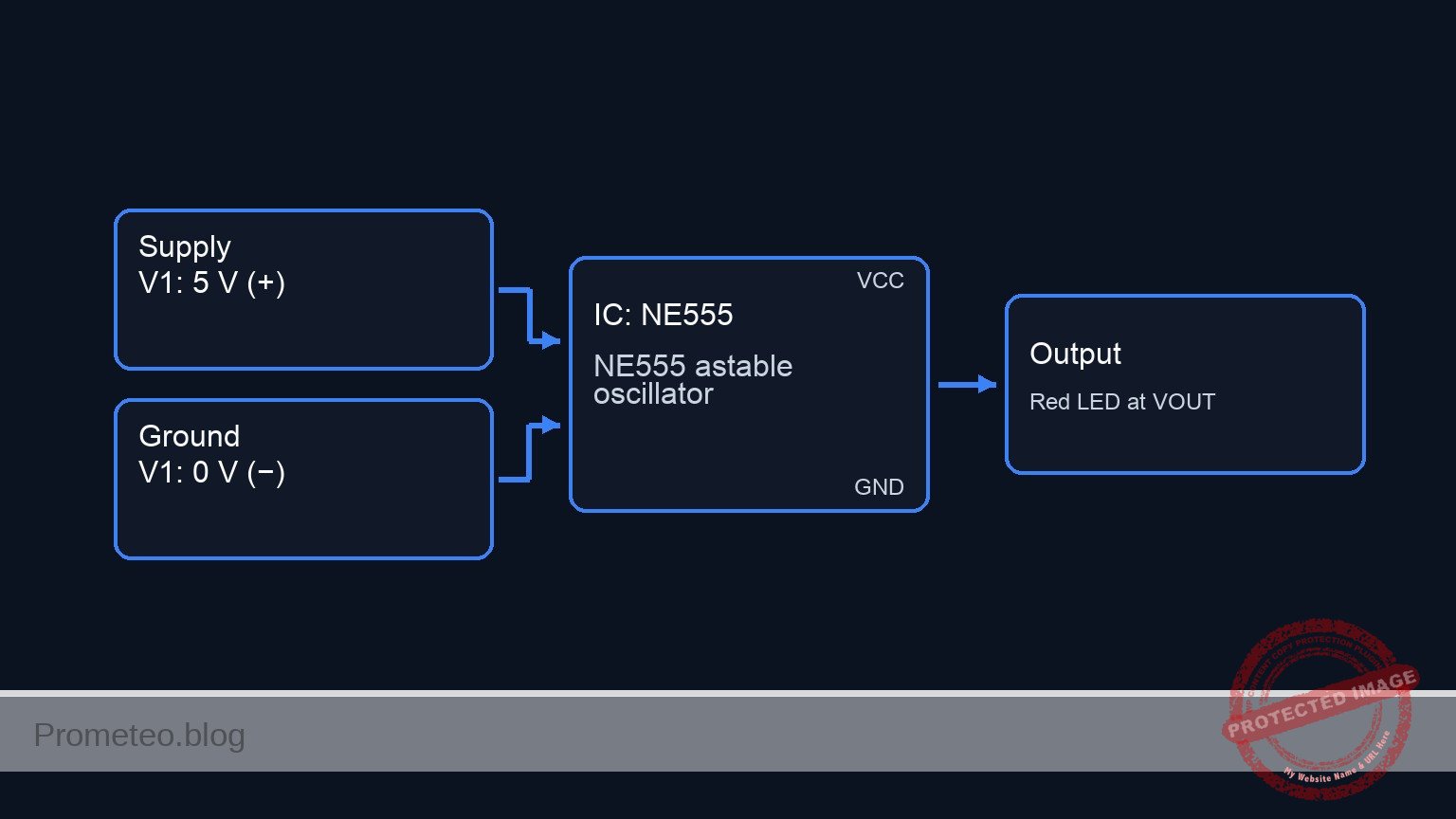
Follow me: