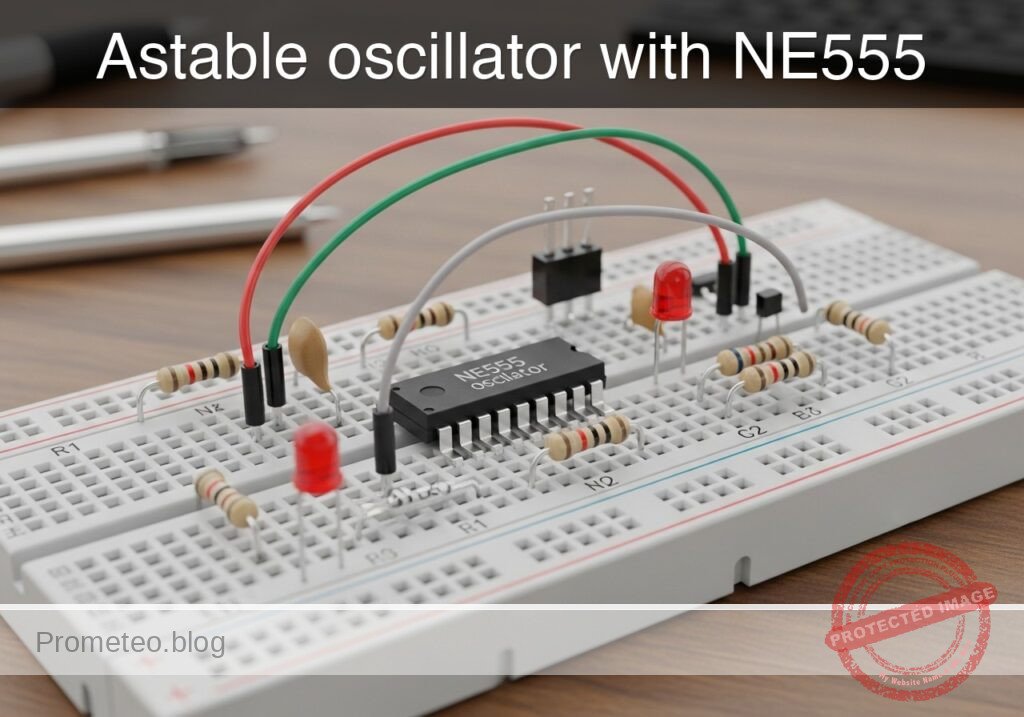
Practical case: astable oscillator with NE555

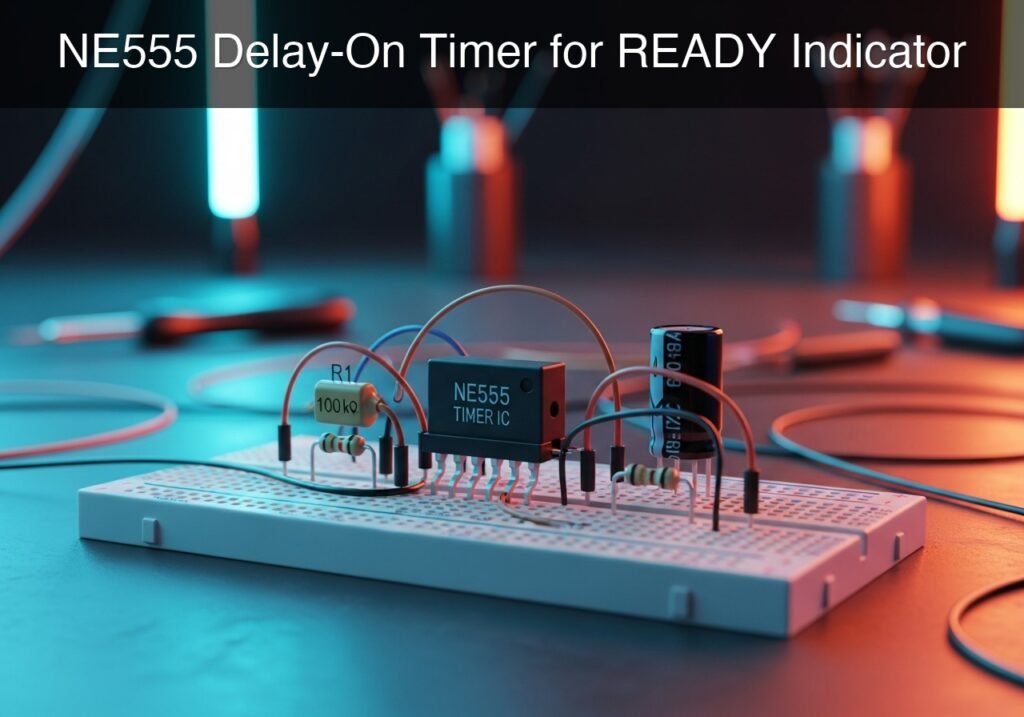
Astable oscillator with NE555 prototype (Maker Style)

Level: Basic — Build an NE555 astable timer that blinks an LED at a visible frequency.

Objective and use case

You will build a simple astable timer with an NE555 powered from 5 V. The circuit will generate a repetitive square wave that turns an LED on and off continuously.

Why it is useful:
– It demonstrates how a basic timer generates a clock signal without a microcontroller.
– It is useful as a visual blink indicator for power or system status.
– It can be used as a simple test source for checking frequency measurement tools.
– It helps students observe capacitor charge and discharge behavior in a real circuit.

Expected outcome:
VOUT switches between approximately 0 V and 5 V.
– The LED blinks at a clearly visible rate, about 1 Hz to 3 Hz.
– The timing node TH_TR shows a repeating charge/discharge waveform between about 1/3 VCC and 2/3 VCC.
– The measured period is close to the value predicted by the NE555 astable equations.
– The duty cycle is greater than 50% for the standard RA/RB astable connection.

Target audience and level: Beginners in basic electronics laboratory practice.

Materials

  • U1: NE555 timer IC, function: astable oscillator core
  • R1: 10 kΩ resistor, function: timing resistor RA from VCC to DIS
  • R2: 68 kΩ resistor, function: timing resistor RB from DIS to TH_TR
  • C1: 10 µF electrolytic capacitor, function: timing capacitor
  • C2: 10 nF capacitor, function: control-voltage noise filter on CV
  • C3: 100 nF capacitor, function: supply decoupling across VCC and GND
  • R3: 330 Ω resistor, function: LED current limiting
  • D1: red LED, function: visual output indicator
  • V1: 5 V DC supply
  • B1: breadboard, function: circuit assembly platform
  • J1: jumper wires, function: interconnections

Wiring guide

Use the node names VCC, 0, DIS, TH_TR, CV, RESET, and VOUT.

  • V1 connects between nodes VCC and 0.
  • U1 pin 8 (VCC) connects to node VCC.
  • U1 pin 1 (GND) connects to node 0.
  • U1 pin 4 (RESET) connects to node VCC.
  • U1 pin 3 (OUT) connects to node VOUT.
  • U1 pin 7 (DISCH) connects to node DIS.
  • U1 pin 2 (TRIG) connects to node TH_TR.
  • U1 pin 6 (THRESH) connects to node TH_TR.
  • U1 pin 5 (CTRL) connects to node CV.
  • R1 connects between nodes VCC and DIS.
  • R2 connects between nodes DIS and TH_TR.
  • C1 connects between nodes TH_TR and 0; if electrolytic, connect the positive lead to TH_TR and the negative lead to 0.
  • C2 connects between nodes CV and 0.
  • C3 connects between nodes VCC and 0, placed physically close to U1.
  • R3 connects between nodes VOUT and LED_A.
  • D1 connects between nodes LED_A and 0; connect the anode to LED_A and the cathode to 0.

Conceptual block diagram

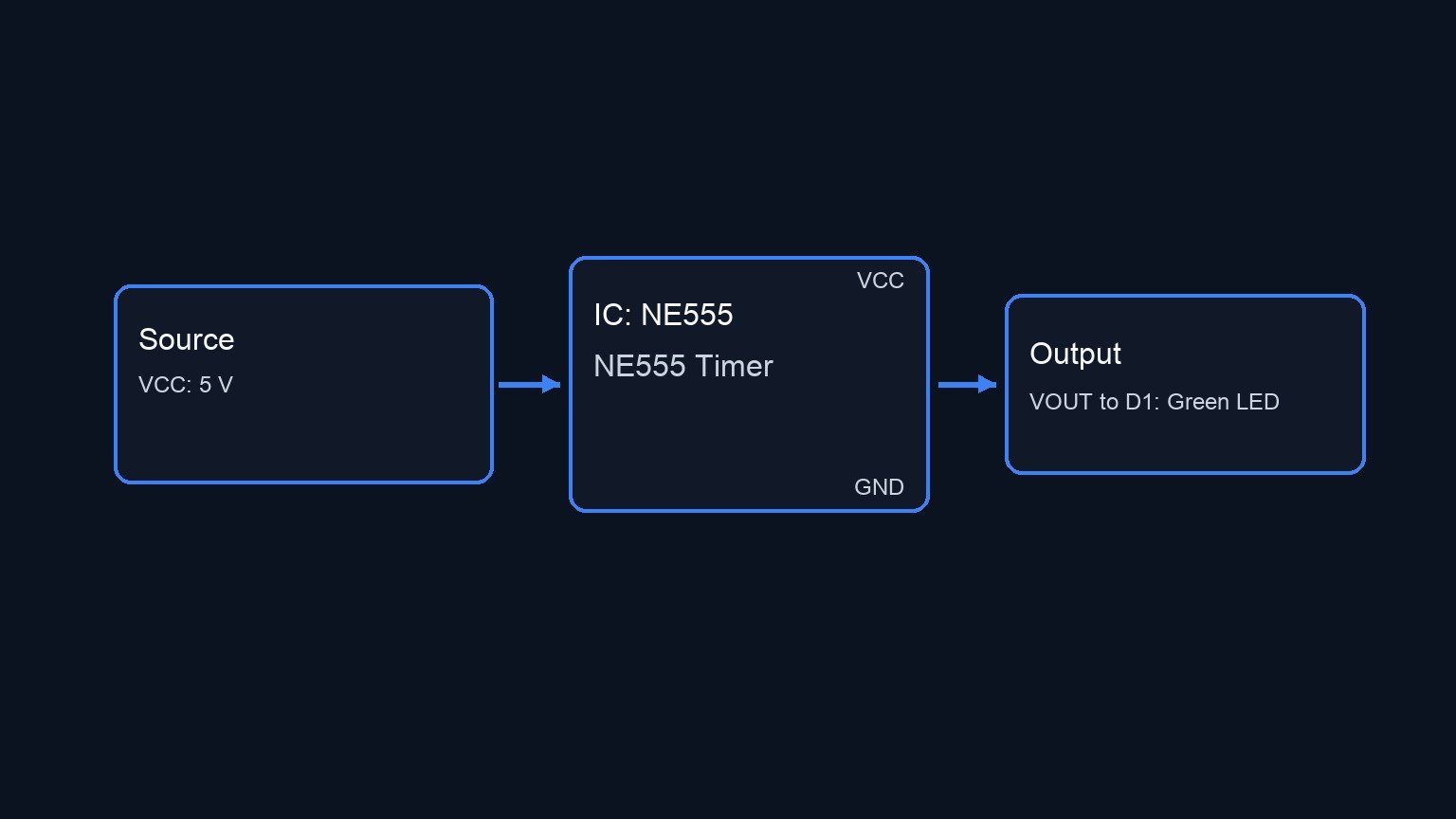
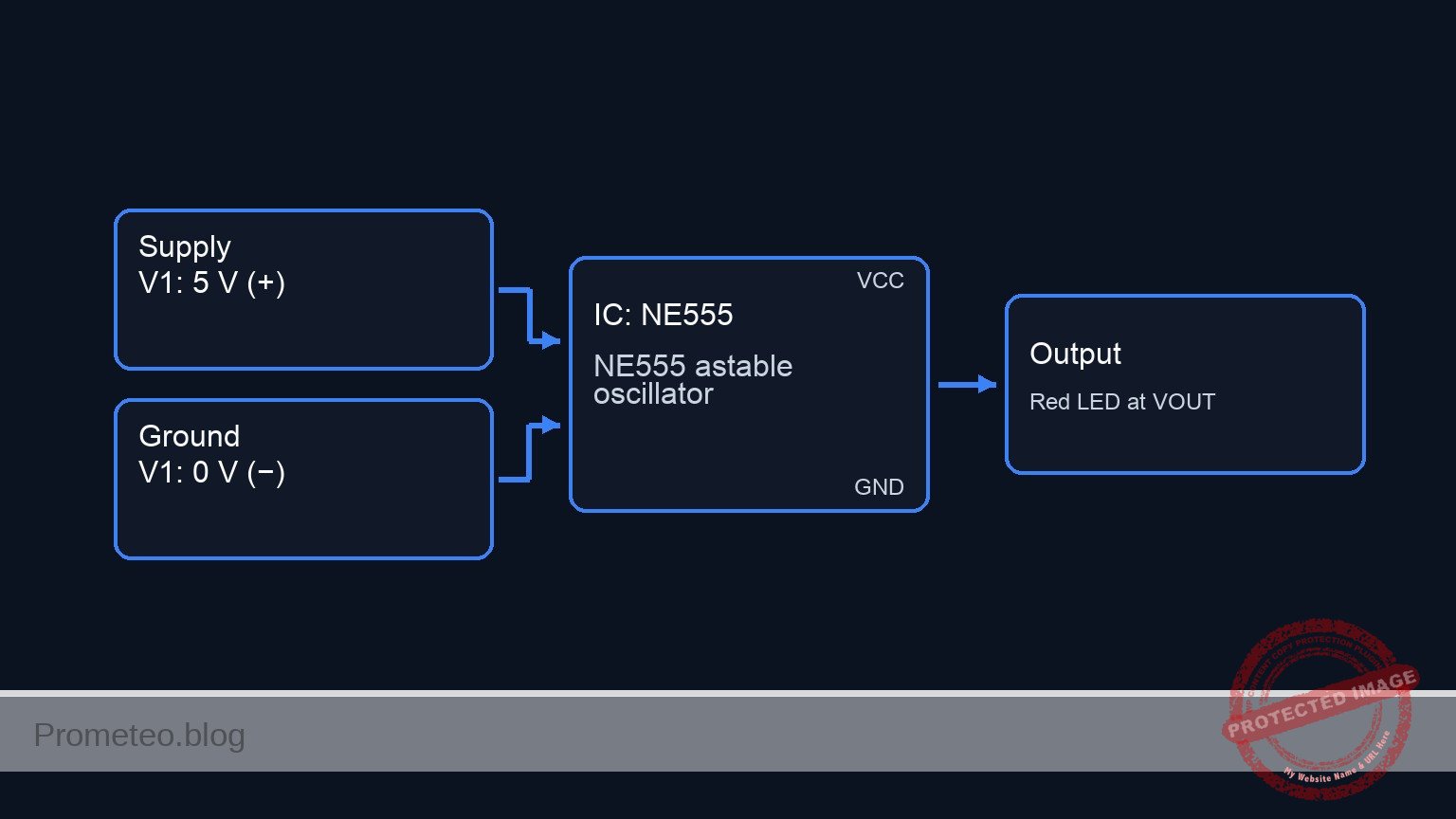
Conceptual block diagram — NE555 NE555 astable oscillator
Quick read: inputs → main block → output (actuator or measurement). This summarizes the ASCII schematic below.

Schematic

Practical case: astable oscillator with NE555

[ V1: 5 V DC ] --(+)--> [ VCC ]
[ V1: 5 V DC ] --(-)--> [ 0 ]

[ VCC ] --(pin8 supply)--> [ U1: NE555 astable core ] --(pin3 = VOUT)--> [ R3: 330 ohm ] --(LED_A)--> [ D1: Red LED ] --> [ 0 ]
[ VCC ] --(RESET to pin4)--> [ U1: NE555 astable core ]
[ VCC ] --(R1: 10 k ohm, RA)--> [ DIS / U1 pin7 ] --(R2: 68 k ohm, RB)--> [ TH_TR / U1 pins2+6 ] --(timing sense)--> [ U1: NE555 astable core ]
[ TH_TR / U1 pins2+6 ] --(C1: 10 uF, + to TH_TR, - to 0)--> [ 0 ]
[ U1 pin5 = CV ] --(C2: 10 nF noise filter to 0)--> [ 0 ]
[ VCC ] --(C3: 100 nF decoupling to 0, close to U1)--> [ 0 ]
[ U1 pin1 = GND ] --> [ 0 ]
Electrical Schematic

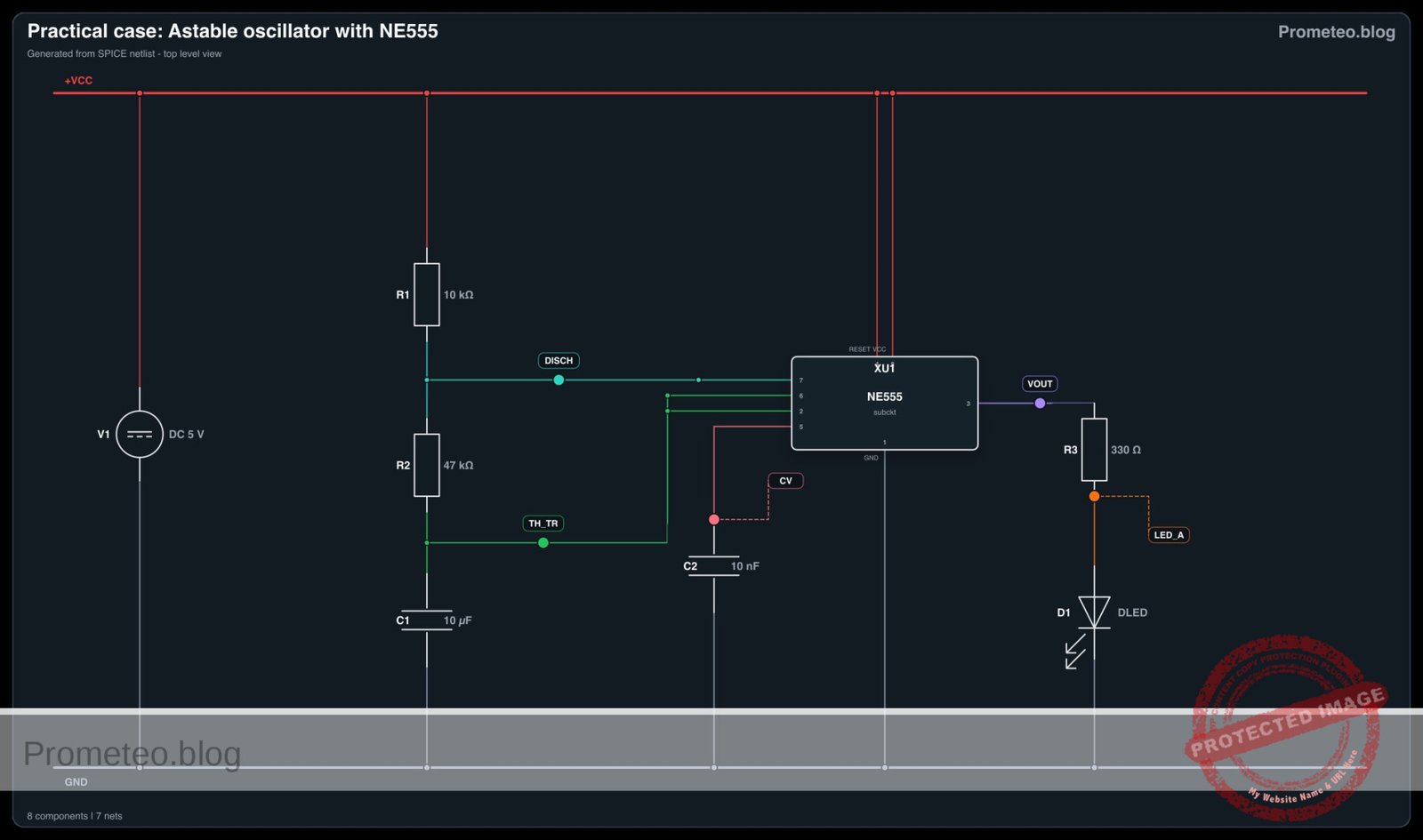
Electrical diagram

Electrical diagram for case: Practical case: astable oscillator with NE555
Generated from the validated SPICE netlist for this case.

🔒 This electrical diagram is premium. With the 7-day pass or the monthly membership you can unlock the complete didactic material and the print-ready PDF pack.🔓 See premium access plans

Measurements and tests

  1. Power-off inspection
  2. Check that U1 pin 1 goes to 0 and U1 pin 8 goes to VCC.
  3. Verify that U1 pin 2 and U1 pin 6 are linked together at TH_TR.
  4. Confirm LED polarity: anode toward R3, cathode toward 0.

  5. Initial power test

  6. Apply 5 V from V1.
  7. The LED should start blinking immediately.
  8. If the LED stays always on or always off, remove power and recheck wiring.

  9. Measure output voltage

  10. Probe VOUT with a multimeter or oscilloscope.
  11. With an oscilloscope, expect a square-like waveform from near 0 V to near 5 V.
  12. With a multimeter, the reading may show an average voltage between these limits, depending on blink speed.

  13. Measure the timing node

  14. Probe TH_TR.
  15. Expect a repeating capacitor waveform rising from about 1.67 V to 3.33 V when VCC = 5 V.
  16. This confirms the internal 1/3 VCC and 2/3 VCC thresholds of the NE555.

  17. Check the control-voltage node

  18. Probe CV.
  19. Expect a nearly steady voltage close to 2/3 VCC, around 3.3 V, with small ripple.

  20. Estimate period and frequency

  21. Use the standard astable equations:
  22. T = 0.693 x (R1 + 2R2) x C1
  23. f = 1 / T
  24. With R1 = 10 kΩ, R2 = 68 kΩ, C1 = 10 µF:
  25. T ≈ 0.693 x (10k + 136k) x 10 µF ≈ 1.01 s
  26. f ≈ 0.99 Hz
  27. Measured blinking should be close to 1 blink per second.

  28. Estimate duty cycle

  29. Use:
  30. tHIGH = 0.693 x (R1 + R2) x C1
  31. tLOW = 0.693 x R2 x C1
  32. Duty cycle ≈ tHIGH / T
  33. For these values, duty cycle is about 53%.
  34. On the oscilloscope, the high time should be slightly longer than the low time.

SPICE netlist and simulation

Reference SPICE Netlist (ngspice) — excerptFull SPICE netlist (ngspice)

* Practical case: Astable oscillator with NE555
.width out=256

* Power Supply
V1 VCC 0 DC 5

* NE555 Timer IC Subcircuit Instance
* Pins: GND TRIG OUT RESET CTRL THRES DISCH VCC_PIN
XU1 0 TH_TR VOUT VCC CV TH_TR DISCH VCC NE555

* Timing Components
R1 VCC DISCH 10k
R2 DISCH TH_TR 47k
C1 TH_TR 0 10u
C2 CV 0 10n

* Output Load (LED)
R3 VOUT LED_A 330
D1 LED_A 0 DLED

* ... (truncated in public view) ...

Copy this content into a .cir file and run with ngspice.

🔒 Part of this section is premium. With the 7-day pass or the monthly membership you can access the full content (materials, wiring, detailed build, validation, troubleshooting, variants and checklist) and download the complete print-ready PDF pack.

* Practical case: Astable oscillator with NE555
.width out=256

* Power Supply
V1 VCC 0 DC 5

* NE555 Timer IC Subcircuit Instance
* Pins: GND TRIG OUT RESET CTRL THRES DISCH VCC_PIN
XU1 0 TH_TR VOUT VCC CV TH_TR DISCH VCC NE555

* Timing Components
R1 VCC DISCH 10k
R2 DISCH TH_TR 47k
C1 TH_TR 0 10u
C2 CV 0 10n

* Output Load (LED)
R3 VOUT LED_A 330
D1 LED_A 0 DLED

* Models
.MODEL DLED D(IS=1e-19 N=1.6 RS=10 BV=5 IBV=10u)

* Behavioral NE555 Subcircuit
.SUBCKT NE555 GND TRIG OUT RESET CTRL THRES DISCH VCC_PIN
* Internal voltage divider (3 x 5k resistors)
R1 VCC_PIN CTRL 5k
R2 CTRL N1 5k
R3 N1 GND 5k

* Smooth comparators for threshold, trigger, and reset
B_COMP_TH COMP_TH GND V=0.5*(1+tanh(100*(V(THRES,GND)-V(CTRL,GND))))
B_COMP_TR COMP_TR GND V=0.5*(1+tanh(100*(V(N1,GND)-V(TRIG,GND))))
B_COMP_RST COMP_RST GND V=0.5*(1+tanh(100*(0.7-V(RESET,GND))))

* SR Latch (Integrator with positive feedback for infinite hold time)
B_LATCH GND LATCH I=V(COMP_TR,GND) - V(COMP_TH,GND) - 5*V(COMP_RST,GND) + (V(LATCH,GND)>0.5 ? 0.1 : -0.1)
C_LATCH LATCH GND 1n
R_LATCH LATCH GND 100Meg

* Latch Voltage Clamps (Clamps V(LATCH) between ~0V and ~1V)
D1 GND LATCH D_CLAMP
V_CLAMP V_CLAMP_NODE GND 1
D2 LATCH V_CLAMP_NODE D_CLAMP
.model D_CLAMP D(N=0.01 RS=1)

* Output Driver Stage
B_OUT OUT_INT GND V=V(LATCH,GND)>0.5 ? V(VCC_PIN,GND) : 0.1
R_OUT OUT_INT OUT 10

* Open-Collector Discharge Transistor (Modeled as a Switch)
B_DISCH_CTRL DISCH_CTRL GND V=V(LATCH,GND)<0.5 ? 1 : 0
S_DISCH DISCH GND DISCH_CTRL GND SW_DISCH
.model SW_DISCH SW(VT=0.5 RON=15 ROFF=100Meg)
.ENDS

* Force initial condition on timing capacitor to ensure guaranteed oscillator startup
.ic V(TH_TR)=0

* Simulation Commands
.op
.tran 1m 3
.print tran V(VOUT) V(TH_TR) V(DISCH) V(LED_A) V(CV)

Simulation Results (Transient Analysis)

Simulation Results (Transient Analysis)
Analysis: The transient analysis spans 0 s to 3 s. Main ranges: v(vout) 100 mV -> 4.9 V; v(disch) 8.02 mV -> 4.71 V; v(th_tr) 0 uV -> 3.32 V.
Show raw data table (3013 rows)
Index   time            v(vout)         v(th_tr)        v(disch)        v(led_a)        v(cv)
0	0.000000e+00	4.903386e+00	0.000000e+00	4.122467e+00	1.715117e+00	3.333333e+00
1	1.000000e-05	4.903386e+00	8.771053e-05	4.122482e+00	1.715117e+00	3.333333e+00
2	2.000000e-05	4.903386e+00	1.754195e-04	4.122498e+00	1.715117e+00	3.333333e+00
3	4.000000e-05	4.903386e+00	3.508344e-04	4.122529e+00	1.715117e+00	3.333333e+00
4	8.000000e-05	4.903386e+00	7.016457e-04	4.122590e+00	1.715117e+00	3.333333e+00
5	1.600000e-04	4.903386e+00	1.403195e-03	4.122713e+00	1.715117e+00	3.333333e+00
6	3.200000e-04	4.903386e+00	2.805997e-03	4.122959e+00	1.715117e+00	3.333333e+00
7	6.400000e-04	4.903386e+00	5.610420e-03	4.123451e+00	1.715117e+00	3.333333e+00
8	1.280000e-03	4.903386e+00	1.121455e-02	4.124434e+00	1.715117e+00	3.333333e+00
9	2.280000e-03	4.903386e+00	1.995841e-02	4.125968e+00	1.715117e+00	3.333333e+00
10	3.280000e-03	4.903386e+00	2.868694e-02	4.127499e+00	1.715117e+00	3.333333e+00
11	4.280000e-03	4.903386e+00	3.740018e-02	4.129028e+00	1.715117e+00	3.333333e+00
12	5.280000e-03	4.903386e+00	4.609814e-02	4.130554e+00	1.715117e+00	3.333333e+00
13	6.280000e-03	4.903386e+00	5.478085e-02	4.132077e+00	1.715117e+00	3.333333e+00
14	7.280000e-03	4.903386e+00	6.344835e-02	4.133597e+00	1.715117e+00	3.333333e+00
15	8.280000e-03	4.903386e+00	7.210065e-02	4.135115e+00	1.715117e+00	3.333333e+00
16	9.280000e-03	4.903386e+00	8.073778e-02	4.136630e+00	1.715117e+00	3.333333e+00
17	1.028000e-02	4.903386e+00	8.935978e-02	4.138143e+00	1.715117e+00	3.333333e+00
18	1.128000e-02	4.903386e+00	9.796666e-02	4.139653e+00	1.715117e+00	3.333333e+00
19	1.228000e-02	4.903386e+00	1.065585e-01	4.141160e+00	1.715117e+00	3.333333e+00
20	1.328000e-02	4.903386e+00	1.151352e-01	4.142665e+00	1.715117e+00	3.333333e+00
21	1.428000e-02	4.903386e+00	1.236969e-01	4.144166e+00	1.715117e+00	3.333333e+00
22	1.528000e-02	4.903386e+00	1.322436e-01	4.145666e+00	1.715117e+00	3.333333e+00
23	1.628000e-02	4.903386e+00	1.407753e-01	4.147162e+00	1.715117e+00	3.333333e+00
... (2989 more rows) ...

Common mistakes and how to avoid them

  1. Reversing the electrolytic capacitor
  2. Error: C1 installed with wrong polarity.
  3. Fix: connect the positive terminal of C1 to TH_TR and the negative terminal to 0.

  4. Wrong NE555 pin placement on the breadboard

  5. Error: pin numbering mirrored or shifted.
  6. Fix: identify the notch or dot on the IC and count pins correctly before wiring.

  7. Forgetting supply decoupling

  8. Error: omitting C3 causes unstable behavior or irregular blinking.
  9. Fix: place C3 = 100 nF directly between U1 pin 8 and U1 pin 1.

Troubleshooting

  • Symptom: LED does not light at all
  • Cause: no 5 V supply, wrong LED polarity, or open resistor path.
  • Fix: verify VCC, check D1 orientation, and confirm continuity from VOUT through R3 to D1.

  • Symptom: LED stays permanently on

  • Cause: TH_TR not connected correctly, DIS wiring error, or R2 misplaced.
  • Fix: check that R2 is between DIS and TH_TR, and that pins 2 and 6 are tied together.

  • Symptom: LED stays permanently off

  • Cause: RESET not tied high or output shorted.
  • Fix: connect U1 pin 4 directly to VCC and inspect VOUT for accidental grounding.

  • Symptom: Blink rate is much too fast or too slow

  • Cause: wrong resistor value or wrong capacitor value.
  • Fix: measure R1, R2, and C1; replace parts with the intended values.

  • Symptom: Irregular or noisy waveform

  • Cause: poor breadboard contacts or missing C2/C3.
  • Fix: reseat the IC, shorten wiring, and install the bypass capacitors.

Possible improvements and extensions

  • Add a frequency control
  • Replace R2 with a series combination of a fixed resistor and a potentiometer to adjust the blink rate.

  • Drive a buzzer or second indicator

  • Use VOUT to control a transistor stage so the timer can flash a brighter LED or pulse a small buzzer.

More Practical Cases on Prometeo.blog

Find this product and/or books on this topic on Amazon

Go to Amazon

As an Amazon Associate, I earn from qualifying purchases. If you buy through this link, you help keep this project running.

Quick Quiz

Question 1: What is the main IC used to build the blinking circuit?


Question 2: What supply voltage is used for the astable timer in the article?


Question 3: What is the expected LED blink rate?


Question 4: In the standard NE555 astable connection, the duty cycle is expected to be


Question 5: What voltage range does VOUT switch between approximately?


Question 6: What does the circuit generate continuously?


Question 7: What is one practical use of this circuit?


Question 8: What waveform behavior is expected at the TH_TR timing node?


Question 9: Why is this circuit useful for checking instruments?


Question 10: Why is this project helpful for beginners?


Carlos Núñez Zorrilla
Electronics & Computer Engineer

Telecommunications Electronics Engineer and Computer Engineer (official degrees in Spain).
Follow me:


Practical case: One-Shot Timer Using NE555

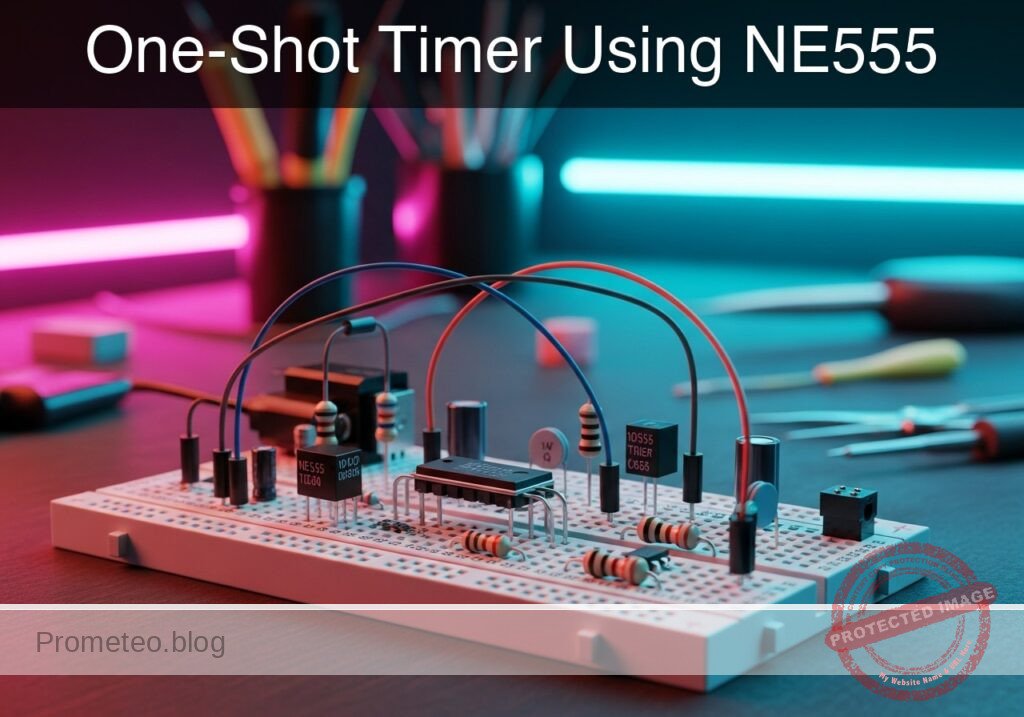
One-Shot Timer Using NE555 prototype (Maker Style)

Level: Basic – Build a monostable timer circuit using the NE555 IC to control an LED output for a set duration.

Objective and use case

In this practical case, you will build a monostable multivibrator (one-shot timer) using the classic NE555 IC. A mechanical push-button will trigger the circuit to illuminate an LED for a specific, predetermined amount of time based on a resistor-capacitor (RC) network.

This circuit is highly useful in real-world applications:
* Debouncing mechanical switches and push-buttons for digital microcontrollers.
* Creating timed light switches for hallways, staircases, or closets.
* Generating precise delays for industrial and automated dispensing systems.
* Providing a fixed-width pulse for alarm triggers or motor control logic.

Expected outcome:
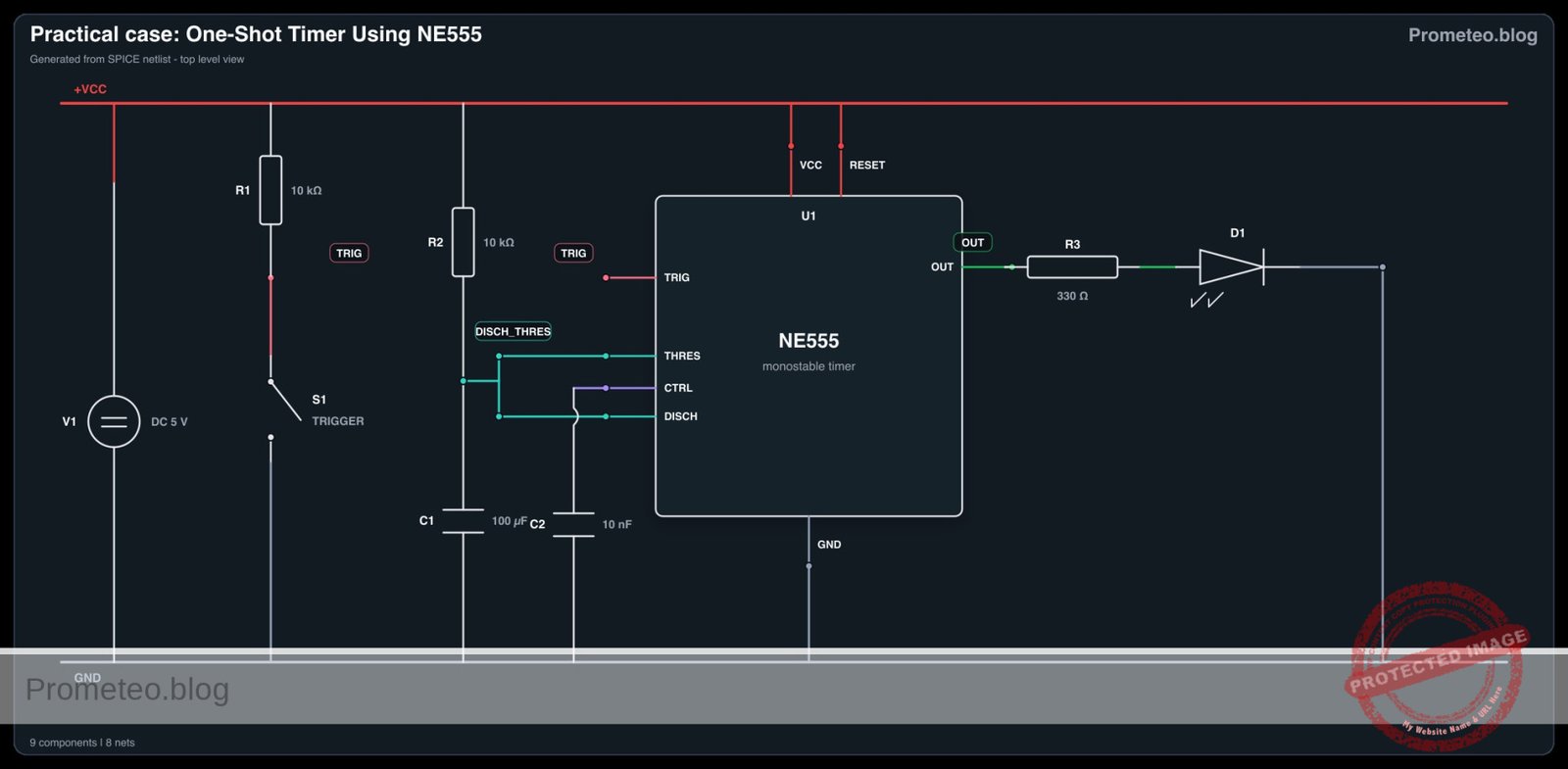
* The LED remains completely OFF when the circuit is in its idle state.
* Pressing the trigger button causes the output to immediately go HIGH (approx. 5 V), turning on the LED.
* The LED stays illuminated for approximately 1.1 seconds before turning OFF automatically.
* The voltage across the timing capacitor will exponentially charge to 3.33 V (2/3 of VCC) before the output resets to LOW.

Target audience and level: Beginners in electronics learning about timing concepts, RC networks, and the 555 timer.

Materials

  • V1: 5 V DC supply
  • U1: NE555 timer IC, function: monostable controller
  • R1: 10 kΩ resistor, function: pull-up for the trigger pin
  • R2: 10 kΩ resistor, function: timing resistor (RT)
  • R3: 330 Ω resistor, function: LED current limiting
  • C1: 100 µF electrolytic capacitor, function: timing capacitor (CT)
  • C2: 10 nF ceramic capacitor, function: control voltage stabilization
  • S1: Normally Open (NO) push-button, function: trigger input
  • D1: Red LED, function: output indicator

Wiring guide

  • V1 connects between VCC and 0 (GND).
  • U1 Pin 1 (GND) connects to 0.
  • U1 Pin 8 (VCC) connects to VCC.
  • R1 connects between VCC and TRIG.
  • S1 connects between TRIG and 0.
  • U1 Pin 2 (Trigger) connects to TRIG.
  • R2 connects between VCC and DISCH_THRES.
  • C1 connects between DISCH_THRES (positive lead) and 0 (negative lead).
  • U1 Pin 6 (Threshold) connects to DISCH_THRES.
  • U1 Pin 7 (Discharge) connects to DISCH_THRES.
  • U1 Pin 4 (Reset) connects to VCC.
  • C2 connects between CTRL and 0.
  • U1 Pin 5 (Control Voltage) connects to CTRL.
  • R3 connects between OUT and NODE_LED.
  • D1 connects between NODE_LED (anode) and 0 (cathode).
  • U1 Pin 3 (Output) connects to OUT.

Conceptual block diagram

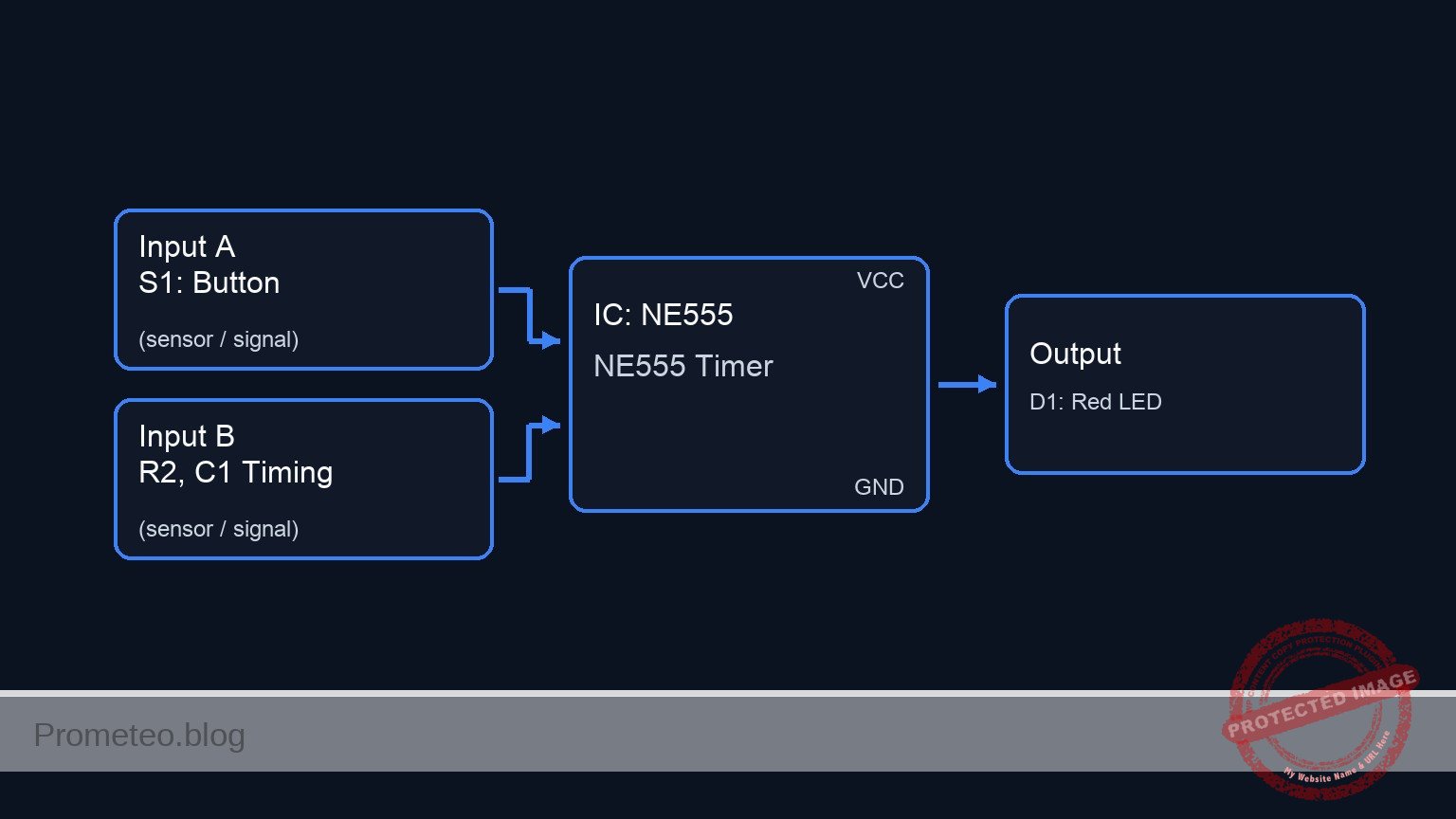
Conceptual block diagram — NE555 NE555 Timer
Quick read: inputs → main block → output (actuator or measurement). This summarizes the ASCII schematic below.

Schematic

[ U1: NE555 Timer ]
VCC -----------------------------------------> [ Pin 8: VCC      ]
                                               [                 ]
VCC --> [ R1: 10 kΩ ] --(TRIG)----------------> [ Pin 2: Trigger  ]
                          |                    [                 ]
                     [ S1: Button ]            [                 ]
                          |                    [                 ]
                         GND                   [                 ]
                                               [                 ]
VCC --> [ R2: 10 kΩ ] --(DISCH_THRES)---------> [ Pin 6: Thres    ] --(Pin 3: OUT)--> [ R3: 330 Ω ] --> [ D1: Red LED ] --> GND
                          |                    [ Pin 7: Disch    ]
                     [ C1: 100µF ]             [                 ]
                          |                    [                 ]
                         GND                   [                 ]
                                               [                 ]
VCC -----------------------------------------> [ Pin 4: Reset    ]
                                               [                 ]
                                               [ Pin 5: Control  ] --(CTRL)--> [ C2: 10nF ] --> GND
                                               [                 ]
GND -----------------------------------------> [ Pin 1: GND      ]
Electrical Schematic

Electrical diagram

Electrical diagram for case: Practical case: One-Shot Timer Using NE555
Generated from the validated SPICE netlist for this case.

🔒 This electrical diagram is premium. With the 7-day pass or the monthly membership you can unlock the complete didactic material and the print-ready PDF pack.🔓 See premium access plans

Measurements and tests

  1. Standby Validation: Before pressing the button, use a multimeter to measure the voltage at node TRIG. It should read 5 V due to the pull-up resistor. The voltage at node OUT should be 0 V.
  2. Trigger Observation: Press S1 and measure TRIG momentarily dropping to 0 V.
  3. Output Behavior: Connect your multimeter or oscilloscope to node OUT. Press the button and verify the voltage jumps to ~5 V, stays high, and returns to 0 V automatically.
  4. Capacitor Charging Curve: Connect a probe to node DISCH_THRES. Observe the voltage charging from 0 V up to ~3.33 V (which is 2/3 of VCC) immediately after the trigger is pressed. Once it hits this threshold, the voltage should sharply drop back to 0 V.
  5. Timing Verification: Use a stopwatch or oscilloscope to measure the ON duration. Verify that it matches the theoretical formula: T = 1.1 × R2 × C1 (1.1 × 10,000 Ω × 0.0001 F ≈ 1.1 seconds).

SPICE netlist and simulation

Reference SPICE Netlist (ngspice) — excerptFull SPICE netlist (ngspice)

* One-Shot Timer Using NE555
.width out=256

* Power Supply
V1 VCC 0 DC 5

* Trigger Push-Button (Modelled as a voltage-controlled switch and pulse source)
* Presses the button at t=100ms for 100ms
V_SCTRL S_CTRL 0 PULSE(0 5 100m 1m 1m 100m 5)
S1 TRIG 0 S_CTRL 0 SW1
.model SW1 SW(Vt=2.5 Ron=1 Roff=100Meg)

* Pull-up for Trigger
R1 VCC TRIG 10k

* Timing Components (10k and 100uF -> ~1.1s pulse)
R2 VCC DISCH_THRES 10k
C1 DISCH_THRES 0 100u

* Control Voltage Stabilization
* ... (truncated in public view) ...

Copy this content into a .cir file and run with ngspice.

🔒 Part of this section is premium. With the 7-day pass or the monthly membership you can access the full content (materials, wiring, detailed build, validation, troubleshooting, variants and checklist) and download the complete print-ready PDF pack.

* One-Shot Timer Using NE555
.width out=256

* Power Supply
V1 VCC 0 DC 5

* Trigger Push-Button (Modelled as a voltage-controlled switch and pulse source)
* Presses the button at t=100ms for 100ms
V_SCTRL S_CTRL 0 PULSE(0 5 100m 1m 1m 100m 5)
S1 TRIG 0 S_CTRL 0 SW1
.model SW1 SW(Vt=2.5 Ron=1 Roff=100Meg)

* Pull-up for Trigger
R1 VCC TRIG 10k

* Timing Components (10k and 100uF -> ~1.1s pulse)
R2 VCC DISCH_THRES 10k
C1 DISCH_THRES 0 100u

* Control Voltage Stabilization
C2 CTRL 0 10n

* Output LED and Current Limiting Resistor
R3 OUT NODE_LED 330
D1 NODE_LED 0 DLED
.model DLED D(IS=1e-15 N=2.0 RS=10)

* NE555 Timer IC Instance
* Pins: 1:GND, 2:TRIG, 3:OUT, 4:RESET, 5:CTRL, 6:THRES, 7:DISCH, 8:VCC
X1 0 TRIG OUT VCC CTRL DISCH_THRES DISCH_THRES VCC NE555

* Dummy IN node to satisfy print requirements
V_IN IN TRIG 0
R_IN IN 0 1G

* Functional NE555 subcircuit (Behavioral)
.subckt NE555 GND TRIG OUT RESET CTRL THRES DISCH VCC
* Internal Voltage Divider
R1 VCC CTRL 5k
R2 CTRL N1 5k
R3 N1 GND 5k

* SR Latch Logic (Reset > Trigger > Threshold)
B1 LATCH_IN GND V= V(RESET, GND)<1.0 ? 0 : ( V(TRIG, GND)V(CTRL, GND) ? 0 : V(Q_delay, GND) ) )

* Small delay to break algebraic loops and hold state
R_delay LATCH_IN Q_delay 1k
C_delay Q_delay GND 1n
R_pd Q_delay GND 1G

* Output Stage
B2 OUT_INT GND V= V(Q_delay, GND)>0.5 ? V(VCC, GND) : 0.1
R_OUT OUT_INT OUT 10

* Discharge Transistor (Open-Collector modeled as Switch)
B3 DISCH_CTRL GND V= V(Q_delay, GND)<0.5 ? 1 : 0
R_DC DISCH_CTRL GND 1G
S1 DISCH GND DISCH_CTRL GND S_DISCH
.model S_DISCH SW(Vt=0.5 Ron=10 Roff=100Meg)
.ends

.op
.tran 1m 2s
.print tran V(IN) V(OUT) V(TRIG) V(DISCH_THRES) V(CTRL) V(NODE_LED) V(S_CTRL) V(VCC)
.end

Simulation Results (Transient Analysis)

Simulation Results (Transient Analysis)
Analysis: The simulation shows the trigger signal dropping low at t=100ms, which causes the output to go high (~4.9V) and the LED node voltage to rise (~1.65V). The discharge threshold voltage then charges up to ~2.74V (which is slightly below 2/3 VCC, but the output drops back low at ~895ms). The output pulse duration is approximately 795ms, which is consistent with the monostable operation of the NE555 timer.
Show raw data table (2054 rows)
Index   time            v(in)           v(out)          v(trig)         v(disch_thres)  v(ctrl)         v(node_led)     v(s_ctrl)       v(vcc)
0	0.000000e+00	4.999450e+00	1.000000e-01	4.999450e+00	4.995005e-03	3.333333e+00	1.000000e-01	0.000000e+00	5.000000e+00
1	1.000000e-05	4.999450e+00	1.000000e-01	4.999450e+00	4.995005e-03	3.333333e+00	1.000000e-01	0.000000e+00	5.000000e+00
2	2.000000e-05	4.999450e+00	1.000000e-01	4.999450e+00	4.995005e-03	3.333333e+00	1.000000e-01	0.000000e+00	5.000000e+00
3	4.000000e-05	4.999450e+00	1.000000e-01	4.999450e+00	4.995005e-03	3.333333e+00	1.000000e-01	0.000000e+00	5.000000e+00
4	8.000000e-05	4.999450e+00	1.000000e-01	4.999450e+00	4.995005e-03	3.333333e+00	1.000000e-01	0.000000e+00	5.000000e+00
5	1.600000e-04	4.999450e+00	1.000000e-01	4.999450e+00	4.995005e-03	3.333333e+00	1.000000e-01	0.000000e+00	5.000000e+00
6	3.200000e-04	4.999450e+00	1.000000e-01	4.999450e+00	4.995005e-03	3.333333e+00	1.000000e-01	0.000000e+00	5.000000e+00
7	6.400000e-04	4.999450e+00	1.000000e-01	4.999450e+00	4.995005e-03	3.333333e+00	1.000000e-01	0.000000e+00	5.000000e+00
8	1.280000e-03	4.999450e+00	1.000000e-01	4.999450e+00	4.995005e-03	3.333333e+00	1.000000e-01	0.000000e+00	5.000000e+00
9	2.280000e-03	4.999450e+00	1.000000e-01	4.999450e+00	4.995005e-03	3.333333e+00	1.000000e-01	0.000000e+00	5.000000e+00
10	3.280000e-03	4.999450e+00	1.000000e-01	4.999450e+00	4.995005e-03	3.333333e+00	1.000000e-01	0.000000e+00	5.000000e+00
11	4.280000e-03	4.999450e+00	1.000000e-01	4.999450e+00	4.995005e-03	3.333333e+00	1.000000e-01	0.000000e+00	5.000000e+00
12	5.280000e-03	4.999450e+00	1.000000e-01	4.999450e+00	4.995005e-03	3.333333e+00	1.000000e-01	0.000000e+00	5.000000e+00
13	6.280000e-03	4.999450e+00	1.000000e-01	4.999450e+00	4.995005e-03	3.333333e+00	1.000000e-01	0.000000e+00	5.000000e+00
14	7.280000e-03	4.999450e+00	1.000000e-01	4.999450e+00	4.995005e-03	3.333333e+00	1.000000e-01	0.000000e+00	5.000000e+00
15	8.280000e-03	4.999450e+00	1.000000e-01	4.999450e+00	4.995005e-03	3.333333e+00	1.000000e-01	0.000000e+00	5.000000e+00
16	9.280000e-03	4.999450e+00	1.000000e-01	4.999450e+00	4.995005e-03	3.333333e+00	1.000000e-01	0.000000e+00	5.000000e+00
17	1.028000e-02	4.999450e+00	1.000000e-01	4.999450e+00	4.995005e-03	3.333333e+00	1.000000e-01	0.000000e+00	5.000000e+00
18	1.128000e-02	4.999450e+00	1.000000e-01	4.999450e+00	4.995005e-03	3.333333e+00	1.000000e-01	0.000000e+00	5.000000e+00
19	1.228000e-02	4.999450e+00	1.000000e-01	4.999450e+00	4.995005e-03	3.333333e+00	1.000000e-01	0.000000e+00	5.000000e+00
20	1.328000e-02	4.999450e+00	1.000000e-01	4.999450e+00	4.995005e-03	3.333333e+00	1.000000e-01	0.000000e+00	5.000000e+00
21	1.428000e-02	4.999450e+00	1.000000e-01	4.999450e+00	4.995005e-03	3.333333e+00	1.000000e-01	0.000000e+00	5.000000e+00
22	1.528000e-02	4.999450e+00	1.000000e-01	4.999450e+00	4.995005e-03	3.333333e+00	1.000000e-01	0.000000e+00	5.000000e+00
23	1.628000e-02	4.999450e+00	1.000000e-01	4.999450e+00	4.995005e-03	3.333333e+00	1.000000e-01	0.000000e+00	5.000000e+00
... (2030 more rows) ...

Common mistakes and how to avoid them

  • Leaving the Reset pin (Pin 4) floating: A floating reset pin can act as an antenna, picking up noise and causing erratic resetting of the timer. Always tie Pin 4 to VCC when not actively using the reset functionality.
  • Reversing the electrolytic capacitor polarity: Placing C1 backward will prevent it from charging correctly, alter the timing, and potentially damage the capacitor. Always ensure the negative stripe is connected to 0 (GND).
  • Omitting the pull-up resistor on the trigger: If R1 is left out, Pin 2 will float, causing the 555 timer to trigger randomly from ambient electrical noise. Ensure R1 is in place to hold the pin solidly at HIGH when idle.

Troubleshooting

  • Symptom: The LED stays ON indefinitely.
    • Cause: The trigger pin (TRIG) is held LOW continuously, either because the push-button is stuck or wired incorrectly, or the trigger pulse is longer than the set RC timing.
    • Fix: Disconnect the button temporarily to check if the LED turns off. Ensure S1 is wired properly and only briefly pulls TRIG to ground.
  • Symptom: The LED never turns on when the button is pressed.
    • Cause: Pin 4 (Reset) is incorrectly connected to ground, the LED is inserted backward, or the NE555 IC lacks power.
    • Fix: Verify that VCC is 5 V, Pin 4 is tied to VCC, and check the orientation of D1 (anode toward R3, cathode to ground).
  • Symptom: Timer duration is much shorter or longer than 1.1 seconds.
    • Cause: Using a faulty, leaky electrolytic capacitor, or substituting incorrect values for R2 or C1.
    • Fix: Check component codes. Remember that electrolytic capacitors often have a wide tolerance (±20%). Measure R2 with a multimeter to confirm it is 10 kΩ.
  • Symptom: The circuit re-triggers continuously by itself.
    • Cause: Missing decoupling capacitor on the control voltage pin, allowing internal noise to cross the comparative thresholds.
    • Fix: Ensure the 10 nF capacitor (C2) is securely connected between Pin 5 and ground to stabilize the internal voltage divider.

Possible improvements and extensions

  • Adjustable Timer: Replace R2 with a 1 kΩ fixed resistor in series with a 100 kΩ potentiometer. This modification allows you to manually sweep the timing duration from roughly 0.1 seconds to 11 seconds.
  • High-Power Load Control: Replace the LED and current-limiting resistor with an NPN transistor or an N-channel MOSFET at node OUT to drive heavier loads, such as a 5 V relay, a DC motor, or a high-brightness lamp.

More Practical Cases on Prometeo.blog

Find this product and/or books on this topic on Amazon

Go to Amazon

As an Amazon Associate, I earn from qualifying purchases. If you buy through this link, you help keep this project running.

Quick Quiz

Question 1: What is the primary function of the NE555 IC in this circuit?


Question 2: What happens to the LED when the circuit is in its idle state?


Question 3: How long does the LED stay illuminated after the trigger button is pressed?


Question 4: What is the voltage across the timing capacitor just before the output resets to LOW?


Question 5: What determines the specific amount of time the LED remains illuminated?


Question 6: What happens to the output immediately after pressing the trigger button?


Question 7: Which of the following is listed as a real-world application for this circuit?


Question 8: Which of the following is another mentioned use case for this circuit?


Question 9: What fraction of VCC does the timing capacitor charge to before the output resets?


Question 10: What type of pulse does this circuit provide for alarm triggers or motor control logic?


Carlos Núñez Zorrilla
Electronics & Computer Engineer

Telecommunications Electronics Engineer and Computer Engineer (official degrees in Spain).
Follow me: