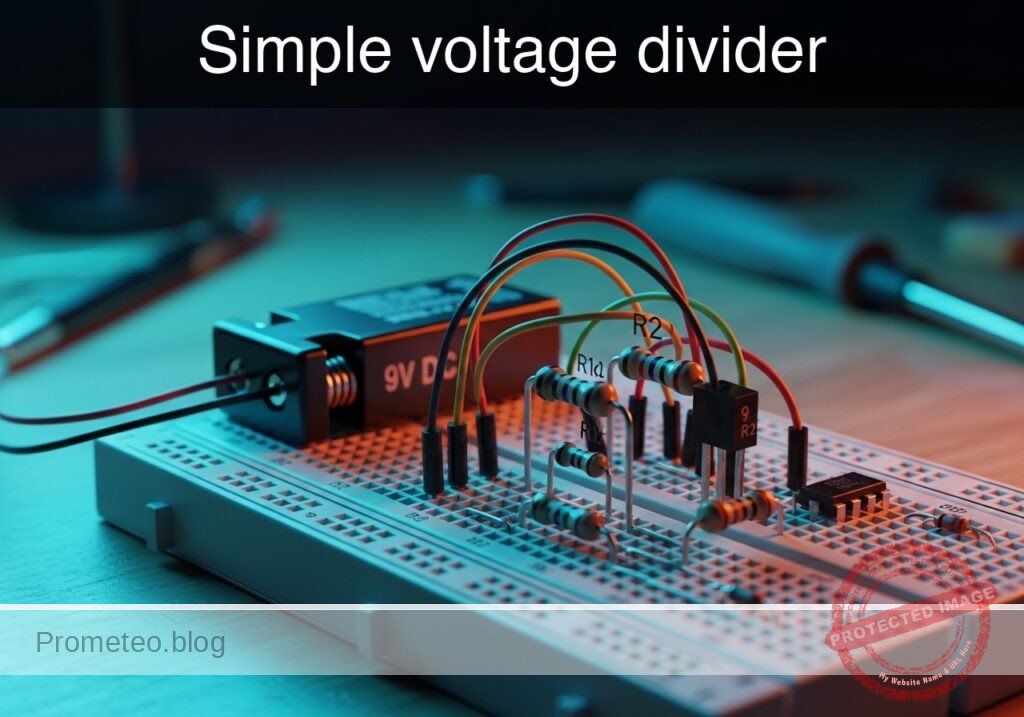
Level: Basic. Demonstrate how two resistors in series divide the input voltage into predictable proportions.
Objective and use case
In this practical case, you will build a fundamental circuit that uses two resistors in series to reduce a higher DC source voltage to a specific lower voltage level.
-
Why it is useful:
- Sensor interfacing: Adapts high-voltage sensors (e.g., 12 V automotive sensors) to low-voltage microcontrollers (e.g., 3.3 V or 5 V logic).
- Biasing: Provides stable reference voltages for transistor bases or operational amplifier inputs.
- Level shifting: Simple method to step down signal levels between different circuit stages.
-
Expected outcome:
- Input Voltage (Vin): Measured at the full 9 V supply.
- Output Voltage (Vout): Measured at the junction between the resistors; expecting exactly 4.5 V (50% of input).
- Current: A small, safe current flows continuously from the source to ground through the series path.
- Ratio verification: The output voltage follows the formula Vout = Vin × (R2 / (R1 + R2)).
-
Target audience and level: Students starting with Ohm’s Law and Series Circuits (Level: Basic).
Materials
- V1: 9 V DC voltage source (battery or power supply).
- R1: 10 kΩ resistor, function: high-side element (drops half the voltage).
- R2: 10 kΩ resistor, function: low-side element (measurement resistor).
- M1: Digital Multimeter (Voltmeter mode), function: measurement tool.
Wiring guide
Construct the circuit using the following node connections. Ensure the power supply is turned off while assembling components.
- V1: Connect the positive terminal to node
VCCand the negative terminal to node0(GND). - R1: Connect between node
VCCand nodeVOUT. - R2: Connect between node
VOUTand node0(GND).
Conceptual block diagram

Schematic
[ INPUT ]                    [ PROCESSING ]                    [ OUTPUT ]

 [ 9V Source (V1) ] --(VCC)--> [ R1: High-Side 10k ] --(VOUT)--> [ Multimeter (M1) ]
                                          |
                                          v
                                 [ R2: Low-Side 10k ]
                                          |
                                          v
                                    [ Node 0 (GND) ]
Measurements and tests
Perform the following steps to validate the circuit behavior.
- Set up the Multimeter: Switch your multimeter to DC Voltage mode (20 V range or auto-range).
- Measure Input (Vin): Place the red probe on node
VCCand the black probe on node0. Verify the reading is approximately 9 V. - Measure Output (Vout): Place the red probe on node
VOUT(the junction between R1 and R2) and the black probe on node0. - Validate Result: The reading should be approximately 4.5 V.
- Calculation: Vout = 9V × (10kΩ / (10kΩ + 10kΩ)) = 9V × 0.5 = 4.5V.
SPICE netlist and simulation
Reference SPICE Netlist (ngspice) — excerptFull SPICE netlist (ngspice)
* Title: Simple voltage divider

* --- Power Supply ---
* V1: 9 V DC voltage source
* Connected positive to VCC, negative to 0 (GND)
V1 VCC 0 DC 9

* --- Components ---
* R1: 10 kOhm resistor (High-side)
* Connected between VCC and VOUT
R1 VCC VOUT 10k

* R2: 10 kOhm resistor (Low-side)
* Connected between VOUT and 0 (GND)
R2 VOUT 0 10k

* M1: Digital Multimeter (Voltmeter mode)
* Function: Measurement tool across R2 (VOUT to GND)
* Modeled as a high-impedance resistor (10 MegOhm) to represent input impedance
R_M1 VOUT 0 10Meg
* ... (truncated in public view) ...
Copy this content into a .cir file and run with ngspice.
* Title: Simple voltage divider

* --- Power Supply ---
* V1: 9 V DC voltage source
* Connected positive to VCC, negative to 0 (GND)
V1 VCC 0 DC 9

* --- Components ---
* R1: 10 kOhm resistor (High-side)
* Connected between VCC and VOUT
R1 VCC VOUT 10k

* R2: 10 kOhm resistor (Low-side)
* Connected between VOUT and 0 (GND)
R2 VOUT 0 10k

* M1: Digital Multimeter (Voltmeter mode)
* Function: Measurement tool across R2 (VOUT to GND)
* Modeled as a high-impedance resistor (10 MegOhm) to represent input impedance
R_M1 VOUT 0 10Meg

* --- Simulation and Output ---
* Operating point analysis for DC steady state
.op

* Transient analysis (required for .print tran)
* Simulating for 5ms to show steady DC levels
.tran 100u 5ms

* Print directives
.print tran V(VCC) V(VOUT)

.end
Simulation Results (Transient Analysis)

Show raw data table (59 rows)
Index   time            v(vcc)          v(vout)
0	0.000000e+00	9.000000e+00	4.497751e+00
1	5.000000e-07	9.000000e+00	4.497751e+00
2	1.000000e-06	9.000000e+00	4.497751e+00
3	2.000000e-06	9.000000e+00	4.497751e+00
4	4.000000e-06	9.000000e+00	4.497751e+00
5	8.000000e-06	9.000000e+00	4.497751e+00
6	1.600000e-05	9.000000e+00	4.497751e+00
7	3.200000e-05	9.000000e+00	4.497751e+00
8	6.400000e-05	9.000000e+00	4.497751e+00
9	1.280000e-04	9.000000e+00	4.497751e+00
10	2.280000e-04	9.000000e+00	4.497751e+00
11	3.280000e-04	9.000000e+00	4.497751e+00
12	4.280000e-04	9.000000e+00	4.497751e+00
13	5.280000e-04	9.000000e+00	4.497751e+00
14	6.280000e-04	9.000000e+00	4.497751e+00
15	7.280000e-04	9.000000e+00	4.497751e+00
16	8.280000e-04	9.000000e+00	4.497751e+00
17	9.280000e-04	9.000000e+00	4.497751e+00
18	1.028000e-03	9.000000e+00	4.497751e+00
19	1.128000e-03	9.000000e+00	4.497751e+00
20	1.228000e-03	9.000000e+00	4.497751e+00
21	1.328000e-03	9.000000e+00	4.497751e+00
22	1.428000e-03	9.000000e+00	4.497751e+00
23	1.528000e-03	9.000000e+00	4.497751e+00
... (35 more rows) ...
Common mistakes and how to avoid them
- Connecting a heavy load: Connecting a motor or low-resistance load to
VOUTwill cause the voltage to drop significantly below 4.5 V (loading effect). Solution: Only connect high-impedance loads (like microcontroller inputs) or use a buffer. - Using incorrect resistor ratios: Using random resistor values will result in a random output voltage. Solution: Always calculate the required ratio using the voltage divider formula before building.
- Overheating resistors: Using very low resistance values (e.g., 10 Ω) connects the supply almost directly to ground, causing high current. Solution: Use values in the kΩ range for signal reference voltages to minimize power waste.
Troubleshooting
- Symptom: VOUT reads 0 V.
- Cause: R1 is open (broken) or R2 is shorted to ground.
- Fix: Check continuity of R1 and ensure R2 legs are not touching.
- Symptom: VOUT equals VCC (9 V).
- Cause: R2 is open (broken) or R1 is shorted.
- Fix: Ensure R2 is correctly inserted into the breadboard rails.
- Symptom: VOUT is slightly off (e.g., 4.6 V instead of 4.5 V).
- Cause: Resistor tolerance (standard resistors vary by ±5%).
- Fix: This is normal behavior. Use 1% precision resistors if exact values are critical.
Possible improvements and extensions
- Variable Divider: Replace R1 and R2 with a single 10 kΩ potentiometer (wiper to output) to create a variable voltage source from 0 V to 9 V.
- Buffered Output: Connect the
VOUTnode to an Operational Amplifier configured as a voltage follower to drive loads like LEDs without dropping the voltage.
More Practical Cases on Prometeo.blog
Find this product and/or books on this topic on Amazon
As an Amazon Associate, I earn from qualifying purchases. If you buy through this link, you help keep this project running.
Quick Quiz

Telecommunications Electronics Engineer and Computer Engineer (official degrees in Spain).