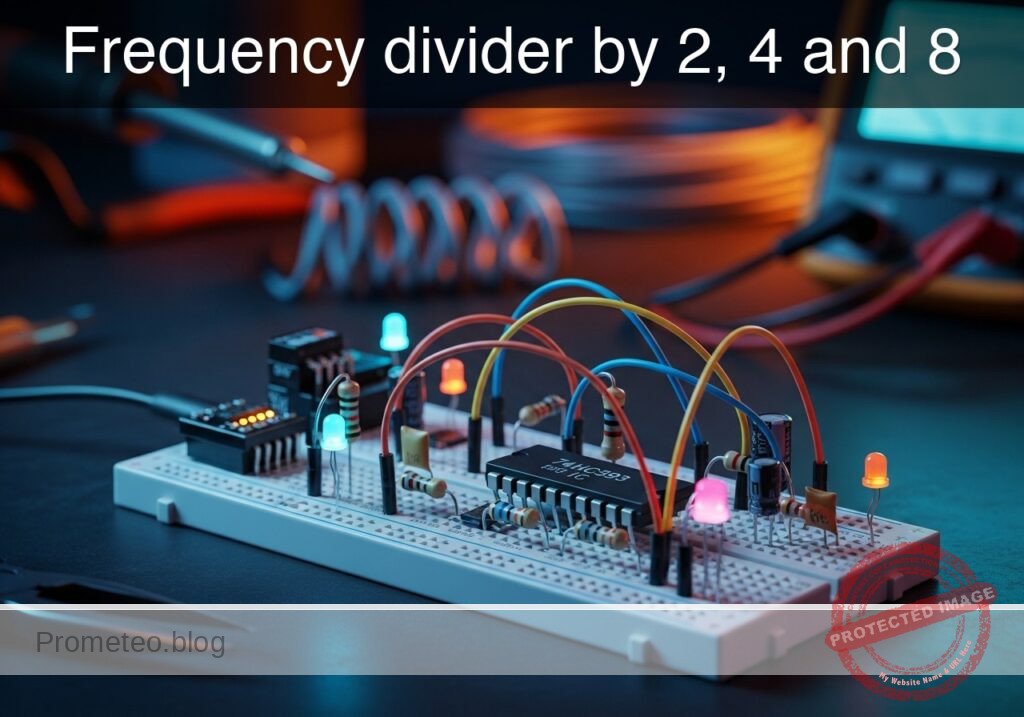
Level: Basic – Verify the frequency division relationship on the Q outputs of a binary counter relative to the clock.
Objective and use case
In this practical case, you will build a digital circuit using a 4-bit binary counter (74HC393) to divide an input clock signal frequency by factors of 2 (2^1), 4 (2^2), and 8 (2^3).
- Digital Clocks: Used to divide high-frequency crystal oscillator signals down to 1 Hz for keeping time (seconds).
- Audio Synthesis: Used to generate lower octaves from a base tone (frequency halving results in a tone one octave lower).
- Baud Rate Generation: Used in UART communication to derive specific data transmission speeds from a master system clock.
- Address Counters: Used to sequence through memory addresses in microcontrollers.
Expected outcome:
* Q0 Output: A square wave with a frequency exactly half of the input clock (f/2).
* Q1 Output: A square wave with a frequency one-quarter of the input clock (f/4).
* Q2 Output: A square wave with a frequency one-eighth of the input clock (f/8).
* Target Audience: Basic level students and hobbyists.
Materials
- V1: 5 V DC supply, function: Main power source.
- V_CLK: Pulse generator (0 V to 5 V, 1 kHz, 50% duty cycle), function: Input Clock signal.
- U1: 74HC393, function: Dual 4-bit Binary Counter.
- R1: 330 Ω resistor, function: Current limiting for LED D1.
- R2: 330 Ω resistor, function: Current limiting for LED D2.
- R3: 330 Ω resistor, function: Current limiting for LED D3.
- D1: Red LED, function: Visual indicator for Q0 (f/2).
- D2: Green LED, function: Visual indicator for Q1 (f/4).
- D3: Yellow LED, function: Visual indicator for Q2 (f/8).
- Scope: 4-Channel Oscilloscope, function: Waveform analysis.
Pin-out of the IC used
Selected Chip: 74HC393 (Dual 4-bit Binary Counter). We will use the first counter block (Side 1).
| Pin | Name | Logic function | Connection in this case |
|---|---|---|---|
| 1 | 1CP (CLK) | Clock Input (Falling edge trigger) | Connected to CLK_IN |
| 2 | 1MR | Master Reset (Active High) | Connected to 0 (GND) |
| 3 | 1Q0 | Output Bit 0 (Divide by 2) | Connected to Q0 |
| 4 | 1Q1 | Output Bit 1 (Divide by 4) | Connected to Q1 |
| 5 | 1Q2 | Output Bit 2 (Divide by 8) | Connected to Q2 |
| 7 | GND | Ground | Connected to 0 |
| 14 | VCC | Power Supply (+5 V) | Connected to VCC |
Wiring guide
- V1 connects between node
VCCand node0(GND). - U1 pin 14 connects to node
VCC. - U1 pin 7 connects to node
0(GND). - U1 pin 2 (Reset) connects to node
0(GND) to enable counting. - V_CLK connects between node
CLK_INand node0(GND). - U1 pin 1 connects to node
CLK_IN. - U1 pin 3 connects to node
Q0. - U1 pin 4 connects to node
Q1. - U1 pin 5 connects to node
Q2. - R1 connects between node
Q0and nodeLED_Q0. - D1 anode connects to
LED_Q0, cathode connects to0(GND). - R2 connects between node
Q1and nodeLED_Q1. - D2 anode connects to
LED_Q1, cathode connects to0(GND). - R3 connects between node
Q2and nodeLED_Q2. - D3 anode connects to
LED_Q2, cathode connects to0(GND).
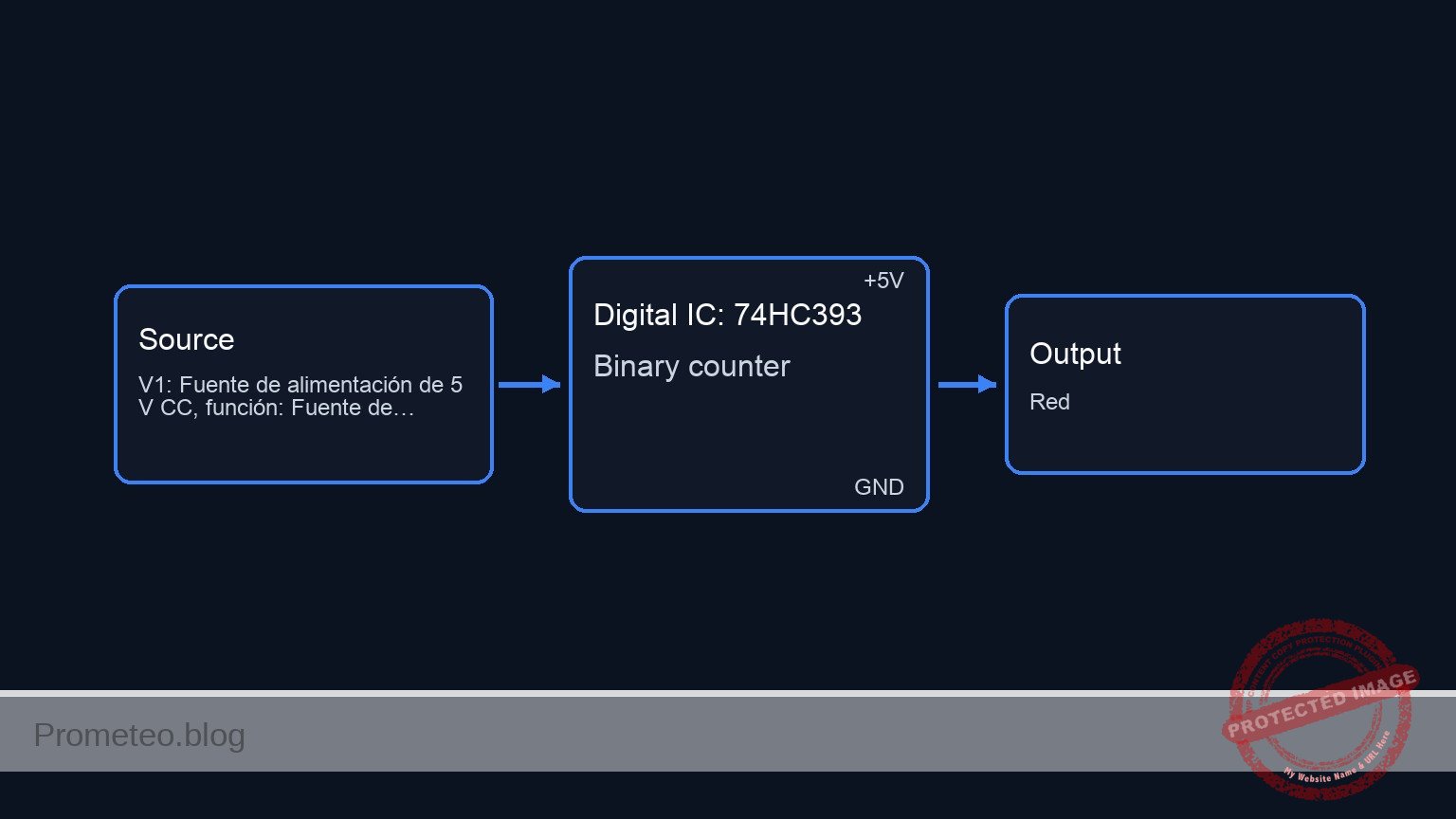
Conceptual block diagram
Schematic
INPUTS                                   PROCESSING                                     OUTPUTS / LOADS
(Left)                                    (Center)                                          (Right)

                                   +-----------------------+
                                   |                       |
 [ V_CLK: 1kHz ] --(Pin 1: CP)---> |                       | --(Pin 3: Q0)--> [ R1: 330 ] --> [ D1: Red ] --> GND
                                   |                       |       |
                                   |      U1: 74HC393      |       '--------(Scope Ch1: f/2)
                                   |      Dual 4-bit       |
                                   |      Bin Counter      |
 [ GND ] ---------(Pin 2: MR)--->  |                       | --(Pin 4: Q1)--> [ R2: 330 ] --> [ D2: Grn ] --> GND
             (Reset Disabled)      |   (Power: VCC=Pin 14, |       |
                                   |           GND=Pin 7)  |       '--------(Scope Ch2: f/4)
                                   |                       |
                                   |                       |
                                   |                       | --(Pin 5: Q2)--> [ R3: 330 ] --> [ D3: Yel ] --> GND
                                   |                       |       |
                                   +-----------------------+       '--------(Scope Ch3: f/8)
Measurements and tests
To validate the circuit, perform the following measurements using the 4-channel oscilloscope:
- Setup: Connect the Ground clip of all oscilloscope probes to node
0(GND). - Channel 1 (Input): Connect to
CLK_IN. Verify the frequency is 1 kHz. - Channel 2 (Q0): Connect to
Q0. Measure the frequency. It must be 500 Hz ($1kHz / 2$). - Channel 3 (Q1): Connect to
Q1. Measure the frequency. It must be 250 Hz ($1kHz / 4$). - Channel 4 (Q2): Connect to
Q2. Measure the frequency. It must be 125 Hz ($1kHz / 8$). - Visual Check: If you lower the input clock frequency to 10 Hz, you should see D1 blinking fastest, D2 slower, and D3 slowest.
SPICE netlist and simulation
Reference SPICE Netlist (ngspice)
* Practical case: Frequency divider by 2, 4 and 8

.width out=256

* --- Models ---
* Generic LED Model
.model DLED D(IS=1e-14 N=2 RS=10 BV=5 IBV=10u CJO=10p)

* --- Power Supply ---
* V1: 5V Main Supply
V1 VCC 0 DC 5

* --- Input Signal ---
* V_CLK: 1kHz Pulse, 0V to 5V, 50% Duty Cycle
V_CLK CLK_IN 0 PULSE(0 5 0 1u 1u 0.5m 1m)

* --- Subcircuit: 74HC393 (Behavioral XSPICE) ---
* Dual 4-bit Binary Counter
* Implements Counter 1 logic using XSPICE primitives.
* Pinout (DIP-14): 1=1CP, 2=1MR, 3=1Q0, 4=1Q1, 5=1Q2, 6=1Q3, 7=GND
* ... (truncated in public view) ...
Copy this content into a .cir file and run with ngspice.
Simulation Results (Transient Analysis)

Show raw data table (3323 rows)
Index   time            v(clk_in)       v(q0)           v(q1)           v(q2)
0	0.000000e+00	0.000000e+00	0.000000e+00	0.000000e+00	0.000000e+00
1	1.000000e-08	5.000000e-02	0.000000e+00	0.000000e+00	0.000000e+00
2	2.000000e-08	1.000000e-01	0.000000e+00	0.000000e+00	0.000000e+00
3	4.000000e-08	2.000000e-01	0.000000e+00	0.000000e+00	0.000000e+00
4	8.000000e-08	4.000000e-01	0.000000e+00	0.000000e+00	0.000000e+00
5	1.600000e-07	8.000000e-01	0.000000e+00	0.000000e+00	0.000000e+00
6	3.200000e-07	1.600000e+00	0.000000e+00	0.000000e+00	0.000000e+00
7	6.400000e-07	3.200000e+00	0.000000e+00	0.000000e+00	0.000000e+00
8	1.000000e-06	5.000000e+00	0.000000e+00	0.000000e+00	0.000000e+00
9	1.064000e-06	5.000000e+00	0.000000e+00	0.000000e+00	0.000000e+00
10	1.192000e-06	5.000000e+00	0.000000e+00	0.000000e+00	0.000000e+00
11	1.448000e-06	5.000000e+00	0.000000e+00	0.000000e+00	0.000000e+00
12	1.960000e-06	5.000000e+00	0.000000e+00	0.000000e+00	0.000000e+00
13	2.984000e-06	5.000000e+00	0.000000e+00	0.000000e+00	0.000000e+00
14	5.032000e-06	5.000000e+00	0.000000e+00	0.000000e+00	0.000000e+00
15	9.128000e-06	5.000000e+00	0.000000e+00	0.000000e+00	0.000000e+00
16	1.732000e-05	5.000000e+00	0.000000e+00	0.000000e+00	0.000000e+00
17	2.732000e-05	5.000000e+00	0.000000e+00	0.000000e+00	0.000000e+00
18	3.732000e-05	5.000000e+00	0.000000e+00	0.000000e+00	0.000000e+00
19	4.732000e-05	5.000000e+00	0.000000e+00	0.000000e+00	0.000000e+00
20	5.732000e-05	5.000000e+00	0.000000e+00	0.000000e+00	0.000000e+00
21	6.732000e-05	5.000000e+00	0.000000e+00	0.000000e+00	0.000000e+00
22	7.732000e-05	5.000000e+00	0.000000e+00	0.000000e+00	0.000000e+00
23	8.732000e-05	5.000000e+00	0.000000e+00	0.000000e+00	0.000000e+00
... (3299 more rows) ...
Common mistakes and how to avoid them
- Floating the Master Reset (MR) pin: Leaving pin 2 disconnected causes the counter to reset randomly due to noise. Solution: Always tie the MR pin to GND (Logic 0) for normal counting operation.
- Confusing Pin Numbers: The 74HC393 has two counters inside. Students often mix pins from Counter 1 and Counter 2. Solution: Strictly follow the datasheet and use pins 1, 2, 3, 4, 5, and 6 for the first counter only.
- Ignoring VCC/GND: Forgetting to power the chip leads to unpredictable output or no activity. Solution: Always connect Pin 14 to +5 V and Pin 7 to GND before testing.
Troubleshooting
- Symptom: No LEDs light up, and outputs remain at 0 V.
- Cause: Master Reset (Pin 2) might be connected to VCC instead of GND.
- Fix: Move connection of Pin 2 to GND.
- Symptom: LEDs are always on or flickering very dimly.
- Cause: Frequency is too high for the eye to see blinking (e.g., 1 kHz).
- Fix: Use the oscilloscope to verify the signal, or lower V_CLK frequency to < 10 Hz for visual confirmation.
- Symptom: Output frequency is unstable or erratic.
- Cause: Noisy power supply or lack of decoupling capacitor.
- Fix: Add a 100 nF capacitor across VCC and GND near the IC.
Possible improvements and extensions
- Divide by 16 and 256: Cascade the first counter into the second counter of the U1 chip (connect 1Q3 to 2CP) to achieve higher division ratios up to 256.
- Variable Audio Generator: Connect the outputs to a simple speaker driver and use a variable potentiometer on a 555 timer (as the clock) to hear how the pitch drops by octaves as you switch between Q0, Q1, and Q2.
More Practical Cases on Prometeo.blog
Find this product and/or books on this topic on Amazon
As an Amazon Associate, I earn from qualifying purchases. If you buy through this link, you help keep this project running.
Quick Quiz
Telecommunications Electronics Engineer and Computer Engineer (official degrees in Spain).