Introduction
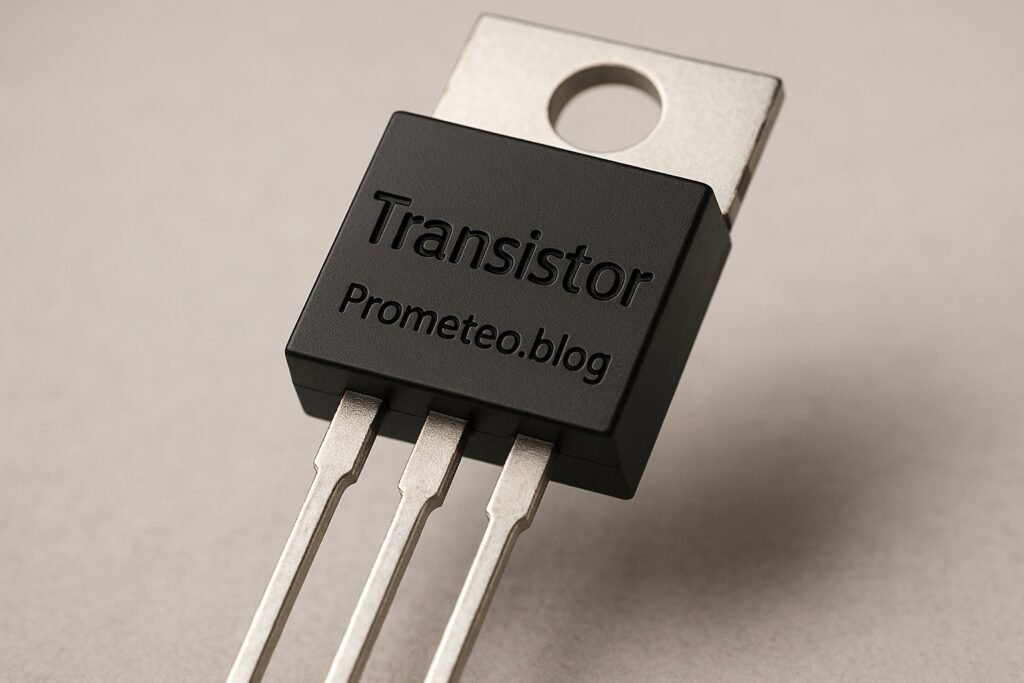
Transistors are often considered the building blocks of modern electronics. They revolutionized the field by replacing bulky vacuum tubes, allowing devices to become smaller, more efficient, and more reliable. I still remember the first time I built a simple circuit using a transistor; it felt like I was unlocking a new level in my understanding of electronics. The excitement of seeing a tiny component control a larger electrical flow is a thrilling experience that every electronics enthusiast should have. In this tutorial, we will delve deeper into the world of transistors, exploring their functionality, applications, and how you can start using them in your projects.
What it’s used for and how it works
Transistors are semiconductor devices that can act as switches or amplifiers, allowing you to control electrical signals. They form the backbone of numerous electronic devices, including radios, computers, and smartphones. In essence, a transistor can regulate the flow of current or voltage in a circuit, which is crucial for signal processing.
How does a transistor work?
At its core, a transistor consists of three layers of semiconductor material, typically silicon, which are doped with impurities to create regions of positive (p-type) and negative (n-type) charge carriers. The three terminals of a transistor are called the emitter, base, and collector.
- Emitter: This terminal emits charge carriers (electrons or holes) into the base region.
- Base: This is the control terminal that regulates the flow of carriers from the emitter to the collector.
- Collector: This terminal collects the charge carriers from the emitter.
In a simple configuration, when a small current flows into the base terminal, it allows a much larger current to flow from the collector to the emitter. This principle is what allows transistors to function as amplifiers. For instance, if you apply a small voltage to the base, it can control a much larger current flowing through the collector-emitter path. This is fundamental in applications such as audio amplification, where a weak signal needs to be boosted.
Types of transistors
There are several types of transistors, but the most common ones are Bipolar Junction Transistors (BJTs) and Field Effect Transistors (FETs).
- BJTs: These transistors use both electron and hole charge carriers. They come in two varieties: NPN and PNP.
In an NPN transistor, electrons flow from the collector to the emitter when activated, while in a PNP transistor, holes flow in the opposite direction. The operation of BJTs is based on the principle of current control, where a small base current controls a larger collector current.
FETs: These transistors, including MOSFETs and JFETs, use an electric field to control the flow of current. FETs are often preferred for high-speed applications due to their high input impedance and low power consumption. Unlike BJTs, FETs are voltage-controlled devices, meaning that a small voltage applied to the gate terminal can control a much larger current flowing from the source to the drain.
Applications of transistors
Transistors have a wide range of applications. In amplifiers, they boost signals for audio and radio frequencies. For example, in audio equipment, a small audio signal from a microphone can be amplified by a transistor circuit to drive speakers. In digital circuits, they function as switches, enabling the binary operations that form the basis of computer logic. Each bit of data in a computer is represented by a transistor being either on or off, which corresponds to the binary states of 1 and 0.
Furthermore, transistors are crucial in power regulation circuits, where they help manage voltage and current levels effectively. They are used in voltage regulators to maintain a constant output voltage despite variations in input voltage or load conditions.
Amplification and switching
In amplification, a small input current can control a larger output current. This is vital in audio applications, where a weak audio signal needs amplification for speakers. For example, in a guitar amplifier, the weak signal from the guitar pickups is amplified by transistors to drive the speaker, producing a louder sound.
On the other hand, in switching applications, transistors can turn circuits on or off based on input signals. This capability is exploited in everything from simple light switches to complex computer processors. For instance, in a microprocessor, millions of transistors switch on and off to perform calculations and process data at incredible speeds.
Importance in modern electronics
Without transistors, modern electronics as we know them would not exist. They have replaced vacuum tubes in most applications due to their smaller size, increased reliability, and lower power consumption. The development of integrated circuits, which combine thousands or millions of transistors on a single chip, has further propelled technological advancements, enabling the creation of compact and powerful devices. As such, understanding how transistors work is fundamental for anyone interested in electronics.
In summary, transistors are essential components that enable the functionality of countless devices we use daily. Their ability to amplify signals and switch currents makes them invaluable in both analog and digital electronics.
Key parameters
| Parameter | Typical | Range | Unit | Note |
|---|---|---|---|---|
| Current Gain (hFE) | 100 | 20 – 1000 | — | Ratio of output to input current |
| Collector Current (IC) | 10 mA | 1 mA – 1 A | mA | Maximum collector current |
| Base Current (IB) | 0.1 mA | 0.01 mA – 1 mA | mA | Input current required |
| Collector-Emitter Voltage (VCE) | 40 V | 1 V – 60 V | V | Maximum voltage between collector and emitter |
| Power Dissipation (PD) | 500 mW | 100 mW – 2 W | mW | Maximum power the transistor can handle |
| Operating Temperature (T) | 25°C | -55°C to 150°C | °C | Range of operating temperature |
Understanding these parameters is crucial for selecting the right transistor for a specific application. For example, if you are designing a circuit that requires high current amplification, you would look for a transistor with a high current gain (hFE) and an adequate collector current (IC) rating. Similarly, if your application involves high voltage, you’d need to ensure that the collector-emitter voltage (VCE) rating is sufficient to handle the expected voltage levels.
Hands-on practical project: Basic Transistor Switch
Goal: Build a simple switch using a transistor to control an LED.
Estimated time: 30 minutes.
Materials
- 1 × NPN transistor — Acts as the switch.
- 1 × 220 Ω resistor — Limits current to the LED.
- 1 × 10 kΩ resistor — Base resistor for the transistor.
- 1 × LED — Light-emitting diode for visual output.
- 1 × 9 V battery — Power source for the circuit.
- 1 × breadboard — Platform for building the circuit.
- 2 × jumper wires (red and black) — Connections for power and ground.
Step-by-step build
- Place the transistor on the breadboard
Start by inserting the NPN transistor into the breadboard. Ensure that the flat side of the transistor is facing you. The left pin will be the collector, the middle pin will be the base, and the right pin will be the emitter. Check: The transistor is oriented correctly.
Connect the base resistor
Take the 10 kΩ resistor and connect one end to the base pin (middle pin) of the transistor. Connect the other end of the resistor to a jumper wire that will connect to the positive terminal of the battery.Check: Resistor is connected to the base.
Connect the collector
Now, connect the collector pin (left pin) to one end of the 220 Ω resistor. Connect the other end of the resistor to the anode (longer lead) of the LED. The cathode (shorter lead) of the LED should be connected to the negative terminal of the battery.Check: The collector is connected to the resistor and LED.
Connect the emitter
Connect the emitter pin (right pin) of the transistor directly to the negative terminal of the battery. This establishes a common ground for the circuit, allowing current to flow through the LED when the transistor is activated.Check: The emitter is correctly grounded.
Final connections
Connect the positive terminal of the battery to the free end of the base resistor (10 kΩ). This connection allows the base of the transistor to receive power, enabling it to switch on the LED when activated.- Check: All connections are secure and correct.
Testing and validation
- Power on the circuit
Connect the battery to the circuit and observe the LED. If everything is connected correctly, the LED should light up. If it doesn’t, double-check all connections, especially the orientation of the transistor and the polarity of the LED. Check: LED lights up when power is applied.
Control the LED
You can control the LED by connecting a small momentary switch or another circuit to the base resistor. When activated, the switch should allow current to flow into the base, turning the LED on.- Check: The LED responds to input control.
Extend the project
- Add multiple LEDs: Create a simple light chaser by connecting multiple LEDs in parallel and controlling them with the same transistor.
- Use different transistor types: Experiment with BJTs and FETs to compare their performance in switching applications.
- Integrate a potentiometer: Control the brightness of the LED by using a potentiometer in place of the base resistor.
- Create a more complex circuit: Use multiple transistors to build a simple flip-flop circuit, which can toggle the state of the LED based on input.
Safety
- Always check the connections before powering the circuit.
- Ensure the transistor is not overheated during operation. If it feels hot, disconnect the power immediately.
- Use resistors to limit the current to the LEDs and prevent them from burning out.
- Be cautious with battery connections to avoid short circuits; ensure that positive and negative terminals are connected correctly.
- Disconnect the power when making adjustments to avoid accidental shocks or damage to components.
Common mistakes and how to avoid them
- Incorrect transistor orientation: Always double-check the pin layout of the transistor. A simple mistake here can prevent the circuit from functioning.
- Wrong resistor values: Using resistors with incorrect values can lead to excessive current flowing through the LED or transistor, potentially damaging them. Always verify resistor values with a multimeter if unsure.
- Not securing connections: Loose connections can lead to intermittent faults. Make sure all jumper wires are firmly inserted into the breadboard.
- Ignoring safety precautions: Always follow safety guidelines when working with electrical components. This includes wearing safety goggles and working in a dry area.
- Overloading the transistor: Stay within the specified current and voltage ratings for the transistor you are using. Exceeding these ratings can cause the transistor to fail.
Conclusion
In summary, transistors are fundamental components in electronics, serving as switches and amplifiers. Understanding their operation and applications is essential for any aspiring engineer or hobbyist. By practicing with simple projects, you can grasp their importance and functionality better. The hands-on experience of building circuits not only solidifies your knowledge but also inspires creativity in your designs. So, why not start experimenting with transistors today? You’ll be amazed at what you can create! More information at prometeo.blog
Third-party readings
- Tutorial: Cómo diseñar un circuito con transistores para controlar dispositivos de bajo consumo
- Curso de Fundamentos de Transistores
- Tutorial de Transistor / MOSFET
Find this product and/or books on this topic on Amazon
As an Amazon Associate, I earn from qualifying purchases. If you buy through this link, you help keep this project running.
Quick Quiz


Telecommunications Electronics Engineer and Computer Engineer (official degrees in Spain).