Level: Medium | Analyze the energy exchange and determine the resonant frequency of an AC-driven LC tank.
Objective and use case
In this practical case, you will build a parallel LC tank circuit driven by an AC sine wave source through a series resistor. By sweeping the input frequency, you will observe the precise point where inductive and capacitive reactances cancel out, maximizing the circuit’s impedance.
Understanding LC resonance is essential in modern electronics because these circuits are the fundamental building blocks of frequency selection. Real-world applications include:
* Radio frequency (RF) tuning: Selecting a specific station’s frequency while rejecting others.
* Audio and signal filtering: Creating band-pass or band-stop (notch) filters to eliminate noise.
* Wireless power transfer: Maximizing the efficiency of inductive coupling between transmitter and receiver coils.
* Oscillator circuits: Generating stable clock signals for microcontrollers and transceivers.
Expected outcome:
* You will calculate the theoretical resonant frequency based on the chosen $L$ and $C$ values.
* The total current drawn from the source (Itotal) will drop to its minimum value at resonance.
* The voltage across the LC tank (VLC) will peak at the resonant frequency.
* You will observe how energy continuously sloshes back and forth between the capacitor’s electric field and the inductor’s magnetic field.
Target audience: Intermediate electronics students transitioning from DC basics to AC reactive circuits.
Materials
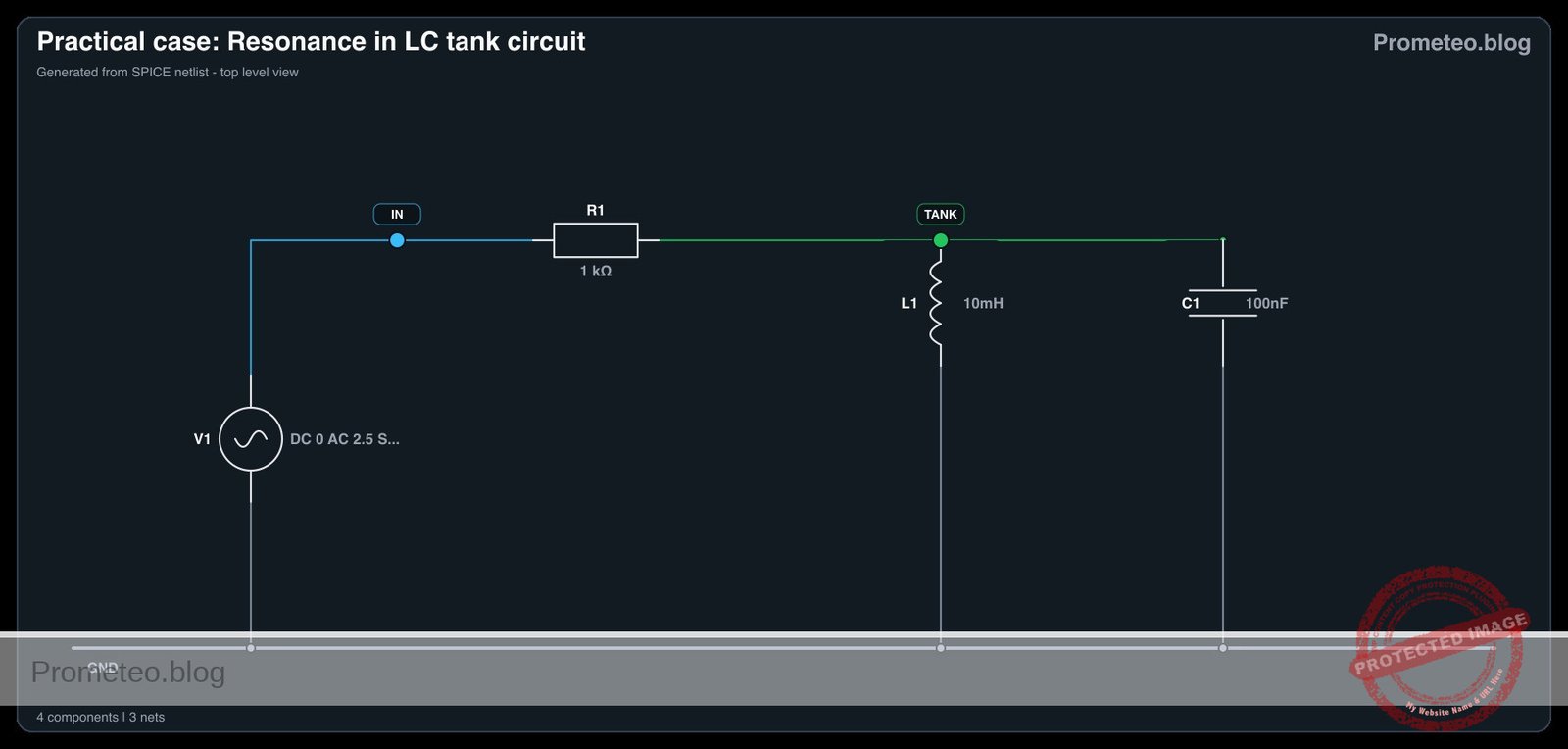
V1: 5 V peak-to-peak AC voltage source, function: sine wave generator for frequency sweepR1: 1 kΩ resistor, function: source impedance to allow voltage variations across the tankL1: 10 mH inductor, function: magnetic energy storageC1: 100 nF ceramic or film capacitor, function: electric energy storage
Wiring guide
V1: Connect the positive terminal to nodeINand the negative terminal to node0(GND).R1: Connect one pin to nodeINand the other pin to nodeTANK.L1: Connect one pin to nodeTANKand the other pin to node0(GND).C1: Connect one pin to nodeTANKand the other pin to node0(GND).
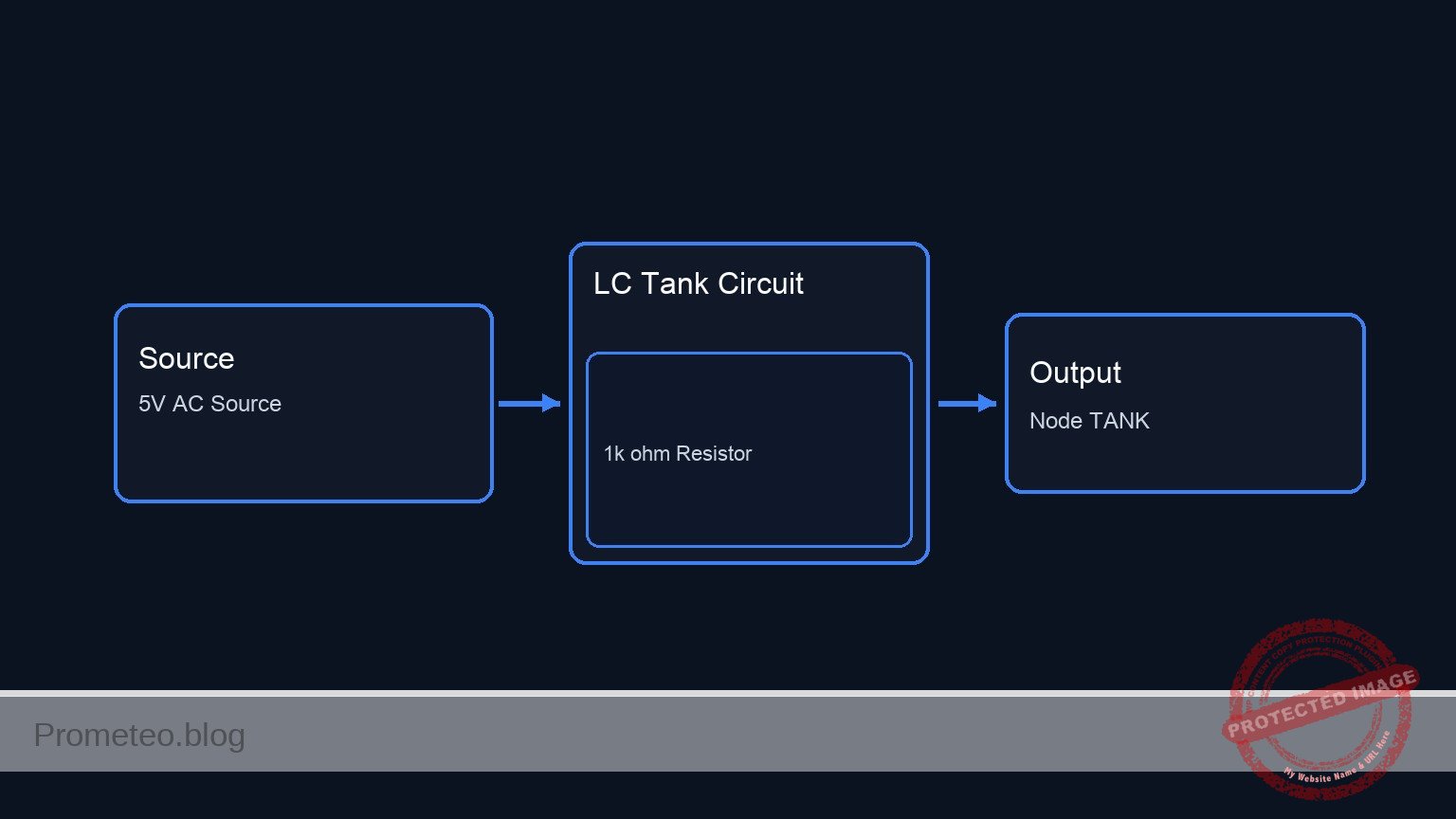
Conceptual block diagram
Schematic
[ V1: 5 V AC ] --(IN)--> [ R1: 1k ohm ] --(Node TANK)--+--> [ L1: 10mH ] --> GND
                                                      |
                                                      +--> [ C1: 100nF ] --> GND
Electrical diagram
Measurements and tests
- Calculate the theoretical resonant frequency (fr):
Use the formula fr = (1 / 2\pi\sqrtLC). With L = 10 mH and C = 100 nF, the expected resonant frequency is approximately 5032 Hz. - Set up the frequency sweep:
ConfigureV1to output a 5 V peak-to-peak sine wave. Begin with a frequency of 1 kHz and gradually increase it up to 10 kHz. - Measure VLC (Tank Voltage):
Monitor the voltage amplitude at nodeTANKrelative to node0(GND) using an oscilloscope or an AC voltmeter. As you approach 5 kHz, the voltage amplitude will rise steadily, hitting a sharp maximum exactly at resonance, and then fall as the frequency increases further. - Measure Itotal (Source Current):
Measure the current flowing throughR1(this can be done by observing the voltage difference betweenINandTANKand applying Ohm’s law: Itotal = ((VIN – VTANK) / R1)). Note that at resonance, the parallel LC tank exhibits maximum impedance, meaning Itotal will drop to its minimum. - Calculate the circuit’s Q-factor:
Identify the -3dB (half-power) frequencies above and below the resonance peak to find the bandwidth ($BW$). The Quality Factor is Q = (fr / BW).
SPICE netlist and simulation
Reference SPICE Netlist (ngspice) — excerptFull SPICE netlist (ngspice)
* Practical case: Resonance in LC tank circuit
.width out=256

* 5V peak-to-peak implies an amplitude of 2.5V.
* The resonant frequency of 10mH and 100nF is approximately 5033 Hz.
* We configure V1 with both a transient sine wave at resonance and an AC magnitude for optional AC analysis.
V1 IN 0 DC 0 AC 2.5 SIN(0 2.5 5033)

* Source impedance
R1 IN TANK 1k

* LC Tank circuit components
L1 TANK 0 10mH
* ... (truncated in public view) ...
Copy this content into a .cir file and run with ngspice.
* Practical case: Resonance in LC tank circuit
.width out=256

* 5V peak-to-peak implies an amplitude of 2.5V.
* The resonant frequency of 10mH and 100nF is approximately 5033 Hz.
* We configure V1 with both a transient sine wave at resonance and an AC magnitude for optional AC analysis.
V1 IN 0 DC 0 AC 2.5 SIN(0 2.5 5033)

* Source impedance
R1 IN TANK 1k

* LC Tank circuit components
L1 TANK 0 10mH
C1 TANK 0 100nF

* Operating point and Transient analysis
.op
.tran 1u 2m

* Print directives for logging the input and output (resonance) nodes
.print tran V(IN) V(TANK) I(L1)

.end
Simulation Results (Transient Analysis)

Show raw data table (2015 rows)
Index   time            v(in)           v(tank)         l1#branch
0	0.000000e+00	0.000000e+00	0.000000e+00	0.000000e+00
1	1.000000e-08	7.905818e-04	7.905026e-08	7.905026e-14
2	1.084006e-08	8.569951e-04	8.624878e-08	8.629565e-14
3	1.252017e-08	9.898217e-04	1.017615e-07	1.020896e-13
4	1.588039e-08	1.255475e-03	1.394809e-07	1.426210e-13
5	2.260084e-08	1.786781e-03	2.416948e-07	2.707046e-13
6	3.604174e-08	2.849394e-03	5.532131e-07	8.049184e-13
7	5.708432e-08	4.512980e-03	1.327631e-06	2.783809e-12
8	8.603868e-08	6.802053e-03	2.965106e-06	8.998482e-12
9	1.305078e-07	1.031768e-02	6.769425e-06	3.064276e-11
10	1.955195e-07	1.545732e-02	1.514065e-05	1.018634e-10
11	2.946313e-07	2.329267e-02	3.431881e-05	3.469641e-10
12	4.417944e-07	3.492633e-02	7.707420e-05	1.166612e-09
13	6.644501e-07	5.252635e-02	1.741480e-04	3.963414e-09
14	9.972436e-07	7.882720e-02	3.917455e-04	1.337970e-08
15	1.499113e-06	1.184727e-01	8.834917e-04	4.537981e-08
16	2.252017e-06	1.778899e-01	1.987598e-03	1.534626e-07
17	3.252017e-06	2.566456e-01	4.126641e-03	4.591745e-07
18	4.252017e-06	3.351447e-01	7.022468e-03	1.016630e-06
19	5.252017e-06	4.133086e-01	1.066173e-02	1.900840e-06
20	6.252017e-06	4.910592e-01	1.502968e-02	3.185410e-06
21	7.252017e-06	5.683189e-01	2.011023e-02	4.942405e-06
22	8.252017e-06	6.450102e-01	2.588597e-02	7.242215e-06
23	9.252017e-06	7.210565e-01	3.233820e-02	1.015342e-05
... (1991 more rows) ...
Common mistakes and how to avoid them
- Using a polarized capacitor in an AC circuit: Electrolytic capacitors are generally polarized and can fail or explode if subjected to reversing AC voltages. Always use non-polarized capacitors (like ceramic or film) for an LC tank.
- Ignoring the inductor’s Equivalent Series Resistance (ESR): Real inductors consist of long coils of wire, adding parasitic DC resistance to the tank. If the measured Q-factor is much lower than expected (resulting in a wider, flatter peak), inductor ESR is usually the culprit.
- Confusing angular frequency (\omega) with standard frequency ($f$): Remember that \omega = (1 / \sqrtLC) yields results in radians per second. You must divide by 2\pi to get the frequency in Hertz.
Troubleshooting
- Symptom: The measured resonant frequency is significantly higher or lower than the calculated 5032 Hz.
- Cause: Component tolerances. Standard ceramic capacitors can have a ±20% tolerance, and inductors often have ±10%.
- Fix: Measure the exact values of
L1andC1using an LCR meter and recalculate the expected frequency.
- Symptom: VLC shows no noticeable peak during the sweep; the voltage remains relatively flat.
- Cause: The chosen frequency sweep range does not cover the resonant point, or
R1is too small, effectively shorting the tank to the rigid voltage source. - Fix: Double-check the math for your specific $L$ and $C$ values to ensure the sweep range encompasses fr. Ensure
R1is adequately sized (1 kΩ is a good starting point).
- Cause: The chosen frequency sweep range does not cover the resonant point, or
- Symptom: Signal distortion or clipping is observed at node
TANK.- Cause: The AC source might be overdriving the circuit, or core saturation is occurring in the inductor (if using a very small ferrite core at high currents).
- Fix: Reduce the amplitude of
V1from 5 V to 1 V peak-to-peak and check if the sine wave becomes clean again.
Possible improvements and extensions
- Vary the damping resistor: Swap
R1for different values (e.g., 470 Ω, 10 kΩ) or add a resistor directly in parallel with the LC tank. Observe and chart how this affects the sharpness of the resonance peak (the Q-factor). - Build an active oscillator: Remove the AC source and connect the LC tank to a transistor or an op-amp with positive feedback (such as a Colpitts or Hartley configuration) to create a standalone circuit that generates its own continuous sine wave at the resonant frequency.
More Practical Cases on Prometeo.blog
Find this product and/or books on this topic on Amazon
As an Amazon Associate, I earn from qualifying purchases. If you buy through this link, you help keep this project running.
Quick Quiz

Telecommunications Electronics Engineer and Computer Engineer (official degrees in Spain).