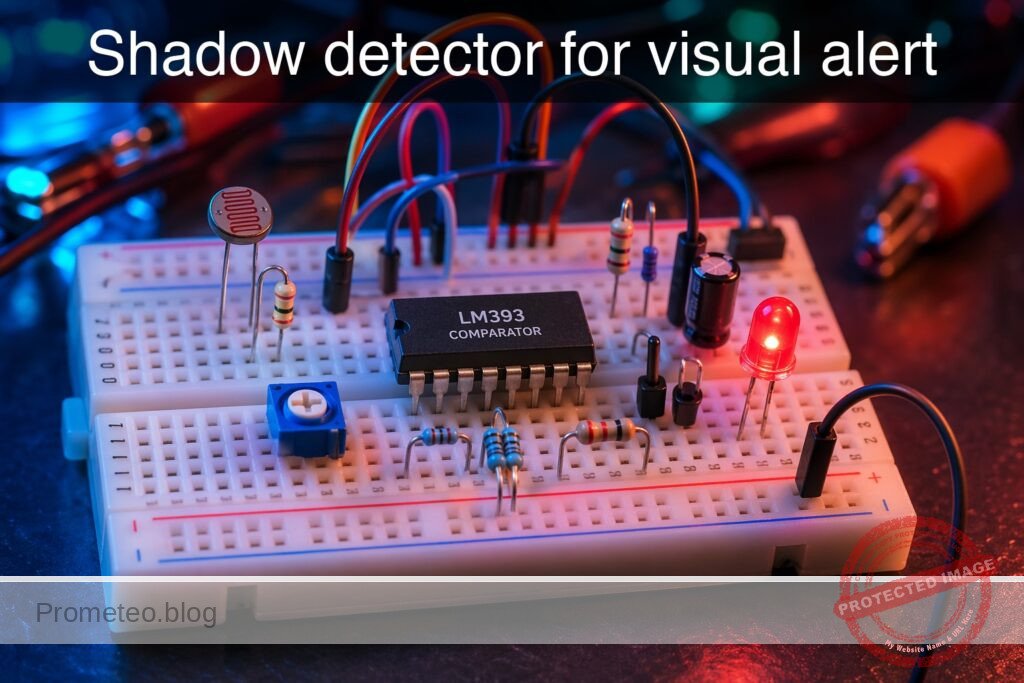
Level: Medium — Build a stable shadow detector with visual indication and low false triggering.
Objective and use case
You will build a photoresistor-based circuit that detects a sudden drop in light caused by a shadow and turns on an LED in a stable way. The design uses an LDR voltage divider, an RC filter, and a comparator with hysteresis to reduce false activations.
Why it is useful:
- Detect when a hand or object passes in front of a lighted opening.
- Create a simple visual warning for access points, boxes, or cabinets.
- Monitor brief shadow events in classroom experiments on light sensing.
- Add a reliable light-change trigger to small automation prototypes.
Expected outcome:
- Sensor voltage at VA changes with light level, typically from about 0.8 V to 4.2 V depending on illumination.
- Filtered voltage at VB changes more slowly than VA, reducing short spikes and flicker.
- Comparator output at VOUT switches cleanly between low and high states.
- LED D1 turns on when light drops below the adjusted threshold and remains stable near the switching point.
- Hysteresis of about 0.2 V to 0.5 V avoids repeated on/off oscillation.
Target audience and level: Students with basic knowledge of resistors, capacitors, and voltage measurement.
Materials
- V1: 5 V DC supply
- R1: LDR photoresistor, function: light-dependent upper arm of sensor divider
- R2: 10 kΩ potentiometer, function: adjustable lower arm of sensor divider and threshold tuning aid
- R3: 22 kΩ resistor, function: series resistor from sensor node to RC filter
- C1: 10 µF capacitor, function: low-pass filter for shadow event stabilization
- U1: LM393 comparator, function: compare filtered sensor voltage against adjustable reference
- R4: 10 kΩ potentiometer, function: reference voltage adjustment for comparator
- R5: 220 kΩ resistor, function: positive feedback to add hysteresis
- R6: 10 kΩ resistor, function: pull-up for LM393 open-collector output
- D1: red LED, function: visual alert output
- R7: 330 Ω resistor, function: LED current limiting
Wiring guide
- V1 connects between nodes VCC and 0.
- R1 connects between nodes VCC and VA.
- R2 connects between nodes VA and 0; use the potentiometer as a variable resistor to adjust the divider sensitivity.
- R3 connects between nodes VA and VB.
- C1 connects between nodes VB and 0.
- R4 connects between nodes VCC and 0; connect the wiper of R4 to node VREF.
- U1 LM393 power pins connect as follows: supply pin to VCC, ground pin to 0.
- U1 comparator non-inverting input connects to node VREF.
- U1 comparator inverting input connects to node VB.
- R5 connects between nodes VOUT and VREF.
- R6 connects between nodes VCC and VOUT.
- R7 connects between nodes VCC and VLED.
- D1 connects between nodes VLED and VOUT; orient the LED so it turns on when VOUT is pulled low by U1.
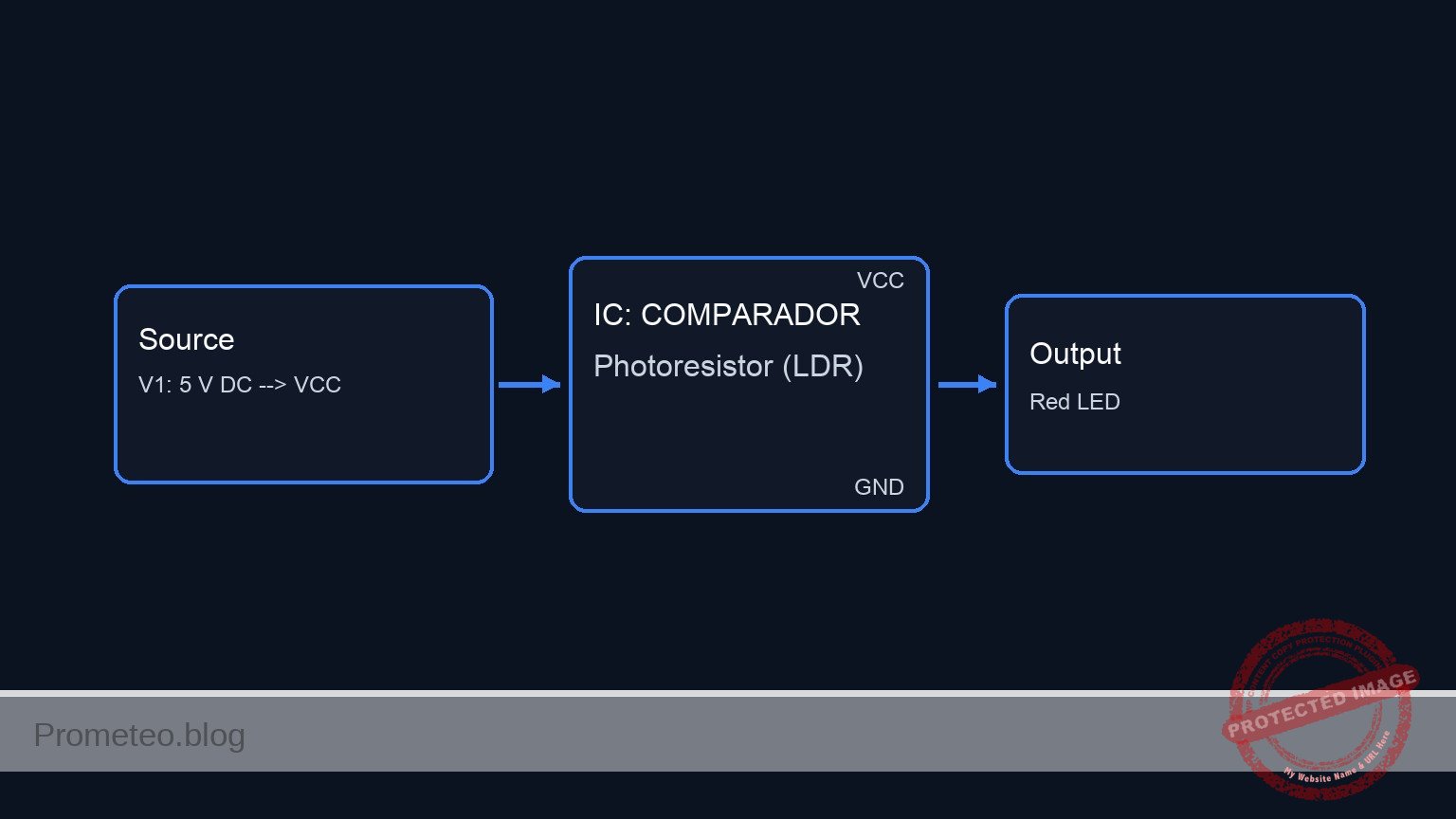
Conceptual block diagram
Schematic
Practical case: Shadow detector for visual alert

Light / Shadow
      --> [ R1: LDR ]
      --> (VA: sensor divider node)
      --> [ R3: 22 kΩ ]
      --> (VB: filtered sensor signal)
      --> [ U1: LM393 Comparator (-) ]

VCC --> [ R2: 10 kΩ Pot, sensitivity adjust ] --> GND
                  \
                   --> (VA)

VCC --> [ R4: 10 kΩ Pot, reference adjust ] --> GND
                  \
                   --> (VREF)
                   --> [ U1: LM393 Comparator (+) ]

[ U1: LM393 Comparator Output VOUT ]
      --> [ R5: 220 kΩ Positive Feedback ] --> (VREF)
      --> [ D1: Red LED ] --> [ R7: 330 Ω ] --> VCC
      --> [ Alert Output: LED ON when VOUT goes LOW ]

VCC --> [ R6: 10 kΩ Pull-up ] --> (VOUT)

(VB) --> [ C1: 10 µF Low-Pass Filter ] --> GND

V1: 5 V DC --> VCC
V1: 0 V    --> GND
U1 power: VCC, GND
Electrical diagram
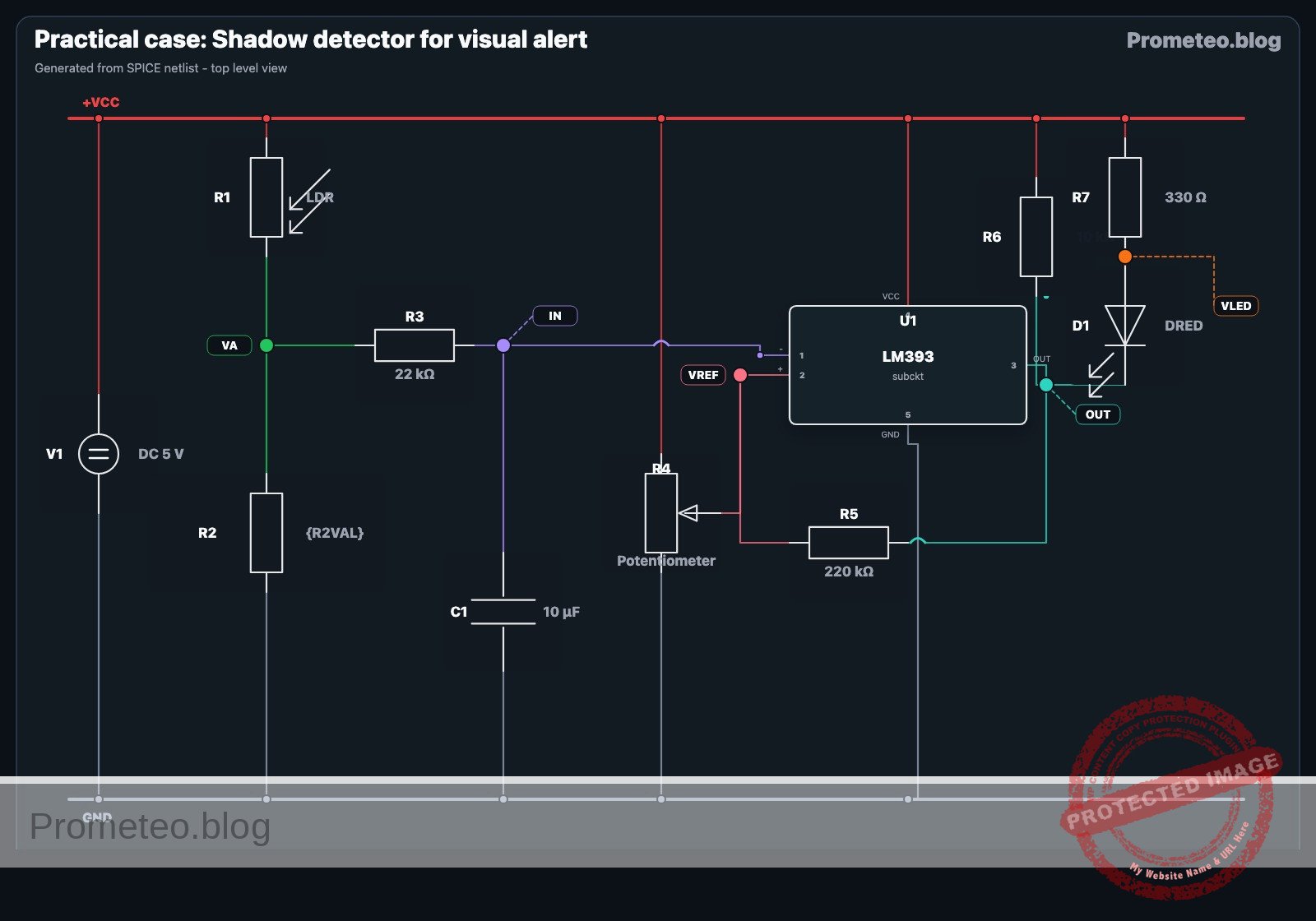
Measurements and tests
- Power-off inspection
- Check that VCC and 0 are not shorted.
- Confirm LED polarity.
Verify that the LM393 output has a pull-up resistor R6.
Supply check
- Power the circuit with V1 = 5 V.
Measure between VCC and 0; expected value: 4.9 V to 5.1 V.
Sensor voltage measurement
- Measure VA in bright light and then under a shadow.
- Expected result: VA should change clearly, often by more than 1 V.
If the change is too small, adjust R2 or change the light angle on the LDR.
Filtered response measurement
- Measure VB while suddenly covering the LDR.
- VB should not jump instantly; it should move with a short delay set by R3 × C1.
With R3 = 22 kΩ and C1 = 10 µF, the time constant is about 0.22 s.
Threshold adjustment
- Adjust R4 until D1 is off in normal light and turns on when a clear shadow is applied.
Measure VREF; typical useful range is 1 V to 4 V.
Hysteresis verification
- Slowly move a hand to create a partial shadow and then slowly remove it.
- Measure the switching voltage at VB when the LED turns on and when it turns off.
The two values should differ slightly because of R5; a difference of 0.2 V to 0.5 V is a good target.
Response time test
- Repeatedly create a sudden shadow and observe LED behavior.
- The LED should react within a fraction of a second, without flickering from very brief light variations.
- If the response is too slow, reduce C1 to 4.7 µF.
If false triggering remains, increase C1 to 22 µF or increase R5 slightly for more hysteresis.
False activation test
- Illuminate the LDR with room light and introduce small disturbances such as hand motion nearby but not fully covering it.
- The LED should remain stable unless the light drop is large enough to cross the threshold.
SPICE netlist and simulation
Reference SPICE Netlist (ngspice) — excerptFull SPICE netlist (ngspice)
* Practical case: Shadow detector for visual alert
.width out=256

.param R2VAL=5k
.param R4POS=0.5
.param R4TOP={10000*(1-R4POS)+1m}
.param R4BOT={10000*(R4POS)+1m}
.param RLIGHT=2k
.param RDARK=50k

V1 VCC 0 DC 5

* Dynamic light/shadow stimulus: 0 = light, 1 = shadow
VLUX LUX 0 PULSE(0 1 50m 1m 1m 200m 400m)

* R1 LDR photoresistor: upper arm of divider
R1 VCC VA r='{RLIGHT + (RDARK-RLIGHT)*V(LUX)}'

* R2 10k potentiometer used as variable resistor
R2 VA 0 {R2VAL}
* ... (truncated in public view) ...
Copy this content into a .cir file and run with ngspice.
* Practical case: Shadow detector for visual alert
.width out=256

.param R2VAL=5k
.param R4POS=0.5
.param R4TOP={10000*(1-R4POS)+1m}
.param R4BOT={10000*(R4POS)+1m}
.param RLIGHT=2k
.param RDARK=50k

V1 VCC 0 DC 5

* Dynamic light/shadow stimulus: 0 = light, 1 = shadow
VLUX LUX 0 PULSE(0 1 50m 1m 1m 200m 400m)

* R1 LDR photoresistor: upper arm of divider
R1 VCC VA r='{RLIGHT + (RDARK-RLIGHT)*V(LUX)}'

* R2 10k potentiometer used as variable resistor
R2 VA 0 {R2VAL}

R3 VA VB 22k
C1 VB 0 10u

* R4 10k potentiometer with wiper at VREF
R4A VCC VREF {R4TOP}
R4B VREF 0 {R4BOT}

* U1 LM393 approximation
* Non-inverting input: VREF
* Inverting input: VB
* Open-collector output: VOUT
B_U1DRV NBASE 0 V='0.95*(1+tanh(80*(V(VREF)-V(VB))))/2'
R_U1B NBASE 0 100k
Q_U1 VOUT NBASE 0 QLM393OC

R5 VOUT VREF 220k
R6 VCC VOUT 10k

R7 VCC VLED 330
D1 VLED VOUT DRED

* Probe aliases so .print can include V(IN) and V(OUT) first
V_INMON IN VB DC 0
V_OUTMON OUT VOUT DC 0

.model QLM393OC NPN(IS=1e-14 BF=100 VAF=100 CJE=5p CJC=3p TF=1n TR=10n)
.model DRED D(IS=1e-18 N=2.0 RS=10 CJO=5p VJ=0.75 M=0.33 TT=50n BV=5 IBV=10u)

.print tran V(IN) V(OUT) V(VB) V(VOUT) V(VREF) V(VA) V(VLED) V(LUX)
.op
.tran 100u 500m
.end
* --- GPT review (BOM/Wiring/SPICE) ---
* circuit_ok=true
* simulation_summary: The simulation is consistent with a shadow detector. In bright condition, VA and VB are high, VB is above VREF, the LM393 output transistor is off, and VOUT stays high at about 4.89 V so the LED is off. After the light-to-shadow transition, VA drops, VB falls slowly because of the R3-C1 filter, and when VB crosses below VREF at about 0.168 s, VOUT is pulled low to about 18 mV and the LED turns on. When light returns, VB rises slowly again, so the alert remains on for a while before resetting, consistent with RC filtering and hysteresis.
* bom/wiring vs SPICE issues (modelo):
*   - The LM393 is not a specific manufacturer macro-model; it is only an approximation of open-collector comparator behavior. This is acceptable for logic/function teaching, but not for accurate device-level output saturation or input common-mode behavior.
* bom_vs_spice equivalences ignored:
*   - R2 is described in the wiring guide as a 10 kΩ potentiometer used as a variable resistor, but the netlist fixes it with .param R2VAL=5k. This is acceptable for one simulation run, but the adjustable setting is not exposed unless the parameter is changed manually.
*   - The 10 kΩ potentiometer R4 is validly modeled as two resistors R4A and R4B with the wiper at node VREF.
*   - The LDR R1 is validly modeled as a resistor whose value changes with a control stimulus (behavioral resistance driven by VLUX).
*   - The LED D1 is validly modeled as a diode, with R7 providing the series current limit.
*   - The LM393 comparator is validly modeled with behavioral circuitry plus an NPN open-collector output stage.
*   - The changing light/shadow condition is validly modeled by the PULSE source VLUX.
* overall_comment: This SPICE netlist is broadly faithful to the BOM and wiring and is usable as a didactic example of a shadow-triggered visual alarm. The divider, RC filter, adjustable reference, hysteresis, open-collector pull-up, and active-low LED wiring all match the intended circuit. The main caveat is pedagogical: the LM393 is only behaviorally approximated, and R2 is represented by a fixed chosen value rather than an interactively adjustable potentiometer position. Before classroom use, I would explain the active-low output, the delayed switching caused by R3-C1, and the role of positive feedback R5 in shifting VREF slightly between output states.
* --------------------------------------
Simulation Results (Transient Analysis)

Show raw data table (5027 rows)
Index   time            v(in)           v(out)          v(vb)           v(vout)         v(vref)         v(va)           v(vled)         v(lux)
0	0.000000e+00	3.571429e+00	4.892473e+00	3.571429e+00	4.892473e+00	2.526882e+00	3.571429e+00	5.000000e+00	0.000000e+00
1	1.000000e-06	3.571429e+00	4.892473e+00	3.571429e+00	4.892473e+00	2.526882e+00	3.571429e+00	5.000000e+00	0.000000e+00
2	2.000000e-06	3.571429e+00	4.892473e+00	3.571429e+00	4.892473e+00	2.526882e+00	3.571429e+00	5.000000e+00	0.000000e+00
3	4.000000e-06	3.571429e+00	4.892473e+00	3.571429e+00	4.892473e+00	2.526882e+00	3.571429e+00	5.000000e+00	0.000000e+00
4	8.000000e-06	3.571429e+00	4.892473e+00	3.571429e+00	4.892473e+00	2.526882e+00	3.571429e+00	5.000000e+00	0.000000e+00
5	1.600000e-05	3.571429e+00	4.892473e+00	3.571429e+00	4.892473e+00	2.526882e+00	3.571429e+00	5.000000e+00	0.000000e+00
6	3.200000e-05	3.571429e+00	4.892473e+00	3.571429e+00	4.892473e+00	2.526882e+00	3.571429e+00	5.000000e+00	0.000000e+00
7	6.400000e-05	3.571429e+00	4.892473e+00	3.571429e+00	4.892473e+00	2.526882e+00	3.571429e+00	5.000000e+00	0.000000e+00
8	1.280000e-04	3.571429e+00	4.892473e+00	3.571429e+00	4.892473e+00	2.526882e+00	3.571429e+00	5.000000e+00	0.000000e+00
9	2.280000e-04	3.571429e+00	4.892473e+00	3.571429e+00	4.892473e+00	2.526882e+00	3.571429e+00	5.000000e+00	0.000000e+00
10	3.280000e-04	3.571429e+00	4.892473e+00	3.571429e+00	4.892473e+00	2.526882e+00	3.571429e+00	5.000000e+00	0.000000e+00
11	4.280000e-04	3.571429e+00	4.892473e+00	3.571429e+00	4.892473e+00	2.526882e+00	3.571429e+00	5.000000e+00	0.000000e+00
12	5.280000e-04	3.571429e+00	4.892473e+00	3.571429e+00	4.892473e+00	2.526882e+00	3.571429e+00	5.000000e+00	0.000000e+00
13	6.280000e-04	3.571429e+00	4.892473e+00	3.571429e+00	4.892473e+00	2.526882e+00	3.571429e+00	5.000000e+00	0.000000e+00
14	7.280000e-04	3.571429e+00	4.892473e+00	3.571429e+00	4.892473e+00	2.526882e+00	3.571429e+00	5.000000e+00	0.000000e+00
15	8.280000e-04	3.571429e+00	4.892473e+00	3.571429e+00	4.892473e+00	2.526882e+00	3.571429e+00	5.000000e+00	0.000000e+00
16	9.280000e-04	3.571429e+00	4.892473e+00	3.571429e+00	4.892473e+00	2.526882e+00	3.571429e+00	5.000000e+00	0.000000e+00
17	1.028000e-03	3.571429e+00	4.892473e+00	3.571429e+00	4.892473e+00	2.526882e+00	3.571429e+00	5.000000e+00	0.000000e+00
18	1.128000e-03	3.571429e+00	4.892473e+00	3.571429e+00	4.892473e+00	2.526882e+00	3.571429e+00	5.000000e+00	0.000000e+00
19	1.228000e-03	3.571429e+00	4.892473e+00	3.571429e+00	4.892473e+00	2.526882e+00	3.571429e+00	5.000000e+00	0.000000e+00
20	1.328000e-03	3.571429e+00	4.892473e+00	3.571429e+00	4.892473e+00	2.526882e+00	3.571429e+00	5.000000e+00	0.000000e+00
21	1.428000e-03	3.571429e+00	4.892473e+00	3.571429e+00	4.892473e+00	2.526882e+00	3.571429e+00	5.000000e+00	0.000000e+00
22	1.528000e-03	3.571429e+00	4.892473e+00	3.571429e+00	4.892473e+00	2.526882e+00	3.571429e+00	5.000000e+00	0.000000e+00
23	1.628000e-03	3.571429e+00	4.892473e+00	3.571429e+00	4.892473e+00	2.526882e+00	3.571429e+00	5.000000e+00	0.000000e+00
... (5003 more rows) ...
Reference SPICE netlist (ngspice)
* Practical case: Shadow detector for visual alert
.width out=256

.param R2VAL=5k
.param R4POS=0.5
.param R4TOP={10000*(1-R4POS)+1m}
.param R4BOT={10000*(R4POS)+1m}
.param RLIGHT=2k
.param RDARK=50k

V1 VCC 0 DC 5

* Dynamic light/shadow stimulus: 0 = light, 1 = shadow
VLUX LUX 0 PULSE(0 1 50m 1m 1m 200m 400m)

* R1 LDR photoresistor: upper arm of divider
R1 VCC VA r='{RLIGHT + (RDARK-RLIGHT)*V(LUX)}'

* R2 10k potentiometer used as variable resistor
R2 VA 0 {R2VAL}

R3 VA VB 22k
C1 VB 0 10u

* R4 10k potentiometer with wiper at VREF
R4A VCC VREF {R4TOP}
R4B VREF 0 {R4BOT}

* U1 LM393 approximation
* Non-inverting input: VREF
* Inverting input: VB
* Open-collector output: VOUT
B_U1DRV NBASE 0 V='0.95*(1+tanh(80*(V(VREF)-V(VB))))/2'
R_U1B NBASE 0 100k
Q_U1 VOUT NBASE 0 QLM393OC

R5 VOUT VREF 220k
R6 VCC VOUT 10k

R7 VCC VLED 330
D1 VLED VOUT DRED

* Probe aliases so .print can include V(IN) and V(OUT) first
V_INMON IN VB DC 0
V_OUTMON OUT VOUT DC 0

.model QLM393OC NPN(IS=1e-14 BF=100 VAF=100 CJE=5p CJC=3p TF=1n TR=10n)
.model DRED D(IS=1e-18 N=2.0 RS=10 CJO=5p VJ=0.75 M=0.33 TT=50n BV=5 IBV=10u)

.print tran V(IN) V(OUT) V(VB) V(VOUT) V(VREF) V(VA) V(VLED) V(LUX)
.op
.tran 100u 500m
.end
* --- GPT review (BOM/Wiring/SPICE) ---
* circuit_ok=true
* simulation_summary: The simulation is consistent with a shadow detector. In bright condition, VA and VB are high, VB is above VREF, the LM393 output transistor is off, and VOUT stays high at about 4.89 V so the LED is off. After the light-to-shadow transition, VA drops, VB falls slowly because of the R3-C1 filter, and when VB crosses below VREF at about 0.168 s, VOUT is pulled low to about 18 mV and the LED turns on. When light returns, VB rises slowly again, so the alert remains on for a while before resetting, consistent with RC filtering and hysteresis.
* bom/wiring vs SPICE issues (modelo):
*   - The LM393 is not a specific manufacturer macro-model; it is only an approximation of open-collector comparator behavior. This is acceptable for logic/function teaching, but not for accurate device-level output saturation or input common-mode behavior.
* bom_vs_spice equivalences ignored:
*   - R2 is described in the wiring guide as a 10 kΩ potentiometer used as a variable resistor, but the netlist fixes it with .param R2VAL=5k. This is acceptable for one simulation run, but the adjustable setting is not exposed unless the parameter is changed manually.
*   - The 10 kΩ potentiometer R4 is validly modeled as two resistors R4A and R4B with the wiper at node VREF.
*   - The LDR R1 is validly modeled as a resistor whose value changes with a control stimulus (behavioral resistance driven by VLUX).
*   - The LED D1 is validly modeled as a diode, with R7 providing the series current limit.
*   - The LM393 comparator is validly modeled with behavioral circuitry plus an NPN open-collector output stage.
*   - The changing light/shadow condition is validly modeled by the PULSE source VLUX.
* overall_comment: This SPICE netlist is broadly faithful to the BOM and wiring and is usable as a didactic example of a shadow-triggered visual alarm. The divider, RC filter, adjustable reference, hysteresis, open-collector pull-up, and active-low LED wiring all match the intended circuit. The main caveat is pedagogical: the LM393 is only behaviorally approximated, and R2 is represented by a fixed chosen value rather than an interactively adjustable potentiometer position. Before classroom use, I would explain the active-low output, the delayed switching caused by R3-C1, and the role of positive feedback R5 in shifting VREF slightly between output states.
* --------------------------------------
Simulation Results (Transient Analysis)
Common mistakes and how to avoid them
- Connecting the LED directly to the comparator output without a resistor
Always use R7 in series with D1 to limit current.
Forgetting that the LM393 output is open collector
Add R6 from VCC to VOUT, or the output will not produce a valid high level.
Using no hysteresis near the threshold
- Keep R5 installed so the LED does not chatter when the light level is close to the switching point.
Troubleshooting
- Symptom: LED never turns on
- Cause: VREF is set too low or the LDR divider range is too small.
Fix: Adjust R4, then verify that VA and VB really change under a shadow.
Symptom: LED is always on
- Cause: VREF is too high, or the LDR is wired incorrectly.
Fix: Lower VREF with R4 and confirm R1 is between VCC and VA.
Symptom: LED flickers near the switching point
- Cause: insufficient filtering or hysteresis.
Fix: Increase C1 or reduce R5 moderately to strengthen hysteresis.
Symptom: Output voltage at VOUT never rises
- Cause: missing or incorrect pull-up resistor R6.
Fix: Confirm R6 is connected between VCC and VOUT.
Symptom: Response is too slow
- Cause: RC filter too large.
- Fix: Reduce C1 or R3 to shorten the response time.
Possible improvements and extensions
- Add a buzzer output
Connect a transistor driver to VOUT so the same shadow event activates both an LED and a buzzer for stronger alerting.
Use a dual-threshold window
- Add a second comparator to detect both excessive darkness and excessive brightness, useful for light-condition monitoring rather than only shadow detection.
More Practical Cases on Prometeo.blog
Find this product and/or books on this topic on Amazon
As an Amazon Associate, I earn from qualifying purchases. If you buy through this link, you help keep this project running.
Quick Quiz

Telecommunications Electronics Engineer and Computer Engineer (official degrees in Spain).