Level: Medium — Calculate and verify a base resistor to switch an NPN transistor safely from a logic output.
Objective and use case
You will build a simple transistor switch where a 5 V logic output drives an NPN transistor through a base resistor. The goal is to choose the resistor so the transistor turns the load on reliably without exceeding the allowed logic output current.
Why it is useful:
– To drive a relay module, buzzer, or small lamp from a microcontroller pin.
– To control loads that require more current than a logic output can supply directly.
– To protect a logic output from excessive base current.
– To learn how to verify transistor saturation with real voltage and current measurements.
Expected outcome:
– When the logic output is LOW, the transistor remains OFF and the load is de-energized.
– When the logic output is HIGH, the transistor turns ON and the load current is about 20 mA.
– Base current stays below the logic output limit, target about 4.3 mA.
– Measured base-emitter voltage is about 0.7 V when ON.
– Measured collector-emitter voltage is low in saturation, typically below 0.2 V.
Target audience and level: Students with basic DC circuit and transistor knowledge.
Materials
- V1: 5 V DC supply
- VSIG: 0 V / 5 V logic source, function: control signal for transistor base
- R1: 1 kΩ resistor, function: base current limiting
- R2: 150 Ω resistor, function: load current limiting for LED branch
- D1: red LED, function: visible collector load indicator
- Q1: 2N2222 NPN transistor, function: low-side switch
- M1: digital multimeter, function: voltage and current measurements
- M2: optional second multimeter, function: simultaneous current check
Wiring guide
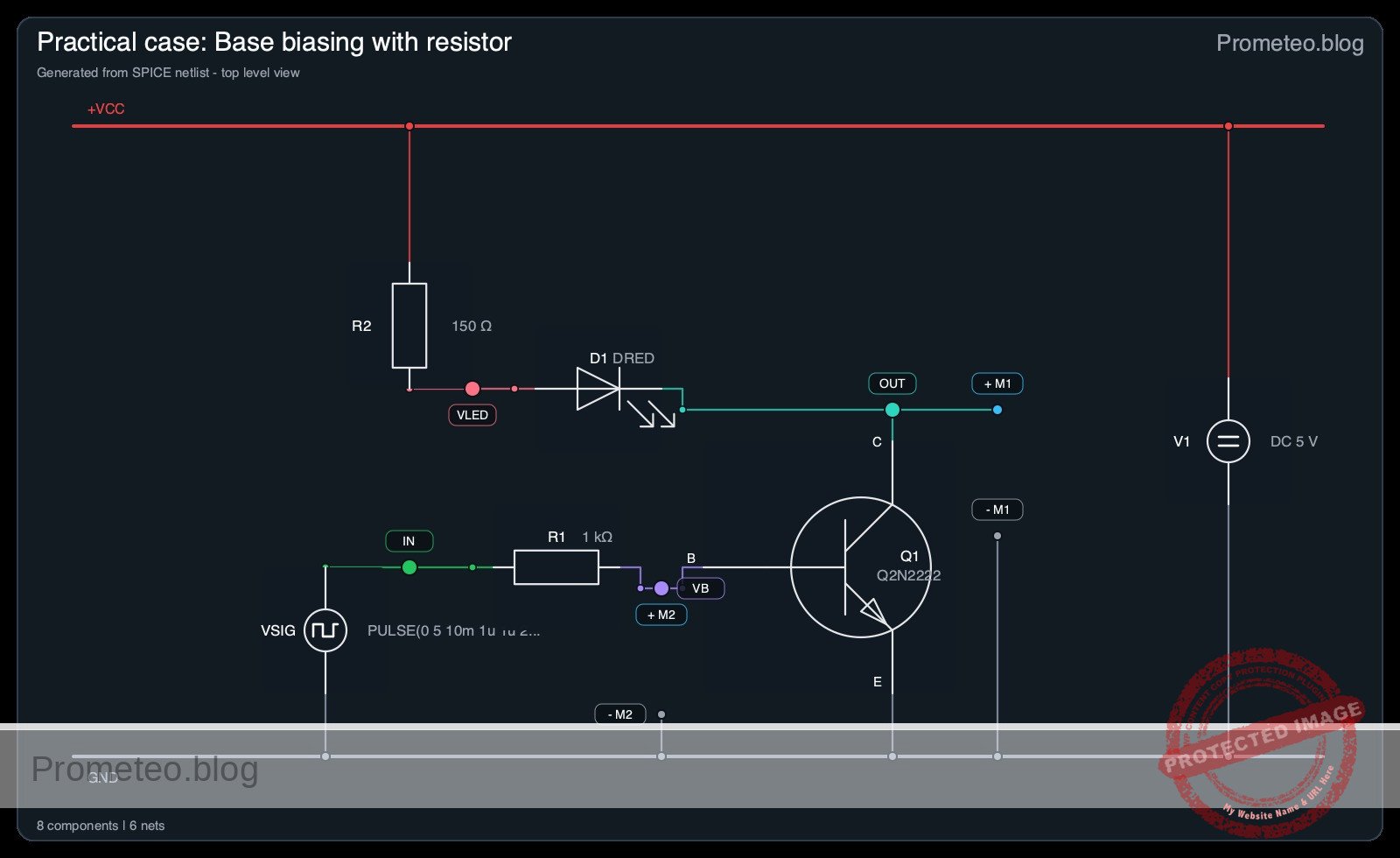
Use these node names: VCC, 0, VIN, VB, VC.
- V1 connects between VCC and 0.
- VSIG connects between VIN and 0.
- R1 connects between VIN and VB.
- Q1 collector connects to VC.
- Q1 base connects to VB.
- Q1 emitter connects to 0.
- R2 connects between VCC and the anode node of D1.
- D1 anode connects to R2; D1 cathode connects to VC.
Practical design values:
– Load current target: about Ic = (5 V - 2.0 V - 0.2 V) / 150 Ω ≈ 18.7 mA
– Forced gain for saturation: use β_forced ≈ 10
– Required base current: Ib ≈ Ic / 10 ≈ 1.9 mA
– Base resistor estimate: R1 ≈ (5 V - 0.7 V) / 1.9 mA ≈ 2.26 kΩ
To make switching more robust, choose a lower standard value:
– Selected R1 = 1 kΩ
– Expected base current: Ib ≈ (5 V - 0.7 V) / 1 kΩ ≈ 4.3 mA
This value is suitable only if the logic output can safely source at least 4.3 mA.
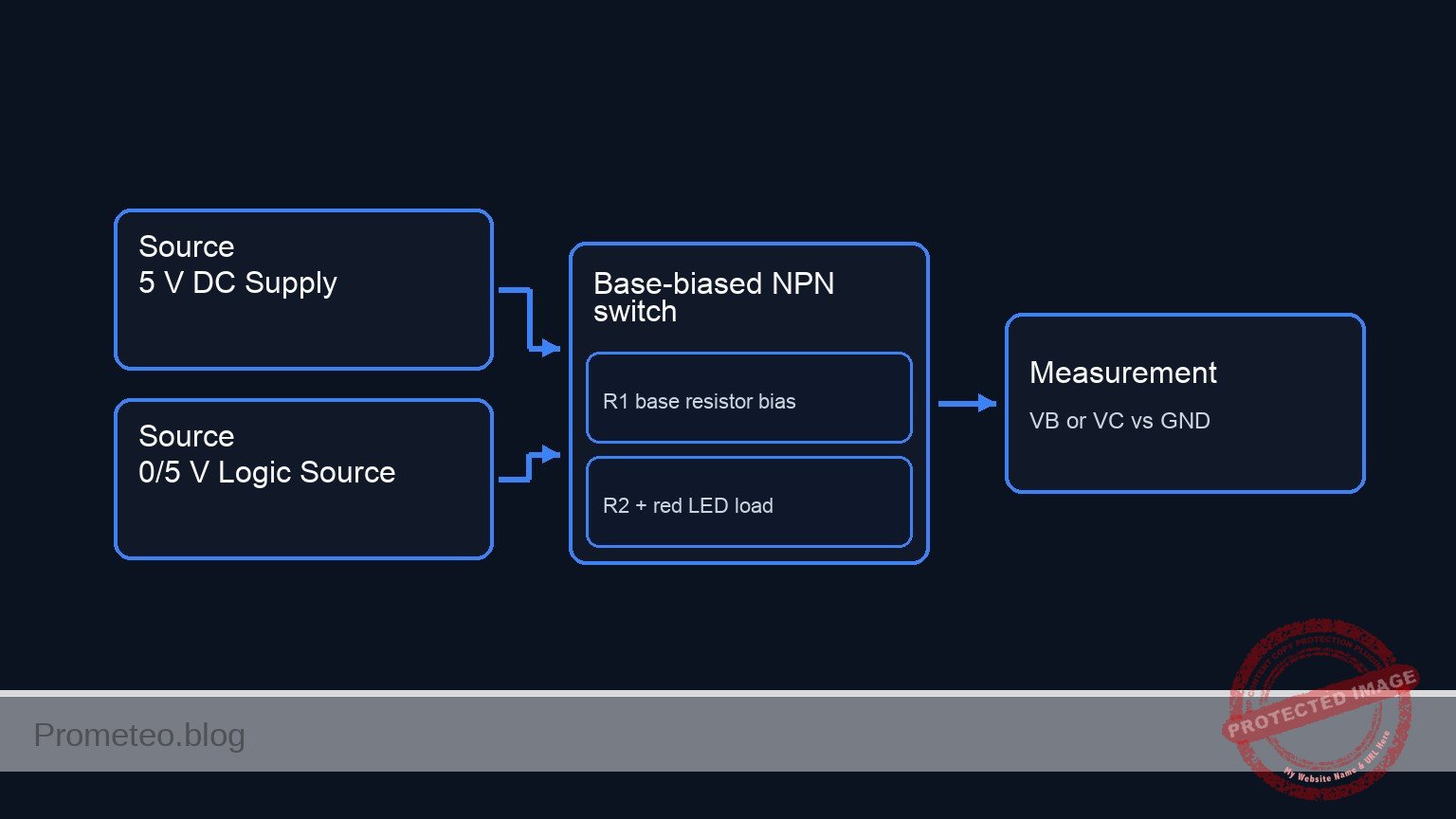
Conceptual block diagram
Schematic
Practical case: Base Biasing with Resistor

Power / load path:
[ V1: 5 V DC Supply ] --(VCC)--> [ R2: 150 ohm ] --(LED current limit)--> [ D1: Red LED ] --(cathode at VC)--> [ Q1:C 2N2222 ]
[ Q1:C 2N2222 ] --(collector-emitter path)--> [ Q1:E 2N2222 ] --(0 / GND)--> [ V1: 0 V ]

Control / base path:
[ VSIG: 0/5 V Logic Source ] --(VIN)--> [ R1: 1 kohm ] --(VB)--> [ Q1:B 2N2222 ]
[ Q1:B 2N2222 ] --(base-emitter junction)--> [ Q1:E 2N2222 ] --(0 / GND)--> [ VSIG: 0 V ]

Node labels:
[ VIN ] --> [ R1 ] --> [ VB ] --> [ Q1:B ]
[ VCC ] --> [ R2 ] --> [ D1 Anode ]
[ D1 Cathode ] --> [ VC ] --> [ Q1:C ]
[ Q1:E ] --> [ 0 / GND ]

Optional measurements:
[ M1 DMM ] --(measure V_B or V_C vs 0)--> [ VB / VC ] --> [ 0 / GND ]
[ M2 DMM ] --(current mode, inserted in series where needed)--> [ Base path or Load path ]
Electrical diagram
Measurements and tests
- Power-off check
- Verify all connections before applying power.
- Confirm Q1 emitter goes to 0.
Confirm R1 is in series between VIN and VB.
OFF-state test
- Set VSIG = 0 V.
- Measure Vb from VB to 0: expected near 0 V.
- Measure Vce from VC to 0: expected near 5 V.
- Observe D1: it should be OFF.
- Measure Ib: expected approximately 0 mA.
Measure Ic: expected approximately 0 mA.
ON-state test
- Set VSIG = 5 V.
- Measure Vb: expected about 0.7 V.
- Measure Vbe: expected about 0.65 V to 0.8 V.
- Measure Ib by placing the meter in series with R1: expected about 4.3 mA.
- Measure Vc: expected low, typically below 0.2 V to 0.3 V.
- Measure Vce: expected below 0.2 V if saturation is achieved.
- Measure Ic in series with the collector path: expected about 18 mA to 20 mA.
Observe D1: it should be clearly ON.
Logic output safety check
- Compare the measured Ib with the maximum source current allowed by the logic output.
If the logic output rating is less than the measured base current, increase R1.
Verification calculation
- Compute measured gain in switching mode: Ic / Ib.
- Example with measured values: 19 mA / 4.3 mA ≈ 4.4
This is consistent with saturated switching, where the transistor is intentionally overdriven.
Pass criteria
- Ib does not exceed the logic output limit.
- D1 turns fully ON at logic HIGH and fully OFF at logic LOW.
- Vce in ON state is low enough to confirm saturation.
SPICE netlist and simulation
Reference SPICE Netlist (ngspice) — excerptFull SPICE netlist (ngspice)
* Practical case: Base Biasing with Resistor
.width out=256

V1 VCC 0 DC 5
VSIG VIN 0 PULSE(0 5 10m 1u 1u 245m 1s)

R1 VIN VB 1k
R2 VCC VLED 150
D1 VLED VC DRED
Q1 VC VB 0 Q2N2222

* Optional multimeter loading approximations (high impedance voltmeters)
RM1 VC 0 10Meg
RM2 VB 0 10Meg

* Alias nodes for guaranteed logging
VALIASIN IN VIN 0
VALIASOUT OUT VC 0

.model DRED D(IS=1e-18 N=2.0 RS=10 CJO=20p VJ=0.75 M=0.5 TT=50n BV=5 IBV=10u)
* ... (truncated in public view) ...
Copy this content into a .cir file and run with ngspice.
* Practical case: Base Biasing with Resistor
.width out=256

V1 VCC 0 DC 5
VSIG VIN 0 PULSE(0 5 10m 1u 1u 245m 1s)

R1 VIN VB 1k
R2 VCC VLED 150
D1 VLED VC DRED
Q1 VC VB 0 Q2N2222

* Optional multimeter loading approximations (high impedance voltmeters)
RM1 VC 0 10Meg
RM2 VB 0 10Meg

* Alias nodes for guaranteed logging
VALIASIN IN VIN 0
VALIASOUT OUT VC 0

.model DRED D(IS=1e-18 N=2.0 RS=10 CJO=20p VJ=0.75 M=0.5 TT=50n BV=5 IBV=10u)
.model Q2N2222 NPN(IS=1e-14 BF=200 VAF=100 IKF=0.1 ISE=1e-13 NE=1.5 BR=5 NR=1.0 VAR=25 IKR=0.05
+ RC=0.5 RE=0.2 RB=10 CJE=25p VJE=0.75 MJE=0.33 TF=0.4n XTF=2 CJC=8p VJC=0.55 MJC=0.33 TR=50n)

.save V(IN) V(OUT) V(VIN) V(VC) V(VB) V(VLED) I(V1) I(VSIG)

.op
.print op V(IN) V(OUT) V(VIN) V(VC) V(VB) V(VLED) I(V1) I(VSIG)

.tran 0.1m 250m
.print tran V(IN) V(OUT) V(VIN) V(VC) V(VB) V(VLED) I(V1) I(VSIG)

.end
Simulation Results (Transient Analysis)

Show raw data table (2528 rows)
Index   time            v(in)           v(out)          v(vin)          v(vc)           v(vb)           v(vled)         v1#branch       vsig#branch
0	0.000000e+00	0.000000e+00	3.623103e+00	0.000000e+00	3.623103e+00	3.624741e-09	4.999946e+00	-3.62318e-07	3.624741e-12
1	1.000000e-06	0.000000e+00	3.623104e+00	0.000000e+00	3.623104e+00	6.699379e-09	4.999946e+00	-3.62321e-07	6.699379e-12
2	2.000000e-06	0.000000e+00	3.623105e+00	0.000000e+00	3.623105e+00	6.506970e-09	4.999946e+00	-3.62321e-07	6.506970e-12
3	4.000000e-06	0.000000e+00	3.623106e+00	0.000000e+00	3.623106e+00	5.984372e-09	4.999946e+00	-3.62320e-07	5.984372e-12
4	8.000000e-06	0.000000e+00	3.623108e+00	0.000000e+00	3.623108e+00	5.188535e-09	4.999946e+00	-3.62320e-07	5.188535e-12
5	1.600000e-05	0.000000e+00	3.623110e+00	0.000000e+00	3.623110e+00	4.293865e-09	4.999946e+00	-3.62319e-07	4.293865e-12
6	3.200000e-05	0.000000e+00	3.623112e+00	0.000000e+00	3.623112e+00	3.693772e-09	4.999946e+00	-3.62318e-07	3.693772e-12
7	6.400000e-05	0.000000e+00	3.623112e+00	0.000000e+00	3.623112e+00	3.610539e-09	4.999946e+00	-3.62318e-07	3.610539e-12
8	1.280000e-04	0.000000e+00	3.623112e+00	0.000000e+00	3.623112e+00	3.631021e-09	4.999946e+00	-3.62318e-07	3.631021e-12
9	2.280000e-04	0.000000e+00	3.623112e+00	0.000000e+00	3.623112e+00	3.621414e-09	4.999946e+00	-3.62318e-07	3.621414e-12
10	3.280000e-04	0.000000e+00	3.623112e+00	0.000000e+00	3.623112e+00	3.626121e-09	4.999946e+00	-3.62318e-07	3.626121e-12
11	4.280000e-04	0.000000e+00	3.623112e+00	0.000000e+00	3.623112e+00	3.624676e-09	4.999946e+00	-3.62318e-07	3.624676e-12
12	5.280000e-04	0.000000e+00	3.623112e+00	0.000000e+00	3.623112e+00	3.623957e-09	4.999946e+00	-3.62318e-07	3.623957e-12
13	6.280000e-04	0.000000e+00	3.623112e+00	0.000000e+00	3.623112e+00	3.626113e-09	4.999946e+00	-3.62318e-07	3.626113e-12
14	7.280000e-04	0.000000e+00	3.623112e+00	0.000000e+00	3.623112e+00	3.623011e-09	4.999946e+00	-3.62318e-07	3.623011e-12
15	8.280000e-04	0.000000e+00	3.623112e+00	0.000000e+00	3.623112e+00	3.626745e-09	4.999946e+00	-3.62318e-07	3.626745e-12
16	9.280000e-04	0.000000e+00	3.623112e+00	0.000000e+00	3.623112e+00	3.622584e-09	4.999946e+00	-3.62318e-07	3.622584e-12
17	1.028000e-03	0.000000e+00	3.623112e+00	0.000000e+00	3.623112e+00	3.627045e-09	4.999946e+00	-3.62318e-07	3.627045e-12
18	1.128000e-03	0.000000e+00	3.623112e+00	0.000000e+00	3.623112e+00	3.622367e-09	4.999946e+00	-3.62318e-07	3.622367e-12
19	1.228000e-03	0.000000e+00	3.623112e+00	0.000000e+00	3.623112e+00	3.627168e-09	4.999946e+00	-3.62318e-07	3.627168e-12
20	1.328000e-03	0.000000e+00	3.623112e+00	0.000000e+00	3.623112e+00	3.622305e-09	4.999946e+00	-3.62318e-07	3.622305e-12
21	1.428000e-03	0.000000e+00	3.623112e+00	0.000000e+00	3.623112e+00	3.627229e-09	4.999946e+00	-3.62318e-07	3.627229e-12
22	1.528000e-03	0.000000e+00	3.623112e+00	0.000000e+00	3.623112e+00	3.622257e-09	4.999946e+00	-3.62318e-07	3.622257e-12
23	1.628000e-03	0.000000e+00	3.623112e+00	0.000000e+00	3.623112e+00	3.627228e-09	4.999946e+00	-3.62318e-07	3.627228e-12
... (2504 more rows) ...
Reference SPICE netlist (ngspice)
* Practical case: Base Biasing with Resistor
.width out=256

V1 VCC 0 DC 5
VSIG VIN 0 PULSE(0 5 10m 1u 1u 245m 1s)

R1 VIN VB 1k
R2 VCC VLED 150
D1 VLED VC DRED
Q1 VC VB 0 Q2N2222

* Optional multimeter loading approximations (high impedance voltmeters)
RM1 VC 0 10Meg
RM2 VB 0 10Meg

* Alias nodes for guaranteed logging
VALIASIN IN VIN 0
VALIASOUT OUT VC 0

.model DRED D(IS=1e-18 N=2.0 RS=10 CJO=20p VJ=0.75 M=0.5 TT=50n BV=5 IBV=10u)
.model Q2N2222 NPN(IS=1e-14 BF=200 VAF=100 IKF=0.1 ISE=1e-13 NE=1.5 BR=5 NR=1.0 VAR=25 IKR=0.05
+ RC=0.5 RE=0.2 RB=10 CJE=25p VJE=0.75 MJE=0.33 TF=0.4n XTF=2 CJC=8p VJC=0.55 MJC=0.33 TR=50n)

.save V(IN) V(OUT) V(VIN) V(VC) V(VB) V(VLED) I(V1) I(VSIG)

.op
.print op V(IN) V(OUT) V(VIN) V(VC) V(VB) V(VLED) I(V1) I(VSIG)

.tran 0.1m 250m
.print tran V(IN) V(OUT) V(VIN) V(VC) V(VB) V(VLED) I(V1) I(VSIG)

.end
Simulation Results (Transient Analysis)
Common mistakes and how to avoid them
- Using no base resistor
- Error: connecting the logic output directly to the transistor base.
- Result: excessive base current and possible damage to the logic output.
Fix: always place R1 between VIN and VB.
Choosing a base resistor that is too large
- Error: using R1 = 10 kΩ without checking current.
- Result: base current may be too low, so the transistor may not saturate.
Fix: calculate Ib from the load current and use a forced gain of about 10 for switching.
Reversing transistor terminals
- Error: swapping collector and emitter.
- Result: abnormal voltages, weak load current, or no switching.
- Fix: confirm the 2N2222 pinout from its datasheet before wiring.
Troubleshooting
- Symptom: LED never turns ON
- Cause: VSIG is not reaching 5 V, or Q1 base is not connected through R1.
Fix: measure VIN and VB; verify R1 continuity and transistor pinout.
Symptom: LED is dim
- Cause: transistor is not saturated because R1 is too large.
Fix: reduce R1 after checking the logic output current limit.
Symptom: Logic output voltage drops when ON
- Cause: base current demand is too high for the logic source.
Fix: increase R1 or use a transistor driver stage.
Symptom: LED stays ON all the time
- Cause: wrong wiring at the collector node or unintended base bias.
Fix: check that Q1 emitter is at 0 and that VIN actually goes to 0 V in the LOW state.
Symptom: Measured Vce is high when ON
- Cause: insufficient base current or incorrect collector load wiring.
- Fix: verify Ib, recalculate R1, and check R2 and D1 orientation.
Possible improvements and extensions
- Add a 10 kΩ pull-down resistor from VB to 0 so the transistor stays OFF if the logic source becomes disconnected or high-impedance.
- Replace the LED load with a relay coil and add a flyback diode across the coil to study transistor switching with inductive loads.
More Practical Cases on Prometeo.blog
Find this product and/or books on this topic on Amazon
As an Amazon Associate, I earn from qualifying purchases. If you buy through this link, you help keep this project running.
Quick Quiz

Telecommunications Electronics Engineer and Computer Engineer (official degrees in Spain).